
How to run a one-shot D&D (And Not Panic) – Guide
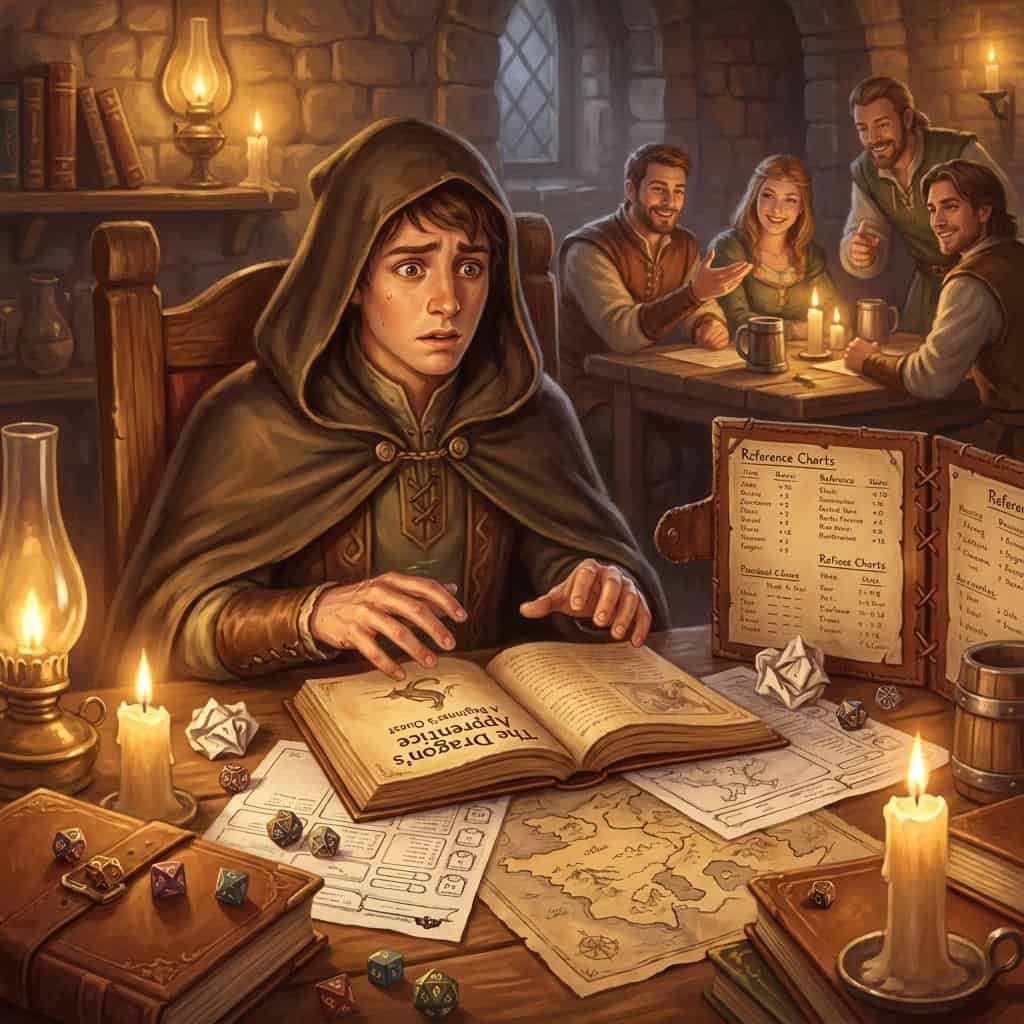
If you’re thinking about running your first D&D one-shot but feel paralyzed by everything you don’t know, you’re experiencing the exact same fear that stops thousands of potential DMs from ever trying. The good news is that your anxiety is worse than the actual experience, and most of what you’re worried about simply doesn’t matter.
Learning how to run a one-shot D&D adventure is the perfect entry point to dungeon mastering because it’s low-stakes, time-limited, and self-contained. You’re not committing to a years-long campaign. You’re just facilitating one fun evening of collaborative storytelling. If it goes perfectly, great. If it’s a disaster, you’ll never run that specific adventure again and nobody gets hurt.
This guide walks you through exactly what to do before, during, and after your first session as a DM. Not theory—practical, step-by-step instructions that assume you’re nervous and don’t know what you’re doing yet. Because that’s completely normal and fine.
Why One-Shots Are Perfect for First-Time DMs
Before diving into mechanics, understand why running first D&D one-shot adventures specifically helps new DMs more than jumping into campaigns.
Complete story in one session means clear endpoints. You’re not juggling ongoing plot threads, managing long-term character development, or tracking complex relationships across months. You run one adventure, it resolves, and you’re done. Success or failure, the commitment ends in 2-4 hours.
Mistakes don’t compound. Mess up a rule in session one of a 20-session campaign and you might have to retcon or maintain the incorrect ruling for months. Mess up a rule in a one-shot and it affects exactly one session that will never run again.
Lower player expectations. Players understand that one-shots are experimental and might be rough. They’re generally more forgiving of pacing issues, rules mistakes, or awkward NPC performances when everyone knows this is your first time.
You learn core DM skills efficiently. Running a one-shot teaches you encounter pacing, combat management, NPC improvisation, and rules adjudication without the additional complexity of campaign management, character arcs, and long-term plotting.
Easy to iterate and improve. After your first one-shot, you can run a completely different adventure next time, applying lessons learned without baggage from previous choices. Or run the same adventure again with improvements, seeing exactly what changed with experience.
Choosing Your First Adventure: Don’t Write It Yourself
This might be the most important advice for first time running D&D one-shot sessions: use a published adventure, not homebrew content.
Why Published Adventures Work Better
Creating original adventures while simultaneously learning DM mechanics is like trying to learn cooking by inventing recipes while figuring out how your stove works. Possible, but unnecessarily difficult.
Published adventures provide structure you can follow when improvisation fails. They include balanced encounters tested by designers who understand action economy. They have backup plans for common player approaches. They teach you pacing through example.
You’re not being uncreative by using published content. You’re being smart by learning fundamentals before adding complexity.
What Makes a Good First Adventure
Look for adventures with these characteristics:
Explicitly designed for one session: Check the estimated play time. If it says “2-4 hours” or “one session,” that’s what you want. Avoid adventures designed for multiple sessions.
Simple plot structure: Clear hook, straightforward objective, obvious climax. “Goblins kidnapped the blacksmith’s daughter, track them to their cave, rescue her” is perfect. “Investigate a web of noble houses connected to ancient cults with competing factions” is too complex.
Limited NPC cast: Fewer than 10 named NPCs means less to track and fewer voices to improvise. More than that and you’ll struggle to keep them distinct.
Self-contained location: A single dungeon, building, or small area works better than adventures requiring extensive travel or multiple separate locations.
Includes maps and stat blocks: Everything you need should be included. Avoid adventures that reference other books or require extensive supplementary research.
Recommended First Adventures
D&D Beyond offers free one-shot adventures in their basic rules. DMs Guild has hundreds of pay-what-you-want options. Look for highly-rated adventures with “beginner-friendly” tags.
Popular first adventures include rescue missions (save prisoners from goblins/bandits), monster hunts (track and eliminate a threatening creature), or simple mysteries (investigate strange occurrences in a village).
Avoid overly complex heists, intricate political intrigue, or adventures with elaborate magic item mechanics until you’ve run 2-3 simpler sessions.
The 60-Minute Preparation Method
You don’t need to memorize every word of your chosen adventure. Here’s how to prepare adequately in about one hour.
First Read-Through (15 Minutes)
Read the entire adventure once without taking notes. Just absorb the overall structure: what’s the hook, what’s the goal, how does it end? Understand the story arc before worrying about details.
Don’t stress about memorizing everything. You’re building mental framework, not studying for an exam. If details slip away, that’s fine—you’ll reference the adventure during play.
Extract Key Information (20 Minutes)
Create a one-page cheat sheet with essential information in bullet format:
• Opening hook (one sentence)
• Main objective (one sentence)
• 3-5 key locations with one sentence describing each
• Main NPC names and one-word personality descriptor each
• Climax encounter description (what happens, who’s involved)
• Possible session ending hook
This cheat sheet goes on top of your adventure text during play. Quick glances remind you of structure without hunting through pages.
Study the First Encounter (15 Minutes)
Whatever happens first in your adventure—whether it’s combat, social interaction, or investigation—study that scene in detail. Know exactly what you’ll describe, what the initial challenge involves, and how you’ll respond to likely player actions.
The first 15 minutes of your session are crucial. Confident opening creates momentum that carries through rough patches later. Fumbling the start makes everything harder.
Prepare the Climax (10 Minutes)
Understand your final encounter thoroughly. Review enemy stats, tactics, and what victory/defeat looks like. Know the setup, objective, and how it connects to the adventure’s opening.
Everything else in the adventure exists to get players to this climax. If you nail the beginning and ending, middling middle sections won’t ruin the session.
Gather Materials (Remaining Time)
Assemble everything you need: dice, pencil, paper, printed adventure, player character sheets if using pre-gens, any maps or handouts mentioned in the adventure.
Do a quick mental walkthrough: “Session opens with hook, players probably investigate the village, encounter the clues, fight the goblins in the cave, rescue the prisoner, return victorious.” Visualizing flow helps internalize structure.
What You Actually Need (And What You Don’t)
Anxiety about running first one-shot D&D sessions often stems from thinking you need more preparation, materials, or skills than you actually do.
Essential Materials
The adventure text: Printed or on a device where you can reference it easily during play. PDF on a laptop works. Phone screen is too small for comfortable reference.
Dice: One set of polyhedral dice minimum (d4, d6, d8, d10, d12, d20). Digital dice rollers work in a pinch.
Paper and pencil: For tracking hit points, initiative order, and quick notes when players do unexpected things.
Player character sheets: Either pre-generated characters from the adventure or created in advance with players. Don’t spend your first session on character creation.
Helpful But Optional
DM screen: Hides your notes and provides quick reference charts, but you can survive without one. A propped-up binder works as makeshift screen.
Miniatures and battle map: Enhance combat visualization but aren’t necessary. Theater of the mind (pure description) works fine, especially for simple combats.
Music or ambient sound: Creates atmosphere but can be distracting. If you use it, set it to low volume and don’t fiddle with it mid-session.
Snacks and drinks: Players appreciate refreshments, but don’t let hosting stress add to DM anxiety. Store-bought cookies are fine.
Things You Definitely Don’t Need
Perfect rules knowledge, voice acting skills, elaborate props, painted miniatures, custom artwork, professional maps, memorized monster stat blocks, or years of D&D experience. Your players care more about fun and engagement than production values.
The First 15 Minutes: Starting Strong
How you open your session sets tone and builds confidence. Here’s exactly what to do.
Welcome and Brief Introduction (3 Minutes)
“Thanks for playing today. This is my first time DMing, so I appreciate your patience. We’re running a one-shot adventure that should take about 2-3 hours. The tone is heroic fantasy with some combat and problem-solving. Any questions before we start?”
Acknowledging inexperience removes pressure. Players will be more forgiving and helpful when they know you’re learning. Don’t apologize excessively—just set expectations and move forward.
Establish House Rules (2 Minutes)
“I’ll do my best with rules, but if I’m unsure I’ll make a quick ruling to keep things moving and we can look up the exact rule later. If you know your character abilities better than I do, feel free to explain how they work. And if I clearly make a mistake, politely let me know.”
This establishes collaborative rather than adversarial tone and gives players permission to help you succeed.
The Opening Hook (10 Minutes)
Deliver your adventure’s opening hook clearly and with detail. This is the scene you prepared thoroughly, so lean on that preparation.
“You’re in the village of Greenshire. It’s early morning, mist still hanging over the fields. You’re gathered in the common room of the Fox and Hound tavern when the blacksmith bursts through the door, wild-eyed and desperate. ‘They took her!’ he shouts. ‘Goblins came in the night and took my daughter!'”
Pause after delivering the hook. Let players respond naturally. They might ask questions, express sympathy, or immediately start planning. All of these are good signs.
Answer their questions, provide requested information, and transition into whatever the adventure says happens next. You’re underway.
During the Session: Moment-by-Moment Guide
Running your first time D&D one-shot means constantly making small decisions. Here’s how to handle the most common situations.
When Players Ask Questions You Don’t Know
This will happen constantly and it’s fine. You have three options:
Option 1 – Check the adventure text: “Let me check what the adventure says about that.” Take 30 seconds to scan the relevant section. Players understand this is your first time.
Option 2 – Make a ruling: “I don’t know the exact rule, so here’s what we’ll do for now…” Make something reasonable and move on. You can verify later.
Option 3 – Ask the table: “Does anyone know how this works?” Experienced players often know rules better than new DMs. Use their expertise.
The worst option is freezing and feeling like you’ve failed. Nobody expects perfect knowledge on your first session.
When Players Do Something Unexpected
You prepare for the adventure’s expected path. Players will deviate immediately. The blacksmith asks for help. Instead of rushing to rescue his daughter, players might:
- Demand payment upfront
- Investigate the blacksmith’s shop for clues
- Interrogate the blacksmith about his enemies
- Want to gather more villagers for help
- Try to track the goblins’ path
Most of these still lead to the adventure’s main content eventually. Say “yes, and…” to reasonable actions: “Yes, you can search his shop. You find signs of forced entry and small goblin footprints leading north toward the forest.”
Gently redirect if they completely derail: “The blacksmith emphasizes time is critical—goblins might move his daughter or worse. You can investigate more later, but immediate pursuit seems wisest.”
If they genuinely go a different direction, improvise what makes sense and steer back toward your prepared material when opportunities arise. You can’t prepare for everything, and that’s okay.
Running Your First Combat
Combat intimidates new DMs most, but it’s actually the most structured part of D&D. Follow these steps:
1. Describe the situation: “You enter the cave and spot four goblins around a campfire. They’re 30 feet away and haven’t noticed you yet. What do you do?”
2. Roll initiative: Everyone rolls d20 and adds their initiative bonus. Write names in order from highest to lowest. This is your turn order.
3. Run rounds: Starting with the highest initiative, each person takes one turn doing one action (attack, cast spell, dodge, etc.) and moving up to their speed. Then go to next person on the list.
4. Describe results: When attacks hit, describe the damage: “Your arrow strikes the goblin in the shoulder for 7 damage. He staggers but stays on his feet.”
5. Track hit points: When creatures take damage, subtract from their total HP. When they hit 0, they’re dead or unconscious.
6. Repeat until one side wins: Keep going through the turn order until all enemies are defeated/fled or all players are down.
Don’t worry about perfect tactical play from enemies. Have them make straightforward attacks. Complexity comes with experience.
Handling Rules Confusion
When you don’t know how something works (spell effects, grappling rules, cover mechanics), use the “make a ruling now, verify later” approach.
“I’m not sure if you can cast that spell as a bonus action, but for this session let’s say yes and I’ll check the exact rules afterward.”
Write down the uncertainty so you can research later. Don’t spend 10 minutes searching rulebooks mid-session. Momentum matters more than perfect accuracy.
Pacing the Adventure
Glance at your watch periodically. If you’re 90 minutes in and only halfway through the adventure, start accelerating:
- Summarize less important encounters: “You fight off two more goblins on the way deeper into the cave.”
- Volunteer information instead of waiting for perfect investigation: “Searching the room, you immediately notice the hidden door.”
- Reduce NPC dialogue and get to key information faster
- Skip or simplify random encounters that don’t advance plot
Better to finish the story than perfectly run every scene but end mid-adventure.
Common First-Session Problems (And Quick Fixes)
Almost every first time DM hits these issues. Here’s how to recover.
Problem: You Forget Important Information
Mid-session you realize you forgot to mention a crucial clue, NPC, or plot detail earlier. Players are proceeding without it.
Fix: Introduce it now naturally. “As you’re preparing to leave, you remember the blacksmith mentioned strange symbols carved into his door frame before the goblins came.”
Or use an NPC to deliver it: “A village child runs up. ‘Did the blacksmith tell you about the symbols? My da says they’re goblin warning signs.'”
Don’t stress about perfect chronology. Just get the information to players before it’s too late to matter.
Problem: Players Are Stuck and Don’t Know What to Do
They’re staring at a puzzle, mystery, or situation without clear next steps. Conversation halts. Everyone looks at you expectantly.
Fix: Offer an ability check to reveal information. “Anyone can make an Investigation check to search the room more thoroughly.” Then provide useful clues based on results.
Or have an NPC arrive with suggestions: “A village elder approaches. ‘If I were tracking goblins, I’d check the northern forest. They’ve been sighted there before.'”
Don’t let players flounder for more than 5 minutes. The first session should feel successful, not frustrating.
Problem: Combat Is Taking Forever
You’re 45 minutes into a fight that should take 20. Players are bored and the session timeline is shot.
Fix: Accelerate resolution. Have remaining enemies flee when reduced to half numbers. Narrate the end: “Seeing their leader fall, the remaining goblins scatter into the forest. You’ve won.”
Or reduce enemy HP on the fly. If goblins have 7 HP each and combat is dragging, secretly reduce them to 3 HP. Players never know the difference.
Or rule that low-HP enemies die from any hit: “Your swing connects and the goblin drops immediately.” This dramatically speeds up late combat rounds.
Problem: You Made an Obvious Mistake
You gave wrong information, misread enemy HP, applied incorrect modifiers, or contradicted something said earlier.
Fix: Just acknowledge it and correct. “Actually, I miscounted—the guard captain is still standing. Let’s rewind that last turn.”
Players are incredibly forgiving of honest mistakes, especially in first sessions. What frustrates them is pretending errors didn’t happen or doubling down on obvious mistakes.
Problem: Players Aren’t Engaging
They seem bored, distracted, or uninterested. Side conversations increase. Phones come out.
Fix: Introduce immediate action or decision. “Suddenly you hear screams from deeper in the cave. It sounds like the blacksmith’s daughter. What do you do?”
Or directly ask for input: “What’s your character thinking right now?” Engagement often increases when players are directly addressed.
After the session, ask for honest feedback about pacing and content. Maybe the investigation section was too long, or they wanted more combat. Learn and adjust for next time.
Wrapping Up Your First Session
As you approach your planned endpoint (usually 2-3 hours), bring the adventure to satisfying conclusion.
The Climax and Resolution (Final 30 Minutes)
Make sure your final encounter happens with enough time to resolve it. If you’re 90 minutes in and haven’t reached the climax yet, accelerate as described earlier.
The climax should feel significant. Build it up: “You push open the chamber doors and see the goblin chieftain holding the blacksmith’s daughter. He snarls at you in broken Common: ‘You come far, but go no further!'”
Run the encounter according to your adventure. Win or lose, provide clear resolution. If players win, they rescue the daughter. If they lose (unlikely in most one-shots), the daughter escapes during chaos or players wake up in goblin cages but manage to escape.
After the climax, wrap up quickly. Don’t spend 30 minutes on epilogue. Brief resolution is fine: “You return the daughter safely. The blacksmith is overjoyed and rewards you with weapons from his best stock. The village celebrates your victory.”
Thank Your Players (5 Minutes)
“Thanks for playing my first session as DM. I know it was rough in places, and I appreciate your patience. What worked? What didn’t? Be honest—I want to improve.”
This feedback is invaluable. Players notice different things than you do. Maybe combat pacing was fine but NPC voices blurred together. Maybe they loved the investigation but wanted more combat. This information guides your second session.
Decide on Next Steps
Do they want to play again? If yes, when? If you enjoyed DMing and they enjoyed playing, schedule another session soon while enthusiasm is high.
Consider running the same adventure again with improvements based on feedback. Or try a different one-shot adventure to practice different skills.
Post-Session: Learn and Improve
After your first one-shot D&D session ends, take time to reflect and prepare for future games.
Immediate Reflection (10 Minutes)
While the session is fresh, write down:
- What went well (specific moments, not generalities)
- What felt difficult or uncomfortable
- Rules you need to look up for next time
- Player feedback you received
- Ideas for improvement
This brief reflection helps you remember lessons when running your second session weeks or months later.
Study the Rules You Struggled With
Identify 2-3 rules that caused confusion or slowed the game. Look them up properly now. Read examples. Watch videos if needed.
Don’t try to master all of D&D rules between sessions. Just improve the specific areas that impacted your game. Over time, you’ll naturally expand knowledge through targeted learning.
Forgive Yourself for Imperfections
Your first session was almost certainly rougher than you hoped but better than you feared. That’s normal. Every experienced DM had an awkward first session where they fumbled rules, NPCs, and pacing.
What matters is whether people had fun despite imperfections. If your players laughed, engaged with the story, and want to play again, you succeeded. Everything else improves with practice.
Building Confidence for Session Two
The jump from first to second session is often harder than starting. First sessions have “new DM” forgiveness. Second sessions make you realize DMing is your responsibility now.
Run another one-shot rather than starting a campaign. Apply lessons from session one: better NPC preparation, tighter pacing, clearer combat explanations, whatever you identified as rough spots.
Consider running the exact same adventure again with different players. Comparing experiences shows what worked inherently versus what you improved. Plus you’ll know the material better and execute more smoothly.
After 3-4 successful one-shots, you’ll have enough confidence and skills to consider starting an actual campaign if that interests you. But one-shots remain valid even for experienced DMs—not everything needs to be a multi-year epic.
The Truth About Running Your First One-Shot
Here’s what nobody tells you: your first session will be simultaneously more stressful and less catastrophic than you expect. You’ll make dozens of mistakes. Players will do unexpected things. You’ll fumble rules and forget important details.
But unless you’re actively hostile or completely unprepared, everyone will probably have fun anyway. The collaborative nature of D&D means players contribute half the entertainment. Your job is facilitating their creativity, not performing perfectly.
The anxiety about running your first time D&D one-shot comes from caring about doing it well. That same care ensures you’ll prepare adequately, respond to player needs, and improve after each session. The anxiety is actually evidence you’ll be fine.
So stop researching, reading guides, and preparing for the perfect first session. Pick an adventure. Schedule 2-3 hours with willing players. Prepare for 60 minutes. Then run it.
You’ll survive. They’ll have fun. And you’ll be a DM—imperfect, learning, but absolutely legitimate. Because the only difference between aspiring DMs and actual DMs is that the latter scheduled a session and showed up.
Once you know how to run one, the next question is what to run — our complete DND one-shots guide sorts the options by genre, group size, and level.
Brand new and not sure what to run first? Our D&D one-shots for beginners are the gentlest place to start. Your players are waiting. Time to begin.