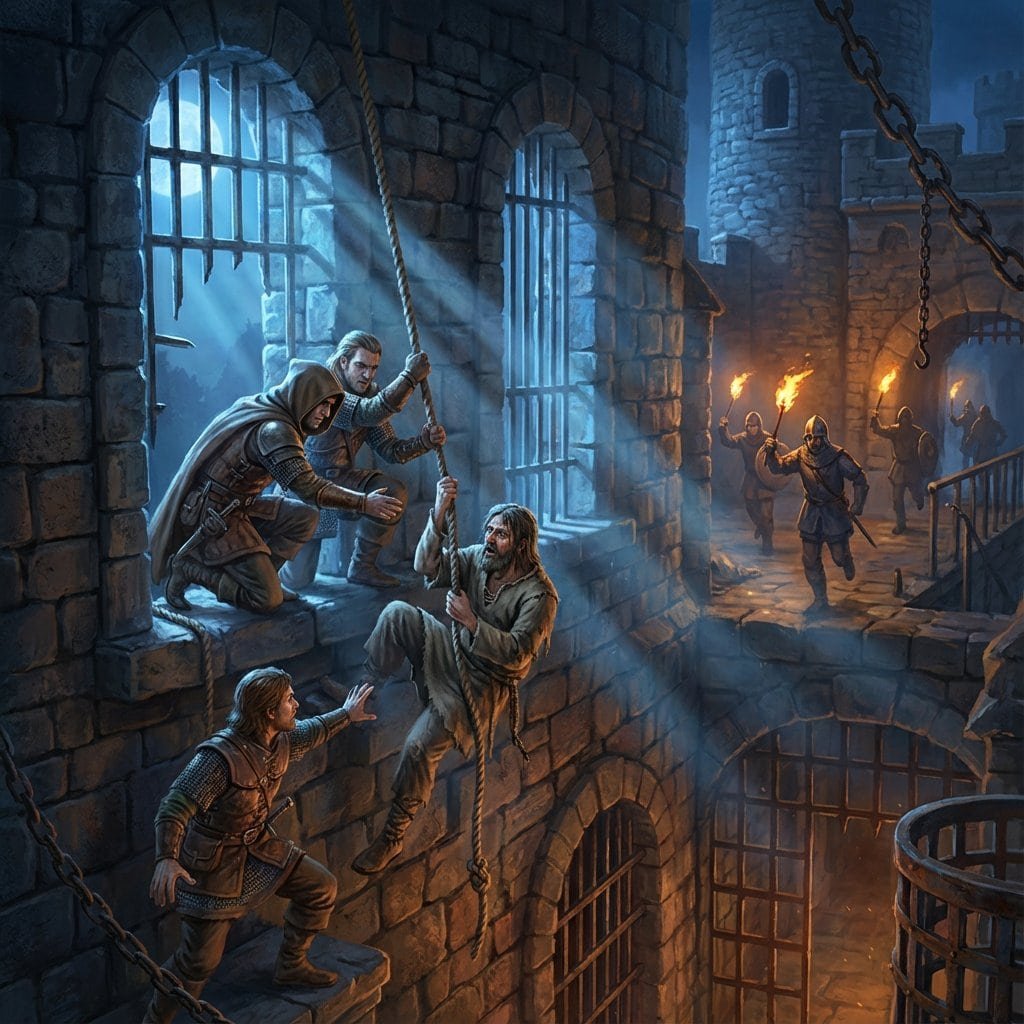

D&D Rescue Mission One-Shot: Running the Perfect Rescue
Few D&D scenarios deliver more immediate tension and satisfaction than a well-executed rescue mission. Learning how to run a D&D rescue mission one-shot gives you a proven adventure framework that works for any experience level, naturally creates time pressure, and delivers heroic moments without complex setup.
The rescue-mission structure is deceptively simple: someone important is captured, players must infiltrate the location, free the prisoner, and escape before reinforcements arrive. But within this framework exists room for stealth, combat, social manipulation, puzzle-solving, and genuine moral complexity. The best part is that rescue missions are almost impossible to mess up because the objective is crystal clear from the start.
This guide walks you through designing, preparing, and running rescue mission adventures that keep players engaged from hook to resolution. Whether you’re running a quick two-hour one-shot or a longer centerpiece session, rescue missions deliver consistent results.
If your players are the ones behind bars rather than breaking someone else out, that’s a different adventure with its own structure — see our guide to the D&D prison break one-shot.
Why Rescue Missions Work for Every Group
Before diving into mechanics, understand what makes rescue mission D&D adventures uniquely effective across different player types and experience levels.
The objective requires no explanation. “Save the prisoner” needs no complex backstory, political context, or setting knowledge. Players immediately understand what success looks like, removing ambiguity that bogs down other adventure types.
Time pressure creates natural urgency. Rescue missions come with built-in deadlines: execution at dawn, prisoner transfer to another location, interrogation that reveals dangerous secrets. This time pressure keeps players focused and prevents endless deliberation.
Multiple solution paths accommodate different playstyles. Stealth players can sneak in disguised or through secret entrances. Combat-focused groups can fight their way through. Social characters can bluff, bribe, or negotiate. The rescue framework supports all approaches.
Moral complexity emerges naturally. Rescuing one person often means leaving other prisoners behind, killing guards who are just doing their jobs, or making deals with unsavory allies. These ethical dilemmas create memorable moments without feeling forced.
Escalation is built into the structure. Even perfect plans go sideways during a rescue. When alarms sound, when guards change shifts early, when the prisoner is injured and can’t run—these complications feel logical rather than arbitrary DM interference.
The Core Rescue Mission Structure
Every successful rescue adventure follows this basic framework, which you can adapt to any setting or complexity level.
Act 1: The Hook and Information Gathering (30 Minutes)
Establish who’s captured, why it matters, and what’s at stake. The prisoner might be a party member’s contact, a noble’s child, a rebel leader, an innocent villager, or someone with crucial information.
Make the urgency personal. “The cult will sacrifice your mentor at midnight” hits harder than “a prisoner is scheduled for execution.” Connect the rescue to player character motivations whenever possible.
Players then gather information about the location: layout, guard numbers, shift changes, entrances, security measures, prisoner location. This reconnaissance phase lets them plan while building anticipation.
Limit intelligence gathering to 2-3 sources to prevent endless information-seeking. An informant who worked there, a former prisoner, or reconnaissance from outside gives players enough to plan without perfect knowledge.
Act 2: Infiltration and Approach (40 Minutes)
Players execute their plan to reach the prisoner. This might involve disguises, sneaking through sewers, bluffing past guards, scaling walls, or creating diversions.
During infiltration, introduce 2-3 complications that test player adaptability: an unexpected patrol, a locked door they didn’t know about, a guard who recognizes one party member. These obstacles should be solvable but require thinking on their feet.
Avoid the temptation to make infiltration impossible. If players devise clever approaches, reward them with progress. Save the really difficult challenges for after they’ve located the prisoner.
Act 3: The Rescue and Complications (30 Minutes)
Players reach the prisoner and must free them. This is rarely as simple as unlocking a door. Maybe the prisoner is injured, drugged, or doesn’t trust the party. Perhaps guards are interrogating them right now. Maybe another prisoner begs to be rescued too.
Introduce at least one significant complication here that forces adaptation: the alarm goes off, the prisoner reveals surprising information, guards arrive for shift change, or a more dangerous threat appears.
This complication should make escape harder but not impossible. The goal is raising stakes, not creating unwinnable situations.
Act 4: The Escape (40 Minutes)
Getting out is always harder than getting in. Guards are alerted, exits are watched, and reinforcements are coming. Players must move fast while protecting a potentially vulnerable NPC who can’t defend themselves.
The escape should feel like a running battle or tense chase, not static combat. Guards pursue through corridors, archers fire from towers, alarms summon reinforcements. Create momentum that builds to the moment players clear the walls.
Have a clear endpoint where safety is achieved: reaching the city sewers, crossing the river, entering the friendly district, or simply getting far enough away that pursuit ends.
Act 5: Resolution (10 Minutes)
Players reunite the prisoner with allies, receive rewards, or learn information the prisoner possessed. Acknowledge their success and provide closure.
If running an episodic campaign, the prisoner can reveal hooks for future adventures. For one-shots, simple resolution works: “The rebel leader thanks you for saving his life and promises the resistance won’t forget this.”
Designing Your Prison Location
The location is central to rescue mission one-shot adventures. Here’s how to create compelling locations that enable varied approaches.
Size and Complexity
Keep locations compact for one-shots. A fort with 8-12 rooms works better than a sprawling dungeon with 30 chambers. Players need to navigate quickly, not explore exhaustively.
Design vertically when possible. A tower with 4-5 levels creates natural progression and makes escape more dramatic (descending while pursued feels thrilling). Underground dungeons work but lack the visual drama of tower escapes.
Include multiple paths to the prisoner’s location. If there’s only one route, players have no meaningful infiltration choices. Three possible approaches (main entrance, side entrance, secret route) provide flexibility without overwhelming complexity.
Guard Placement and Patrols
Station guards logically based on what they’re actually protecting. Entrances are heavily guarded, the prisoner’s cell has nearby guards, key corridors have patrols, and some areas have minimal security.
Use patrol routes that create windows of opportunity. Guards who patrol predictable paths allow stealthy players to time movements. This rewards observation and planning without making infiltration trivial.
Vary guard types: regular soldiers (multiple but weaker), sergeants (tougher, more perceptive), and maybe one captain (mini-boss encounter). This creates tactical variety and clear priority targets.
Security Measures Beyond Guards
Include non-combat obstacles that require problem-solving: locked doors with varying complexity, barred windows, alarm systems (magic or mundane), trapped corridors, or areas requiring specific keys or passwords.
Each security measure should have multiple solutions. A locked door might be picked, the key stolen, magic used to bypass it, or a nearby window used instead. Avoid single-solution obstacles that stop progress cold if players lack specific skills.
Environmental Advantages
Include elements players can exploit: shadows for hiding, barrels and crates for cover, distractions like kitchen fires or stable animals, high ground for ambushes, or chokepoints for controlling guard movement.
These environmental features reward creative thinking and give players agency over how encounters unfold. The difference between “you fight eight guards in an empty room” and “you fight eight guards in a mess hall with tables for cover and a chandelier overhead” is enormous.
NPC Prisoner Design: Making Them Matter
The prisoner determines how invested players feel in the rescue. Here’s how to create NPCs worth saving.
Personal Connection
Whenever possible, connect the prisoner to player character backstories. They might be a mentor, family member, romantic interest, old friend, or someone who helped them in the past. Personal stakes trump abstract heroism.
If players created characters without establishing these connections, build them quickly in session zero or the opening scene: “The captured rebel leader is your character’s sister” or “The imprisoned merchant saved your character’s life years ago.”
Useful Information or Skills
Give prisoners value beyond being rescued. They might know the villain’s plans, have witnessed a crime, possess crucial information, or have skills the party needs. This transforms the rescue from pure altruism to strategic necessity.
The prisoner might also complicate escape by having knowledge that changes the party’s objectives: “You came to save me, but there’s a child prisoner two cells down. We can’t leave her behind.”
Personality and Agency
Avoid “damsel in distress” stereotypes. Give prisoners personality, agency, and the ability to contribute to their own rescue. Maybe they’ve been working on escape plans, have smuggled tools, know guard patrol patterns, or can fight if armed.
Prisoners who participate in their rescue feel like characters rather than objectives. They might pick locks while players distract guards, know shortcuts through the location, or bluff their way past questioning.
Physical State
Consider what condition the prisoner is in. Fresh captures are healthy and mobile. Long-term prisoners might be injured, malnourished, or traumatized. This affects both mechanics (can they run? fight? climb?) and roleplay opportunities.
Injured prisoners create additional challenges without feeling like DM punishment. Carrying or supporting someone while escaping raises difficulty organically and creates heroic moments when players overcome the added burden.
Running Stealth and Infiltration
The infiltration phase determines whether your rescue adventure feels like a tense heist or a straightforward dungeon crawl.
The Stealth Challenge
Use group Stealth checks where everyone rolls but you take the average, or use “majority rules” where more than half need to succeed. This prevents one low-roll character from constantly exposing the group.
Set clear DCs for different situations: DC 10 to sneak through shadows at night, DC 13 to move past inattentive guards, DC 16 to approach alert sentries. Communicate what players are attempting so they understand risk levels.
Failed Stealth checks don’t automatically mean combat. Guards might investigate noises, call for backup, or raise their alertness level. This creates escalating tension rather than binary success/failure.
Disguises and Deception
Allow creative infiltration beyond pure Stealth. Players might steal guard uniforms, forge transfer papers, impersonate inspectors, or use illusion magic. These approaches should require different skill checks (Deception, Forgery, Performance) giving different characters opportunities to shine.
Disguises work until scrutinized closely. They get players past casual observation but won’t survive direct questioning from someone who knows all the guards personally. This creates tension around how long the ruse can hold.
Creating Diversions
Smart players create distractions to pull guards away from key areas. Encourage this by having flammable materials in storerooms, animals in stables, or other opportunities for chaos.
When players create diversions, actually move guards away from their posts. Reward creativity by making plans work. The tension comes from racing against how long the distraction lasts before guards return.
Information During Infiltration
As players sneak through the location, let them overhear conversations that provide useful intelligence: guard shift times, prisoner locations, security measures, or villain plans. This rewards stealth with tactical advantages.
Overheard information can also create moral dilemmas: guards discussing their families, questioning orders, or expressing sympathy for prisoners. This humanizes opponents and complicates the “guards are just obstacles” mindset.
Combat During Rescue Missions
Even stealth-focused rescues often involve combat when things go sideways. Here’s how to run exciting rescue fights.
Alarms and Reinforcements
When combat starts, establish what happens: alarms sound, nearby guards investigate, reinforcements arrive in X rounds. Players need to understand the clock is ticking and extended combat means more enemies.
Use a visible timer or count: “Two rounds until reinforcements arrive from the barracks.” This creates tension and encourages players to fight efficiently rather than grinding through every HP.
Reinforcements should be manageable but threatening. Three additional guards arriving feels dangerous without being overwhelming. Ten guards showing up feels like punishment for combat starting.
Running Battles vs. Static Fights
Rescue combat should feel mobile, not static. Players are trying to reach the prisoner or escape, not hold positions. Use chase mechanics, fighting retreats, and running battles through corridors.
Each round of combat, players can choose to fight normally or prioritize movement (Dash action). Guards pursue but are often slowed by having to navigate around furniture, climb stairs, or open doors.
This creates dynamic combat where players must balance killing threats versus creating distance. Sometimes knocking guards prone and running past works better than fighting to the death.
Environmental Combat Options
Give players interesting combat choices through environment. They might collapse scaffolding to block pursuit, cut ropes holding chandeliers, kick over braziers to create fire barriers, or smash through weakened walls.
These environmental options should be described clearly so players know they exist. Don’t hide creative solutions behind skill checks—make opportunities obvious and let players decide whether to use them.
Non-Lethal vs. Lethal Combat
Some players prefer knocking guards unconscious rather than killing people just doing their jobs. Make this viable by allowing declared non-lethal damage with melee weapons (standard D&D rule).
Unconscious guards wake up eventually, potentially complicating escape, but don’t pursue immediately. This creates consequences without punishing merciful play.
Alternatively, guards might surrender when clearly outmatched, flee when losing badly, or focus on sounding alarms over fighting to the death. Not every enemy needs to be fanatically loyal.
Adding Complexity: Multiple Prisoners and Moral Dilemmas
Once you’ve mastered basic rescues, add moral complexity that creates memorable moments.
The Secondary Prisoner Dilemma
Players arrive to rescue one prisoner but discover others captured nearby. Maybe innocent villagers, criminals who claim to be wrongly accused, or political prisoners. Freeing everyone is possible but dramatically harder.
This creates genuine choice: abandon people to succeed at the primary mission, or attempt a harder rescue that risks everyone. Neither choice is wrong, both have consequences, and players will debate passionately.
Some secondary prisoners might be dangerous or guilty. That accused murderer in cell three might actually be guilty. Players must decide without perfect information, creating post-rescue complications if they free someone they shouldn’t have.
Guard Sympathy and Defection
Not all guards are evil. Some might be sympathetic to the prisoner, conflicted about their orders, or willing to be bribed. One guard might secretly help players in exchange for amnesty or payment.
This complicates “kill all the guards” approaches and rewards players who attempt social interaction. A sympathetic guard who provides keys, distracts other guards, or simply looks away creates satisfying moments.
The Prisoner Doesn’t Want Rescue
Occasionally, prisoners refuse rescue. They’re protecting someone else, waiting for different timing, gathering intelligence, or don’t trust the party. Players must convince them or resort to forcible “rescue.”
This subversion of expectations creates fantastic roleplay opportunities and moral questions. Rescuing someone against their will—even for good reasons—feels very different from heroic prisoner liberation.
Betrayal and Double-Crosses
For mature groups, the prisoner might betray players (they were captured deliberately to lure enemies), or the quest-giver who hired the party has ulterior motives (eliminating a political rival, not saving an innocent).
Use betrayals sparingly and telegraph them through clues. Players should feel clever if they spot the betrayal coming, not blindsided by arbitrary twists.
Escape Mechanics: Making the Exit Thrilling
The escape phase determines whether your rescue ends with exhilaration or anticlimax.
Chase Scene Structure
Use simplified chase rules: players and pursuers roll dice each round. High rollers gain ground, low rollers fall behind. After 4-6 rounds, determine if players escaped or were caught up to.
During chases, give players choices each round: take risky shortcuts (Athletics check, gain ground on success, lose ground on failure), create obstacles for pursuers (knock over market stalls, cut ropes on bridges), or hide and let pursuers pass.
These choices make chases interactive rather than pure dice-rolling. Players feel agency over escape rather than watching random outcomes.
Safe Houses and Extraction Points
Establish where “safe” is before the rescue starts. Players need to know the goal: reach the sewers, cross the river, enter the friendly district, or rendezvous with allies.
This endpoint should be achievable but require overcoming final obstacles: guards at the gate, a gap to jump, a river to cross, or a final stand against pursuing forces.
Allies can provide extraction support if appropriate: a boat waiting at the docks, horses ready outside, a friendly crowd to disappear into, or magic to teleport away once clear of anti-magic wards.
Rear Guard Actions
During escape, some players might volunteer to hold off pursuers while others get the prisoner to safety. These self-sacrificial moments create heroic scenes but need careful handling.
Players holding the rear guard shouldn’t be overwhelmed immediately. Give them 2-3 rounds of fighting before they can retreat themselves. This lets them feel effective without becoming martyrs.
The rescued prisoner or other NPCs might insist on helping rear guard actions, preventing players from feeling forced into suicide stands.
Common Rescue Mission Pitfalls (And Solutions)
Even experienced DMs encounter these problems. Here’s how to avoid or recover from them.
Pitfall: Perfect Stealth Makes Everything Trivial
Players roll well, bypassing all encounters through pure stealth. You’ve prepared guards and encounters that never trigger.
Solution: Don’t punish successful stealth with arbitrary failures. Instead, create mandatory interactions: locked doors requiring keys from guards, patrol routes that force timing challenges, or the prisoner’s location requiring passing specific obstacles.
Reward good stealth by making early stages easier while ensuring some challenges are unavoidable. The escape phase can still be dramatic even if infiltration was perfect.
Pitfall: Combat Alerts Everyone Immediately
First combat triggers total lockdown and overwhelming force. Players feel they can’t win.
Solution: Use graduated response. Nearby guards investigate noise. Alarms bring reinforcements in waves, not all at once. Players have 2-3 rounds to finish fights before serious reinforcements arrive.
This maintains tension without making combat an automatic loss condition. Players can win quick fights but extended battles become untenable.
Pitfall: Players Spend Forever Planning
Information-gathering and planning consume 90 minutes of your session. You never reach actual infiltration.
Solution: Introduce time pressure in the narrative. “You have until dawn—that’s when the execution happens.” As planning drags on, narrate time passing: “Another hour gone. It’s now 2 AM.”
Alternatively, limit intelligence sources to 2-3 specific NPCs or locations. When players have gathered available information, tell them: “That’s everything you can learn without actually infiltrating.” This signals planning time is over.
Adapting Rescues for Different Power Levels
Rescue missions work at any character level with appropriate adjustments.
Low-Level Rescues (Levels 1-4)
Focus on mundane locations: bandit camps, city guard jails, cultist hideouts. Guards are soldiers and thugs without magic. Security is physical locks and patrols.
Low-level parties struggle with numerous enemies, so keep guard numbers manageable. Six guards total is challenging. Twenty guards is impossible.
Stealth and creativity matter more than combat power. Smart planning should enable success even for weak characters.
Mid-Level Rescues (Levels 5-10)
Introduce magical security: alarm spells, scrying sensors, magical locks, or guard beasts. Locations can be forts, wizard towers, or underground complexes.
Players have more resources (flight, invisibility, teleportation) so increase security proportionally. Anti-magic zones, true sight guards, or dimensional anchors prevent trivializing challenges.
Guard forces can include spellcasters, veteran soldiers, or dangerous creatures. Combat is viable but still dangerous with reinforcements.
High-Level Rescues (Levels 11+)
Locations become demi-planes, extra-dimensional spaces, or heavily fortified planar strongholds. Security involves powerful magic, constructs, and legendary creatures.
High-level players have numerous problem-solving tools, so focus on time pressure and complicated objectives rather than impossible barriers. They can bypass most obstacles, but can they do it fast enough?
The prisoner might be a god, demon, or powerful NPC whose rescue has planar consequences. Stakes escalate to match player power.
Sample Rescue Mission: The Bandit’s Keep
Here’s a complete low-level rescue framework you can run tonight.
The Hook
A merchant’s daughter was kidnapped by bandits operating from an old fort. They’re demanding ransom by tomorrow night or she’ll be sold to slavers. The merchant can’t pay and begs the party for help.
Intelligence Gathering
An escaped captive reveals: the fort has 12 bandits, the daughter is held in the tower, guards patrol walls at night, and there’s a secret entrance through old cellars.
The Fort
Eight rooms: main gate (2 guards), courtyard, barracks (4 bandits sleeping), armory, kitchen, stairs to tower, tower cell (1 guard), tower top (bandit captain’s room).
Secret entrance: cellar tunnel leads to kitchen, bypassing main gate.
Complications
The daughter has befriended a guard who secretly helps. She knows when patrol shifts change. Bandits are planning to move her tomorrow, so timing matters.
Escape
Once the alarm sounds, bandits pursue. Players must cross the river using a bridge (defensible chokepoint) or steal boats. Friendly villagers can provide distraction or hiding once players reach town.
Resolution
Merchant rewards players and the sympathetic guard defects, potentially joining as recurring NPC. The bandit captain escapes, potentially returning for future adventures.
This structure runs in 2-3 hours, accommodates stealth or combat approaches, and teaches core rescue mission mechanics.
Infiltrate, Storm, or Incite: Three Ways Through the Walls
A rescue is not a heist, and the difference shapes everything. In a heist, the objective sits still and stays quiet. In a rescue, the objective is a living, frightened person who complicates every plan — they might be injured, guarded around the clock, unable to walk, or scheduled to die at dawn. The party can’t abandon the “loot” and fight their way clear if things go wrong, because the loot is the mission. Protecting a vulnerable target while under pressure is a fundamentally different challenge from grabbing an object, and it’s what gives a rescue its weight.
When you present the mission, frame the party’s options as three doors. They can infiltrate — disguises, stealth, forged papers, slipping through quietly. They can storm the location — a frontal assault, fast and loud, betting speed against the garrison. Or they can incite — turn the guards, spark a riot, raise the locals, and let chaos open the cell for them. The best rescues let the party mix all three and improvise when the plan falls apart, as it always does. Don’t script the route; build the fortress and its weaknesses, then let the players decide whether they’re ghosts, battering rams, or revolutionaries.
Whichever door they choose, show the clock rather than telling them about it. A scaffold being built in the square, a tumbril rolling closer, a bell counting down the hours — concrete, visible reminders that time is running out do more than any amount of narrated urgency. The dread of a rescue is watching the hours bleed away.
A Ready-to-Run Rescue: Storm the Bastille
For a rescue built at the scale of a revolution, Storm the Bastille hands the party the ultimate version of this scenario. The city is starving, the tyrant feasts behind fortress walls, and a silver-tongued revolutionary hires the heroes for one desperate job: breach the impregnable fortress and free the realm’s most beloved prisoner before the regime can silence him for good.
It’s infiltrate, storm, and incite all at once — a fortress to crack, a crowd to raise, and a captive who matters to an entire city. A no-prep one-shot for two to three players, and a complete worked example of the rescue at its most cinematic. For the defenders’ side of a fortified wall, see how to run a siege defense.
Get Storm the Bastille:
- PDF on Payhip — instant download
- Paperback & Ebook on Amazon
Why Rescue Missions Never Get Old
After running dozens of rescue adventures, I’m convinced they’re the most reliably satisfying D&D structure. The clarity of purpose removes ambiguity. The inherent time pressure prevents dragging pace. The multiple solution paths accommodate any party composition.
Players remember successful rescues vividly because they feel genuinely heroic. Saving someone creates emotional payoff that defeating random monsters or finding treasure can’t match. When the rescued NPC thanks them, when families reunite, when captives gain freedom—these moments resonate.
The framework is simple enough for new DMs but flexible enough for veterans to add complexity. Start with basic “rescue the prisoner from bandits” and evolve to “rescue a political prisoner while navigating guard sympathy and moral dilemmas about leaving other prisoners behind.”
Your next rescue mission is waiting. Someone needs saving, and only your players can do it. Time to plan the infiltration.