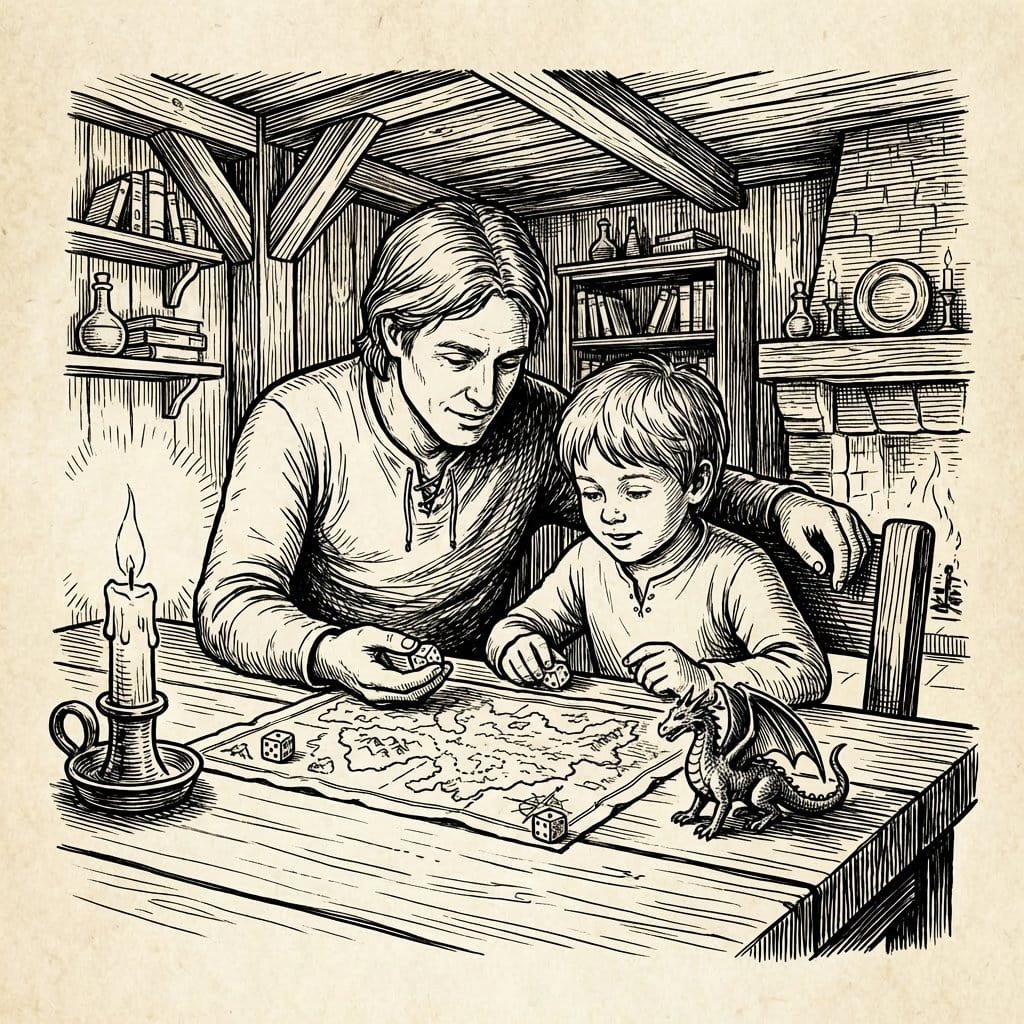

How to Start Playing D&D With Your Kids: A Parent’s Complete Guide
You want to share Dungeons & Dragons with your children, but you’re not sure where to begin. Maybe you played in college and haven’t touched a d20 in fifteen years. Maybe you’ve never played at all but your kid keeps asking about it. Either way, the gap between “this sounds fun” and “we’re actually playing” feels enormous when you’re staring at a 300-page rulebook and a child who wants to start right now.
Here’s the truth: starting D&D with your kids is simpler than you think, requires far less preparation than you imagine, and produces something genuinely valuable — shared storytelling that builds creativity, problem-solving, and the kind of memories your family talks about for years.
This guide walks you through everything from choosing your first adventure to managing session length for different ages. It’s part of our Complete Guide to Running D&D for Small Groups, designed specifically for tables of 2-3 players — the natural size of most family gaming groups.
What Age Can Kids Start Playing D&D?
The short answer is younger than you think. The longer answer depends on what you mean by “playing D&D.”
Children as young as five or six can participate in simplified D&D with heavy DM guidance. At this age, you’re essentially running collaborative storytelling with dice. “You see a dragon. What do you do?” The child says something, you narrate the result, maybe they roll a die to see if it works. The mechanical framework is minimal, but the imaginative engagement is real and valuable.
By age eight to ten, most children can handle simplified character sheets, basic ability checks, and straightforward combat. They understand “roll this die and add this number” and can make meaningful tactical choices in encounters designed for their level. This is the sweet spot for structured gateway adventures that teach the game through play.
Ages eleven to fourteen bring the capacity for full rules engagement, character creation, and the kind of narrative complexity — moral dilemmas, unreliable allies, consequences for choices — that makes D&D compelling for adults. At this point, you’re playing real D&D with your teenager, and the sessions you share become a communication channel that many parents describe as irreplaceable.
Don’t wait for the “right” age. Start where your child is and scale complexity upward as they grow. A child who starts with simplified storytelling at six becomes a confident player by ten and an experienced DM by fourteen.
You Don’t Need to Know All the Rules
The biggest barrier for parents isn’t their child’s readiness — it’s their own intimidation. The Player’s Handbook is thick, the rules seem complex, and the fear of “doing it wrong” stops many parents before they start. Here’s permission to let that go.
D&D at its core is three things: you describe a situation, the player says what their character does, and you determine the outcome — sometimes with a dice roll, sometimes with common sense. Everything else in the rulebook is elaboration on that basic loop. You don’t need to master spell slot mechanics, grappling rules, or the nuances of opportunity attacks to run a fun session for your kids. You need a scenario, a willingness to say “let’s figure that out together,” and dice.
When a rule question comes up mid-session, make a quick ruling that seems fair and move on. Look up the official rule after the session if you want. Your kids won’t care whether you applied the flanking rules correctly. They’ll care whether the story was exciting and whether their choices mattered.
Choosing Your First Adventure
Your first family D&D session needs to accomplish two things: teach the basic mechanics through play and deliver a satisfying story in a limited timeframe. The worst thing you can do is run a complex adventure that stalls halfway through because you ran out of time or got lost in the rules.
What Makes a Good Gateway Adventure
A gateway adventure is specifically designed to introduce new players to D&D. The best ones weave tutorial moments into the narrative so players learn by doing, not by reading. The first encounter teaches combat. A locked door teaches ability checks. An NPC conversation teaches social interaction. Each new mechanic arrives when the story needs it, not in a front-loaded rules lecture that glazes every kid’s eyes.
Gateway adventures should also be completable in a single session. For kids under ten, that means 60 to 90 minutes. For older kids, two hours is the ceiling for a first session. Nothing kills enthusiasm faster than stopping mid-adventure because bedtime arrived. Your first session should end with a clear victory, a resolved story, and your child asking “when can we play again?”
No Rest for the Buried was designed exactly for this purpose. It’s a complete gateway adventure for 2-3 players where earthquakes crack open an ancient tomb and the dead begin to rise. The village of Millbrook needs heroes, and your kids get to be those heroes. It includes a bonus adventure and a village gazetteer for extending the experience when your family inevitably wants to keep playing.
Beginner-Friendly One-Shots
If your kids have some D&D exposure — from actual play shows, video games, or friends — they may be ready for a standard one-shot rather than a gateway adventure. The Stolen Festival Bell is a beginner-friendly one-shot for 2 players with a clear objective (goblins stole the magical Festival Bell — go get it back) and a structure that naturally introduces mechanics through the adventure itself. For families with three players, The Sinking Tower of Hours adds exciting time-pressure mechanics that keep older kids completely engaged. Still weighing your options? Our roundup of the best D&D one-shots for beginners lines up several accessible first adventures side by side so you can match one to your kids’ experience level.
Session Length by Age: A Practical Framework
Getting session length right is critical for family D&D. Too short and the story feels rushed. Too long and kids check out, creating negative associations with the game. Here’s what works based on extensive feedback from family gaming groups.
Ages 5-7: 30-45 Minutes
At this age, you’re running micro-sessions. One clear objective, one or two encounters, and a resolution. Think of it like a picture book — a beginning, a middle, and an end in one sitting. Use simple yes/no decision points and roll a single d20 for almost everything. Celebrate every roll with enthusiasm. The goal isn’t D&D mastery; it’s positive association with collaborative storytelling.
Ages 8-10: 60-90 Minutes
This is the gateway adventure sweet spot. Kids can sustain attention for a complete short adventure with three to four distinct scenes. Introduce basic character sheets with the essential stats — hit points, armor class, a few abilities. Let them make real choices with real consequences, but keep the consequences kid-appropriate. The dragon doesn’t eat your character; it captures them and you have to escape.
Ages 11-14: 90 Minutes to 2 Hours
Older kids can handle full one-shot adventures with moral complexity, tactical combat, and real narrative weight. This is where D&D becomes genuinely powerful as a family activity. Teens who might resist “family game night” will engage with D&D because it treats them as capable, creative individuals making decisions that matter. The game meets them at their level rather than condescending.
Ages 15+: Full Sessions (2-3 Hours)
Teenagers are ready for the complete D&D experience. At this point, you’re not simplifying the game — you’re playing it together as equals. The DM role can even alternate between parent and teen, building a collaborative world that belongs to the whole family.
Building Characters Kids Love
Character creation is where kids first feel ownership of the D&D experience. It’s also where sessions can stall for forty-five minutes while a ten-year-old agonizes over ability scores. Balance creative freedom with practical constraints.
Pre-Generated Characters With a Personal Touch
For first sessions, use pre-generated characters but let kids customize one or two elements. They choose the name, pick their character’s favorite food, and decide one personality trait. This gives them ownership without the analysis paralysis of building from scratch. Every adventure in our Ready Adventure Series includes pre-generated characters specifically balanced for small groups — perfect for family play.
Let Them Choose What Looks Cool
Adults optimize. Kids pick the character that looks awesome. A seven-year-old doesn’t care whether the fighter or the wizard has better synergy with the party composition. They want to be the one with the big sword, or the one who can talk to animals, or the one with a mysterious scar. Let aesthetic and fantasy drive character choice. Mechanical balance is the DM’s job, not the player’s — especially when the player is nine.
Backstory in One Sentence
Kids don’t need three pages of backstory. They need one sentence: “You’re a brave knight who lost your horse and is looking for a new one.” That’s enough motivation to drive an entire adventure. As sessions accumulate, the backstory grows organically through play. The horse they found becomes important. The friend they made becomes a recurring ally. The story writes itself when you give it room.
DM Tips for Running Family Games
Running D&D for kids requires some adjustments to standard DM technique. These aren’t compromises — they’re adaptations that make the experience better for everyone at the table.
Describe With All Five Senses
Kids engage more deeply when you paint vivid pictures. Don’t just say “you enter a cave.” Say “the cave smells like wet stone and old leaves. Water drips somewhere in the darkness. The air is cold on your skin.” Sensory descriptions activate imagination more powerfully than visual descriptions alone, and kids respond to this instinctively. They’ll start contributing their own sensory details — “I listen for the dripping to find where the water is” — which is exactly the kind of engaged play you want.
Reward Creative Solutions
Children approach problems with fewer assumptions about what’s “supposed” to work. The adult player checks for traps. The kid asks if they can befriend the trap. The adult player attacks the dragon. The kid asks if the dragon is sad and maybe needs a friend. These aren’t wrong approaches — they’re creative ones, and D&D should reward creativity above all else.
When your child proposes an unexpected solution, find a way to make it work. This doesn’t mean every wild idea succeeds, but it means every idea gets a fair hearing and a dice roll. The habit of creative problem-solving that D&D builds in children transfers directly to schoolwork, social situations, and every other area where thinking differently produces better outcomes.
Keep Stakes Age-Appropriate
Character death hits differently when the player is eight years old and spent twenty minutes naming their character. For younger kids, replace death with capture, unconsciousness, or temporary setbacks. The story still has consequences — the mission fails, the treasure is lost, the NPC is disappointed — but the player’s emotional investment in their character is protected.
As kids grow older and more experienced, you can gradually introduce higher stakes. By age twelve or thirteen, most kids can handle real consequences including character death, moral ambiguity, and the understanding that not every story ends happily. This progression mirrors their emotional development and makes D&D grow with them rather than staying static.
Use Voices and Sound Effects
You don’t need to be a professional voice actor. You need willingness to be silly. Give the goblin a squeaky voice. Make the dragon’s roar a ridiculous sound effect. Knock on the table when something knocks on the in-game door. Kids light up when the DM commits to performance, and their own roleplay deepens in response. If you feel self-conscious, remember — your audience is eight and they think you’re amazing.
D&D as a Tool for Development
Beyond entertainment, D&D provides genuine developmental benefits for children that few other activities match.
Math becomes invisible and fun. Adding modifiers, calculating damage, comparing numbers against armor class — kids do arithmetic eagerly when it determines whether their arrow hits the orc. Reading comprehension improves as kids engage with character sheets, spell descriptions, and adventure text. Social skills develop through in-character conversation and collaborative problem-solving.
For children on the autism spectrum, D&D offers structured social interaction with clear rules and predictable patterns — a safe framework for practicing communication, perspective-taking, and emotional regulation. The Neurodivergent Adventurer’s Guide was created specifically for parents, educators, and DMs running D&D for children ages 8-14 on the autism spectrum. It includes adapted adventures, session structures, and practical guidance for making D&D accessible and engaging for neurodivergent players.
Common Family D&D Mistakes
A few patterns consistently trip up parents new to family D&D. Recognizing them in advance saves frustration for everyone.
Over-explaining rules before playing is the most common mistake. Kids learn by doing, not by listening to a fifteen-minute explanation of how ability checks work. Start playing immediately with the bare minimum of rules. Introduce mechanics as they become relevant to the story. “You want to climb the wall? Roll this die and add this number. If you get 12 or higher, you make it.” That’s all the explanation they need in the moment.
Running published adventures designed for adult groups without modification is a close second. An adventure written for four experienced players with a mature tone will frustrate kids mechanically and bore them narratively. Use content designed for families or small groups, or significantly adapt published material. The small group adventure design principles in our pillar guide apply directly to family games.
Making the game too easy removes the satisfaction of overcoming challenges. Kids can handle failure — they do it constantly in video games without throwing controllers through windows. A character falling into a pit trap, failing a persuasion check, or losing a fight teaches resilience and motivates them to try harder or think differently next time. Protect their emotional investment in their characters while still giving challenges real teeth.
Finally, making D&D homework kills it instantly. The moment it becomes mandatory family time, forced creative writing, or sneaky education, kids smell it and resist. D&D should be the thing they beg to do, not the thing they’re told to do. Keep it voluntary, keep it fun, and the learning happens on its own.
Your First Family Session: A Step-by-Step Walkthrough
Ready to actually do this? Here’s your roadmap for tonight.
Set aside 90 minutes total — 15 minutes for setup, 60 minutes for play, 15 minutes for snacks and discussion afterward. Clear a table, gather some dice (a free dice app works if you don’t own physical dice), and grab a simple adventure.
Let each player pick a pre-generated character. Spend five minutes letting them customize — rename the character, pick a personality trait from a short list, decide what their character looks like. Don’t let this phase expand past ten minutes.
Read the adventure’s opening scene aloud, then ask the magic question: “What do you do?” From this point forward, you’re playing D&D. Everything else — rules questions, mechanical details, pacing adjustments — you handle in the moment, as needed.
End the session by asking each player their favorite moment. This simple debrief reinforces positive associations and often reveals what your kids want more of in future sessions. Then ask the most important question of all: “Do you want to play again next week?”
The answer is almost always yes.
Adventures the whole family can share. Gateway adventures, beginner-friendly one-shots, and resources for neurodivergent players — find everything your family needs at anvilnink.com.