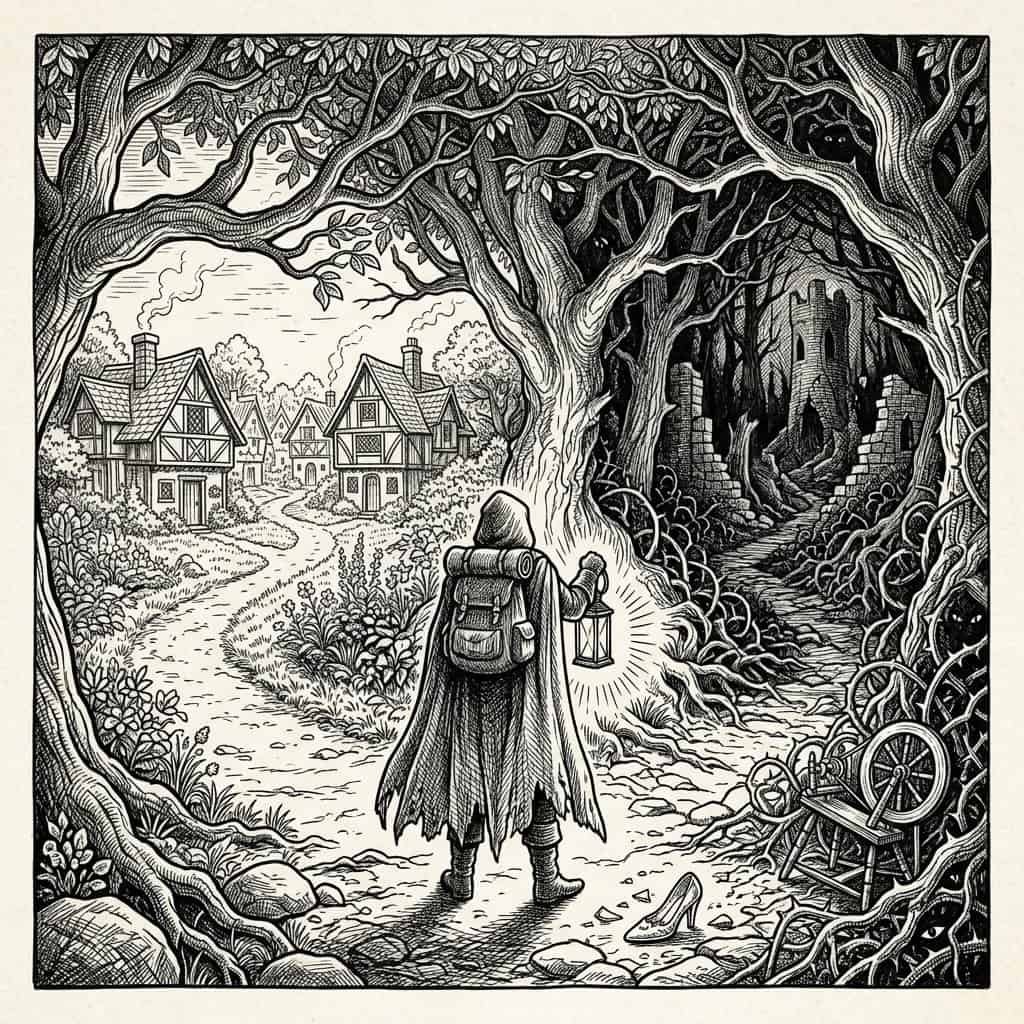

Dark fairy tale D&D adventures are the secret weapon that experienced DMs have been using to create sessions their players genuinely cannot stop talking about. Forget the generic dungeon crawl with its predictable treasure chest at the end. Forget the straightforward villain who exists only to be defeated. When you take a story everyone already knows — Rumpelstiltskin, the Pied Piper, the Twelve Dancing Princesses — and reveal that the truth behind the tale is far more complicated than anyone imagined, something powerful happens at your table. Players lean forward. They argue with each other about what the right thing to do actually is. They remember the session not because of the loot they found, but because of the choice they had to make.
This guide breaks down seven proven techniques for turning classic fairy tales into dark, morally complex D&D one-shot adventures that work especially well for small groups of two to three players. Whether you’re a busy DM looking for a fresh approach or a seasoned storyteller who wants to push beyond heroic fantasy into something with more emotional weight, these secrets will transform how you think about adventure design.
Why Dark Fairy Tale D&D Adventures Hit Different
There’s a reason fairy tales have survived for centuries. They tap into something primal — fears about trust, bargains, justice, and the cost of getting what you wish for. When you bring that energy into a D&D session, you’re working with stories that already live in your players’ heads. They walk into the adventure thinking they know how the story goes. The spinning wheel is dangerous. The wolf is evil. The witch in the forest wants to eat children.
Then you pull the rug out.
The spinning wheel was the only thing keeping the curse contained. The wolf was protecting the forest from something far worse. The witch has been sheltering the children from their own parents. Suddenly your players aren’t just fighting monsters — they’re questioning everything they assumed. That moment of realization, when the entire table goes quiet and someone says “wait, are we the bad guys?” — that’s the power of dark fairy tale D&D adventures.
This works because fairy tales come with built-in dramatic irony. Your players already have expectations, which means you can subvert those expectations in ways that feel earned rather than arbitrary. A random NPC betrayal feels cheap. But when the “villain” your players have been hunting turns out to be a grieving parent who made a desperate bargain to save their child? That hits different because the fairy tale framework made the twist feel inevitable rather than contrived.
Secret 1: Start With the Story They Know
The most important technique for running dark fairy tale D&D adventures is letting players recognize the story before you twist it. Spend the first act of your adventure leaning into every familiar element. If you’re running a Rumpelstiltskin adaptation, give them the locked room, the impossible task, and the mysterious helper who demands a terrible price. If it’s a Pied Piper story, let them see the rats, meet the desperate townsfolk, and hear about the stranger who can solve everything.
This recognition phase is crucial. You want at least one player to say “oh, I know this story” within the first thirty minutes. That moment of recognition creates investment. They think they know where this is heading, which means the eventual twist carries far more emotional weight than it would in an original scenario. Players don’t just discover new information — they have to actively revise a story they’ve known since childhood.
The 75% Faithful Rule
Aim for roughly seventy-five percent fidelity to the source material. The spinning wheel, the glass slipper, the enchanted forest, the tower — all the iconic set pieces should be present. What changes is the why behind those elements. The tower exists, but the person inside isn’t a prisoner — they’re in quarantine, containing a plague they willingly took upon themselves to save the kingdom. The glass slipper is real, but it’s not a romantic token — it’s a binding contract with a fey creature, and the prince who finds it is unknowingly completing a dark bargain. If you’re looking for examples of this approach in action, The Name of Rumpelstiltskin demonstrates how to keep every recognizable element while completely reframing who the real villain is.
Secret 2: Make Every Villain Sympathetic
The heart of every great dark fairy tale D&D adventure is a villain who has a point. Not a villain who is secretly good — that’s too simple. A villain whose actions are wrong but whose motivations are completely understandable. Someone your players might have become if they’d lived through the same circumstances.
Think about the original Brothers Grimm tales. The wicked stepmother in Hansel and Gretel wasn’t evil for the sake of it — she was starving. The wolf in Little Red Riding Hood was hungry. Rumpelstiltskin kept his end of every bargain he made. When you design sympathetic antagonists for your adventures, you create situations where defeating the villain doesn’t feel like a triumph. It feels like a tragedy. And that’s exactly the tone you want.
The Motivation Framework
Give every fairy tale antagonist three things: a legitimate grievance, a line they’ve crossed, and something they’re protecting. The grievance makes them relatable. The crossed line makes them a threat. The thing they’re protecting makes defeating them costly. A fey creature who steals children is terrifying — until your players discover she’s a mother whose own children were taken by the village centuries ago, and the stolen children are genuinely happier in her care than they were with parents who neglected them. Now what do your players do? That tension is what makes dark fairy tale D&D adventures unforgettable.
Secret 3: Design Three Endings, Not One
Linear adventures kill the magic of fairy tale D&D. If there’s only one way the story can end, your players are just passengers on a guided tour. Instead, design every dark fairy tale adventure with exactly three resolution paths.
The first path is the Fairy Tale Ending — do what the original story says. Punish the villain, rescue the victim, restore order. It’s the simple choice, and it ignores everything the players have learned about the true complexity of the situation. The second path is the Twisted Ending — side with the “villain,” break the expected pattern, show compassion where the original tale demanded punishment. This feels right emotionally but comes with real costs. The third path is what I call the Third Way — a creative solution that tries to satisfy everyone. It’s the hardest to achieve, the most rewarding when it works, and still imperfect.
The key is that none of these endings is unambiguously correct. Each one sacrifices something. Each one has consequences the players will carry with them. This approach to moral dilemmas in your adventures gives players genuine agency while ensuring the story feels weighty regardless of their choice.
Secret 4: Use Fairy Tale Logic as Game Mechanics
Dark fairy tale D&D adventures should feel different from standard fantasy adventures at the mechanical level, not just the narrative level. Fairy tales operate on their own internal logic — names have power, bargains are binding, hospitality creates obligation, and the number three is sacred. When you translate these principles into actual game mechanics, the entire session takes on a different texture.
Speaking a creature’s true name might impose disadvantage on its saving throws. Offering bread and salt to a host might invoke guest-right, making violence impossible within the dwelling. Breaking a mirror might shatter an illusion but release whatever was trapped inside. A task attempted a third time might automatically succeed — but only if the first two attempts were genuine efforts that failed.
Bargains as Binding Contracts
The single most effective fairy tale mechanic is the binding bargain. When an NPC offers a deal, make it mechanically real. A fey creature’s promise isn’t flavor text — it’s an unbreakable magical contract. If a player agrees to give “their most precious possession” in exchange for information, that bargain will come due, and the fey gets to define what “most precious” means. This creates incredible tension because players must weigh every word of every offer. It also means NPCs who offer bargains become genuinely dangerous encounters without a single combat roll. For a complete toolkit of mechanics like these, investigation and mystery frameworks can help structure these non-combat encounters.
Secret 5: Small Groups Tell Better Fairy Tales
Here’s something most DMs discover by accident: dark fairy tale D&D adventures work dramatically better with two to three players than with four or five. There’s a reason for this, and it goes beyond simple encounter balancing.
Fairy tales are intimate stories. They’re about a woodcutter’s daughter, a youngest son, a single brave soul walking into the dark forest. When you have two players at your table, every choice belongs to both of them. There’s no hiding behind the party’s decision — each player’s voice matters, each player’s moral compass is tested, and each player feels the weight of consequences personally. A table of five players debating what to do with the sympathetic villain becomes a committee meeting. A table of two becomes an agonizing conversation between partners who might genuinely disagree.
If you’re running D&D for two players, fairy tale adventures are your best possible format. The narrative structure fits perfectly, the moral weight lands harder, and the pacing stays tight. You can complete a full dark fairy tale one-shot in two to three hours — a complete, satisfying story arc with meaningful choices and real consequences, all in a single evening.
Secret 6: Let the Environment Tell the Story
In standard D&D adventures, environment is backdrop. In dark fairy tale adventures, environment is narrative. Every location should contain clues about the true story — the story the official fairy tale doesn’t tell. A cottage that looks cozy from outside but is filled with children’s drawings on the walls, all depicting the same dark figure. A forest path where the trees have been deliberately cut back, not by a woodcutter clearing land, but by someone creating a barrier. A well in the town square that’s been sealed shut and covered with warning runes.
This environmental storytelling serves two purposes. First, it rewards careful players who examine their surroundings rather than just charging forward. Second, it builds atmosphere in a way that spoken exposition never can. Finding a child’s drawing is more unsettling than being told “the children are afraid.” Discovering scratch marks on the inside of a sealed door is more horrifying than any description of what made them.
The Contradiction Technique
Place one detail in every major location that directly contradicts the story your players have been told. If the village elder says the witch kidnapped the children, put toys and comfortable beds in the witch’s cottage. If the king says the enchanted forest is deadly, have the players find a well-maintained campsite with fresh flowers. These contradictions don’t need to be explained immediately — they plant seeds of doubt that blossom throughout the adventure. Good dungeon and location design makes every room a piece of the puzzle.
Secret 7: End With a Cost, Not a Victory
The final secret to running memorable dark fairy tale D&D adventures is understanding that the ending should never feel like a clean victory. Even the best possible outcome should carry a price. This isn’t nihilism or grimdark misery — it’s the authentic weight of fairy tale storytelling. In the original Grimm tales, happy endings were rare. Resolutions came with prices paid, lessons learned through suffering, and a recognition that the world doesn’t divide neatly into heroes and villains.
After your players make their final choice, show them the consequences. If they sided with the fairy tale ending and punished the “villain,” let them see the grief of those who loved the villain. If they broke the pattern and showed mercy, let them witness the cost of leaving the original injustice unresolved. The best fairy tale sessions end with players sitting in silence for a moment, processing what they chose and what it meant.
The Story They’ll Tell
Close every dark fairy tale adventure with a brief epilogue describing how the events will be remembered by the world. The players made their choice, but the world will tell its own version. Maybe the players showed mercy to the witch, but the village will remember it differently — they’ll say brave heroes drove the monster away. Maybe the players uncovered the truth about the king’s dark bargain, but history will record that the king was a great ruler who made necessary sacrifices. This final irony — that the fairy tale will be rewritten no matter what the players did — is the perfect emotional punctuation mark.
Bonus: The Tone That Makes It Work
There’s a specific tonal sweet spot for dark fairy tale D&D adventures that’s easy to miss. You’re not running grimdark horror where everything is bleak and hopeless. You’re not running Disney fantasy where everything works out. The tone you want is what the original Grimm tales delivered: wonder carrying weight. Beauty with thorns. A world that is genuinely magical and genuinely dangerous in equal measure.
Think about it this way: the enchanted forest should be beautiful enough that players understand why people enter it, and dangerous enough that players understand why some people never come back. The fey court should be dazzling and terrifying simultaneously. The villain’s lair should feel like a home, not a dungeon — because the best fairy tale villains aren’t lurking in evil fortresses. They’re living in cottages and castles, surrounded by the things they love, doing terrible things for understandable reasons.
When your players laugh and shudder in the same scene, you’ve found the tone. When they feel sympathy for someone they know they should oppose, you’ve found the tone. When the adventure ends and the table is quiet for a moment before someone says “that was heavy” — that’s the exact emotional register that makes these adventures stick in memory long after the dice are put away.
Putting It All Together: Your First Dark Fairy Tale Session
Ready to run your first dark fairy tale D&D adventure? Start with a story everyone knows. Pick one from the Brothers Grimm — not Disney, the originals. Read the original tale and ask yourself: who in this story made a bargain? Who broke a promise? What if the “villain” had a reason? Those questions will generate your twist.
Structure your session around the seven secrets: establish the familiar tale, then crack it open. Make the antagonist sympathetic. Design three possible endings. Use fairy tale logic as real mechanics. Keep the group small. Let the environment contradict the official story. And end with a cost, not a conquest.
If you want to see these principles in action rather than building from scratch, The Twelve Dancing Princesses, The Name of Rumpelstiltskin, and Pay the Piper are complete, ready-to-run adventures in The Twisted Tale Series that use every technique described in this guide. Each one adapts a classic fairy tale for two to three players, runs in a single session, and requires zero prep beyond reading the book.
The best D&D sessions aren’t the ones where players defeat the biggest monster. They’re the ones where players face a choice that haunts them — where every option costs something and there’s no perfect answer. Dark fairy tale adventures deliver that experience every single time.
Dark fairy tale D&D adventures transform familiar stories into morally complex sessions where every choice matters, every villain has a reason, and no ending comes without a price — the kind of sessions your players will still be talking about months from now.