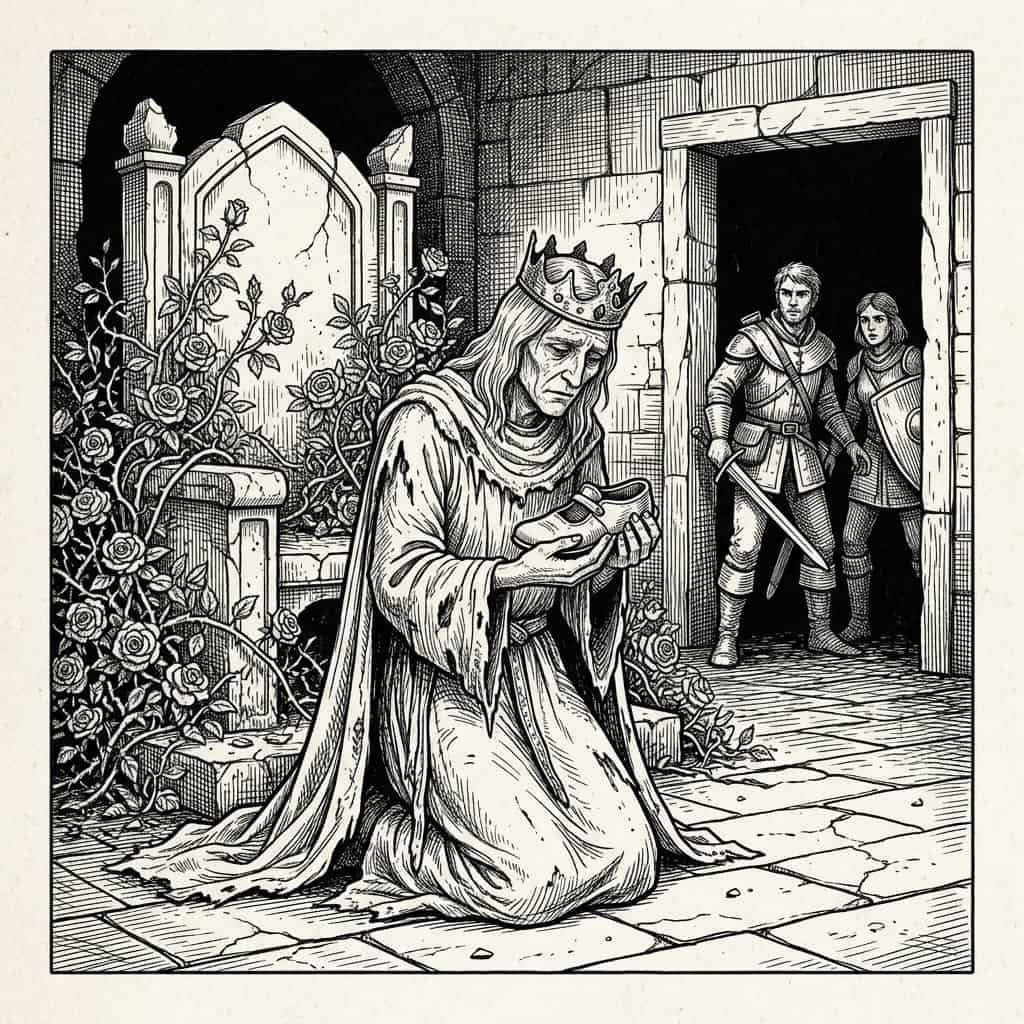

Sympathetic villains in D&D are the difference between a session your players forget by next week and one they argue about for months. Most DMs build antagonists the same way: give them a scary stat block, a dark lair, and a plan to destroy something the players care about. It works well enough. The players fight, the villain falls, everyone levels up. But if you want sessions that actually stick — the kind where a player says “I still think about that choice” weeks later — you need villains whose defeat feels like a tragedy, not a triumph.
This is especially true when you’re running dark fairy tale D&D adventures, where the entire genre depends on antagonists who exist in moral grey areas. But the techniques work in any setting, any adventure, any tone. A sympathetic villain transforms a combat encounter into a moral crisis. And moral crises are what players remember.
Why Sympathetic Villains Create Better D&D Sessions
Think about the villains that stuck with you from fiction. Magneto. Jaime Lannister. The Witcher’s Bloody Baron. None of them were evil for the sake of evil. Each one had a motivation you could understand, even if you disagreed with their methods. That understanding is what creates dramatic tension. When players face a villain who is simply malicious, the only question is “how do we beat them?” When they face a villain who has a point, the question becomes “should we beat them?” That second question is infinitely more interesting at the table.
Sympathetic villains in D&D also solve one of the most common problems DMs face: player disengagement during the final act. When the antagonist is a generic evil overlord, the climax is just a boss fight. Players go through their combat rotations, burn their spell slots, and collect their rewards. But when the antagonist is someone they’ve come to understand — maybe even someone they partly agree with — the climax becomes a genuine dramatic event. Players hesitate. They try to talk instead of fight. They look for alternatives. That engagement is what separates a good session from a great one.
Technique 1: The Legitimate Grievance
Every sympathetic villain starts with a grievance the players would share if they’d lived through the same experience. Not a vague tragic backstory — a specific, concrete wrong that was done to them. The more specific and relatable the grievance, the more sympathetic the villain becomes.
A necromancer who raises the dead because she’s lonely is vaguely sad. A necromancer who raises the dead because her village was destroyed by adventurers who mistook a peaceful settlement for a monster lair, and no one was ever held accountable, and now she’s bringing back the only people who ever loved her — that’s a grievance your players can feel in their gut. They’ve been those adventurers. They’ve kicked in doors and asked questions later. The villain’s anger is directed at people exactly like them.
Making the Grievance Personal
The strongest sympathetic villains hold grievances that implicate the systems or institutions the players serve. A fairy tale villain who kidnaps children is monstrous — until players learn that the children were promised to the villain by their own parents as payment for a debt, and the kingdom’s courts refused to enforce the contract because the villain is a fey creature with no legal standing. The villain isn’t fighting the players. The villain is fighting an unjust system, and the players are just the system’s latest enforcers.
This is exactly the dynamic that drives the best villain design in D&D. When the grievance is personal and the system is complicit, players can’t simply defeat the villain and call it justice. They have to reckon with the fact that the villain might be right about the problem, even if their solution is wrong.
Technique 2: The Crossed Line
A sympathetic villain isn’t a good person. That distinction matters. If the antagonist hasn’t done anything genuinely wrong, they’re not a villain — they’re a misunderstood NPC, and the adventure becomes a simple miscommunication that resolves itself once everyone talks. That’s boring.
Sympathetic villains in D&D need to have crossed a clear moral line. Their grievance is legitimate, but their response has gone too far. The mother who lost her children has started taking other people’s children. The soldier who was betrayed by their commander has begun assassinating anyone connected to the military, including innocent conscripts. The fey lord who was cheated out of a bargain has cursed an entire village, punishing the grandchildren of the original offenders.
The Line Makes the Dilemma
The crossed line is what prevents the adventure from collapsing into a simple “the villain was right all along” revelation. Yes, the villain has a point. Yes, the villain was wronged. But the villain has also done something genuinely harmful that cannot be simply forgiven or ignored. Players must hold both truths simultaneously: the villain deserves justice for what was done to them, AND the villain must be stopped from doing more harm. That tension — sympathy and opposition existing in the same moment — is what makes sympathetic villains in D&D so powerful at the table.
When designing the crossed line, make it proportional enough that players understand how the villain got there. A villain who was cheated out of ten gold and then burned down a city feels arbitrary. A villain who watched their family die because a healer refused to treat non-humans, and who now poisons every healer’s water supply — that escalation feels inevitable even though it’s horrific. The best crossed lines make players think “I understand exactly how they got here, and I would have wanted to do the same thing, and I still have to stop them.”
Technique 3: Something Worth Protecting
Give your villain something they love. Something innocent. Something that complicates the players’ willingness to use force. This is the element that turns a sympathetic backstory into an active moral obstacle during gameplay.
The dragon who hoards gold is a target. The dragon who hoards gold because she’s incubating her last surviving egg on a bed of warm coins, and her species is dying because adventurers have killed every other dragon in the region — she’s a dilemma. Defeating her doesn’t just end a threat. It ends a species. The egg is innocent. The mother’s protectiveness is understandable. But she’s also been eating livestock and threatening villages, and the farmers she’s terrorizing are also innocent.
The Protected Thing as Gameplay Element
The thing the villain protects should be physically present during the climactic encounter. If the villain is protecting a child, the child should be in the room. If the villain is protecting a sacred grove, the fight happens among the trees. This forces players to consider collateral damage in real time. A fireball that would end the combat easily might also destroy the thing the villain is protecting — and once it’s destroyed, the players have become the very thing the villain feared.
In Pay the Piper, this technique drives the entire adventure. The antagonist has taken something precious, but destroying the antagonist means losing what was taken forever. Players must find a resolution that addresses the villain’s grievance without sacrificing innocent lives — and every option has a cost.
Technique 4: The Villain’s Offer
One of the most effective tools for creating sympathetic villains in D&D is giving the villain a genuine offer to make. Not a trap disguised as negotiation. Not a deal that’s obviously too good to be true. A real, honest offer that would solve the immediate problem — at a price the players might actually consider paying.
The fey creature who stole the children offers to return them if the town acknowledges the original broken contract and pays the debt they owe. The cursed knight offers to stand down if the players help them achieve justice through legal means rather than violence. The witch in the forest offers to teach the players her magic if they agree to protect her home from the village that wants to burn it.
Why the Offer Changes Everything
The moment a villain makes a reasonable offer, combat becomes a choice rather than an inevitability. Players who were preparing to fight suddenly have to ask themselves: is this offer fair? Can we trust it? Is negotiation better than violence here? And the DM doesn’t have to push the players toward negotiation — the offer itself does the work. Some groups will reject it and fight anyway. Some will accept it. Some will try to negotiate better terms. All of those responses create memorable gameplay.
The offer also reveals character. When a player argues for accepting the villain’s deal while another player insists on fighting, that disagreement tells you something real about how those players think about justice, mercy, and pragmatism. Those character-revealing moments are the scenes players remember years later. This approach pairs beautifully with social encounter design that treats conversation as a genuine gameplay mechanic with stakes and consequences.
Technique 5: The Mirror
The most devastating sympathetic villain technique is making the villain a mirror of the players themselves. Not a dark reflection or an evil twin — that’s too on the nose. A mirror in the sense that the villain made the same choices the players would make, just under worse circumstances or with worse luck.
Consider an adventurer NPC who went on a quest just like the players’ current quest. They fought the same kinds of monsters, made the same kinds of bargains, pushed through the same kinds of moral grey areas. But somewhere along the way, a single bad break — a failed save, a trusted ally’s betrayal, a moment of desperation — pushed them past the line. They didn’t become evil. They became someone who made one too many compromises. And now the players have to decide what to do about someone who is essentially a version of themselves that ran out of luck.
The Mirror in Fairy Tale Adventures
This technique is particularly powerful in dark fairy tale D&D adventures because fairy tales are inherently about universal human experiences. The woodcutter’s wife who abandoned her children made the same desperate choice any starving parent might make. The prince who broke his promise to the frog did what any disgusted person might do. The miller who lied about his daughter’s abilities was a parent trying to give his child a better life through the only means available.
When players confront a fairy tale villain who mirrors their own potential for moral failure, the adventure stops being about defeating an enemy and starts being about confronting an uncomfortable truth: the line between hero and villain isn’t about character. It’s about circumstance. Players who wrestle with that realization produce the kind of roleplaying moments that define campaigns.
Putting the Five Techniques Together: A Complete Example
Let’s build a sympathetic villain from scratch using all five techniques. Imagine a fairy tale adventure based loosely on Hansel and Gretel. The villain is a hedge witch who lives deep in the forest.
The Grievance: Twenty years ago, the village burned her home and drove her into the wilderness because they feared her healing magic. She lost everything — her home, her livelihood, her place in the community. She did nothing wrong. They destroyed her life because they were afraid of what they didn’t understand.
The Crossed Line: Over the years, she’s begun luring village children to her new cottage in the forest. She feeds them, teaches them herbalism, and genuinely cares for them. But she refuses to let them go home. She’s building a new family from the community that rejected her, and the children’s parents are frantic.
The Protected Thing: The children themselves. They’re happy, well-fed, and learning skills they’d never learn in the village. Several of them don’t want to leave. One child came from an abusive home and begs the players not to send them back.
The Offer: The witch will return every child who wants to go home if the village publicly acknowledges what they did to her and guarantees she can live in peace. She’ll even continue teaching any children whose parents consent. It’s a reasonable offer — if the village can swallow its pride.
The Mirror: The witch did exactly what the players’ characters do every day — she used her abilities to help people, and she was punished for it. One bad break, one fearful mob, and she went from healer to outcast. The players are one angry village away from the same fate.
Notice how every technique layers on the others. The grievance makes her relatable. The crossed line makes her a problem. The protected thing makes solving that problem painful. The offer creates a path to resolution. The mirror makes the whole thing personal. A villain built this way doesn’t need a dramatic monologue or a complex backstory dump — the situation itself tells the story.
Building Your Sympathetic Villain: A Practical Checklist
Before your next session, build your antagonist using these five elements in order. Start with the grievance — what specific, concrete wrong was done to this person? Make it relatable and unjust. Then define the crossed line — how has this person’s response to that wrong gone too far? Next, identify what they’re protecting — what innocent thing exists in their orbit that makes defeating them costly? Then craft their offer — what reasonable deal would they propose if given the chance to negotiate? Finally, establish the mirror — in what way does this villain reflect the players’ own choices, values, or potential path?
You don’t need all five elements for every villain. A minor antagonist might only need a grievance and a crossed line. But for your adventure’s central antagonist — the one players will spend the session learning about, confronting, and ultimately making a decision about — all five create the full emotional experience.
For DMs running small groups of two to three players, sympathetic villains are especially effective because every player’s reaction matters. There’s no majority vote to hide behind. Each player must personally decide how they feel about the antagonist, and that personal investment makes the moral weight land harder.
The Reveal Timing
Don’t reveal the villain’s sympathetic qualities too early. Players should spend the first third of the adventure believing they’re facing a straightforward antagonist. The middle third should introduce doubt — contradictions in the story, evidence that doesn’t match the narrative, NPCs who defend the villain when they shouldn’t. The final third delivers the full picture. This pacing structure, which maps directly to the four-act approach described in the adventure design guide, ensures maximum emotional impact because players have already committed to opposing the villain before they understand the villain’s perspective.
The goal isn’t to trick players into feeling sorry for the bad guy. The goal is to create a situation where “the bad guy” is an inadequate description. Where the villain is a person — flawed, hurt, dangerous, and understandable. Where defeating them is possible but not satisfying. Where mercy is tempting but not safe. That ambiguity is where the best D&D sessions live.
Sympathetic villains in D&D transform every encounter from a simple fight into a moral reckoning — because the most dangerous antagonist isn’t the one with the highest CR, it’s the one your players secretly agree with.