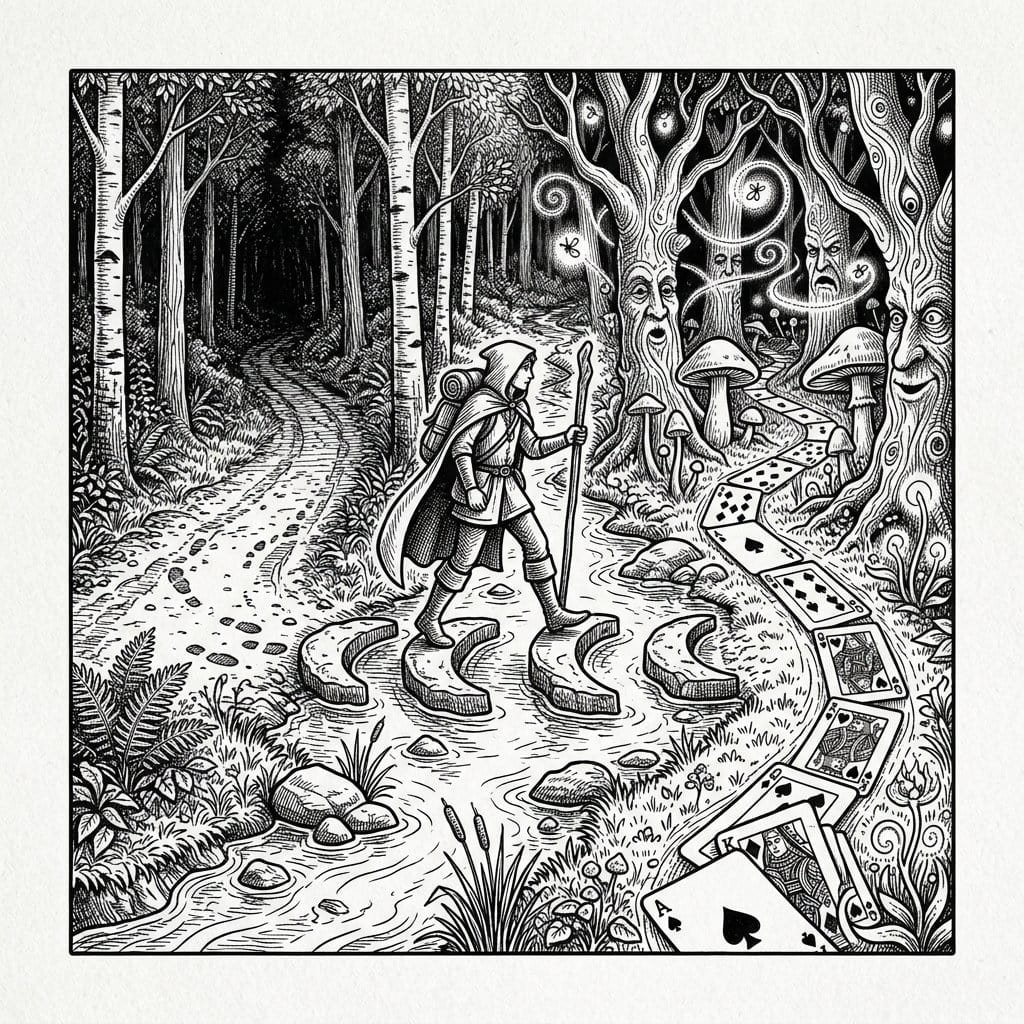

The Feywild in D&D 5e is the single most underused setting in the entire game, and that’s a shame because it’s the perfect environment for the kind of adventures players remember forever. Most DMs treat the Feywild as a detour — a weird dimension the party stumbles through on their way somewhere else. Bright colors, trickster fey, some confusing time shenanigans, and then back to the Material Plane for the “real” adventure. But if you build the Feywild as a full setting for dark fairy tale D&D adventures, it becomes something extraordinary: a place where the rules of reality bend to serve story, where words carry binding power, and where beauty and danger are the same thing.
This guide covers everything you need to make the Feywild feel real at your table — not as a colorful backdrop, but as a living world with its own logic, its own threats, and its own emotional weight. Whether you’re running a full campaign in the Feywild or dropping a single fairy tale one-shot into fey territory, these techniques will make the setting sing.
Understanding the Feywild: More Than Just the Pretty Plane
The Feywild in D&D 5e is described as an echo of the Material Plane — a parallel world of heightened emotion and wild magic where everything is more intense. Colors are brighter. Sounds are sharper. Emotions hit harder. Time moves differently. That official description is fine as far as it goes, but it misses the thing that makes the Feywild genuinely compelling as a setting for fairy tale adventures: the Feywild operates on narrative logic, not physical logic.
In the Material Plane, a locked door is a physical obstacle. You pick the lock, break it down, or find the key. In the Feywild, a locked door might open if you tell it a secret, or sing the song the door remembers from when it was a living tree, or simply ask politely — because in the Feywild, courtesy has mechanical weight. This shift from physical problem-solving to narrative problem-solving is what makes the Feywild perfect for fairy tale adventures. Players who are used to solving problems with skill checks and spell slots suddenly find themselves in a world where the right words matter more than the right weapon.
The Emotional Amplifier
The most useful Feywild concept for DMs is emotional amplification. Everything felt in the Feywild is felt more intensely. Joy becomes euphoria. Sadness becomes crushing despair. Anger becomes blind rage. This isn’t just flavor text — make it a real mechanic. When a player’s character feels an emotion strongly, the Feywild responds. Trees might bloom when a character falls in love, or wither when they feel grief. The weather might shift from sunny to stormy because someone at the table is angry. This creates an environment where players’ emotional choices have visible, tangible consequences in the world around them.
For fairy tale adventures specifically, emotional amplification means that every moral dilemma lands harder. When players discover the truth about a sympathetic villain in the Material Plane, it’s an intellectual realization. When they discover it in the Feywild, the forest around them darkens, the air grows cold, and the ground beneath their feet softens as if the world itself shares their uncertainty. The setting becomes an active participant in the story’s emotional arc.
The Rules of the Feywild: Fairy Tale Logic as Game Mechanics
The key to running a Feywild D&D 5e setting that feels authentic is establishing clear rules that follow fairy tale logic rather than physics. These rules should be explained to players early — not as limitations, but as the laws of this new reality. When players understand how the Feywild works, they can engage with it creatively rather than feeling confused by arbitrary DM decisions.
Rule 1: Names Have Power
In the Feywild, knowing something’s true name gives you power over it. This applies to fey creatures, enchanted objects, and even places. A locked gate might swing open when addressed by the name of the archfey who created it. A hostile fey creature might be compelled to answer truthfully when called by their birth name. Conversely, giving your own true name to a fey creature is dangerous — it creates a connection they can exploit.
At the table, this means players should be cautious about introductions. Smart players will use nicknames or titles when speaking with fey NPCs. Even smarter players will try to learn the true names of creatures they need to deal with. This single mechanic — names as power — transforms every social interaction in the Feywild into a game of information warfare that feels completely different from Material Plane conversations.
Rule 2: Bargains Are Binding
This is the most important rule in any Feywild D&D 5e adventure. When a deal is struck in the Feywild — any deal, spoken aloud and agreed to by both parties — it becomes magically binding. Breaking a fey bargain has consequences ranging from minor curses to catastrophic transformations. This isn’t optional or negotiable. It’s the fundamental law of the Feywild.
For DMs, this means every NPC offer is potentially dangerous. A friendly satyr offering to guide the party through the forest “in exchange for a story” might seem harmless — until the satyr defines “story” as the most painful memory the character possesses, and the bargain compels them to share it. The lesson players learn quickly: in the Feywild, every word matters. Every agreement is a contract. And fey creatures have had centuries to perfect the art of deals that sound fair but aren’t.
This mechanic drives the core tension in adventures like The Name of Rumpelstiltskin, where the entire plot revolves around a bargain that was freely made and now demands a terrible price. Players can’t simply fight their way out of a binding contract — they must find a way to satisfy the terms, renegotiate, or discover a loophole within the fairy tale’s own logic.
Rule 3: Hospitality Is Sacred
Guest-right is ancient fairy tale tradition, and in the Feywild it carries mechanical weight. When a host offers food and shelter to a guest, both parties are bound by hospitality. The host cannot harm the guest. The guest cannot steal from or betray the host. This protection lasts until the guest leaves the host’s domain. Breaking guest-right is one of the worst offenses in fey society — worse than violence, worse than theft, because it violates a fundamental social contract.
This creates fascinating tactical considerations. A villain who offers the party hospitality in their home suddenly becomes untouchable — the players literally cannot attack them without catastrophic consequences. But the villain also can’t harm the players. The entire encounter becomes a verbal chess match where both sides are trying to gain advantage without technically breaking hospitality. It’s the kind of gameplay that social encounter design was made for.
Rule 4: The Rule of Three
Three is the sacred number in fairy tales, and in the Feywild it should function as actual game mechanics. Three attempts at any task are permitted — the third attempt carrying extra significance. Three lies can be told before a curse manifests. Three gifts must be offered before passage is granted. Three questions can be asked of an oracle. This pattern creates a natural rhythm to encounters that feels both familiar and mechanically interesting. Players learn to count their attempts, plan their three questions carefully, and understand that the third iteration of any pattern is always the most important.
Building Feywild Locations That Enchant Players
Feywild locations should feel like places that exist in dreams — recognizable enough to navigate but strange enough to unsettle. The trick is taking familiar environments and adding one element that breaks expectations. A forest where the trees grow upside down, their roots reaching into the sky and their canopy buried underground. A village that looks perfectly normal except every building is slightly too large, as if built for people eight feet tall. A river that flows uphill, carrying memories instead of water.
The Court of Seasons
If you’re running a longer Feywild D&D 5e adventure, the fey courts are your most powerful setting tool. Traditional fey lore divides the Feywild into seasonal courts — Summer, Winter, Spring, and Autumn — each ruled by a powerful archfey whose personality defines their domain. The Summer Court is passionate, generous, and prone to destructive excess. The Winter Court is cunning, patient, and ruthlessly pragmatic. Spring is playful and unpredictable. Autumn is melancholy and wise.
For fairy tale adventures, place your story in the domain of whichever court matches the tale’s emotional core. A story about forbidden love belongs in Summer. A story about sacrifice and endurance belongs in Winter. A story about trickery and mischief belongs in Spring. A story about loss and remembrance belongs in Autumn. The court’s personality should color every NPC interaction, every environmental description, and every challenge the players face.
Liminal Spaces
The most evocative Feywild locations sit at boundaries — between seasons, between courts, between the Feywild and the Material Plane. A bridge over a stream that marks the border between Summer and Winter, where one bank is covered in wildflowers and the other in frost. A clearing where the Feywild is so thin that players can see their own world ghosting through the trees like a double exposure. These liminal spaces create natural encounter areas where the rules are uncertain and anything can happen.
Good dungeon and location design principles apply here, but with a fairy tale filter. Every room tells a story. Every corridor has a personality. Every environmental detail is a clue about the world’s history or a hint about what lies ahead.
Fey NPCs: Making Encounters Feel Authentically Otherworldly
Fey creatures should never feel like humans in costume. They think differently. They value different things. Their concept of time, morality, and social obligation is fundamentally alien — not evil, just different in ways that create genuine friction with mortal characters.
The Fey Mindset
Fey creatures live for centuries or millennia. This means they value entertainment over efficiency, process over outcome, and aesthetic beauty over practical function. A fey guide asked for directions might give them — but as a riddle, because a straightforward answer is boring. A fey merchant might accept payment in memories, songs, or the color of someone’s eyes rather than gold, because gold is common and experiences are unique. A fey noble might refuse to help the party not because they’re hostile, but because the party’s request was phrased inelegantly.
Play fey NPCs as beings who have all the time in the world and find mortal urgency both adorable and baffling. They’re not trying to be difficult — they genuinely don’t understand why anyone would rush through a conversation when the conversation itself is the point. This creates wonderful friction with players who are used to efficient quest-giving NPCs who dispense information and move on.
Fey Social Hierarchy
Fey society is rigidly hierarchical despite its chaotic appearance. Every fey creature knows exactly where they stand in relation to every other fey creature. Titles matter enormously. Addressing a fey noble incorrectly is a serious offense. Offering a gift that is too grand suggests the giver is trying to create an obligation the receiver cannot repay — which is an act of social aggression. Offering a gift that is too modest is an insult.
For players, navigating fey social dynamics becomes a puzzle as engaging as any dungeon. Who do you bow to first when entering a fey court? What gift do you bring? How do you request an audience without accidentally pledging fealty? This social complexity is what makes fey encounters memorable, and it’s exactly the kind of challenge that works brilliantly with small groups of two to three players where each character’s social choices receive full attention.
Time in the Feywild: The DM’s Secret Weapon
Time moves differently in the Feywild, and this single concept is one of the most powerful DM tools available for fairy tale adventures. An hour in the Feywild might be a day on the Material Plane — or a year, or a century. This time distortion creates natural stakes without requiring a villain or a ticking clock. The longer players spend in the Feywild, the more they risk losing in the world they left behind.
Use time distortion selectively rather than constantly. If every scene has a time consequence, it becomes exhausting. Instead, make time the stakes for one critical decision. The fey queen offers the players exactly what they need, but the audience will take three hours in the Feywild — which might be three days, three months, or three years back home. Do they accept the help and risk what they’ll lose, or do they find another way?
Time as Emotional Weight
The most devastating use of Feywild time in fairy tale adventures is the return. Players complete their adventure, step back through to the Material Plane, and discover that more time has passed than they expected. The people they left behind have aged. The crisis they were trying to prevent has already happened — or was resolved without them. The world moved on. This is straight from the oldest fairy tales — Rip Van Winkle, Thomas the Rhymer, Oisin in Tir na nOg — and it hits players with surprising emotional force when used well.
Running Your First Feywild Fairy Tale Session
Start small. You don’t need to build an entire Feywild setting to run a single fairy tale adventure there. Pick one fairy tale — the Brothers Grimm are an excellent source — and set it in a pocket of the Feywild accessible through a crossing point near where the players already are. A ring of mushrooms in a forest clearing. A bridge over a stream at midnight. A door in a tree that wasn’t there yesterday.
Establish two or three Feywild rules at the start of the session: names have power, bargains are binding, and the rule of three. Let players know these rules in character through an NPC warning or a signpost at the crossing. Then let the rules create natural challenges as the adventure unfolds. Players who remember the rules will find creative solutions. Players who forget will face consequences that teach them to pay attention.
The Feywild Atmosphere Checklist
Before your session, prepare five sensory details you’ll sprinkle throughout play. The Feywild should engage every sense. The air tastes like honey near the Summer Court. Mushrooms glow faintly blue along the forest paths. Birdsong sounds like distant laughter. The ground feels soft and warm, like stepping on something alive. Flowers turn to follow characters as they walk past, like sunflowers tracking the sun. These small details accumulate into an atmosphere that feels genuinely magical without requiring constant DM narration.
For ready-to-run fairy tale adventures that use all of these Feywild techniques, The Twisted Tale Series from Anvil N Ink Publishing puts players directly into dark fairy tale scenarios with fey bargains, sympathetic antagonists, and moral complexity built in. Adventures like The Twelve Dancing Princesses and Pay the Piper are designed for two to three players and run in a single session — the perfect introduction to fairy tale gaming in a Feywild setting.
The Feywild isn’t just another plane to visit. It’s a place where the rules of storytelling become the rules of reality — and that makes it the most powerful setting in all of D&D for the kind of adventures players never forget.
The Feywild in D&D 5e transforms your table into a world where names carry power, bargains are unbreakable, and every fairy tale adventure feels as real and dangerous as the stories that inspired it.