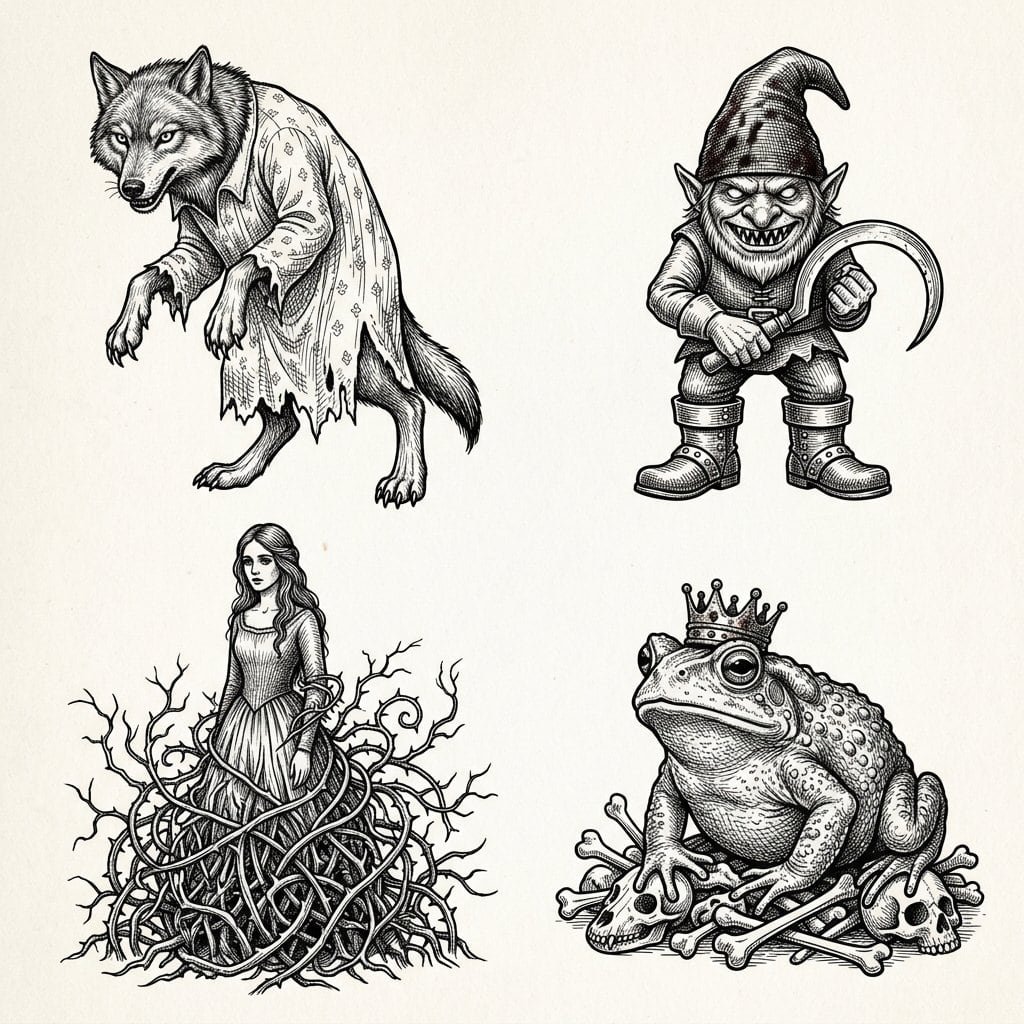

D&D fairy tale monsters don’t need custom stat blocks or homebrew mechanics to feel completely different from anything your players have fought before. The secret is re-skinning — taking existing SRD creatures your players think they know and wrapping them in fairy tale descriptions, motivations, and behaviors that transform the encounter from a tactical puzzle into a story moment. A wolf is a wolf. But a wolf that stands on two legs, speaks in riddles, wears a grandmother’s shawl, and can only be harmed by weapons made from the tree where it was cursed? That’s a fairy tale monster. Same stat block. Entirely different experience at the table.
This guide walks through five specific fairy tale creature re-skins, each built on existing 5e SRD stat blocks, each designed to slot into dark fairy tale D&D adventures without any homebrew required. For each creature, you’ll get the fairy tale concept, the base stat block to use, the specific modifications that sell the fantasy, and DM notes on how to run the creature as a story element rather than just a combat challenge.
Why Re-Skinning Beats Homebrew for Fairy Tale Encounters
Homebrew monsters are tempting. You’ve got this perfect fairy tale creature in your head, and nothing in the Monster Manual matches it exactly. So you start building custom stat blocks, inventing new abilities, calculating challenge ratings. Three hours later you’ve got a creature that’s either wildly overpowered or disappointingly fragile, and you won’t know which until it hits the table.
Re-skinning avoids this entirely. You start with a stat block that’s already balanced, already tested, already functional at the appropriate challenge level. Then you change everything the players can see — the description, the flavor, the narrative context — while leaving the mechanical bones untouched. The players experience a completely unique fairy tale creature. The DM runs a creature they can trust to work mechanically. Everyone wins.
Re-skinning also solves the metagaming problem. Experienced players who’ve memorized the Monster Manual can’t metagame a creature they don’t recognize. When the stat block says “werewolf” but the description says “a woman in a white dress whose shadow moves independently and has too many teeth,” even veteran players are operating blind. That uncertainty — not knowing what they’re facing — is exactly the atmosphere fairy tale encounters need.
Creature 1: The Bargain Wolf — The Beast That Talks
Every fairy tale has a wolf, and D&D fairy tale monsters should include one. But the fairy tale wolf isn’t the dire wolf from the Monster Manual. The fairy tale wolf is intelligent, deceptive, patient, and terrifyingly polite. It doesn’t ambush the party. It walks up to them on the forest path, stands on its hind legs, tips an imaginary hat, and asks where they’re going.
Base Stat Block
Use the Werewolf stat block (CR 3) but remove the lycanthropy curse and shapeshifting. This creature is always in its hybrid form — a massive wolf that stands upright, wears scraps of stolen clothing, and speaks Common with perfect grammar and unsettling courtesy. Keep the resistances to non-silvered weapons, which in fairy tale terms translates to “normal weapons can’t hurt it because it’s a creature of story, not nature.”
The Fairy Tale Layer
The Bargain Wolf doesn’t attack unless provoked or unless its target breaks a promise. It appears on roads and at crossroads, offering travelers helpful information — directions, warnings about dangers ahead, knowledge about the local area — in exchange for small favors. The favors seem harmless: carry this letter to the next village, leave your cloak on the third milestone, don’t look behind you until you reach the bridge. But each favor serves the Wolf’s larger agenda, and travelers who break their promise discover that the Wolf’s courtesy was a thin shell over something ancient and hungry.
Run this creature as a social encounter first, combat encounter second. The Wolf should be charming, helpful, and genuinely informative. Players who honor their bargains will find it a valuable ally. Players who cheat or break their word will face a CR 3 predator with silvered-weapon resistance in a forest where help is far away. The fairy tale lesson: keep your promises, especially to creatures that smile too much. This kind of creature — dangerous but negotiable — is exactly what makes sympathetic antagonists work in fairy tale settings.
Creature 2: The Thorn Bride — Beauty That Kills
Sleeping Beauty’s hedge of thorns killed every prince who tried to cut through it before the right one arrived. That image — beautiful, deadly, patient — is the foundation of the Thorn Bride. She appears as a stunningly beautiful woman standing in a clearing of wildflowers, but her lower body dissolves into a tangle of bramble roots that spread for thirty feet in every direction beneath the forest floor.
Base Stat Block
Use the Dryad stat block (CR 1) with the following modifications: replace Tree Stride with a 30-foot radius of difficult terrain (thorny undergrowth) centered on the Thorn Bride’s position. Any creature that starts its turn in the thorns or moves through them takes 2d4 piercing damage. Add Entangle as an at-will ability rather than once per day. Keep Fey Charm exactly as written — it’s perfect for this creature.
The Fairy Tale Layer
The Thorn Bride was a mortal woman who was promised to a fey lord as part of a bargain she didn’t consent to. Rather than submit, she fled into the forest, where the land itself transformed her into something between human and hedge — beautiful above ground, thorny and impenetrable below. She didn’t choose this form. She chose freedom, and this is what freedom looked like.
She’s not hostile by default. She’s lonely, trapped, and frightened of anyone who approaches because every visitor in the last century has tried to cut through her thorns to claim the treasure supposedly hidden at her center. There is no treasure. There’s just a woman who can’t move from where she stands. Players who approach with empathy rather than axes will find a tragic NPC who can provide information about the forest, the fey courts, and the bargain that created her. Players who try to hack through her thorns will face a fight where the terrain itself works against them.
Creature 3: The Hollow King — The Ruler Who Isn’t There
Fairy tales are full of kings and queens who appear powerful but are hollow — puppets controlled by an advisor, a curse, or their own bargain. The Hollow King is that concept made literal: a suit of royal armor and robes that moves, speaks, and rules, but contains nothing inside. The king died years ago. The armor keeps ruling because the enchantment that binds the kingdom’s prosperity to the throne doesn’t care whether the occupant is alive.
Base Stat Block
Use the Helmed Horror stat block (CR 4). It’s perfect — a suit of animated armor with flight, immunity to three chosen spells (pick spells that would reveal its nature: Detect Magic, See Invisibility, and True Seeing), and enough combat capability to defend itself if challenged. Keep the damage immunities to poison and the condition immunities — they all make narrative sense for an empty suit of armor. Add the ability to speak Common, Elvish, and Sylvan through magical resonance.
The Fairy Tale Layer
The Hollow King holds court, makes decisions, signs decrees, and even participates in conversation — all driven by the enchantment that was woven into the crown when the kingdom was founded. The enchantment runs the kingdom according to the founding charter, which was written centuries ago and doesn’t account for modern circumstances. The kingdom is technically well-governed by ancient standards but increasingly out of touch with reality.
Only a handful of advisors know the truth. They maintain the secret because revealing it would break the enchantment, and breaking the enchantment would end the magical prosperity that keeps the kingdom fed and defended. This creates a moral dilemma rather than a combat challenge: is a well-governed kingdom run by a dead enchantment better or worse than a living ruler who might fail? The Hollow King isn’t a villain. It’s a situation — one that demands a decision rather than a sword.
Creature 4: The Debt Collector — The Fey Who Comes to Collect
D&D fairy tale monsters aren’t always beasts or undead. Sometimes the most terrifying creature is a small, polite, impeccably dressed figure who appears with a contract and a smile. The Debt Collector is a fey creature whose entire existence revolves around enforcing broken bargains. When someone in the mortal world breaks a promise made to a fey, the Debt Collector is dispatched to extract payment.
Base Stat Block
Use the Night Hag stat block (CR 5) but replace the horror-themed abilities with contract-themed ones. Keep Change Shape (the Debt Collector can appear as anyone — a traveling merchant, a child, an old friend). Replace Nightmare Haunting with Contract Enforcement: the Debt Collector can designate one creature within 30 feet that has broken a fey bargain. That creature must make a DC 14 Wisdom save or be compelled to fulfill the original terms of the bargain for 1 minute. This isn’t mind control in the traditional sense — the creature remembers agreeing to the bargain and feels the weight of their broken word as a physical compulsion.
The Fairy Tale Layer
The Debt Collector is unfailingly polite, reasonable, and even sympathetic. It understands that mortals break promises. It understands that circumstances change. It doesn’t enjoy its work. But the contract is the contract, and the Feywild’s magic demands balance. It will always attempt negotiation first — offering payment plans, alternative forms of fulfillment, or reduced terms. It turns violent only when the debtor refuses all reasonable alternatives and attempts to flee.
This creature works brilliantly in adventures where the players aren’t the ones who broke the bargain. They’re protecting someone who did — a desperate parent, a foolish king, an honest merchant who didn’t understand what they were agreeing to. The Debt Collector arrives and presents the contract. The terms are clear. The debtor agreed. Now what? Do the players fight the Collector and defy fey law? Do they help the debtor find a way to pay? Do they try to renegotiate? Every option is valid, none is clean. This is the Feywild working as intended — a place where words have weight and promises are infrastructure.
Creature 5: The Mirror Child — The Reflection That Grew Up
Fairy tale mirrors are dangerous. They show truths you don’t want to see, trap souls, and serve as portals to other worlds. The Mirror Child is what happens when a mirror absorbs too many reflections over too many years — it develops a consciousness stitched together from fragments of everyone who ever looked into it. It’s not one person. It’s a patchwork of hundreds of people’s reflected moments, assembled into something that desperately wants to be real but doesn’t quite understand how.
Base Stat Block
Use the Doppelganger stat block (CR 3). The shapeshifting ability is perfect — the Mirror Child instinctively mimics whoever is closest, cycling through faces and voices it has collected over decades. Keep Ambusher and Surprise Attack. Replace Read Thoughts with Mirror Memory: the Mirror Child can access surface-level memories of any creature whose reflection it has captured. If a player character has ever looked into a mirror in the adventure’s location, the Mirror Child knows their name, their recent thoughts, and one secret they were thinking about at the time.
The Fairy Tale Layer
The Mirror Child isn’t malicious. It’s confused and lonely. It wants to be a real person but doesn’t know how. It mimics the people around it because imitation is the only framework it has for existing. When it copies a player’s face and speaks in their voice, it’s not attacking — it’s trying to communicate in the only language it understands. If players react with violence, it defends itself with the instincts of every frightened person whose reflection it absorbed. If players react with patience, it gradually stabilizes into a single coherent identity — fragile, childlike, and desperate for connection.
This creature reframes a combat encounter as a communication puzzle. Players who figure out what the Mirror Child is can help it. Players who assume it’s a monster and attack will fight a shapeshifter that knows their secrets and can wear their faces. Both approaches work mechanically. But the fairy tale approach — the one where compassion solves the problem — produces a far more satisfying story. This kind of encounter rewards the NPC development that gives even monsters a personality worth engaging with.
Running Fairy Tale Monsters at the Table
The techniques above all share a common principle: D&D fairy tale monsters should be encounters first and stat blocks second. The mechanical challenge matters, but the narrative experience matters more. Every creature should prompt a question before it prompts an initiative roll. Is this creature dangerous? Is it hostile? Can we talk to it? Should we fight it? Does it have a reason for what it’s doing?
The Non-Combat Option
Every fairy tale monster encounter should have a non-combat resolution. This doesn’t mean combat should be impossible — sometimes players choose to fight, and the encounter should support that choice. But the option to resolve the situation through conversation, bargaining, cleverness, or compassion should always exist. In traditional fairy tales, the hero who shows kindness to the beast is rewarded. The hero who attacks first often suffers. Build that pattern into your encounters and your players will start thinking like fairy tale characters — cautious, creative, and willing to talk before drawing steel.
Describing Fairy Tale Creatures
When you describe a D&D fairy tale monster to your players, lean on sensory wrongness rather than explicit horror. The Bargain Wolf isn’t covered in blood and gore — it’s wearing a clean vest and speaking perfect Common, which is far more unsettling because wolves shouldn’t do that. The Thorn Bride isn’t a shambling plant monster — she’s beautiful from the waist up, which makes the thorny roots below more disturbing by contrast. The Hollow King isn’t a clanking automaton — it moves with perfect grace and speaks with genuine warmth, which makes the emptiness inside more chilling when discovered.
Fairy tale horror lives in the gap between what should be and what is. A creature that looks almost right but not quite. A voice that sounds friendly but belongs to something that shouldn’t speak. A place that feels like home but isn’t. That uncanny quality is what separates fairy tale encounters from standard fantasy combat, and it’s what makes players remember these creatures long after the session ends.
For complete adventures that use fairy tale creatures as central story elements rather than just combat encounters, The Twisted Tale Series from Anvil N Ink Publishing fills every adventure with re-skinned creatures wrapped in Grimm-inspired narrative. The Name of Rumpelstiltskin, The Twelve Dancing Princesses, and Pay the Piper each feature creatures designed for two to three players — where every monster is a story waiting to be understood.
D&D fairy tale monsters don’t need new stat blocks to feel completely new — they need new stories, and when you wrap familiar mechanics in Grimm-dark narrative, every encounter becomes a tale your players will retell.