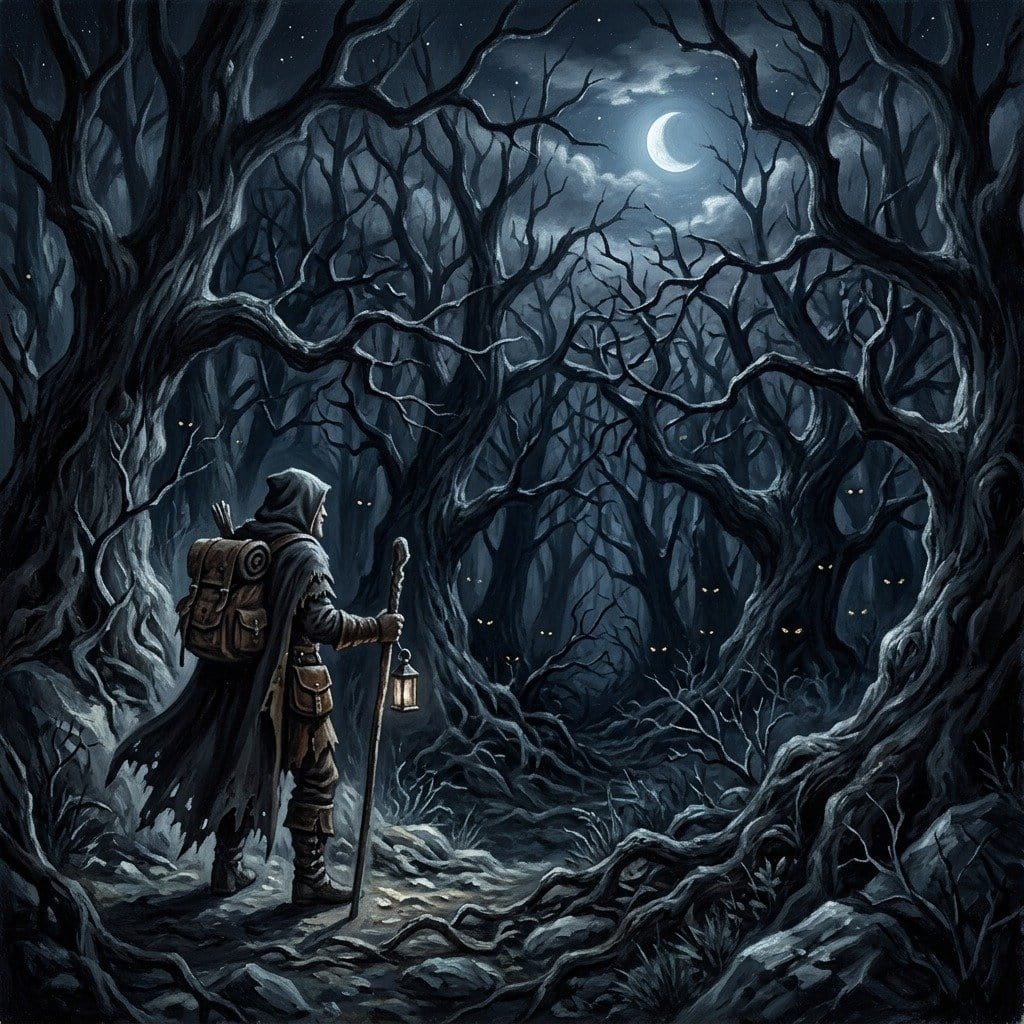

Dark Fairy Tale D&D: Adventures Inspired by the Brothers Grimm
Before Disney softened them, fairy tales were brutal. Children were abandoned in forests, deals were made with supernatural beings who always collected, and the consequences of greed, cruelty, or simple bad luck fell on the innocent and guilty alike. The Brothers Grimm didn’t write comfort stories — they documented something older and stranger: the moral weight of a world where choices have permanent consequences. That is exactly what makes dark fairy tale D&D so powerful. This guide covers everything you need to bring the Brothers Grimm to your table.
Why Fairy Tales Were Always Dark Fantasy
The fairy tales we know today have been through centuries of sanitisation. Charles Perrault polished them for the French aristocracy in the 1600s. The Brothers Grimm cleaned up their own collection between editions as Victorian sensibilities hardened. Disney finished the job in the twentieth century. But strip away those layers and the original stories are disturbing in exactly the right ways.
Cinderella’s stepsisters have their eyes pecked out by doves. Rumpelstiltskin tears himself in two when he loses. The Little Mermaid dies and her body dissolves into sea foam — there is no prince who saves her in the Andersen original. The Pied Piper doesn’t stop at the rats. These stories aren’t cautionary tales dressed up in pretty language. They are genuine explorations of what happens when power is abused, when promises are broken, and when ordinary people are caught between forces they don’t understand.
That moral seriousness is precisely what makes fairy tales so compatible with D&D. The best tabletop adventures aren’t about defeating monsters — they’re about navigating impossible situations, making choices under pressure, and living with what you decided. Dark fairy tale D&D takes that premise and gives it a setting rich with imagery, moral texture, and stories that players already have an emotional relationship with.
What Makes Dark Fairy Tale D&D Different From Standard Fantasy
Standard D&D fantasy tends toward clear moral alignment. The orcs are the enemy. The king is good (usually). The dragon is a problem to be solved with sufficient levels and the right spell combinations. Dark fairy tale D&D rejects that clarity entirely.
In a dark fairy tale adventure, the witch who lives in the forest might be protecting the village from something worse. The desperate miller’s daughter who made a deal with Rumpelstiltskin didn’t do it out of greed — she was going to be killed if she refused. The players who arrive to ‘rescue’ her may find that the story is far more complicated than the version they heard at the tavern. The antagonist has a reason. The victim is sometimes complicit. The right answer is rarely available.
This moral complexity is what separates dark fairy tale adventures from generic dungeon crawls. It creates genuine dramatic tension because players can’t fall back on ‘kill the bad guy’ as a default solution. They have to think, negotiate, and make difficult choices that reveal who their characters actually are. For many players, that’s the most memorable D&D they’ve ever played.
The Three Pillars of a Great Dark Fairy Tale Adventure
Moral Complexity Over Clear Heroism
Every major character in a dark fairy tale adventure should have a comprehensible motivation. The villain isn’t evil because the plot requires a villain — they’re doing what they’re doing for a reason that, under different circumstances, might even be understandable. A debt that was never repaid. A child who was taken. A promise that was broken first by someone else. Players should finish the adventure uncertain about whether they made the right call, not triumphant about having identified and eliminated evil.
This doesn’t mean the antagonist is secretly sympathetic — it means they’re human (or whatever they are) in a way that makes the conflict genuinely uncomfortable. The best fairy tale villains make players feel like they might have made the same choices. For more on building antagonists with this kind of depth, our guide to sympathetic villains in D&D covers the technique in depth.
Consequences That Actually Matter
Fairy tales operate on a logic of permanent consequences. You make a deal and you pay the price. You break a promise and something terrible happens. You take the shortcut through the forest and you meet the wolf. This logic transfers directly to the D&D table — and it transforms how players engage with the adventure when they know that choices have real weight.
Design your dark fairy tale adventures with at least one choice that cannot be undone. Not a puzzle with a right answer — a genuine moral decision where something is lost regardless of what the players choose. A village saved at the cost of someone’s freedom. A monster destroyed but the knowledge of its suffering not forgotten. These moments create the emotional resonance that players talk about years later.
Transformation as a Central Theme
Fairy tales are obsessed with transformation — physical, moral, social. Beasts become princes. Humble woodcutters become kings. Proud queens are reduced to ash. In D&D terms, transformation manifests most powerfully as character change: who the player characters become through the experience of the adventure, not just what they accomplished.
Build your adventures around moments that test character values rather than character statistics. The fighter who must decide whether to honour their word to an enemy. The rogue who can steal the MacGuffin easily but doing so would betray someone who trusted them. The cleric whose god’s will conflicts with what they know to be right. These are the moments that transform characters — and the players who run them.
The Brothers Grimm as Your Adventure Sourcebook
The original Brothers Grimm collection contains over two hundred tales. Most D&D players know a handful from their Disney-filtered childhoods. Going back to the source material reveals a library of adventure hooks that are genuinely dark, morally complicated, and structurally suited to tabletop play.
Rumpelstiltskin is not a story about a malicious imp. It’s a story about impossible demands, desperate bargains, and the cruelty of a system that put a young woman in an impossible position in the first place. In D&D terms: who made the original deal, what were the circumstances, and is Rumpelstiltskin actually the monster here — or is he the only one in the story who kept his word? Our adventure The Name of Rumpelstiltskin explores exactly this question.
The Twelve Dancing Princesses raises a fascinating structural question: why are the princesses sneaking out? In the original tale they’re dancing with faerie princes who may not have their best interests at heart — but the princesses seem to prefer the faerie world to their own. That’s the seed of a genuinely interesting adventure about agency, captivity, and what ‘rescue’ actually means. Our adaptation, The Twelve Dancing Princesses, turns that question into a two-to-three-hour moral puzzle.
The Pied Piper of Hamelin is the darkest of the lot — a town that refused to pay a debt, and the supernatural contractor who collected at maximum cost. It works as a D&D adventure because it’s fundamentally about civic failure, broken promises, and whether the Piper is a monster or an enforcer of a contract the town agreed to. Pay the Piper takes that premise and gives players the impossible job of resolving it.
Other rich sources from the Grimm collection include: The Juniper Tree (a murdered child, a grieving stepmother, and a supernatural reckoning), Fitcher’s Bird (three sisters, a sorcerer, and a test of trust), and The Robber Bridegroom (which is exactly as dark as the title suggests). Any of these provide a complete adventure premise requiring almost no additional invention.
Running Dark Fairy Tale Adventures for Small Groups
Dark fairy tale adventures are particularly suited to small groups of two to three players. The moral complexity that makes them powerful requires each player to engage fully with the story — and that engagement is easier to sustain in a small group where every player is always at the centre of the action.
Large groups tend to split on moral dilemmas, which can paralyse decision-making or resolve the dilemma through majority vote rather than genuine character engagement. Small groups have to negotiate more directly, which means the choice feels more personal. When two players disagree about whether to help the witch or report her to the village council, that conflict is itself the story — and it’s more powerful than any monster you could put in front of them.
For dark fairy tale adventures, we consistently recommend two to three players at levels 2–3. Low-level characters feel the danger of the story world more acutely than high-level ones. A level 2 ranger who has to talk their way past the Black Forest guardian rather than fireball it has a very different — and better — experience than a level 12 wizard who solves every problem with overwhelming magical force.
How to Set the Right Tone at Your Table
Dark fairy tale D&D requires a tone conversation before play begins. The genre deals with themes that some players find genuinely uncomfortable — child endangerment in some original tales, coercive deals, the suffering of innocent characters. None of this needs to be graphic or gratuitous to be effective, but players should know what kind of story they’re walking into.
The most useful framing is to describe the tone as ‘Brothers Grimm, not Disney.’ Most players immediately understand what that means: the story is darker, the choices are harder, and not everything ends well. It sets appropriate expectations without requiring a lengthy content discussion.
Use safety tools — at minimum, the X Card — so players can step back from content that becomes genuinely uncomfortable. Dark fairy tale adventures are meant to provoke discomfort, but not distress. The difference is important. Discomfort makes you think; distress makes you leave the table. A simple ‘X’ tap skips past any scene that crosses the line without interrupting the flow of the game.
Lean into the sensory details that establish atmosphere: candlelight descriptions, the sound of wind in bare trees, the specific quality of silence in a forest where the birds have stopped singing. Dark fairy tale adventures don’t need mechanical horror — they need atmosphere thick enough to make players feel the weight of the world the characters are moving through.
Dark Fairy Tale Monsters: Beyond the Monster Manual
Standard D&D monsters don’t quite fit the dark fairy tale aesthetic. The bestiary’s orcs, dragons, and undead carry associations from decades of fantasy gaming that work against the fairy tale tone. Instead, look toward the creatures that inhabit fairy tale logic: entities defined by rules they cannot break, bargains they must honour, or hungers that are metaphors for something human.
A fairy tale monster is dangerous not because of its HP pool but because of what it represents. The wolf who speaks in a grandmother’s voice is terrifying because it understands human vulnerability. The miller’s imp who can spin gold is threatening because his power is something humans want. The sea witch who grants wishes always extracts a price because that’s the law of the world she inhabits. These creatures have internal logic that players can engage with, which makes them far more interesting than monsters who simply attack until dead.
For stat block inspiration and creature re-skins that fit the fairy tale aesthetic, our fairy tale monsters guide covers five classic D&D creatures rebuilt for dark fantasy fairy tale play.
The Twisted Tale Series: Dark Fairy Tale Adventures Ready to Run
Anvil N Ink’s Twisted Tale Series is built specifically around the dark fairy tale D&D premise. Each adventure takes a classic Brothers Grimm or folk tale source, strips away the Disney interpretation, and rebuilds it as a morally complex one-shot for two to three players.
The series currently includes four adventures: The Name of Rumpelstiltskin, The Twelve Dancing Princesses, Pay the Piper, and the upcoming Breadcrumbs (Hansel and Gretel reimagined). Each adventure features: a sympathetic antagonist whose motivations are comprehensible, at least one choice with no clean resolution, multiple paths through the story, and pre-generated characters designed to create internal party tension alongside the external conflict.
These are adventures designed to leave players thinking about them after the session ends — not about whether they won, but about whether they chose correctly. That’s the measure of a dark fairy tale done right.
Frequently Asked Questions: Dark Fairy Tale D&D
Do I need to know the original fairy tales to run these adventures?
No. The best dark fairy tale D&D adventures are self-contained — the source material informs the design, but players don’t need to know Rumpelstiltskin from the Brothers Grimm to engage with an adventure about a desperate bargain and its supernatural consequences. Familiarity helps, but the adventures work without it.
Are dark fairy tale adventures appropriate for all players?
The tone is darker than standard D&D, but dark fairy tale adventures don’t require graphic violence or horror. The darkness is moral rather than graphic — difficult choices, ambiguous outcomes, and consequences that linger. Use a brief tone conversation and safety tools before play, and adjust content as needed for your specific group.
What level should characters be for dark fairy tale adventures?
Levels 2–4 work best. Low-level characters feel genuine vulnerability that reinforces the fairy tale tone. High-level characters with world-reshaping magical power tend to resolve the moral complexity of fairy tale scenarios through force rather than negotiation, which undercuts what makes the genre powerful.
Can I run dark fairy tale D&D as a campaign rather than one-shots?
Absolutely. A campaign structured around fairy tale arcs — with recurring supernatural figures, consequences that accumulate across sessions, and a world that operates on fairy tale logic throughout — can be extraordinarily compelling. One-shots let you test the genre; a campaign lets you explore it in depth. Our Brothers Grimm D&D guide covers building a fairy tale campaign from the ground up.
Start Your Dark Adventure
The easiest way to bring dark fairy tale D&D to your table is to start with a single one-shot. One evening, one story, one impossible choice — and you’ll understand immediately why this style of adventure creates the moments players remember longest. No prep required, no campaign commitment, no five-player scheduling nightmare.
Browse the Twisted Tale Series at anvilnink.com/adventures. Every adventure is built for two to three players, runs in two to three hours, and comes with everything you need to run it tonight. The story is darker than you remember. That’s what makes it worth telling.
Dark fairy tale D&D doesn’t ask whether the heroes win. It asks whether they chose correctly — and makes sure they’re never quite certain they did.