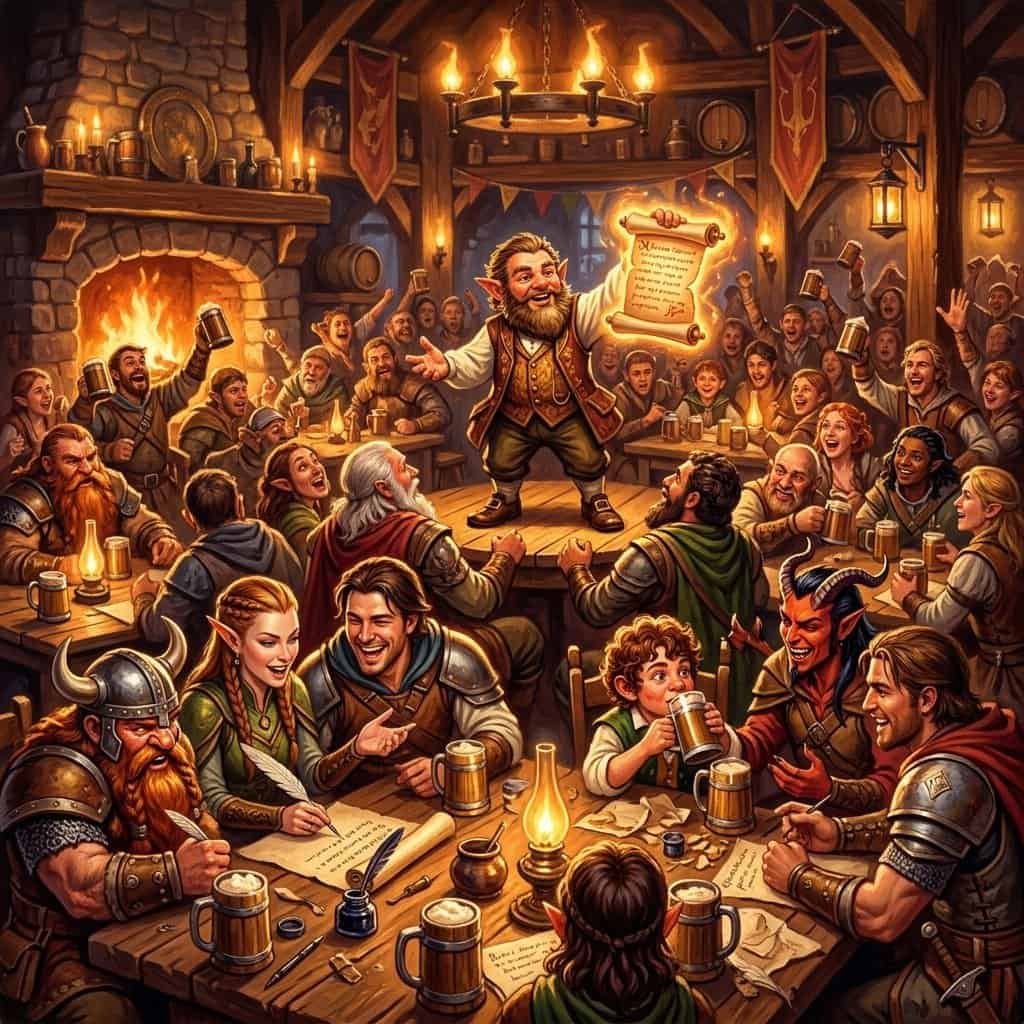

D&D Pub Quiz Night: How to Run One (Plus Free Sample Questions)
A D&D pub quiz is one of the simplest — and most surprisingly fun — events you can organise for your gaming group, local club, or game store. Unlike running a full D&D session, a quiz night needs no prep beyond writing the questions: no maps, no monster stats, no adventure structure. Yet it consistently generates the same kind of energy as a great session — laughter, heated argument, that moment of collective triumph when someone finally remembers the name of the Forgotten Realms’ god of death. This guide covers everything you need to run a D&D pub quiz from scratch, including ten free questions to get you started.
Why D&D Pub Quizzes Work So Well
The tabletop community is unusually well-suited to pub quiz format. D&D players are enthusiastic consumers of lore, rules, history, and pop culture — exactly the kind of varied knowledge base that makes for interesting quiz teams. A party that’s been playing together for years will quickly discover which member knows the Monster Manual backwards, who can name every canonical Ravenloft domain, and who can identify which edition introduced the Warlock class.
Quiz nights also have a valuable social function that regular game sessions don’t. They’re accessible to people who’ve never played D&D — a friend, partner, or family member with no roleplaying experience can still answer a question about what a d20 is, or what colour a red dragon’s breath weapon is. That accessibility makes quiz nights excellent entry points for bringing new people into the community.
For game stores, gaming clubs, and convention events, a D&D pub quiz is a low-cost, high-engagement event that fills space and builds community without requiring the logistics of running actual play sessions. The barrier to hosting is almost zero once you have a good question set.
How to Run a D&D Pub Quiz Night: Step by Step
Choose Your Format
Most D&D pub quizzes work best with team-based play: groups of three to six players per team, competing across several rounds of questions. Teams add a social element that solo play can’t replicate — the moment when a teammate remembers the answer you were certain you’d forgotten is genuinely satisfying in a way that has nothing to do with the prize.
For smaller groups (six to fifteen people), individual scoring works well and gives every participant equal stakes in every question. For larger events, teams are easier to manage and reduce the administrative overhead of scoring.
Decide on your round structure in advance. A standard D&D pub quiz runs four to six rounds of ten questions each, with a short break between rounds two and three. That gives you a sixty to ninety minute event — long enough to feel substantial, short enough to sustain energy throughout. A lightning round at the end (fastest correct answer scores) adds excitement to the finish.
Pick Your Categories
Category variety is what separates a good D&D pub quiz from a frustrating one. If every question tests Monster Manual memorisation, you’ll quickly separate the hardcore lore enthusiasts from everyone else — and the everyone else will stop having fun. Spread your questions across different knowledge types so that every player has at least one round where they shine.
Strong D&D pub quiz categories include: Monster Identification (describe a creature, teams identify it), Spell School Sorting (which spells belong to which school of magic), D&D History and Editions (when was 3.5 released? who created the Forgotten Realms?), Famous Locations (identify the city, dungeon, or plane from a description), Rules and Mechanics (how does flanking work in different editions?), Pop Culture D&D (which show, film, or book features a famous D&D reference?), and Dungeon Master Challenges (a quick puzzle or improvisation task scored by group vote). Mix serious knowledge rounds with accessible fun rounds and the quiz sustains energy from start to finish.
Set Up Your Scoring
Keep scoring simple. One point per correct answer is the baseline. For bonus rounds, two or three points per question ramps up the drama. If you’re running a wager round — where teams bet points before a high-difficulty question — cap the maximum wager at half the team’s current score to prevent runaway leads from becoming insurmountable.
Designate a scorekeeper who isn’t playing. Keeping score while simultaneously competing is stressful and error-prone. If you’re running a pub quiz as a host, consider a whiteboard or projected scoreboard that keeps standings visible throughout the event — visible scoring creates competition and keeps energy high.
Running the Event
Read each question clearly, pause long enough for teams to discuss, and give a consistent time limit — thirty to forty-five seconds per question is typical. Collect answer sheets at the end of each round and announce scores before moving to the next. The between-round score announcement is one of the best moments in a quiz night: it resets the stakes and creates urgency for the rounds ahead.
Have a tiebreaker ready for close finishes. A classic D&D tiebreaker: roll a d20 for each tied team (the host rolls), highest result wins. It’s thematic, fast, and acknowledges that sometimes luck matters as much as knowledge — very much in the spirit of the game.
10 Free D&D Trivia Questions to Get You Started
These ten questions span a range of difficulties and categories. Use them as a sample round or as the basis for your own expanded question set.
- What is the maximum number of spell slots a Warlock has at level 5 in D&D 5e?
Answer: 2 (both at 3rd level) - Which god of death rules the Forgotten Realms’ City of the Dead?
Answer: Jergal (or Kelemvor, who is the current Lord of the Dead — accept either) - What shape does a Beholder’s main body take?
Answer: A large floating sphere - In which edition of D&D was the Warlock class introduced as a core class?
Answer: 3.5 edition (as a base class in Complete Arcane) - What is the name of the famous inn at the start of the Mines of Phandelver adventure?
Answer: Stonehill Inn (in Phandalin) - How many eyes does a standard Beholder have, not counting its central eye?
Answer: 10 - What is the Underdark city most associated with Drow culture in the Forgotten Realms?
Answer: Menzoberranzan - Which plane of existence is home to the githzerai?
Answer: Limbo - What colour is the breath weapon of a White Dragon?
Answer: Cold (white/icy) - What does the abbreviation ‘TPK’ stand for in D&D terminology?
Answer: Total Party Kill
Mix these into your first round alongside easier questions (What does d20 stand for? How many sides does a standard D&D dice set have in total?) to ensure new players have questions they can answer too.
Category Ideas That Work Best for D&D Pub Quizzes
Beyond the basics, these categories consistently generate the most engagement at D&D quiz nights.
Creature Sound-Alikes: Describe a creature’s abilities without naming it, and teams identify it. ‘This creature has one large central eye and ten smaller eyes on stalks, each of which fires a different magical ray.’ Beholder. This format rewards Monster Manual knowledge without being a pure memorisation test.
Missing Word: ‘The Tomb of _____ Horrors is one of D&D’s most notorious classic adventures.’ (Answer: Annihilation, or Horrors — the classic is Tomb of Horrors.) These feel immediately solvable and generate confident participation.
Edition Archaeology: Name the edition in which a specific rule or class first appeared. This rewards long-term players while giving newer players something to aspire to. Keep questions focused on well-known rules rather than obscure supplemental material.
D&D in Pop Culture: Which 1980s animated series was based on D&D? (Answer: Dungeons & Dragons, 1983.) What show features four teens who play D&D in a basement? (Stranger Things.) These questions are accessible to people who’ve never rolled a d20 and create a moment of inclusion for the non-gamers in the room.
True or False — Rules Edition: ‘True or false: In D&D 5e, you can use your reaction to cast the Shield spell even if you’ve already used your reaction this round.’ (False.) Fast-paced, low-pressure, and generates great argument.
Tips for a Great D&D Quiz Night
Balance difficulty deliberately. Aim for roughly one-third easy questions, one-third medium, one-third hard in each round. If every question requires deep lore knowledge, casual participants disengage quickly. If every question is obvious, experienced players feel patronised. The mixed difficulty curve keeps everyone in the game.
Write clear, unambiguous questions. Nothing derails a quiz faster than a disputed answer. Before your event, have someone who didn’t write the questions read each one and tell you what they think the answer is. If their interpretation differs from yours, rewrite the question. Ambiguity is the enemy of a good quiz night.
Theme each round visually. If you’re projecting your quiz, give each round a title slide with themed art. A Monster Knowledge round that opens with a dramatic creature illustration signals the category change clearly and adds production value with almost no additional effort.
Have prizes, but make them optional. The quiz night experience doesn’t depend on prizes — the competition is reward enough for most groups. But small prizes (a dice set, a D&D-themed snack, a copy of a module) add excitement without requiring significant expense. Even ‘the right to pick next session’s adventure’ is a prize that costs nothing and feels meaningful.
Roll for Knowledge: 550+ D&D Pub Quiz Questions Ready to Go
Writing a comprehensive question set from scratch takes significant time — writing, fact-checking, difficulty balancing, and category organisation all add up. If you want to run a polished D&D pub quiz without spending hours building your question bank, Anvil N Ink’s Roll for Knowledge is the complete solution.
Roll for Knowledge contains over 550 D&D trivia questions organised into thematic rounds, with difficulty ratings for every question, answer sheets included, and a complete host guide covering timing, scoring, and event flow. It’s designed to be pulled out and run with zero additional preparation — open to the first round and start asking questions.
The question set spans five editions of D&D, covers monsters, spells, classes, famous settings, D&D history, and pop culture references, and includes a lightning round and a Dungeon Master challenge section for hosts who want to add something unusual. Whether you’re running a casual evening for your regular group or a quiz night at your local game store, Roll for Knowledge has everything you need.
Frequently Asked Questions: D&D Pub Quiz Night
Do participants need to play D&D to enjoy a D&D pub quiz?
No. A well-designed D&D pub quiz includes questions accessible to pop culture fans, fantasy readers, and curious newcomers alongside questions that challenge hardcore lore enthusiasts. The key is category variety — mixing rules knowledge with pop culture references and general fantasy trivia creates a quiz that works for mixed groups.
How long should a D&D pub quiz run?
Plan for sixty to ninety minutes including a mid-quiz break. Four rounds of ten questions each hits the sweet spot — substantial enough to feel like a proper event, short enough to sustain energy. Extend to six rounds for larger events with more participants who need time to discuss and score.
Can I run a D&D pub quiz at a game store or convention?
Absolutely. D&D pub quizzes are one of the most logistically simple events you can run at a game store or convention. They require no game materials beyond your question set, accommodate any number of participants in team format, and run in under two hours. They’re excellent for filling event slots between gaming sessions or as evening social events at multi-day conventions.
Ready to Host Your Quiz Night?
A D&D pub quiz needs very little to get started: a question set, somewhere to gather, and enough D&D fans to form a few competitive teams. The ten questions in this guide give you a sample round. Roll for Knowledge gives you everything else. Your quiz night is ready to run tonight.
A great D&D pub quiz doesn’t just test knowledge — it creates the same sense of shared adventure as a session at the table. The dice are optional. The fun isn’t.