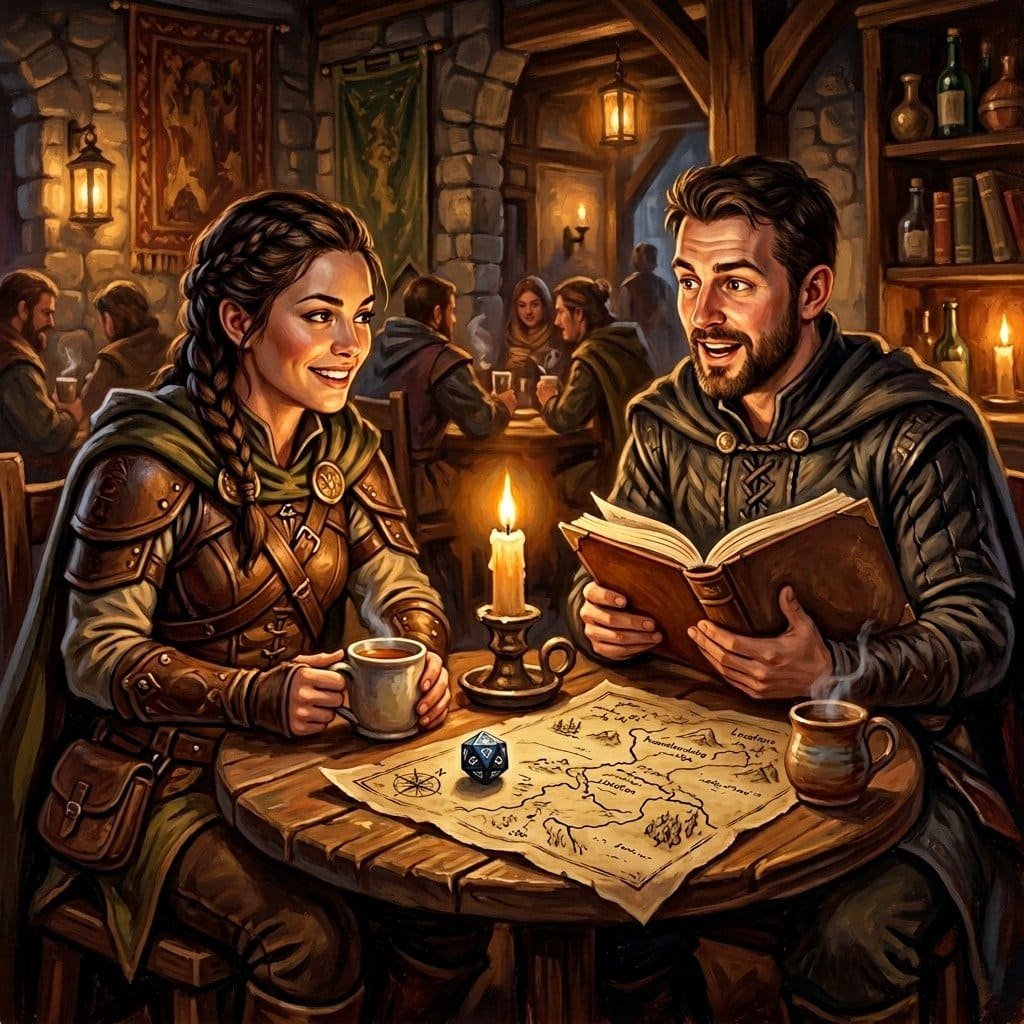

Can You Play D&D With 2 People? (Yes — Here’s How)
Can you play D&D with 2 people? Not only is the answer yes — for many players, a two-person game is the best D&D they’ve ever had. The question gets asked constantly, usually by someone who wants to play but can’t wrangle a full group, or a couple who’d like to share the hobby. The honest answer: two-person D&D, often called duet play, is a genuinely different experience from the standard five-player game, and the differences are mostly advantages.
What ‘Can You Play D&D With 2 People’ Actually Means
The standard D&D 5e rulebook is written for parties of three to five players, with a DM running the world behind the screen. Nothing in the rules explicitly says you can’t play with fewer. The encounter-building guidelines assume four to five characters, the adventure modules assume a full party, and some spells are clearly designed with teamwork in mind — but none of that stops a two-person game. It just means you need to make a few deliberate adjustments.
When people ask whether you can play D&D with 2 people, they’re usually asking two different questions: can the rules support it, and can it actually be fun? Both answers are yes. For a deeper look at all the mechanics and techniques involved in small-group play, our complete guide to D&D for 2–3 players covers everything in depth.
The Three Things That Actually Change in a 2-Person Game
1. Combat Difficulty
A standard D&D encounter is balanced around four to five characters combining their actions. With one player, you have one set of actions per round. Enemies designed for a full party will overwhelm a solo character very quickly — not because the player is doing anything wrong, but because the math simply doesn’t hold.
The fix is straightforward: drop your encounter difficulty targets significantly. For a solo character at levels 1–5, treat any encounter rated Medium or higher as genuinely dangerous. Run Easy encounters as your baseline. Avoid multi-enemy swarms where action economy crushes the player. A single well-designed opponent — or two weaker ones — creates more interesting combat than six goblins who gang up and drop the character in two rounds.
An optional sidekick, built using the rules in Tasha’s Cauldron of Everything, gives the solo player a second body in combat without adding scheduling complexity or campaign management overhead. Keep the sidekick reactive rather than heroic — their job is to support, not steal scenes.
2. Character Survivability
In a standard party, a downed character has three or four others who can stabilise them. In a two-person game, if the player character falls unconscious and fails three death saving throws, the session ends. Design characters and sessions with this in mind.
Characters for two-person play benefit from: Constitution of 14 or higher, at least one reliable self-healing option (a healing potion, the Second Wind fighter ability, Lay on Hands), and a defensive feature that reduces incoming damage before it lands. A Paladin, a Ranger with the right subclass, or a Fighter/Cleric multiclass all handle solo survival demands well without requiring optimal builds.
As a DM, avoid attritional adventure structures — six-room dungeons where resources drain fight by fight — in favour of focused sessions with defined recovery points. The player should be able to press on without feeling like every resource used now is a resource unavailable for the final encounter.
3. Story Depth and Pacing
This one is not a challenge — it’s an advantage. When you play D&D with 2 people, the story becomes intensely personal in a way that large groups can’t replicate. Every NPC interaction is directly with your character. Every moral choice belongs to you, not to the group. Every consequence lands on someone specific rather than being diffused across five players’ perspectives.
DMs running duet games can tailor the plot directly to the player’s backstory in ways that feel impossible with larger groups. Villains can have a direct relationship with the character. Recurring NPCs can track the player’s specific choices and react accordingly. The result is more like collaborative fiction than traditional tabletop gaming — which many players find more meaningful and more memorable than any campaign they’ve run with a full party.
What to Run: Best Adventures for 2-Person D&D
Not all adventure types suit duet play equally. Investigation and mystery scenarios work brilliantly — the solo player is the detective, every clue matters, and the story can branch in directions a larger group would argue over for twenty minutes before moving. Social adventures where the player must navigate factions and build relationships shine in duet format. Heist scenarios — tense, resource-conscious, built for specialists — are natural fits for a single competent character.
Straightforward dungeon crawls are harder. Without the action economy of a full party, combat-heavy dungeons become punishing quickly. If you love dungeon settings, use them as environments rather than combat gauntlets: the dungeon is the backdrop for investigation, negotiation, and discovery, with combat as punctuation rather than the main course.
Look specifically for adventures designed with small groups in mind. Generic WotC modules scaled for five players require significant adjustment. Adventures built from the ground up for two to three players — like the titles in Anvil N Ink’s Ready Adventure Series — handle the encounter balance and story structure for you. Each one is designed for two to three players, runs in two to three hours, and requires zero prep from the DM.
For couples who want to play D&D together, our D&D date night guide covers the setup, adventure selection, and tone tips that make a two-player session feel like a special occasion rather than a practice run.
Quick Start: Running Your First 2-Person D&D Session
If you’ve never run a two-person game before, the simplest approach is a single one-shot rather than a campaign commitment. Choose a short, focused adventure. Build a character together in a session zero — discuss backstory, motivation, and what kind of story the player wants to experience. Then run it. One session will tell you everything you need to know about how duet play works for your specific table.
A few practical tips for first-time duet DMs: keep NPC conversations shorter than you would in a full group (no one is waiting for their turn, but the solo player is also absorbing all the information alone), design at least one scene per session that connects directly to the character’s backstory, and ask for player feedback at the end about pacing and difficulty. Duet play is collaborative in a more direct way than group play — the feedback loop is shorter and more personal.
Frequently Asked Questions
Is D&D with 2 people the same as duet D&D?
Yes. Duet D&D specifically refers to one DM and one player — the most intimate form of the game. It’s worth distinguishing from two-player-plus-DM formats (two players and one DM), which share some characteristics but have different group dynamics. Both work; duet play is simply the most focused version.
Can you play D&D with 2 people using the standard rulebook?
Yes, with encounter difficulty adjustments. The core rules work fine for duet play. You’ll want to reduce encounter CR targets and consider optional rules like sidekicks — both covered in the Player’s Handbook and Tasha’s Cauldron of Everything. No alternative ruleset required.
What’s the best class for solo D&D play?
The Paladin is consistently the strongest solo class: durable frontline defence, self-healing through Lay on Hands, strong single-target damage, and social skills that function in non-combat scenes. The Ranger is a close second for players who prefer a skill-heavy, mobile playstyle. Both handle the demands of playing without party support.
Ready to try it? Browse the full Anvil N Ink adventure catalogue at anvilnink.com/adventures — every title is built for two to three players and ready to run tonight.
Can you play D&D with 2 people? The question answers itself the first time a solo player looks their DM in the eye, takes a breath, and makes a decision that no one else at the table can unmake.