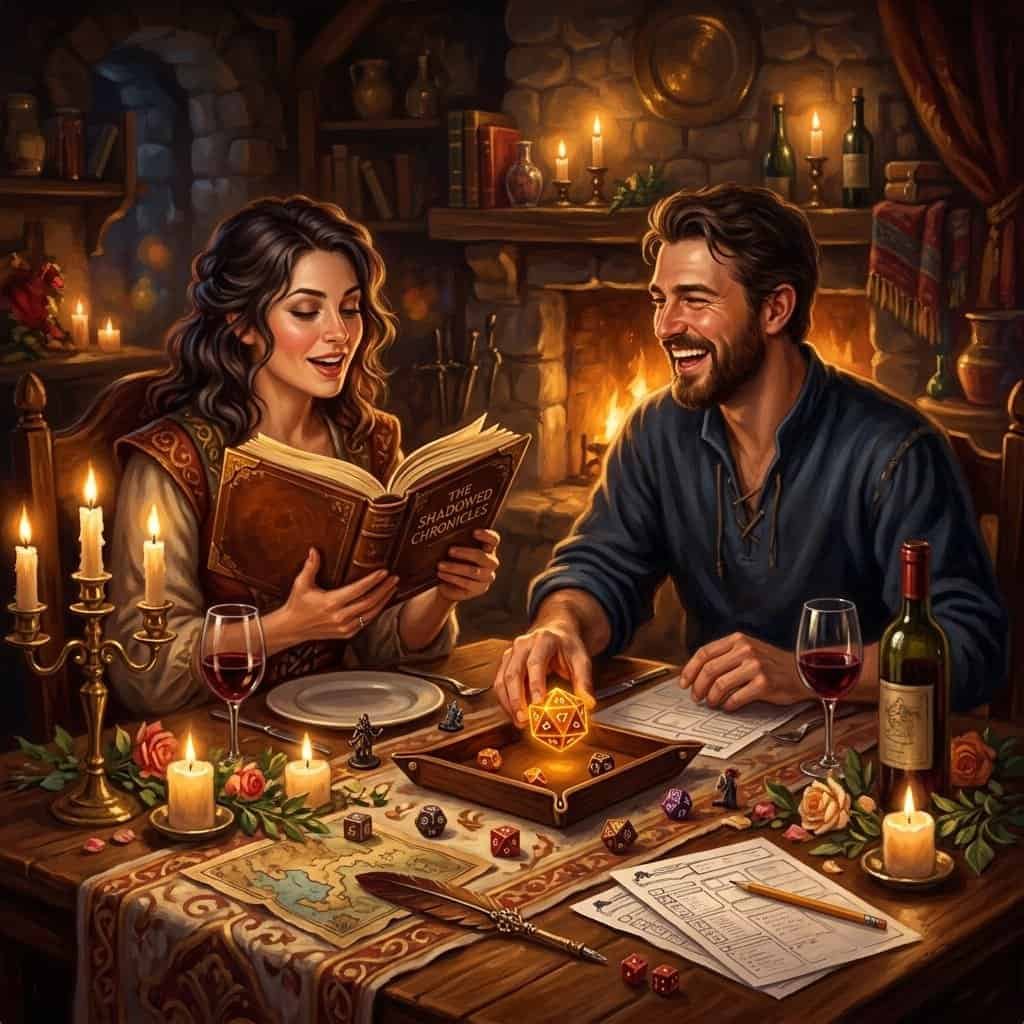

DND Date Night: The Complete Guide to D&D for Couples
A D&D date night is one of the most original and genuinely memorable evenings two people can share. It sounds unusual until you’ve done it — and then it sounds obvious. Two people, a story built for exactly them, choices that reveal character in ways that conversation alone doesn’t. Whether one of you is a seasoned player introducing the hobby to a partner, or you’re both new and starting together, this guide covers everything you need to make your D&D date night land.
Why D&D Makes Such a Good Date
The best dates create shared experiences with a little bit of stakes. You’re not just talking — you’re doing something together, navigating something together, and occasionally surprising each other in the process. D&D date night does all of that in a format that’s infinitely customisable to the two people playing it.
A well-chosen adventure gives you both a role in the story and moments of genuine tension — will this plan work? What do we do about that choice? — without requiring competitive stakes that can create friction. The dungeon is your shared enemy. The story is something you’re building together. That collaborative energy is rare in date activities and genuinely valuable for both new couples and long-term partners looking for a new shared hobby.
For the DM half of the equation: running D&D for one player is a different kind of creative challenge than running for a full group. It’s more personal, more responsive, and more focused on a single story. If you’re new to DMing, the smaller scale is actually an advantage — less to manage means more attention on the moments that matter. For the full picture on running D&D for two, see our complete guide to small group D&D.
Setting Up Your D&D Date Night
Choose Who Does What
Standard D&D date night format: one person is the Dungeon Master (the storyteller and world-runner), one person is the player (the protagonist). The DM doesn’t need to prepare an elaborate world from scratch — a single self-contained one-shot adventure handles all of that. The DM’s job is to present the story, play the NPCs, and make the player feel like the hero of something worth remembering.
If neither of you has DM experience, choose an adventure with clear, DM-friendly guidance — ideally one written specifically for new DMs running small groups. Adventures with embedded DM tips and clearly structured scenes are dramatically easier to run than open-ended sandbox content. Anvil N Ink’s Ready Adventure Series is built specifically for this situation: every title includes DM guidance, clear scene structure, and no prep requirement beyond reading it once before play.
Set the Mood Before You Start
Atmosphere matters more for a D&D date night than for a regular gaming session. Spend five minutes before you start establishing the right environment: dim the main lights and use candles or a lamp with warm-toned bulbs, put on a fantasy ambient soundtrack (the Skyrim OST, a Spotify D&D ambience playlist, or YouTube’s ‘Tavern Ambience’ channels all work), and clear the table of anything that isn’t part of the game. The transition into the fiction is easier when the environment supports it. Snacks and drinks deserve real thought too — themed cocktails, a cheese board, or takeout from a restaurant you both love. This is a date, after all. And phones away: treat this like any quality time together.
You don’t need special equipment. A single d20, a pen, and a piece of paper for character notes is enough. Elaborate dice towers and battle maps are optional. The story is the thing — everything else is decoration.
Build the Character Together
Spend fifteen to twenty minutes building the player character together before starting the adventure. Ask questions: What does your character want? What are they afraid of? What do they look like, and how do they carry themselves? You don’t need to fill in every box on the character sheet — a name, a class, a handful of personality details, and a clear motivation is enough to start.
Pre-generated characters are a perfectly valid shortcut. Many small-group adventures include them, and using a pre-gen means you spend your time playing rather than character-building. For a D&D date night where one person is new to the game, a pre-gen removes the mechanical overhead and lets the story start faster.
You Don’t Need a Big Group — or Even a Game Master
The two biggest blockers people imagine are “we need more players” and “one of us has to learn to run the game.” Neither is true anymore.
Two-player tabletop play — sometimes called a duet — has quietly become one of the fastest-growing corners of the hobby, largely because scheduling is the single most common reason groups fall apart. Roleplaying doesn’t require a quorum; it requires a story and someone to share it with. If you want the wider picture, our guide to the best D&D one-shots for 2 players covers the whole field.
And the Game Master problem solves itself if you pick the right book. A growing number of adventures are written to run themselves — the story is structured so neither of you has to prep, hide information, or referee. You both read as you go, and the book handles the parts a GM normally would. That’s the sweet spot for a date night: nobody is “working,” you’re both just playing.
If you’d both rather play characters over multiple sessions, you can also alternate who runs the game — one of you DMs this month’s story, then you switch — or use a co-DM adventure where neither player knows the full story and the book reveals its twists to both of you simultaneously. Date Night Dungeons pioneered that format specifically for couples.
Choosing the Right Adventure for a D&D Date Night
Not every D&D adventure works for a date night context. The best options share a few characteristics: they’re focused (two to three hours maximum), they’re narratively accessible without requiring rules knowledge, and they have emotional texture — moments of connection, choice, or tension that mean something beyond mechanical victory. The big published modules assume four to six characters and a dedicated GM, and they’ll steamroll a pair — look instead for adventures explicitly built for one or two players, with encounters pre-balanced for your actual table. The curated shortlist is in the Best Date-Night Adventures for Two section below.
If your partner enjoys darker stories, the Twisted Tale Series adventures — Pay the Piper, The Name of Rumpelstiltskin, The Twelve Dancing Princesses — provide richer narrative and more complex choices than lighter adventures. These are better suited to couples who already share an interest in dark fantasy or folk horror.
For completely new players, No Rest for the Buried is the gentlest entry point in the catalogue. The rules explanation is embedded in the adventure itself, which means the DM can teach as they play rather than front-loading a rules lecture before anything interesting happens.
Date-Night Adventure Formats That Work
The Heist. Planning and executing a heist requires collaboration, creativity, and improvisation. You’ll strategize together, adapt when plans go sideways, and share the thrill of success (or the comedy of spectacular failure). Heist adventures emphasize teamwork over combat, making them ideal for couples who prefer problem-solving to dice-rolling.
The Mystery. Investigation adventures let you piece together clues as a team. Discussing theories, following leads, and experiencing the “aha” moment of solving the case creates genuine shared accomplishment. The pacing tends to be conversational rather than combat-heavy, which suits intimate sessions.
The Rescue Mission. A ticking clock, someone in danger, and limited resources create natural tension. Rescue missions give both characters clear stakes and urgent motivation. The emotional payoff of success feels earned.
The Moral Dilemma. Adventures that pose genuine ethical questions spark meaningful conversation. When there’s no clearly “right” answer, you’ll discover how your partner thinks through complex situations. These discussions often continue long after the session ends.
Best Date-Night Adventures for Two
The Goblin’s Guide to Courtship — A Whole Date Night in One Book
If you’d rather not assemble a date night from parts, there’s an adventure built for exactly this. The Goblin’s Guide to Courtship is one adventure, two players, and no Game Master required.
The premise: a half-elf bard and an elf cartographer both reach for the same battered green book at a market stall, and accidentally buy a goblin’s guide to romance. The advice inside is uniformly, catastrophically terrible. Following it turns one ordinary evening into the most dangerous, embarrassing, and revealing night of either character’s life.
It’s designed so the two of you alternate reading and reacting — the book carries the structure, you supply the chaos. It runs in an evening, needs zero prep, and the comedy is the point. For a first DND date night, having the whole thing handed to you in one volume removes every excuse to not just sit down and play.
Get The Goblin’s Guide on Amazon →
Prefer to play tonight? Grab the PDF on Payhip for an instant download, or the ebook on Amazon.
Love’s Labyrinth — The Valentine’s Adventure
If your date night falls anywhere near February — or you just want something bigger and sillier — Love’s Labyrinth is the pick. It’s Anvil N Ink’s Valentine’s Day one-shot, specifically designed as a romantic D&D adventure for two players, and it works any time of year.
Cherubs have kidnapped a bride and groom mid-wedding. You are the wedding guests, and you’re crashing a pocket dimension of weaponised romance to get them back before a massive, muscle-bound cupid called Big Chonk sacrifices their love and unleashes chaos on the mortal world.
It’s a full one-shot for 2–3 players, zero prep, and it leans hard into the joke. Where the Goblin’s Guide is intimate and awkward, Love’s Labyrinth is loud and ridiculous. Pick according to your relationship.
Get Love’s Labyrinth on Amazon →
Also available as a PDF on Payhip or an ebook on Amazon.
The Stolen Festival Bell — The Classic GM-and-Player One-Shot
If one of you is happy to run the game, a ready-to-run one-shot keeps the workload near zero. The Stolen Festival Bell needs no prep — everything the DM needs is on the page, pre-balanced for small groups and designed to run smoothly from the first read-through.
Which One Should You Run?
Never played before, want zero friction, no GM at all → The Goblin’s Guide to Courtship.
Want a proper one-shot with combat, comedy, and a villain → Love’s Labyrinth.
One of you enjoys DMing and wants a classic adventure → The Stolen Festival Bell, or the Twisted Tale one-shots above.
Want to browse the wider field of two-player adventures → our roundup of the best D&D one-shots for 2 players.
5 Tips That Make D&D Date Night Work
1. Let the player be the hero. D&D date night is not the time for the DM to show off their storytelling ambitions. The player character should be central to every scene, every NPC interaction, every moral choice. If the DM is enjoying themselves more than the player, something’s wrong.
2. Say yes to creative solutions. New players often approach problems with lateral thinking that experienced players have been trained out of. When a player does something unexpected — tries to bribe the guard, asks to speak to the monster’s manager, looks for a back entrance rather than fighting through the front — say yes and build on it. These moments of creative agency are what players remember most fondly.
3. Don’t correct the rules mid-scene. Rules questions in D&D date night should be answered quickly and moved on from, not turned into a mechanics lecture. ‘You can do that — roll a d20 and add your modifier’ is always the right answer in the moment. Fix the technical details later if they matter, but don’t let mechanics interrupt the flow of a scene that’s working.
4. Build in one genuinely difficult choice. The emotional weight of a D&D date night comes from moments of real decision — not puzzles with correct answers, but situations where something is lost regardless of what the player decides. These moments create shared emotional memory. They’re the scenes that come up in conversation weeks later.
5. Have snacks. This is not optional. A D&D date night without good food on the table is a missed opportunity. Set the table properly — it signals that this is a real occasion, not just a game night. The ambiance carries the experience.
How D&D Date Night Strengthens Your Relationship
Couples who play together often report benefits that extend beyond game night. Roleplaying reveals aspects of personality that rarely emerge in everyday life: how your partner approaches problem-solving when the stakes feel real but the consequences are fictional, whether they negotiate with the villain or charge in swinging, whether they prioritize caution or boldness. The fictional framework creates psychological safety to explore ideas, express creativity, and take social risks that feel too vulnerable in real life.
Improved communication: Roleplaying requires clearly expressing intentions, listening actively, and building on each other’s ideas. These skills transfer directly to everyday conversations.
Shared vocabulary: Inside jokes from your adventures become relationship shorthand. References to NPCs, memorable moments, and running gags create linguistic bonds unique to you.
Regular quality time: In busy lives, having a scheduled activity you both look forward to ensures you’re connecting meaningfully on a regular basis.
Creative outlet: Many adults lack opportunities for imaginative play. D&D date night provides guilt-free permission to be silly, dramatic, and creative together. Years from now, you won’t remember the plot of most movies you watched together — but you’ll remember the ridiculous plan that somehow worked against all odds.
After the Session: Making It a Habit
The best D&D date nights become recurring events. After your first session, ask each other what you’d like more of next time — more combat? more roleplay? more mystery? Use that feedback to choose the next adventure. Over time, you’re not just playing games together; you’re building a shared story history that belongs specifically to the two of you.
Put it on the calendar like any date — a recurring slot every other Friday or the second Saturday of the month keeps it from getting lost in busy schedules. And let your own rituals grow around it: the same takeout order, special dice reserved for these sessions, a recap of the last adventure over dinner before you play. These rituals make the experience feel like your thing. Once you’ve tried a few one-shots, consider a campaign — an ongoing story that develops over multiple sessions, where watching your characters grow adds emotional investment.
For more on D&D for couples specifically — including advice on scheduling, adventure selection, and keeping the experience fun when one person is new — our duet D&D guide covers the long-term approach in detail.
Frequently Asked Questions
Can you really play D&D with just two people?
Yes. Two-player (duet) play is a well-established format. The main difference is that adventures should be balanced for two characters rather than a full party — which is why a purpose-built duet adventure works far better than a standard module.
Does my partner need to know D&D to enjoy a date night session?
No. A well-chosen adventure is accessible to someone who has never played. The DM handles the rules; the player makes story choices. You don’t need to know what an action economy is to decide whether your character trusts the mysterious stranger in the tavern. Choose an accessible adventure, use a pre-generated character, and let the story do the teaching.
Do we need someone to be the Game Master?
Not if you choose a no-GM adventure. The Goblin’s Guide to Courtship is written so the story runs itself and both players read along — ideal for a DND date night where nobody wants to feel like they’re hosting.
How long does a DND date night take?
Plan for two to three hours for a self-contained one-shot. Pick something with a clear ending so the story actually resolves in one evening rather than trailing off.
What do we actually need to buy?
A self-contained two-player adventure and a set of dice. That’s it. You don’t need the full rulebooks or a subscription to try your first DND date night.
What if only one of us wants to play D&D?
Start with an adventure that appeals to what your partner already enjoys rather than leading with the D&D label. Someone who loves murder mysteries will engage with a D&D investigation adventure. Someone who loves fantasy novels will find a fairy tale one-shot immediately accessible. Meet them in the genre they know and the mechanics become secondary.
Will it cause arguments?
In-game disagreements are part of the story, not threats to your relationship. Characters can argue while players laugh about it. That said, discuss expectations beforehand — if one partner hates horror and the other wants to run a scary adventure, negotiate. Communication matters in D&D just like everything else.
Browse adventures for your D&D date night at anvilnink.com/adventures — all titles designed for two to three players, zero prep required.
A D&D date night isn’t about the rules or the dice. It’s about two people building a story together — and discovering something about each other in the process.