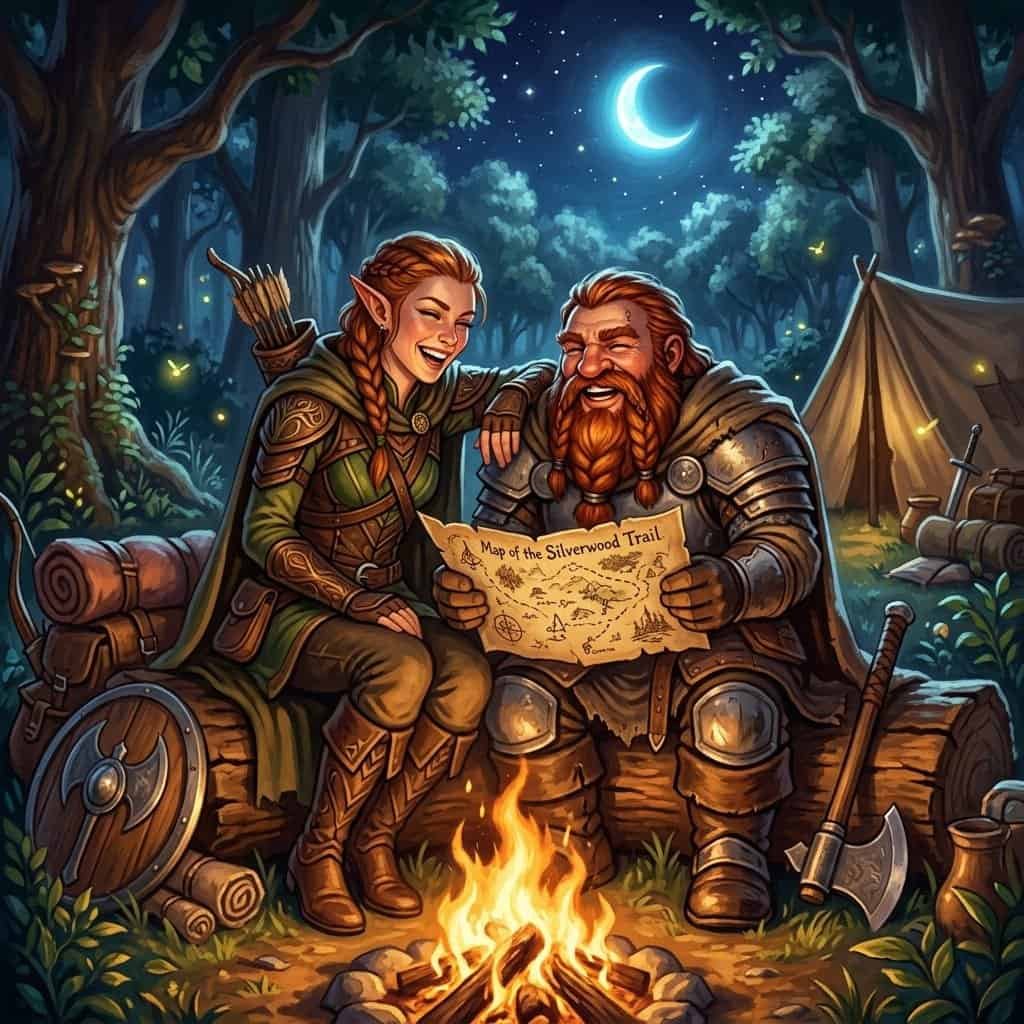

D&D for Couples: Playing Together Without Fighting
D&D for couples sounds simple: two people who love each other, a shared hobby, a story built for both of them. In practice, it requires a little more care than that — not because couples can’t play D&D together, but because the dynamics that make relationships strong (honesty, emotional investment, competitiveness) can collide in surprising ways at the table. This guide covers how to set D&D for couples up properly, which pitfalls to avoid, and how to find the adventures that make it genuinely fun for both of you.
Why D&D Works So Well for Couples
Shared hobbies build relationships. They create private vocabulary, shared memories, and recurring rituals that belong specifically to the two people involved. D&D for couples does all of that and adds something few hobbies offer: a space to experience things together that you can’t experience in ordinary life. Making a decision under pressure, navigating moral complexity, succeeding at something genuinely difficult — these are experiences that create emotional bonds when shared.
D&D also reveals character in ways that dinner conversation doesn’t. The choices a person makes at the table — whether to spare the villain, whether to take the shortcut that harms someone else, whether to sacrifice something important for the group — reflect genuine values and decision-making styles. Many couples who play together report that D&D showed them something real about their partner. That’s a feature, not a bug.
For a practical guide to the mechanics of two-player D&D, our complete guide to small group D&D covers encounter scaling, adventure selection, and session structure in detail. The tips below focus specifically on the relationship dynamics that make D&D for couples different from other small-group play.
The Role Question: Who DMs?
The most common tension point in D&D for couples is the DM question. Running D&D requires different skills than playing it — storytelling, improvisation, rules management, and the willingness to spend preparation time that the player never sees. Not every person enjoys that role, and in couples where only one partner has D&D experience, the assumption that the experienced person should DM can create resentment on both sides.
The cleanest solution is to choose adventures that minimise DM preparation burden. Zero-prep one-shots — adventures where all the story structure, encounter design, and NPC details are provided — let the DM focus entirely on delivery rather than construction. This dramatically lowers the barrier for reluctant DMs and prevents the preparation workload from becoming a source of imbalance in the relationship.
Rotating the DM role across different one-shots is another option that works well for couples where both partners want to experience both sides of the screen. Each person runs one adventure as DM, then plays the next as a player. Neither partner carries the full cognitive burden for the entire campaign, and both develop a fuller understanding of what the other’s role involves.
The Fighting Problem — and How to Prevent It
D&D for couples has one genuinely difficult edge case: when the game creates real conflict. It happens most often in two scenarios — when one partner feels the story isn’t going fairly, and when a moral disagreement at the table reflects a real value difference between the two people.
The first scenario is a design problem. If the player feels that the DM is rigging outcomes or playing favourites with NPCs, the game stops being a shared adventure and starts feeling like an argument with extra steps. DMs running D&D for couples should be especially transparent about die rolls — rolling in the open removes any perception of unfairness — and should resist the temptation to protect the player character from meaningful consequences. Meaningful failure is part of a good story. Arbitrary unfairness is not.
The second scenario — moral disagreement at the table — is usually a feature rather than a problem, as long as both people understand that character choices are not personal accusations. A player character who makes a ruthless choice is exploring a fictional moral position, not declaring their actual values. Establish this framing before play begins: the table is a space for exploring ideas, not a referendum on who you are as a person. Most couples find that disagreeing about what their characters should do is actually one of the most interesting parts of playing together.
Best Adventure Types for D&D Couples
The best adventures for D&D couples share a few qualities: emotional texture, moral complexity, and a runtime that fits into a real evening rather than requiring a five-hour endurance test.
Romantic one-shots are the obvious starting point. Love’s Labyrinth is designed specifically for this — a Valentine’s D&D one-shot that weaves adventure and emotional resonance in equal measure. It works any time of year and is the single strongest recommendation for couples who want to combine D&D with a date night context. For the full setup guide, our D&D date night guide covers ambiance, adventure selection, and session tips.
Mystery and investigation adventures work brilliantly for couples because problem-solving together is collaborative rather than competitive. Both players are working toward the same goal, the intellectual challenge gives both minds something to engage with, and the ‘aha’ moment when the mystery breaks is genuinely satisfying to share.
Dark fairy tale adventures provide the emotional weight that couples who want more than dungeon crawling tend to look for. The Twisted Tale Series — Pay the Piper, The Name of Rumpelstiltskin, The Twelve Dancing Princesses — delivers morally complex scenarios with sympathetic antagonists and choices that don’t resolve cleanly. For couples who enjoy stories that stay with them, these are the strongest options in the catalogue.
5 Ground Rules That Keep D&D for Couples Fun
1. Agree that the table is a no-judgment zone. Character choices, failed rolls, and creative decisions should never become material for later teasing or argument. What happens at the table stays at the table as fiction — this rule protects both the fun of the game and the health of the relationship.
2. Keep sessions short and satisfying. Two hours of focused, well-paced D&D is better than a five-hour marathon that ends in exhaustion. End on a strong narrative moment and leave both players wanting more. The next session becomes something to look forward to rather than a commitment to dread.
3. Use a simple safety tool. The X Card — a physical or verbal signal that skips past uncomfortable content immediately — keeps the game enjoyable without requiring lengthy content negotiation before every session. For couples where one partner is newer to dark or intense themes in fiction, having a clear opt-out signal prevents discomfort from silently building into resentment.
4. Celebrate the wins together. When the plan works, when the dice fall right at the perfect moment, when a roleplay scene genuinely moves both of you — mark it. Say out loud that it was good. These shared celebration moments are the memories that make the hobby stick.
5. Don’t force it. D&D for couples only works if both partners are genuinely interested. If one person is playing out of obligation rather than curiosity, it shows — and it creates exactly the dynamic you’re trying to avoid. Start with an accessible adventure, keep early sessions low-pressure, and let enthusiasm develop organically rather than pushing for it.
Frequently Asked Questions
What if my partner has never played D&D?
Start with an adventure that leads with genre rather than mechanics. A mystery adventure for someone who loves crime fiction, a fairy tale one-shot for someone who loves fantasy novels, a heist scenario for someone who watches Ocean’s Eleven on repeat. When the story is the entry point rather than the rulebook, new players engage immediately. The mechanics can be learned while playing — they don’t need to be mastered in advance.
Can D&D for couples work if one person is a very experienced player?
Yes, with one key adjustment: the experienced player should resist the urge to optimise or solve everything. The best D&D for couples creates a shared experience, not a performance. If the experienced player is solving every problem before the new player has a chance to engage, the new player isn’t playing — they’re watching. Match the pace and complexity to both players’ comfort level, not the experienced player’s preferred style.
Browse adventures for D&D couples at anvilnink.com/adventures — all titles built for two to three players, with zero prep required from the DM.
D&D for couples works best when both players forget they’re playing a game — because the story got interesting enough to matter.