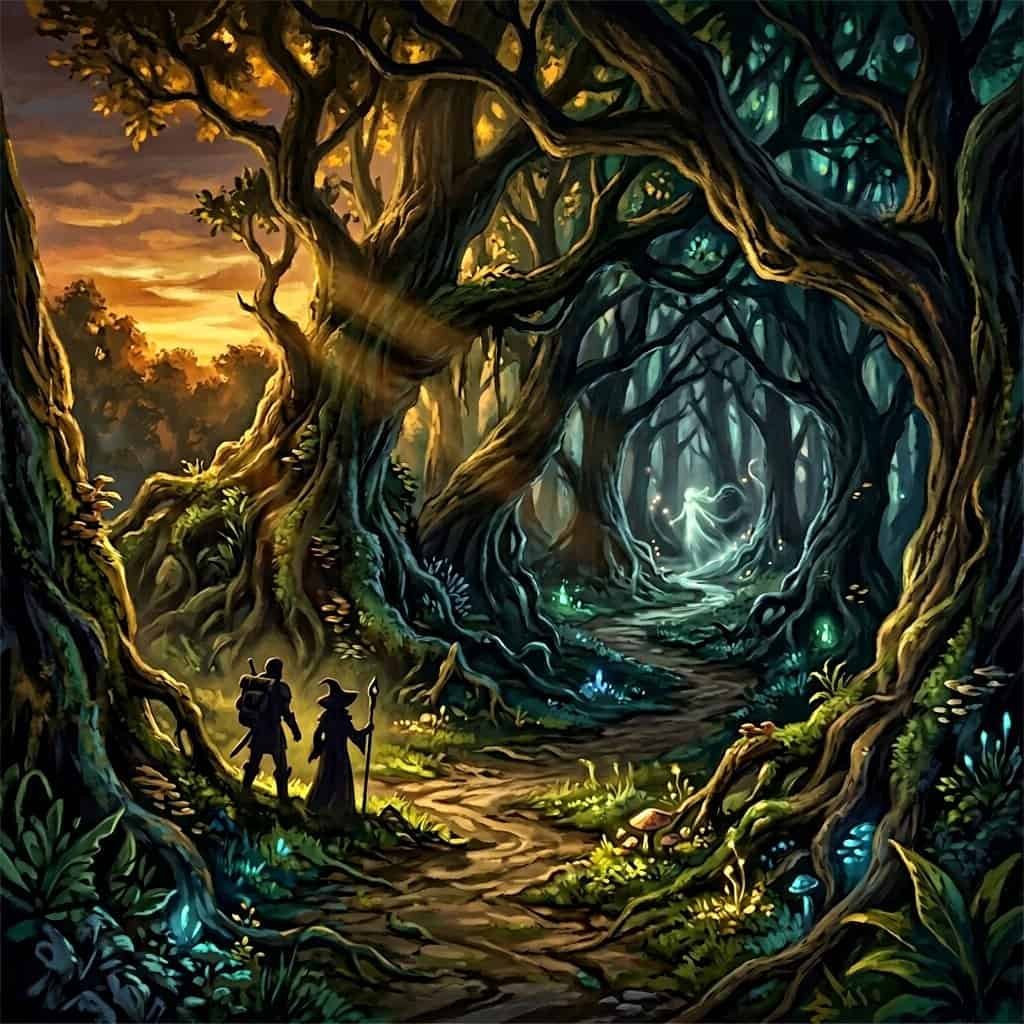

D&D Enchanted Forest Adventure: Running Fey and Fairy Tale Wilderness
A D&D enchanted forest adventure is one of the genre’s most evocative settings — and one of the most difficult to run well. The problem isn’t the monsters or the encounter tables. It’s atmosphere and internal logic. An enchanted forest that functions like a regular forest with more hitpoints is just woodland combat. A forest that operates on genuinely different rules — where directions shift, where time runs wrong, where the trees remember and the paths choose — creates the specific quality of fairy tale dread that makes players hesitant to step off the path even when nothing has explicitly threatened them for doing so. This guide covers how to build and run a D&D enchanted forest adventure that actually feels enchanted.
The Rules of the Enchanted Forest
Every D&D enchanted forest adventure needs a set of consistent internal rules that the players can discover and learn to navigate. These rules don’t have to be explained to the players in advance — in fact, they work better when they’re discovered through experience. But the DM needs to have decided them clearly before the session begins, because inconsistency breaks the spell faster than anything else.
Here are six rules that create the right register for a fairy tale forest. Use all of them, or choose two or three that fit your specific adventure:
Directions shift after dark. Navigation checks made in daylight work normally. After sunset, the Survival DC increases by 5, and a failed check doesn’t just mean getting lost — it means arriving somewhere specific that the forest chose. The players learn quickly that the forest has preferences.
Names have power. Speaking an entity’s true name within the forest gives the speaker advantage on all Charisma checks involving that entity for 24 hours. Entities within the forest will not volunteer their true names and will deflect direct questions. Players who do their investigative homework are rewarded.
Gifts must be reciprocated. Anything given freely within the forest creates an obligation. A berry eaten from a branch, a flower accepted from a fey creature, a story told by a stranger at a crossroads — all create a debt that must be repaid in kind. Players who accept things without thinking about the exchange are storing up obligations.
The old paths are safer. Trails that have been walked for generations are genuinely safer than cutting through undergrowth. On established paths, random encounter checks are made at disadvantage. Off the path, they’re made at advantage — and the forest notices when someone strays.
Time runs differently at the heart. For every hour spent within a mile of the forest’s centre, one additional hour passes outside. Players who camp at the heart and sleep a full night emerge to find that two nights have passed in the village. This rule creates urgency without requiring a countdown clock.
The forest takes what is owed. Any promise made within the forest is binding in the same way a supernatural contract is binding. Breaking a promise made under the trees results in the forest taking something — an item, a memory, a year of life — equal in value to what was promised. The DM adjudicates this quietly, without announcement, which is often more unsettling than a dramatic consequence.
Atmosphere: Making It Feel Enchanted
The sensory detail is what separates a D&D enchanted forest adventure that works from one that’s just a map grid with tree tokens. Establish the forest’s specific quality before the players enter it. Is it the kind of forest that’s beautiful and terrifying simultaneously — wide-canopied, golden-lit, with something moving just at the edge of sight? Is it the kind that’s close and dark, where even midday feels like dusk and the undergrowth presses in on both sides of the path? Is it old beyond reckoning, where the trees have grown together at impossible heights and the ground between them is bare of everything except old bones?
Pick one or two specific sensory details that you return to consistently throughout the session. The sound that stops when the players stop moving. The specific smell — wet leaves and something sweet that shouldn’t be there. The quality of light that’s slightly wrong in a way the players can’t immediately identify. Consistency in these details builds atmosphere more effectively than any amount of dramatic description, because the players begin to notice when something changes.
When something does change — when the birdsong stops, when the smell shifts, when the light quality is suddenly right rather than wrong — the players will feel it without being told. That wordless recognition is the atmospheric payoff of consistent sensory work.
Encounters That Fit the Enchanted Forest
Standard wilderness encounter tables generate bandits, wolves, and the occasional dire animal. A D&D enchanted forest adventure needs encounters that reflect the forest’s nature: entities with internal logic rather than combat roles, situations that require navigation of the forest’s rules rather than victory in combat.
The old woman at the crossroads who offers directions — but whose directions take you where she wants you to go, not where you asked. The deer that walks ahead of the party, always just out of reach, always toward something it seems to want them to find. The child sitting at the base of a tree who claims to have been lost there for three days but looks exactly as they did when they set out (and three days in the forest heart can mean weeks outside). The merchant who appears from a path that wasn’t there before, selling things that shouldn’t be available here, accepting only things the players didn’t expect to give up.
These encounters work because they require players to engage with the forest’s logic rather than its combat stats. Each one is a small puzzle: what does this entity want, what rules govern it, and what’s the right way to navigate this situation without incurring a debt you’ll regret? For more on designing encounters with this quality, our fairy tale monsters guide includes five re-skinned stat blocks built specifically for enchanted forest scenarios.
Ready-to-Run Fairy Tale Forest Adventures
Several Anvil N Ink adventures use enchanted forest settings or forest-adjacent fairy tale logic. Pay the Piper moves through a village on the edge of a forest where the Piper’s power is strongest — the forest functions as a pressure on the scenario rather than a location to explore. The Twelve Dancing Princesses involves descent into an underground world that operates on the same internal logic as an enchanted forest — different rules, consistent enforcement, beauty and danger in equal measure.
For DMs building their own D&D enchanted forest adventure from scratch, our D&D fairy tale campaign guide covers how to structure a full arc of adventures set in this kind of world, and our dark fairy tale D&D guide provides the foundational design philosophy.
Frequently Asked Questions
How is a D&D enchanted forest adventure different from a standard Feywild adventure?
The Feywild as published in D&D 5e is a specific cosmological location with established lore, factions, and mechanics. A D&D enchanted forest adventure can use Feywild elements but doesn’t need to — the fairy tale forest can exist in the material world, operating on old magic rather than planar physics. The key difference is internal consistency: a fairy tale forest follows its own rules absolutely, whether those rules are cosmologically Feywild or simply the ancient logic of a very old wood.
What level should characters be for an enchanted forest adventure?
Levels 2–4 work best. Low-level characters feel genuine vulnerability in a space that operates on rules they don’t fully understand, which creates the right quality of cautious engagement. Higher-level characters with powerful spells tend to solve forest puzzles through magical force rather than careful navigation, which flattens the experience. If you’re running higher-level characters, increase the complexity of the forest’s rules rather than its combat difficulty.
Browse the full fairy tale adventure catalogue at anvilnink.com/adventures — all titles built for two to three players, zero prep required.
A D&D enchanted forest adventure works when players stop treating the forest as terrain and start treating it as a presence — something that notices them, and has opinions about what they do next.