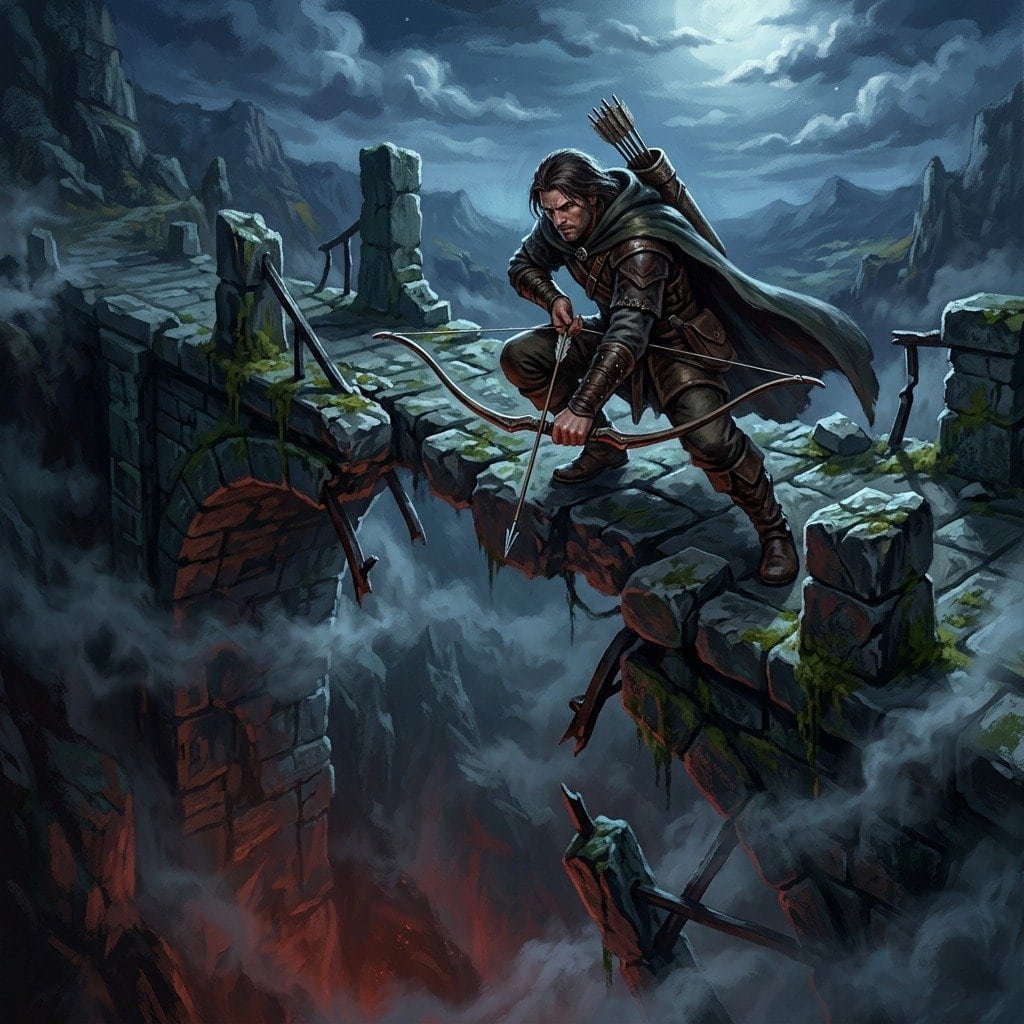

D&D Solo Adventure: Running a One-Player Campaign Without a DM
A D&D solo adventure is exactly what it sounds like: a full 5e experience with one player and no Dungeon Master. You control the character, roll the dice, and let structured tools generate the story around you. This guide is about the adventures themselves — how to choose one, set it up, and run it from first scene to last.
If you’re looking for the broader picture of playing 5e without a group, start with our solo D&D guide. If you want the tools that replace the DM specifically, see the D&D oracle and GM emulator guide. This page assumes you’ve decided to play and want an adventure to run.
Three Kinds of D&D Solo Adventure
Not all solo adventures work the same way. Pick the one that matches how much setup you’re willing to do.
1. The Ready-Made Solo Adventure
A book written from the ground up for one player. Encounters are already scaled, the structure already replaces the DM, and there is nothing to configure. You open it and play.
This is the lowest-friction option and the best place to start. It’s also the only one where the adventure has been designed as an adventure — with pacing, escalation, and an ending — rather than emerging from random tables.
2. The Published Adventure, Run Solo
Take an existing 5e one-shot and run it alone, using an oracle to make the DM’s calls. This works, with two caveats. First, published adventures assume a party of four to five — a lone character will be flattened unless you scale encounters down hard. Second, you’ll know the plot, because you have to read it to run it. Some of the surprise is gone before you start.
Best suited to shorter adventures with clear objectives, and worth pairing with a solo-scaling tool like Scarlet Heroes.
3. The Open-Ended Solo Campaign
No pre-written adventure at all. You create a character, write a one-sentence situation, and generate everything from there with an oracle. Maximum freedom, maximum improvisation, and the closest thing to genuine discovery — you truly don’t know what happens next, because nobody has decided yet.
It also asks the most of you. This is where a GM emulator like Mythic earns its keep.
Ready-Made Solo Adventures to Run Tonight
The Silent Cathedral — Free, and It Teaches You 5e
The Silent Cathedral is a complete solo one-shot that explains every mechanic the first time it appears — skill checks, saving throws, initiative, concentration, legendary actions — in plain language, right where you need it. By the end you will have run a full fifth edition session.
If you have never played 5e, or never played solo, this is the correct starting point. It’s free as a PDF.
Get The Silent Cathedral free →
Deep Delving — An Endlessly Replayable Solo Campaign
Deep Delving is a solo dwarf dungeon crawl built on full 5e rules. The dungeon generates itself as you descend, encounters are pre-balanced for a single character, and 8,000+ boss combinations mean it never repeats. Permadeath makes every choice about pushing deeper or retreating a real one.
Where a one-shot ends, Deep Delving keeps going — it’s the closest thing here to an ongoing solo campaign.
Mindscourge — A Solo Adventure With an Ending
Mindscourge is a complete solo adventure with a beginning, a descent, and a final confrontation. One player, one d20, no Game Master, no prep. Your warband is dead — the colony took their minds before it took their lives, and now they wait in the dark wearing their own faces. Four levels down, something is waking up.
If you want a solo adventure that concludes rather than loops, this is the one.
Half-Pint — A Solo Adventure in Your Browser
Half-Pint is a solo halfling burglar campaign that runs in a web browser. No book, no dice, no download. You have 75 nights to work the city’s merchant houses, noble estates, the Royal Treasury and the Wizard’s Tower before your notoriety catches up. Free to play.
Play Half-Pint free in your browser →
Setting Up Your Own Solo Adventure
If you’d rather build one from scratch, here’s the shortest path from nothing to playing.
Step 1: Create your character. Standard 5e character creation. Keep it simple for a first solo run — a Fighter or Ranger lets you focus on the story rather than tracking spell slots. Write down three personality traits and one personal goal. That goal is the engine of the whole adventure.
Step 2: Define the opening situation. Three sentences, no more. Where is your character? What do they want? What stands in the way? That is your entire setup. Everything else emerges in play.
Step 3: Get an oracle. You need something to answer questions you can’t answer yourself. The simplest version takes thirty seconds to build — our oracle and GM emulator guide has it, free, along with the bigger tools when you outgrow it.
Step 4: Start scene one. Don’t prepare beyond this. Put your character somewhere specific, describe it in a sentence, and ask: what happens first? Then roll.
Running Combat Solo
Combat runs exactly as written in the Player’s Handbook. You control your character, and you also control the enemies — resist the urge to have them fight stupidly to keep yourself alive. The tension only exists if the danger is real.
The one adjustment that matters: scale encounters down, hard. Standard 5e encounters assume four characters with complementary roles. A lone adventurer at that difficulty dies fast and often. Run encounters built for a full party at roughly a quarter strength — halve the enemy count, drop the challenge rating, or both.
Or skip the arithmetic. Deep Delving and Mindscourge are balanced for one character from the ground up, so the maths is already done.
Keeping a Solo Campaign Moving
Think in scenes, not sessions. Each scene has a goal, an obstacle, and an outcome. When it resolves, start the next. This keeps momentum even in a 30-minute sitting.
Always add something. A “Yes” from the oracle becomes “Yes, and I also notice…”. A “No” becomes “No, but…”. The addition is what keeps the story moving when things go against you.
Track threads, not plot. Don’t plan where the story goes. Keep a list of open questions instead — who was the hooded figure, what’s behind the vault door, where did the villain go. Unresolved threads are what pull you back to the table next time.
Stop while you still want more. Ending a session mid-thread makes the next one easy to start. Playing until you’re exhausted makes it easy to never start again.
Frequently Asked Questions
What is a D&D solo adventure?
A 5e adventure designed to be played by one person with no Dungeon Master. The DM’s job — generating the world, running NPCs, deciding outcomes — is handled either by the adventure’s own structure or by an oracle system you roll against.
Can one person play D&D alone without a DM?
Yes. Purpose-built solo adventures like Mindscourge and Deep Delving build the DM’s role into the book itself. Alternatively, an oracle lets you run standard 5e alone.
What is the easiest solo D&D adventure to start with?
The Silent Cathedral — it’s free, it’s built for one player, and it teaches every rule as it comes up. Half-Pint is even faster if you want to play in a browser with no book at all.
Is D&D 5e balanced for one player?
No. Standard 5e encounters assume a party of four. Solo play requires either manual scaling — roughly a quarter of full-party strength — or an adventure that was built for one character from the start.
How long is a solo D&D adventure session?
As long as you want. Most solo players settle around 45 to 90 minutes. There is no group to accommodate and no obligation to play longer than feels good.
Can I run a published D&D adventure solo?
Yes, with two caveats: you’ll need to scale encounters down significantly, and you’ll already know the plot from reading it. Shorter one-shots with clear objectives work best. A purpose-built solo adventure avoids both problems.