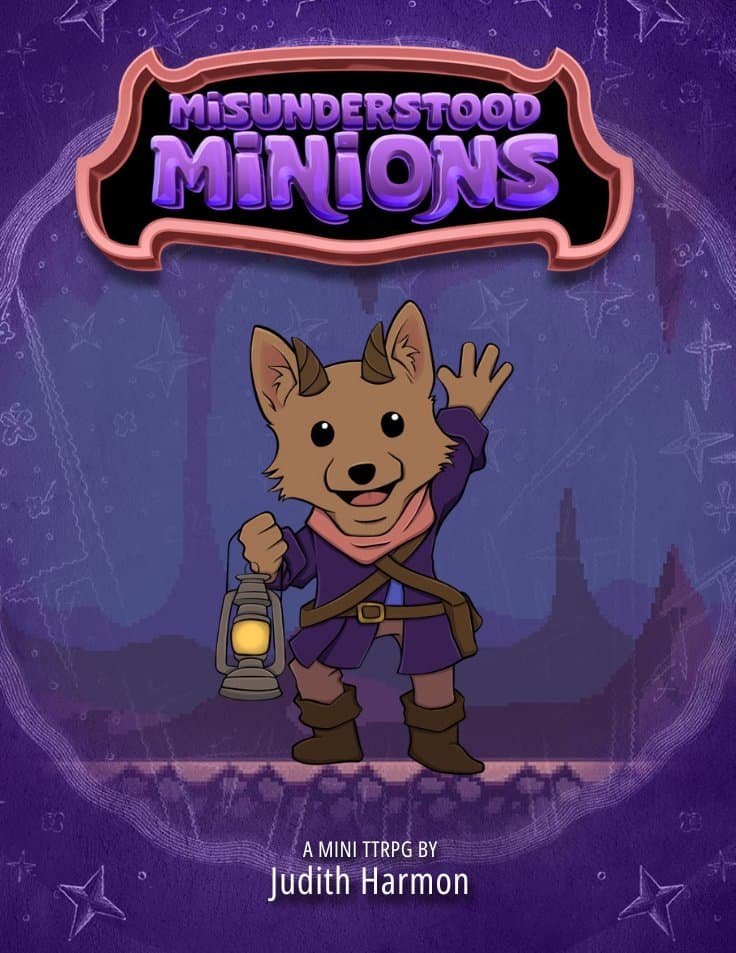

Misunderstood Minions TTRPG: Where You Play the Villain’s Crew
Most tabletop RPGs cast you as the hero. Misunderstood Minions TTRPG flips that entirely. In this fast, funny, and surprisingly thoughtful mini TTRPG from designer Judith Harmon, you and your fellow players are the bumbling workforce behind the villain — clocking in, following questionable orders, and trying not to get obliterated before the session ends. Built on a d12 system, designed for one-shots, and accessible enough for first-time players without losing anything for veterans, this is a game that asks one simple question: what are the bad guy’s henchmen actually thinking?
We recently had the chance to feature Judith’s work as part of our Creator Spotlight series, and the story behind Misunderstood Minions is as compelling as the game itself.
What Is Misunderstood Minions TTRPG?
Misunderstood Minions is a 36-page tabletop RPG in which a group of players take on the roles of minions serving a villain whose plans rarely go as intended. One player steps into the role of the Sinister Storyteller — the game’s take on a Game Master — while the rest build out unique minions complete with their own jobs, skills, backstories, and flaws. Sessions run a few hours, the system uses only a d12, and the book ships with four quickstart adventures so your Sinister Storyteller can run the first session straight out of the box.
The narrative-driven approach keeps the focus on character decisions and story momentum rather than rule lookups. Three to six players plus the Sinister Storyteller is the recommended count, making it well suited to both small gaming groups and larger gatherings. The core question driving every session is one of alignment: do you follow your villain’s orders to the letter, or bend the rules for your own gain? Either way, as the game puts it plainly — someone is getting the blame.
From Classroom to Game Table
Misunderstood Minions TTRPG did not start as a commercial product. It started as a lesson.
Judith Harmon was running an RPG club for her students when she noticed a pattern she could not ignore: even when her players were cast as the heroes, they kept gravitating toward morally grey choices. Rather than fight it, she decided to build something around it.
“I decided that I wanted to see what would happen when we changed perspective and tried to see things from the villain’s side, or more specifically, their minions,” she told us. “I noticed that my students kept choosing the route of villainy, even when they were the good guys, so I wanted to create a strong narrative game that actually let them let loose, but then also have a better idea of perspective.”
What followed was a game designed specifically for her classroom — flexible enough for students who had never touched a TTRPG, but layered enough to hold the interest of more experienced players. The goal was never to make something watered down. It was to make something that met players where they were and grew with them. That philosophy shapes everything from the character creation process to the mission structure, and it is ultimately what makes Misunderstood Minions work as well for a family game night as it does for a dedicated gaming group.
What Is in the Book
At 36 pages, Misunderstood Minions is deliberately compact. That is not a shortcoming — it is a design decision. The game knows exactly what it is, and delivers that without padding. The core book includes the full rules, a character creation system built around four intuitive categories (job, skills, history, and flaws), and four quickstart adventures written to get a group playing with minimal Sinister Storyteller preparation.
The game is available as a digital PDF for immediate play, a physical retail copy shipped from the creator, or a bundle that gets you both. Printable character sheets are available separately from the creator’s website, keeping table paperwork clean and easy to reproduce for groups who play regularly. Physical copies currently ship within the United States only.
Simple Rules, Real Depth
One of the strongest arguments for Misunderstood Minions is how little it asks from players upfront. The d12-based resolution system keeps things moving: roll, interpret the result, and deal with the fallout. There is no dense rulebook to front-load before the fun begins. Character creation gives even a first-time player something concrete to hold onto without a lengthy tutorial, and the Sinister Storyteller role is designed to be approachable for someone who has never run a game before.
But the game earns its replayability through the choices it puts in front of players, not the complexity of its mechanics. Every villain’s scheme is a new opportunity for chaos, misaligned priorities, and the kind of creative problem-solving that makes TTRPG sessions worth remembering. The tone is described as silly, lighthearted, and full of what-could-go-wrong moments — which is accurate — but there is a genuine moral framework underneath the comedy. The minion who follows orders and the minion who goes rogue are both telling a story about loyalty, self-interest, and accountability.
For veteran GMs, Harmon suggests a particularly creative use case: run Misunderstood Minions TTRPG as a side quest within an existing campaign. The minion characters work for the main campaign’s big bad, setting traps and executing schemes — and could even cross paths with the main party. It is a clever way to expand an ongoing story without heavy preparation on either side of the table, and it gives players a genuinely different perspective on the villain they have been fighting all campaign.
In Judith’s Own Words about Misunderstood Minions TTRPG
We asked Judith several questions about Misunderstood Minions, her creative process, and what she would pass on to other TTRPG designers. Her answers are worth reading in full.
Who is your ideal table for this game?
“Honestly, this game is great for all ages, and my hope is for it to be something to bring all experience levels and ages together for a fun game of mischief and fun. My personal favorite way for my game to be utilized by a GM is as a side quest from their main campaign. Your players have the potential to work for the big bad of your campaign, set up traps for their main campaign characters, and maybe even encounter their minion characters!”
What inspired the project?
“This game was written for my students. I was running an RPG club for my students, and was fascinated by their choices in game. I wanted to add mechanics to make things easier for players that were super new to the RPG world, but also wanted to add some mechanics to add some spice to the more seasoned players. So I went to work and wrote the game just for them!”
What did you learn making it — and what would you tell other creators?
“I learned so much about balancing my stats and everything while building this game. The biggest piece of advice I can give is to just try it and play, then be open to the fact that it is going to break. If you can be flexible with the advice, and get over the initial panic of writing something, you can make something truly wonderful!”
Who Should Play Misunderstood Minions TTRPG?
Misunderstood Minions TTRPG is built to work across a wider range of players than most TTRPGs aim for, and that ambition shows in the design.
RPG club leaders and educators will find this game purpose-built for their environment. It was written for a school club, and that context is visible in how accessible the rules are without ever feeling condescending to more experienced players.
New players and mixed-experience groups are the sweet spot. The rules are light, the sessions are short, and the tone is inviting rather than intimidating. Veterans get enough narrative freedom and mechanical texture to stay engaged without carrying the whole session on their shoulders.
DMs running longer campaigns have a ready-made side quest that drops into an existing story with minimal friction. The villain’s-perspective framing adds a storytelling dimension that traditional adventures rarely offer, and it gives players a reason to think differently about the antagonists they have been fighting.
Anyone who has ever rooted for the villain — or spent an entire session wondering what the henchmen were actually thinking — will find something genuinely satisfying here. The game takes that impulse seriously and builds a full experience around it.
You can also explore Judith’s full catalog of projects at gamesbyjudith.com.
Sometimes the most interesting story at the table is not the hero’s — it is the minion who almost got away with it.
Disclosure: This Creator Spotlight was commissioned as a paid feature through Anvil N Ink Publishing. The interview responses are reproduced from information provided directly by the creator. Anvil N Ink Publishing does not independently review or endorse the products featured in paid spotlights.