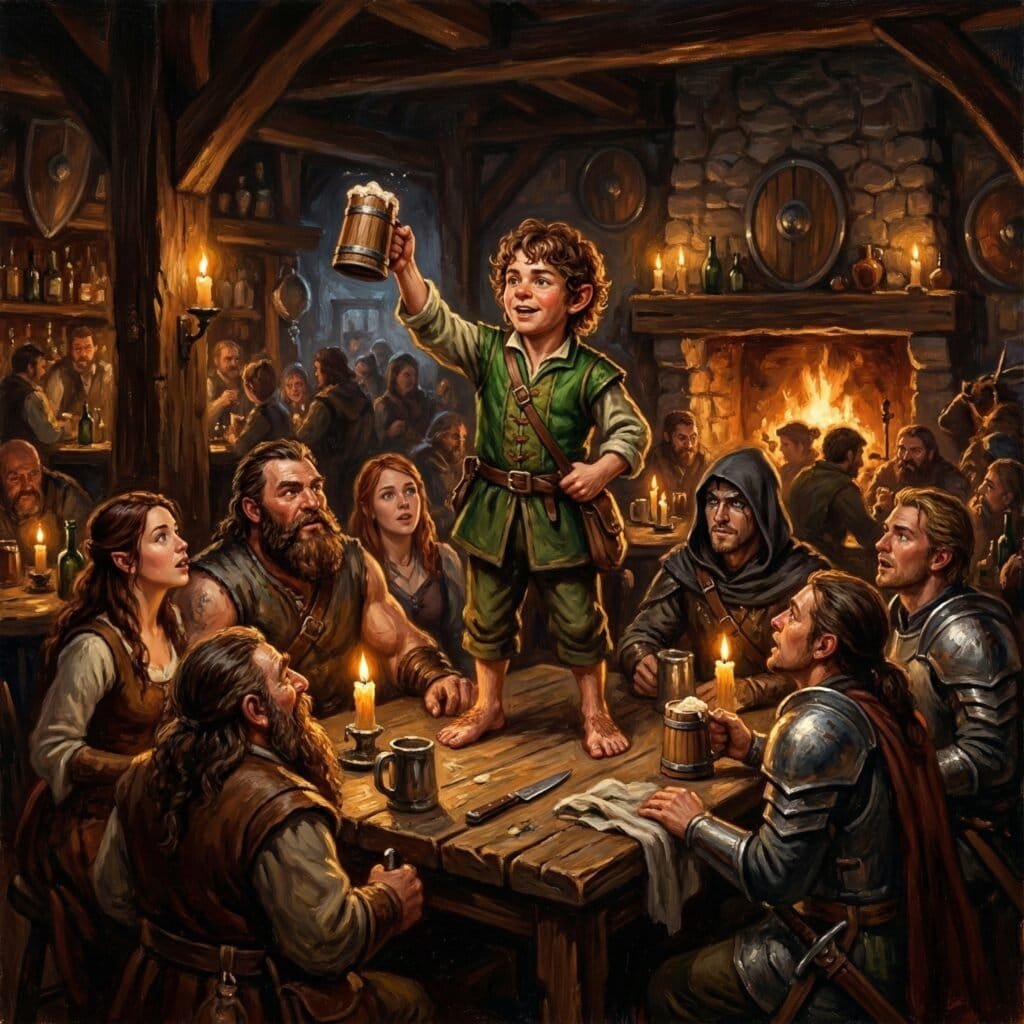

Knowing how to roleplay a halfling in D&D can be surprisingly difficult — not because halflings are mechanically complex, but because the cultural baggage is immense. The Shire. Bilbo. Samwise. Before you sit down with a halfling character sheet, you are already fighting against decades of cheerful, food-obsessed, mild-mannered imagery that the entire table will recognise instantly.
The result is predictable: most halflings at D&D tables end up as comic relief. The short one who says funny things, gets picked up by the big fighters, and provides levity while the serious characters do serious work. That is a perfectly valid character. It is also the only halfling archetype most players ever see.
This guide covers how to roleplay a halfling D&D players will actually take seriously — without abandoning what makes the race interesting in the first place.
The Real Problem With Halfling Roleplay
The halfling stereotype has two parts worth understanding before you decide how to engage with them.
Part one is the cheerful exterior. Halflings in fiction are warm, sociable, slightly hedonistic, and relentlessly good-natured. That is not a bad starting point for a character. The problem is that cheerful without depth reads as shallow, and shallow characters get sidelined.
Part two is the smallness. Halflings are the size of a child in a world scaled for humans. Every tavern stool is too tall. Every NPC looks down at them. Other party members joke about tucking them in a backpack. If the player accepts this as purely comic, the character becomes the table’s mascot rather than one of its heroes.
The way out of both traps is the same: give the halfling something to care about that is not cheerfulness, and give them a relationship with their size that is not self-deprecation.
How to Roleplay a Halfling D&D: 4 Archetypes Worth Playing
The Pragmatist
This halfling has been underestimated their entire life and has made it work for them. They are warm and sociable because that gets things done — people underestimate charming small folk right up until the moment they realise the charming small folk has already solved the problem. They are not cynical. They are efficient. They do not get angry about being overlooked. They use it.
The Survivor
Halflings have Brave as a racial trait — advantage on saving throws against being frightened. Most players treat this as a mechanical footnote. The Survivor treats it as a defining character trait. This halfling has been scared. Genuinely, seriously scared. And they kept going anyway. They are not fearless. They are the person who is afraid and does the thing regardless. That is a different kind of courage, and it earns respect at the table.
The Operator
Quiet, patient, and watching everything. This halfling has learned that information is the most valuable resource in any situation, and that being small and nonthreatening means people talk freely around them. They understand how power works and have figured out how to navigate it without the most obvious levers. Not necessarily a rogue — just someone who has done the math on their situation and played accordingly.
The Idealist
This halfling genuinely believes in something — community, fairness, protecting people who cannot protect themselves. The warmth is real, not a tactic. But beneath it is a serious moral core that does not bend. The cheerfulness is not naivety. It is a choice they make every day in a world that gives them plenty of reasons not to bother.
Speech Patterns for Halfling Characters
Accents are risky and exhausting to sustain. Speech patterns are better — they are consistent, low-effort once established, and signal character without requiring performance.
Halflings in D&D lore are sociable and observant. They notice people. They remember names. They pick up on details others miss. Those qualities suggest specific speech habits:
- They use names. Not constantly, but deliberately. “Right, Garrett — here is the problem with that plan.” It signals that they were paying attention, even when it looked like they were not.
- They redirect rather than refuse. Instead of “no,” a halfling says “sure, but what if we tried…” They have learned that direct pushback rarely works for someone their size, so they steer instead.
- They understate danger. “This is a bit of a situation” said while surrounded by enemies is both in-character and genuinely funny without trying to be.
- They ask practical questions. Not “are we sure about this?” but “who has rope?” The thing most people forget because they are busy being dramatic.
D6 Halfling Personality Trait Table
Roll or pick the trait that interests you most:
| d6 | Trait |
|---|---|
| 1 | You remember the name of every person you have ever met. You have never worked out if this is a gift or a curse. |
| 2 | You are constitutionally incapable of leaving a situation worse than you found it. This has gotten you into considerable trouble. |
| 3 | You do not get angry. You get even — thoughtfully, patiently, and completely. |
| 4 | You have strong opinions about food quality and zero patience for people who do not. Everyone eats. It should be good. |
| 5 | You have been underestimated by smarter people than whoever is currently underestimating you. You find this more funny than insulting. |
| 6 | You are the last person in any room to panic and the first to act. You have never fully understood why this surprises people. |
How to Roleplay the Halfling Lucky Mechanic
Halfling Lucky is one of the most powerful racial traits in D&D 5e: when you roll a 1 on an attack roll, ability check, or saving throw, you can reroll and must use the new result. Mechanically excellent. As a roleplay resource, most players ignore it completely.
The Lucky mechanic implies something about how your character moves through the world — not that they are lucky in a passive way, but that disaster does not stick to them. Something always turns at the last moment. How you interpret that moment matters:
- The shrug: Your halfling does not seem surprised. They were not worried. This reads as confidence or complete obliviousness — both are interesting.
- The wince: They saw how close that was, even if they say nothing.
- The story: “Third time this week.” This halfling keeps track. At some point they will have to reckon with what it means.
A single consistent reaction, repeated every time Lucky triggers, does more for your characterisation than any amount of in-session monologue.
Backstory Hooks That Show Up in Play
These starting points connect racial background to motivation that actually appears at the table, not just on the character sheet:
- You left the community that raised you. Whether you chose to leave or were pushed out says everything about who you are now.
- Someone in your family was famous — or infamous. You have been living in that story your whole life and are not sure whether you are honouring it or escaping it.
- You have a skill no one in your hometown understood or wanted. That is why you are here and they are there.
- You made a promise to someone who is gone now. You are still keeping it.
- You have seen enough of the world to know that cheerful is a choice. You make it anyway, most days.
Connecting Your Halfling to the Party
Halflings in lore are communal. They do not usually leave home alone. If your halfling is adventuring, they have a reason — and that reason probably has something to do with the people they left behind or the people they are travelling with now.
The halfling who has adopted the party as their new community is a different character from the halfling who is passing through. These connections are what make the character feel embedded in the adventure rather than along for the ride.
For the broader framework of bringing any D&D race to life at the table, the complete guide to roleplaying D&D races covers techniques that apply across every racial background. The guides on dwarf roleplay and elf roleplay are worth reading for the contrast — seeing how these techniques apply to very different racial profiles clarifies what makes each race distinct.
If you want to explore the solo halfling experience before building your character, Half-Pint puts you in the role of a halfling burglar on a heist — a good way to get a feel for the character type.
Frequently Asked Questions: How to Roleplay a Halfling D&D
How do I play a halfling without constantly referencing their height?
Stop bringing it up. The table knows. If you reference it every session it becomes the character’s defining trait by default. Let it come up when it matters — when a door handle is too high, when climbing through a window is actually useful. Otherwise play the character, not the measurement.
Can a halfling be a serious character?
Absolutely. The warmth and sociability in the racial profile do not preclude depth or gravity. A halfling who smiles because they have chosen to, despite everything they have seen, is one of the most compelling character types at the table. The key is giving that warmth a reason — something underneath it that earns the mood rather than assumes it.
How do I use Halfling Brave in roleplay?
Brave gives advantage on saving throws against being frightened. In roleplay terms, your character can be in genuinely terrifying situations and keep functioning. They are not fearless — they are functional. Play the fear, then play the choice to keep going anyway. That is more interesting than a character who never shows fear at all.
What class works best for a serious halfling character?
Start with the character, then pick the class that gives them what they need. Rogue fits the Operator and Pragmatist archetypes naturally. Ranger works well for the Survivor. Cleric or Paladin add weight to the Idealist. Fighter gives the Survivor or Pragmatist straightforward tools for proving themselves.
Is there a published halfling roleplay guide?
The Anvil N Ink Roleplay Guide Series includes a dedicated halfling guide with personality archetypes, cultural hooks, speech patterns, and ready-to-use tables. Available on Amazon and through Payhip. The Pink Plague Easter one-shot also features the Hareling — the Anvil N Ink rabbit-folk race — as a central element of the story.
Want to build a halfling with real depth? The Anvil N Ink Halfling Roleplay Guide covers everything in this article in more detail — personality matrices, cultural background tables, speech patterns, and backstory frameworks. Available on Amazon and directly through Payhip. Also try Half-Pint — the solo browser game where you play a halfling burglar on a job tonight.
Learning how to roleplay a halfling in D&D is learning how to make small feel capable — and capable, at any size, is the most interesting thing a character can be.