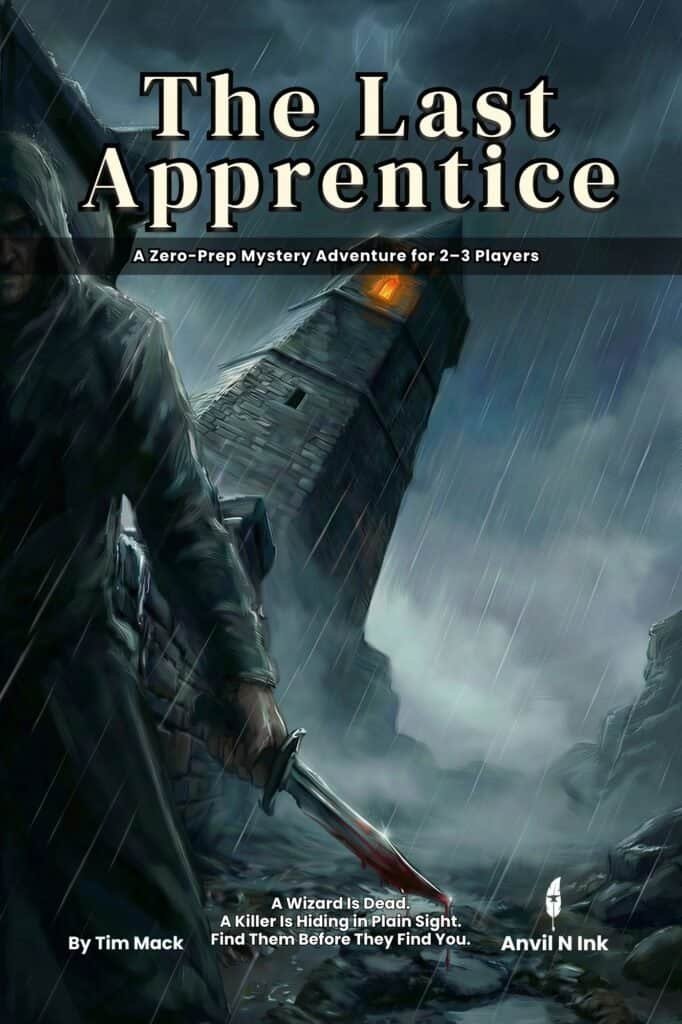

The Last Apprentice: A 5e Mystery One-Shot for Small Groups
Running a D&D 5e mystery one-shot that actually works at the table is harder than it sounds. Most investigation adventures fall apart before the final act — players skip past the clues, the solution is too obscure, or the DM ends up nudging everyone toward the answer anyway. The Last Apprentice is built differently. A powerful wizard is dead in his own study, and the killer is still in the tower. Everything the players need to solve the case is already in front of them. The adventure does the work so you don’t have to.
This is a complete, zero-prep mystery one-shot for D&D 5th Edition, designed for 2-3 players at character levels 2-3 and built to run in a single 2-3 hour session. No preparation required. Pick it up, read the two-page overview, and run it tonight.
A D&D Mystery One-Shot Built to Be Solved
The premise hooks immediately: Aldramis Vorne, a wizard of considerable power, has been found dead in his own study — stabbed with a knife in the room where his magic was strongest. His grieving brother can’t explain it. How does anyone get close enough to kill a wizard like that in his own sanctum? He hires the players to find out before the three apprentices still in the tower finish packing and leave.
What the players don’t know yet is that the wizard isn’t truly dead. Weeks before his murder, he developed a ritual to transfer his consciousness into a living host, tested it on his familiars, and then used it on his youngest apprentice — choosing the boy deliberately for his low magical resistance and his debt-bound family who wouldn’t come looking for some time. Then he killed his own original body and walked away wearing someone else’s life. The killer is still in the tower. He’s watching the investigation. And he is very good at pretending to be nineteen years old.
Three Suspects, Three Hidden Agendas
The three apprentices are the heart of the adventure. Each has a real grievance, each is using the investigation to redirect suspicion, and none of them is straightforwardly honest. Interrogating all three — with the question token system that structures Act 2 — produces a web of contradictions that points toward one person.
Renwick spent twenty years in the tower under an oath bond he signed at twenty-two without fully understanding it. He’s controlled and careful, the kind of man who has spent a long time managing a difficult situation, and he’s quietly building a case against Syla. Syla paid 100 gold pieces to study transmutation theory and spent eight months cleaning floors and fetching supplies. She’s furious, completely uninvolved in the murder, and absolutely certain Renwick did it. Then there’s Tobin — who defends the wizard as patient, generous, and kind, which directly contradicts every word the other two say about him. He hasn’t packed his room. He has no plans to go home. Something is wrong, and players who are paying attention will feel it long before they can name it.
A Three-Clue Chain That Holds Together
The adventure is built around three independent clue chains. Players need any two of them to reach the correct conclusion — the investigation is designed to be solvable, not fragile.
The first clue is planted in Act 1, in the wizard’s study: two familiars whose minds have been swapped. The cat sits at the ceiling and tracks movement overhead. The bird stalks the floor and ignores the open window entirely. Each one answers to the other’s name. No explanation is given. Players who understand what they’re seeing understand everything. Players who file it away as strange wizard behavior will have another chance.
The second emerges in Act 2 during interrogation. Renwick and Syla independently describe the wizard striking Tobin across the face on multiple occasions. Tobin, when asked, has no memory of any of it — because those memories belong to a person who no longer exists. Both other witnesses corroborate each other on this one specific point, despite framing different suspects for the murder. Tobin contradicts both of them at once.
The third lands in Act 3 when players search the tower. Tobin’s room isn’t packed. His boots carry dried grey clay from the construct he built and sealed in the study. His clothing is folded wrong — not in the precise method the wizard required of all his students, the method that Renwick and Syla follow automatically after years of conditioning. The wizard, re-inhabiting a younger body, folded the clothes the way that body’s muscle memory dictated, not the way he spent decades demanding of others.
How the Investigation Runs at the Table
The Question Token System
Act 2 uses a question token mechanic that gives the interrogation meaningful structure without a rigid script. Each player starts with three tokens. Spending a token means asking a direct question of a suspect. Players can push harder on any answer with a Charisma or Wisdom skill check — success gets more, failure closes that line of questioning for the conversation. Tokens are shared across all three suspects, so players must decide how to allocate their questions before they run out.
It creates real tension without a strict timer, and it makes every question feel like it costs something — because it does.
The Final Confrontation
Act 4 ends at the edge of a cliff in a driving storm. Players chase the fleeing wizard out of the tower’s front door and up a rocky mountain path through wind and rain. How well they do in the chase carries into what happens at the clifftop — succeed on three or more skill checks and they arrive with advantage on their first roll; fail three or more and the wizard opens combat with advantage on his first two attacks.
At the clifftop, players choose their approach before Tobin turns to face them. Hands up and words first opens the talk-down path — three skill checks against three defensive walls, representing the wizard’s logical defenses, his moral resistance, and his final decision about surrender. Arrive with solid evidence from the investigation and gain advantage on all three. Draw weapons and he fights back: a young body with one year of magical training carrying sixty years of knowledge, using Shield and Misty Step to create distance while Fire Bolt and Scorching Ray hold pursuers back.
At five hit points, the wizard staggers at the cliff edge and the fall trigger activates. Reduce him to zero in a single blow from above that threshold and he collapses on the clifftop instead. If he goes over, the body is never found — and whether a mind that old and that determined could survive that fall is a question the adventure leaves deliberately unanswered.
What’s Inside The Last Apprentice
This is a complete, ready-to-run package with everything the DM needs and nothing extraneous. Inside you’ll find a full four-act adventure with DM read-aloud text throughout, eight fully described battle maps covering all six tower floors, the site exterior, and the clifftop promontory. All NPCs and creatures have complete stat blocks, including the Mud Construct from Act 1 and Tobin as a combat-capable spellcaster for the Act 4 encounter. All three apprentices have stat blocks too — because players sometimes make unexpected decisions.
Four pre-generated investigator characters are included and ready to play — a rogue, fighter, bard, and divination wizard — each built specifically around the investigation’s demands. Six campaign opening hooks let DMs integrate the adventure into an existing story. Five closing hooks give them material to build from if the table wants more. Eight what-if scenarios in the appendix cover the most common edge cases so no player decision leaves the DM without a path forward. Scaling guidance for two, three, and four players runs throughout every act.
Perfect For Your Table
This mystery one-shot for D&D 5e works best for tables that want more from a session than a combat dungeon. Small groups of two or three players who enjoy investigation, roleplay, and moral complexity will find a lot to work with here. The mystery has no clean resolution — the wizard is sympathetic, the innocent suspects are not entirely honest, and both endings leave something unfinished. That’s by design.
Busy dungeon masters who need something they can run without any preparation time will find this genuinely zero-prep: the three-clue structure is redundant enough that players can miss things without the investigation collapsing. New DMs running their first mystery will appreciate the appendix, which walks through eight specific what-if scenarios for the moments when players go somewhere unexpected. And for groups who want a self-contained one-shot that can grow into something larger, the closing hooks provide immediate material to build from.
Part of the Ready Adventure Series
The Last Apprentice is part of the Ready Adventure Series from Anvil N Ink Publishing — zero-prep one-shots designed from the ground up for small groups and short sessions. Every adventure in the series is complete and self-contained, built for 2-3 players without scaling or modification. Each one is designed to run as written and leave something to think about after the dice are put away. The full catalogue is available at anvilnink.com.
Ready to Run a D&D Mystery One-Shot Tonight?
If your table is ready for a session that does more than move tokens across a grid, The Last Apprentice delivers. A clever premise, a three-clue investigation that holds together under player pressure, and a clifftop confrontation in a storm that players will still be arguing about long after the session ends. Three suspects. Three clue chains. One killer hiding in plain sight.
Pick it up. Read it on the drive over. Run it tonight.
The Last Apprentice is a D&D 5e mystery one-shot for 2-3 players built around an investigation that earns its ending — and a twist that makes the whole session click into place.
Get Your Copy
Choose your preferred format