
Chronicles of the Void:
An Original Dark Fantasy RPG Built for Theatre of the Mind
Chronicles of the Void started as something impossible: a 900-page design document for a computer game one person could not finish alone. What emerged from that realisation is a complete seven-book tabletop RPG system built entirely for theatre of the mind play — the style that predates maps, miniatures, and virtual tabletops. Chronicles of the Void is not a D&D supplement. It is an original dark fantasy system with its own world, its own mechanics, and an approach to character creation the tabletop space has not seen before.
We recently had the chance to feature this project as part of our Creator Spotlight series, and the ambition behind it is worth understanding before you decide whether to sign up to playtest.
What Is Chronicles of the Void?
Chronicles of the Void is set in Vael’Dross, a world three hundred years into a catastrophe known as the Third Sundering. The Void — entropy given consciousness — has been consuming the edges of the continent since the gods fell silent. Sixty thousand survivors live in the last remaining city. The protective Ring of Fire is dimming. Five Dark Spires anchor the Void’s advance, and closing them before the city falls is the central drive of the campaign.
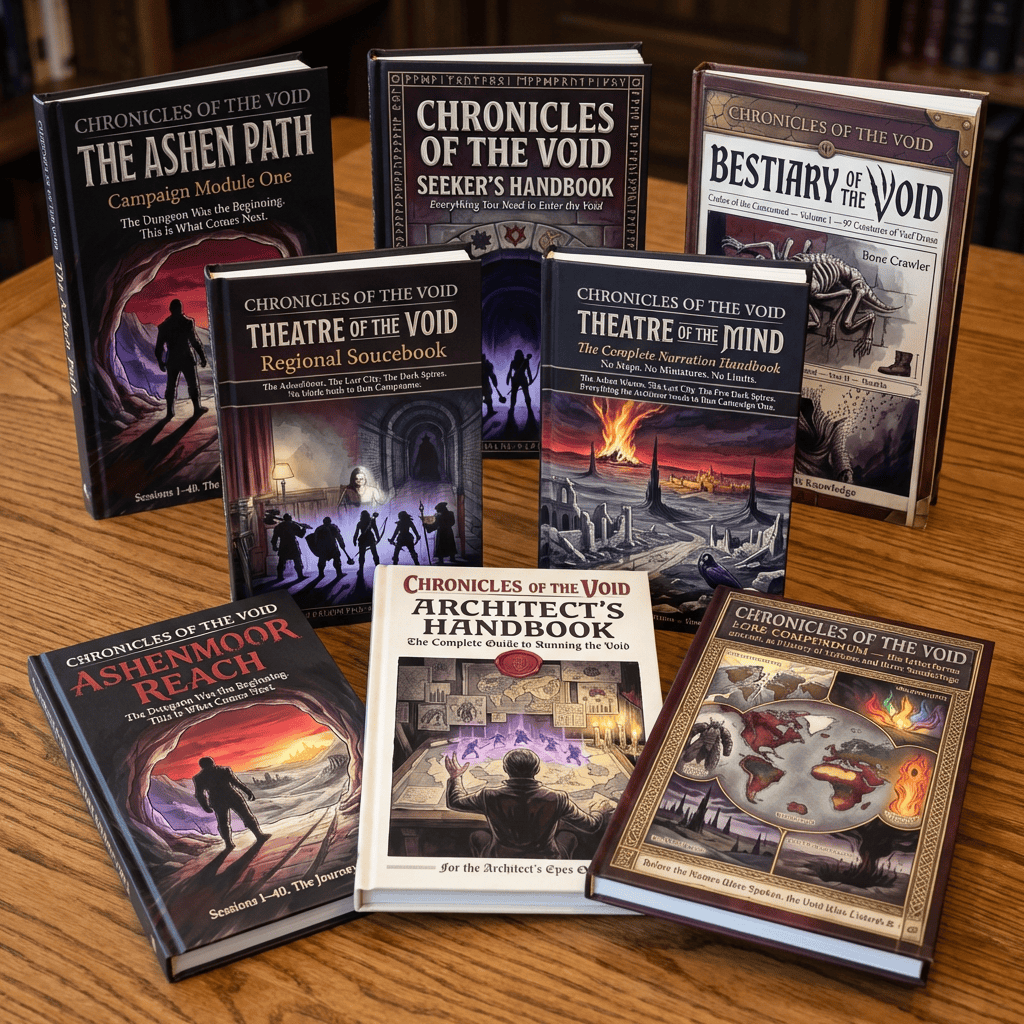
The system spans seven books: a Seeker’s Handbook for players, an Architect’s Handbook for the person running the game, a Lore Compendium, a Bestiary, a Theatre of the Mind craft guide, and two full campaign modules covering the first continent. The first campaign alone runs sixty-five sessions. A second campaign is already in development, with six total campaigns planned — each interlinking toward a final bonus endgame campaign that brings every storyline together.
Chronicles of the Void is not a commercial product with a price tag. The goal is a living community: Architects and Seekers playing through a complete world together, with a dedicated space for each group to discuss the game without spoiling the other’s experience.
From a 900-Page Design Document to the Tabletop
The origin of Chronicles of the Void matters, because it explains why the system feels the way it does.
Its creator spent two years writing a CRPG design document — nine hundred pages covering the history, mechanics, factions, and lore of a complete world. The plan was to build it in Unity or Godot. The scope made that impossible for a solo developer. Rather than abandon the work, he pivoted: everything already written became the foundation for a tabletop RPG campaign.
But not a modern one. The decision was made to strip it back entirely. No maps. No miniatures. No virtual tabletop. Theatre of the mind — the style of play that predates all of that, and the kind that made people fall in love with this hobby in the first place.
The inspiration came from two directions: classic CRPGs like Bard’s Tale and Might and Magic, where worlds existed almost entirely in text and imagination, and the YouTube channel Bardic Quest, where professional actors run full D&D sessions through pure narration. Watching that brought the creator back to his early days with D&D 3rd Edition — and made him notice how far modern tabletop has drifted from what made that era feel like something worth protecting. Chronicles of the Void is a deliberate answer to that drift.
What Makes Chronicles of the Void Different
Most modern RPGs are built around tactical combat: precise positioning, grid squares, attack of opportunity, digital maps. Chronicles of the Void is built around something else entirely — the conversation between a narrator and a group of players building a world together from words alone.
The six Principle Stats — Might, Agility, Fortitude, Insight, Presence, and Essence — reflect the world’s fundamental forces rather than borrowing an existing framework. The Corruption system tracks each character’s proximity to the Void across every session, creating stakes that compound over sixty-five sessions. The Void Ledger, drawn at every long rest, introduces genuine unpredictability that surprises everyone at the table — including the Architect.
The Architect — Chronicles of the Void’s title for the person running the game — holds more creative authority than a traditional Dungeon Master in most modern systems. That is structural, not accidental. The world is built around mystery and discovery, and mystery requires someone to hold the shape of things.
The Destiny Dungeon: Character Creation Unlike Anything Else
The mechanic at the heart of Chronicles of the Void is also the reason the Architect’s Handbook is kept entirely separate from the Seeker’s Handbook.
Every new table begins with the Destiny Dungeon: a self-contained opening session that runs in a single evening. Players arrive with no class, no ability scores, no backstory. They have a weapon, their instincts, and the sound of something moving in the dark ahead of them. What they do next — how they approach a creature, whether they investigate or retreat, what they say to a stranger in the corridor below — is being tracked. Not by the Architect making notes. By the system itself.
Players know the six Archetypes and the skills those Archetypes can develop. What they cannot know — what they must not know — is which specific behaviours and instincts determine which Archetype they will become. That information lives only in the Architect’s Handbook, and that separation is mechanical, not organisational.
The Destiny Dungeon observes how each player actually responds under pressure, not how they plan to respond. The Archetype that emerges is not assigned. It is discovered. Players do not choose their character class. They reveal it. That is the magic at the heart of Chronicles of the Void, and it only works because the Architect’s Handbook stays exactly where it belongs.
In the Creator’s Own Words
We asked the creator of Chronicles of the Void several questions about the project. His answers follow below.
What inspired this project?
“Two things, honestly. The first was my love of classic CRPG computer games — Bard’s Tale, Might and Magic — worlds that existed almost entirely in text and imagination, where your mind did most of the work and the game was richer for it. The second was the YouTube channel Bardic Quest, where professional actors play D&D through pure theatre of the mind. Watching that brought me back to my own early days with D&D 3rd Edition — the joy of discovering a game where the dungeon existed nowhere but in the words being spoken at the table. Chronicles of the Void is my attempt to give that experience a proper home.”
Who is your ideal table for this?
“Chronicles of the Void was built for two kinds of people. The first is the old-school GM — someone who played AD&D in the early eighties and remembers what it felt like when the game lived entirely in the narration. This system gives that experience a fully developed modern home. The second is anyone who wants to try something genuinely different. Players who have only ever played with maps and miniatures will find this a fundamentally different experience — more immersive in some ways, more demanding in others, and entirely dependent on the quality of the storytelling at the table.”
What would you tell other TTRPG creators?
“Build the world first, and trust the system to follow from it. I started with nine hundred pages of world history, factions, geography, and lore — the logic of how everything connected. When it came time to design the mechanics, most of the hard decisions had already been made. The Corruption system exists because the world needed a way to show what the Void does to people over time. I did not design a system and then write a world to fit it. I built a world and let the system emerge from what the world needed. That sequence made everything else possible.”
Who Should Try Chronicles of the Void?
Old-school GMs and experienced Architects will find a system that gives them genuine creative authority and a fully realised world to narrate through. If you remember what this hobby felt like before the digital tools arrived, Chronicles of the Void was designed with you in mind.
Players curious about narrative-first, immersive play who have only ever experienced map-based games will find this a genuinely different kind of session. The absence of a grid is not a limitation. It is the point.
DMs interested in playtesting an original system can run the Destiny Dungeon as a standalone session with any group. It is self-contained, runs in a single evening, and hands every player their character at the end — no prior knowledge of the system required.
Anyone thinking long-term is joining something at the beginning. Six interlinking campaigns are planned, a Skool community for Architects and Seekers is in development, and the eventual goal is a world that its players contribute to themselves.
Note: Chronicles of the Void is currently in active playtesting. The core books are complete and the system is being refined before a wider release. Signing up now means helping shape how it develops.
The dungeon does not ask who you want to be. It finds out who you are.
Disclosure: This Creator Spotlight was commissioned as a paid feature through Anvil N Ink Publishing. The interview responses are reproduced from information provided directly by the creator. Anvil N Ink Publishing does not independently review or endorse the projects featured in paid spotlights. Chronicles of the Void is currently in playtesting and is not yet available as a commercial release.