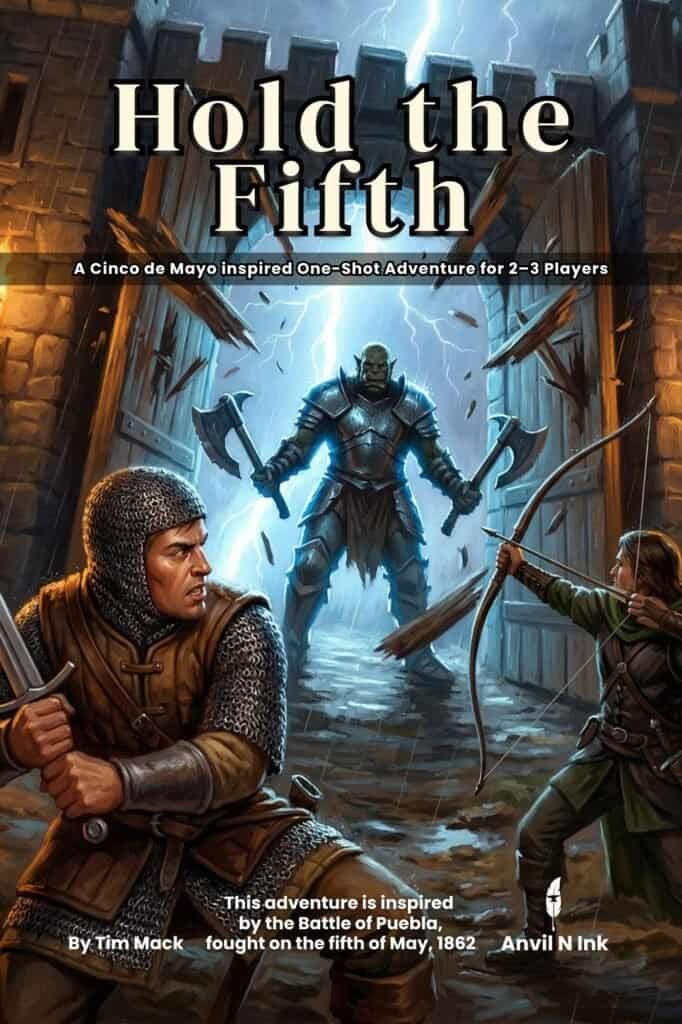

Hold the Fifth: A Cinco de Mayo D&D Adventure for 2-3 Players
Hold the Fifth is a Cinco de Mayo D&D adventure for 2-3 players that takes the underdog victory at the Battle of Puebla in 1862 and rebuilds it as a two-day siege one-shot with moral stakes that actually cost something. Players take the role of soldiers at Fort Guadalupe — outnumbered, under-supplied, and defending a hillside position against an orc horde on a schedule. The supply depot has been destroyed by a saboteur within their own ranks. Reinforcements are a day and a half out. Over four escalating waves of combat and an optional investigation that runs beneath the whole thing, the players decide how the fifth of May ends. This is zero-prep, level 2 (scalable to 3), and built specifically for small groups who want a siege scenario with teeth, a boss fight that turns on a single discovered moment, and a betrayal plot where doing the right thing is genuinely unclear.
A Four-Act Siege That Rewards Tactical Thinking
The structure of this Cinco de Mayo D&D adventure is deliberately mechanical in a way that most one-shots are not. The horde arrives in waves, and each wave is harder than the last — goblin skirmishers in the morning of day one, hobgoblin regulars by midday, orc berserkers at dawn on day two, and the warlord himself at dusk. Every act pushes the players toward a fixed point in time, and every act ends in a combat encounter they cannot avoid. This is not a dungeon crawl. There are no treasure chests and no side rooms to loot.
What makes the structure work is the preparation choice at each of the first three acts. When the players arrive at an outpost, they have roughly thirty minutes before the wave hits. They can either take a tactical action — collapsing a bridge, poisoning a water supply, setting a choke point — which weakens the incoming wave, or they can search the location for investigative clues. They cannot do both. A combat-focused party will take tactical actions and arrive at the final boss rested and prepared. An investigation-focused party will take punishing waves at full strength but walk into the boss fight with information the first party never sees. Most tables split their choices and discover halfway through that both tracks matter.
A Betrayal That Stands Beside You in Combat
The saboteur subplot is where this Cinco de Mayo adventure separates itself from the standard “find the traitor” plot. Someone destroyed the supply depot before the siege began. Five suspects exist. Four can be exonerated. One is guilty. The guilty party is Lieutenant Vasco, the calm and capable officer who hands the players their route maps each morning and means it when he tells them to come back alive.
Vasco is not a villain in the traditional sense. The horde holds someone he loves, and his betrayal is the price they have extracted from him for their safe return. He passes intelligence because he has to. He also genuinely wants the fort to hold, and he will fight beside the players at the final gate without hesitation. Both things are true at once, and neither one cancels the other out. Players who discover the truth have to decide what to do with it — and the adventure offers multiple endings depending on whether they find the cipher fragment at the Ruined Watchtower, whether they recover the matching document from the warlord’s body, and whether they accuse him before the fort disperses at dawn. There is no clean ending. There is a victory. What kind of victory is up to the players.
A Warlord Fight Built Around a Single Discovered Moment
The final act drops the players at the gates of Fort Guadalupe during a rainstorm, holding a courtyard choke point against Grakhul One-Tusk and two of his bodyguards while the rest of the horde assaults the walls around them. Grakhul is a three-phase boss — controlled and methodical at full health, aggressive and personal when bloodied, reckless and obsessed when desperate. His hit points are tuned specifically for 2-3 player groups arriving depleted from earlier fights.
The moment that makes the fight memorable is the tusk. General Zaragoza wears an orc tusk around his neck — taken from a warlord six years ago on a mountain pass three hundred miles north. He does not say the name that night. He does not need to. Before the final battle, he presses the tusk into the players’ hands and walks to the opposite wall. If a player brandishes the tusk during the fight — holds it up, throws it, taunts him with it — Grakhul fixates completely. One round of disadvantage on every attack not directed at that player, and then rage replaces fixation for the rest of the fight. The DM does not prompt it. Players have to discover it themselves. That kind of table-level surprise is genuinely rare in pre-written content.
Inspired by the Battle of Puebla, Built for Fantasy
The historical inspiration for this Cinco de Mayo D&D adventure is handled with more care than most seasonal one-shots manage. The real Battle of Puebla was a striking underdog victory in 1862 — a poorly supplied Mexican force under General Ignacio Zaragoza defeated a much larger and better-equipped French expeditionary army at the forts of Loreto and Guadalupe. The adventure keeps the fort, the hillside, the name of the general, and the spirit of the thing. It changes everything else. The French become an orc horde. The political complexity of the real conflict becomes something more immediately legible at the table: this land must not fall. The book is explicit that it is not trying to teach history — it is using the emotional core of a real event to make the stakes feel earned, and it encourages DMs who want to share the real story with their players to do so.
That framing matters. Cinco de Mayo in commercial contexts often gets reduced to marketing. This adventure takes the actual shape of the underdog victory and lets it carry the weight of the session.
What You Get in the Book
The book contains the full four-act structure with complete stat blocks and scaling tables for 2 players at level 2, 3 players at level 2, and scaled variants at level 3. Five fully-developed outpost locations — the Grain Mill, the Canyon Pass, the Ruined Watchtower, the Church on the Hill, and the Hamlet Center — each with their own terrain notes, tactical action option, and investigation clue. Five suspect profiles with alibis, demeanours, and what they reveal under pressure. A night-between-days interlude with Zaragoza’s backstory scene and a searchable depot ruin. The boss fight with three-phase behaviour tracking, the tusk mechanic, and a DM option for Zaragoza to intervene if the party is genuinely losing. Appendices include continuation hooks for running Hold the Fifth as the opening of a longer campaign, a DM tracker sheet, and five individual character hooks (the conscript, the volunteer, the professional, the survivor, the assigned) for building player buy-in at session zero.
Who This Adventure Is Built For
Small groups with 2-3 players who want siege-scale stakes scaled to their actual table size rather than a four-player adventure with hit points shaved off. DMs with zero prep time who need to run something on a Saturday with no time to build encounters or write NPCs. Tables that prefer moral complexity to clean good-versus-evil — the saboteur subplot is designed to make the right answer genuinely unclear. Players who enjoy optional investigation threads they can ignore or pursue without breaking the session. DMs looking for a seasonal one-shot for early May that treats its historical inspiration with respect rather than as a costume. Groups that want a memorable boss fight built around a mechanic the players have to discover on their own.
Part of the Ready Adventure Series
Hold the Fifth is part of Anvil N Ink Publishing’s Ready Adventure Series — zero-prep one-shots designed specifically for 2-3 player D&D 5e groups. Every adventure in the line runs in 2-3 hours at the table, requires no external supplements, and is built around meaningful player choice rather than railroaded outcomes. The series exists because small-group D&D is one of the most underserved niches in the hobby, and most commercially available content is designed for four to five players and then awkwardly scaled down at the DM’s kitchen table.
Running Hold the Fifth at Your Table
The paperback edition is the format most DMs end up preferring for at-the-table use — the book is built to run from, and a printed copy sitting open next to a battle map is faster than scrolling through a PDF mid-combat. The ebook edition is the better choice for DMs who read on a tablet or want searchable text for finding specific stat blocks quickly. The Payhip edition offers the same PDF at the same price as the Amazon ebook but returns more of each sale to the publisher directly, which matters if you want to support independent D&D content over the long run.
The fifth of May is three weeks from your next session. The fort has to hold. Grab the book.
Hold the Fifth is a Cinco de Mayo D&D adventure about a fort that should not have held — and the two or three players who made sure it did.
Get Your Copy
Choose your preferred format