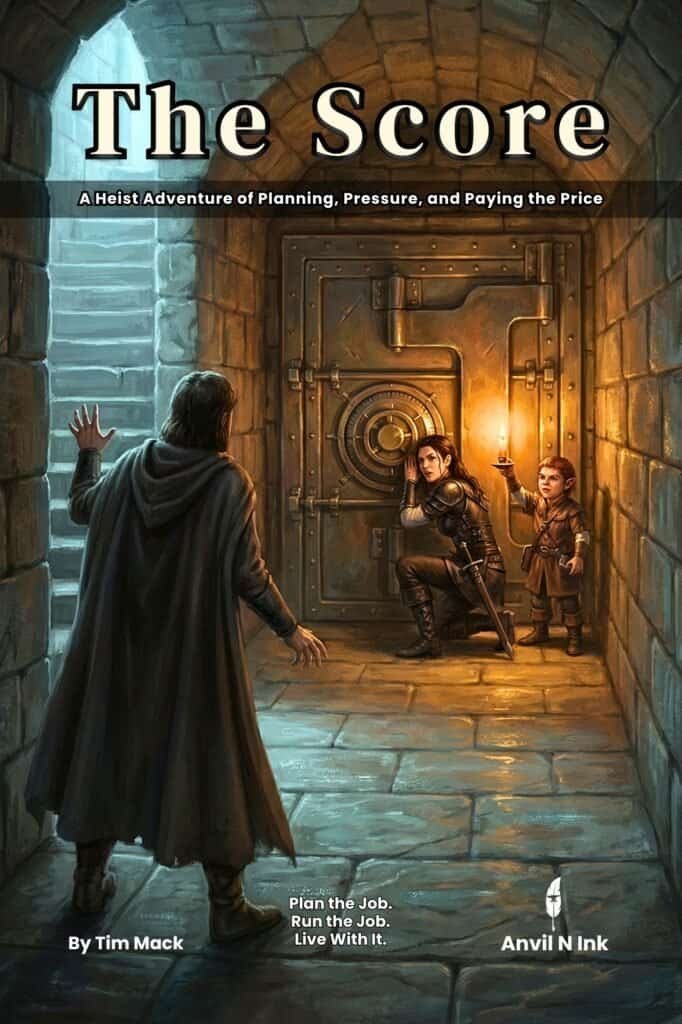

The Score is a D&D 5e heist one-shot that does something most tabletop adventures won’t — it makes the planning matter. Before a single die rolls, your players sit down, review their options, and lock in a plan. How do they get inside? How do they handle the night watchman? How do they crack the vault? How do they get out? Three choices at every decision point, presented openly with the skills each path demands. Once the plan is set, it doesn’t change. Then the session begins.
This is a complete, zero-prep one-shot for 2–3 players designed to run in 2–3 hours. It works as a standalone evening or as a drop-in session within an existing campaign. No backstory is assumed. No prep is required beyond reading the adventure once. Everything the Dungeon Master needs — stat blocks, battle maps, pre-generated characters, hooks, and a full What If? appendix — is inside the book.
A D&D 5e Heist One-Shot Built Around the Plan, Not Just the Action
Most adventures hand players a situation and let them improvise. The Score works differently. The planning phase is structured and deliberate: the DM walks the players through four decisions one at a time, explains what each option demands in plain terms, and waits for a choice before moving to the next. No dice yet. No rolls. Just a group of people around a table deciding what kind of thieves they want to be tonight.
The entry options cover three approaches to getting inside the Merchant’s Bank — the roof, the service alley, and the sewer. Each demands different skills from the party. A group with a strong rogues and a ranger will look at those options differently than a group built around social skills and deception. That choice is theirs to make, and it shapes the entire session.
The same logic applies to the night watchman, the vault, and the escape. Three options each, different skill profiles, all of them viable. There is no correct answer. There is only the plan they made and how well they can execute it when things start going sideways.
The Plan Locks — and That’s the Point
Once all four decisions are made, the DM writes them down and announces that the plan is now fixed. Players cannot switch approaches mid-heist. If they chose the sewer and the sewer goes badly, they deal with the consequences within that framework. They cannot suddenly decide to use the front door instead.
This constraint is intentional. The tension of a heist comes from committing to something and watching it bend under pressure. A plan that can be abandoned the moment it gets difficult isn’t a plan — it’s improvisation with extra steps. The Score locks the plan because that’s where the drama lives: in the gap between what the party expected and what actually happens when they try to execute it.
How the Complication Token System Works
Each of the four acts runs on the same structure: three skill checks, a threshold for failure, and a consequence if that threshold is crossed. Fail two of three checks in any act and the party earns a complication token. That token carries forward into every subsequent act, raising the DCs and scaling up the combat encounters the party faces.
A rough entry in Act One means the night watchman is harder to deal with in Act Two. A messy watchman encounter means more guards defending the vault in Act Three. By the time the party reaches the escape in Act Four, the accumulated weight of every prior failure is sitting on top of them. A clean run feels earned. A rough run feels like everything is tightening at once — because it is.
The system punishes accumulation, not individual failure. A single bad roll doesn’t end the heist. It makes the next act a little harder. That compounding pressure is what gives a two-hour session the feeling of a full night’s work.
The Body Count Changes How the Night Ends
Running parallel to the complication tokens is a quieter mechanic: the body count. Every guard killed or permanently subdued across all four acts gets added to a running tally. Both outcomes count equally — a man left unconscious in a basement and a man left dead in a corridor create the same kind of problem for the people who have to explain them.
At the end of the session, that number determines the epilogue. Zero to one body is a clean job: the crime lord is impressed, pays in full, adds a bonus, and the party’s names never appear in any watch report. Two to four bodies is a messy job: payment arrives, but so does scrutiny — the party are persons of interest now, the kind that start noticing more patrols in their neighbourhood. Five or more is a dirty job: minimum payment, a most wanted listing, and a crime lord who is very publicly certain he has never met them.
The body count epilogue isn’t a punishment for playing badly. It’s a consequence for the choices the players made about how they wanted to operate. The adventure never steers them toward leniency. That’s their call to make and live with.
What’s Inside The Score
The Score is a complete production — nothing is missing, nothing requires a trip to another sourcebook. Every creature and NPC that appears in the adventure has a full stat block in the appendix. Every battle map is described in full. Every planning option is written out for the DM with clear skill challenges, failure consequences, and combat scaling notes.
Inside the book you’ll find a four-act heist adventure with a pre-game planning phase and locked plan structure, six fully described battle maps covering the bank exterior, ground floor, basement vault, street escape, rooftop canal route, and sewer tunnel, and complete stat blocks for every creature and NPC: Calder the night watchman, Bank Guards, City Guards, the City Guard Captain, the Mastiff, and Veck the crime lord. Four ready-made characters at Level 2 are included — a Human Rogue, a Half-Elf Bard, a Human Ranger, and a Halfling Fighter — with skill coverage designed to give viable options across every planning path. A DM quick reference tracker handles the four planning choices, complication token count, and running body count in one place.
The appendices include six opening hooks, four campaign hooks with threads that extend naturally into a larger campaign, a full What If? section covering nine likely player departures from expected structure, and a closing page with series information and campaign seeds. The adventure scales cleanly for two, three, or four players with adjustment notes throughout.
Who Is The Score Perfect For?
Busy Dungeon Masters who want zero prep. Read the adventure once, set up the planning phase, and run the session. Everything needed is inside the book, including stat blocks that don’t require the Monster Manual.
Small groups of two or three players. The Score was designed natively for 2–3 players — not scaled down from a larger adventure. Every encounter, every skill challenge, and every planning option assumes a small, capable crew. This is what the adventure was built for.
Tables who want moral weight without a long campaign. The body count epilogue lands differently depending on how the party chose to operate. That kind of consequence doesn’t require a ten-session arc — it arrives at the end of a single evening and makes the choices feel real.
Players who have always wanted to run a heist. The planning phase gives heist fans what most tabletop systems don’t: a structured moment where the plan actually matters before the job begins. Characters who commit to a plan and execute it well feel like professionals. That’s the experience The Score is built around. For more capers built the same way, see our roundup of the best D&D heist one-shots.
Part of the Ready Adventure Series
The Score is part of the Ready Adventure Series from Anvil N Ink Publishing — complete, zero-prep one-shots designed specifically for small groups. Every title in the series is built for 2–3 players from the ground up, runs in 2–3 hours, and includes everything the DM needs to run a polished session without preparation.
Other titles in the series cover gothic horror, shipwreck survival, prison breaks, and siege defense. Anvil N Ink also publishes the Twisted Tale Series of dark fairy tale adventures, the Roleplay Guide Series for character depth, and the Adventure Toolkit Series for DM tools and supplements. The complete catalog is available at anvilnink.com.
Get Your Copy of This D&D 5e Heist One-Shot Tonight
The Score is available as a paperback and as a digital PDF. The paperback is a clean 6×9 trade format, ready for the table. The PDF is available through Amazon and directly through Payhip — the Payhip version delivers the highest margin to the publisher if you want to support independent D&D content directly.
If your group has been looking for a session that feels different — one where the decisions before the first roll actually shape everything that follows — this is that adventure. The plan is yours to make. What it costs depends on how you run it.
The Score is a D&D 5e heist one-shot where every decision your players make before the session begins determines how the night ends — plan the job, run the job, live with it.
Get Your Copy
Choose your preferred format