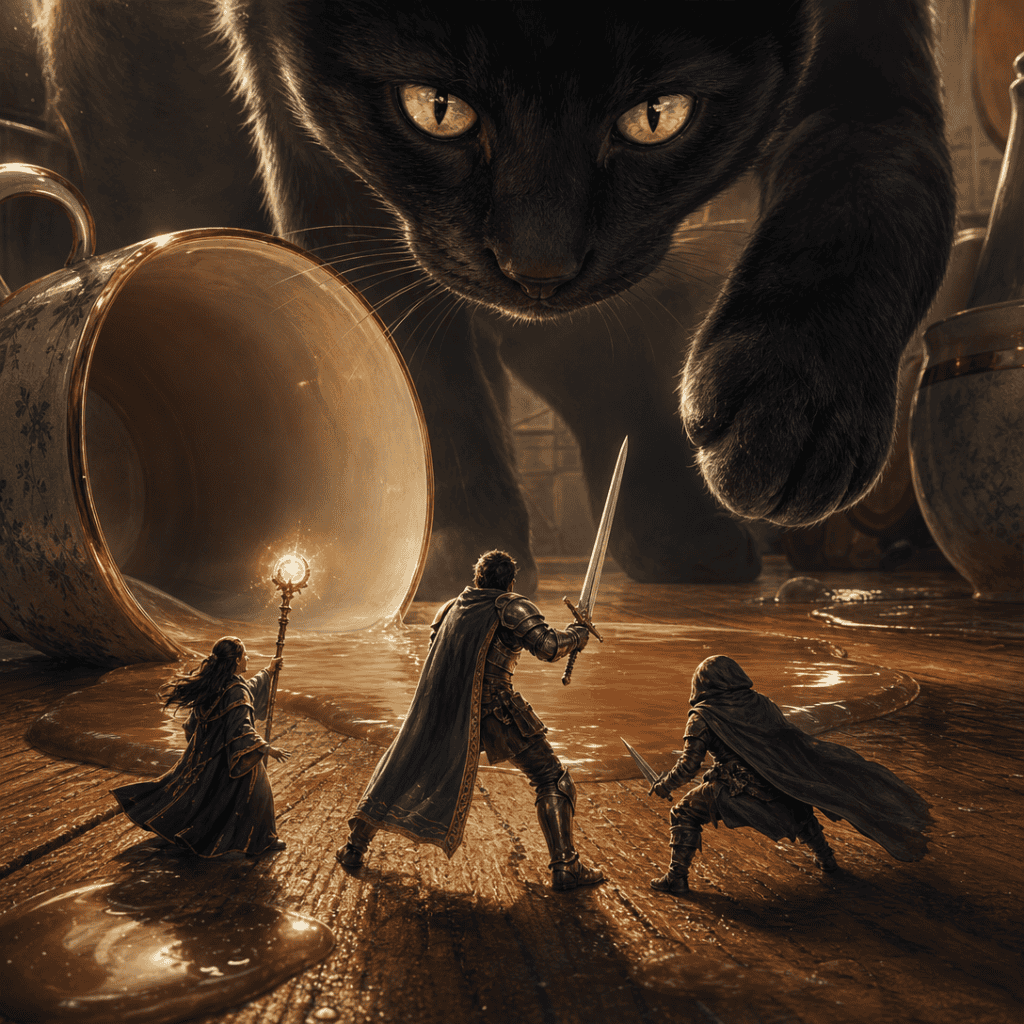

“Tiny heroes” D&D is a niche but evergreen subgenre — adventures where the player characters get shrunk down to miniature scale and have to navigate a world that suddenly feels enormous. The reference is obvious (Honey, I Shrunk the Kids), but the gameplay implications are what make it worth running. This guide covers when shrunk-down adventures work, five hooks for 2-3 players, the rules considerations for miniature-scale combat, and the published one-shots that already use this mechanic.
Why Shrunk-Down Adventures Work for Small Groups
A 2-3 player table is the right size for a tiny-hero adventure. Here’s why: shrunk-down sessions live or die on environmental specificity. Every set piece is a familiar object reframed at a terrifying scale. A teacup becomes a cliff. A house cat becomes a kaiju. A garden becomes a jungle. The DM has to describe each location in vivid sensory detail, and the players have to interact with it carefully — which means the table moves slowly. Six players moving slowly is a slog. Three players moving slowly is a deliberate, almost cinematic experience.
Tiny-hero adventures also eliminate one of the trickiest challenges of one-shot design: scope. The whole adventure can take place in a single room. A kitchen. A garden. The interior of a chest. You don’t need a continent. You don’t need a world. You need a coffee table and twenty fascinating things on it.
5 Tiny Hero Adventure Hooks
Each hook below is built for 2-3 players, levels 2-3, and a two-hour session. All assume the shrinking has already happened — don’t waste session time on the inciting incident.
1. Trapped in the Witch’s Garden
The party drank from the wrong well, ate the wrong mushroom, or accepted the wrong bargain. Now they’re four inches tall, deep in an enchanted garden, and the only person who can restore them is a witch the town hates. They have to cross the garden — past insects, a familiar, and the witch’s wards — to find her, convince her to help, and get back before sunrise when the dew dries and they die of dehydration.
2. The Inside Job
A wizard hired the party to recover something stolen from his sanctum. The catch: the only entrance is through a magical lockbox that only opens for objects smaller than a thimble. The party gets shrunk, climbs inside, and discovers the entire interior is a labyrinth of knife-edge bookshelves, sword-sized writing quills, and a parliament of mice that have built a kingdom in there.
3. Tea Party in the Hollow
A pixie’s tea party lasts seven days for the guests, seven minutes for the world outside. The party was invited. The party drank the tea. Now they’re guests of honor at a table where the host is a hag in disguise, the cake is alive, and one of the other guests is going to be served as the next course unless the party figures out who’s actually in charge of the gathering.
4. The Cat, the Witch, and the Auction
A black cat shrinks the party and carries them through a fae-corrupted garden to rescue a kidnapped witch from a faerie auction. This is the published version of the trope — see the full review of The Cat, the Witch, and the Auction — and runs in two hours with branching paths and a climactic auction-floor showdown.
5. Inside the Sleeping Giant
A storm giant is dying. The party is shrunk and sent inside the giant’s body — cardiovascular cliffs, lungs the size of ballrooms, a parasitic creature lurking in the spine — to find and remove what’s killing him. Body horror disguised as a tiny-hero adventure. Pairs well with parties who like their fairy tales darker.
Running Combat at Miniature Scale
The 5e rules don’t really cover what happens when you’re four inches tall fighting a regular-sized house cat. A few quick rulings make tiny-hero combat run smoothly:
Treat normal-sized creatures as Huge. A house cat at the players’ new scale has the threat profile of a Huge creature. Multiattack (claw, claw, bite). Reach 10 feet. Long jump 30 feet. Don’t actually use the cat’s stat block — use the lion’s, scaled down for hit points.
Ranged weapons get worse, not better. Counterintuitive, but: at miniature scale, a sewing needle is a dagger, but the players’ arrows are toothpicks. A bow at this scale has a 30-foot range, not 150. Adjust accordingly.
Falling damage halves, then halves again. Tiny creatures fall slowly relative to their mass. A four-foot fall deals 1 hp. A forty-foot fall deals 1d6. The danger isn’t falling — it’s what’s at the bottom.
Spells that produce volume scale with the caster. A 4-inch wizard’s fireball isn’t 20 feet across. It’s two. Roll damage normally — the energy is still there — but the area scales down. Same with web, fog cloud, cloudkill. A tiny fireball is still terrifying when the goblin you’re fighting is also tiny.
Common Pitfalls in Tiny Hero Adventures
Shrunk-down sessions fail in three predictable ways:
The novelty wears off in 20 minutes. Players love the premise for the first scene. By the third scene, “everything is big” stops being a joke and becomes a slog. Counter this by giving each scene a different sensory texture — the kitchen, the garden, the workshop — so the scale stays surprising.
The DM forgets that small things are now big. A breadcrumb is a meal. A drop of water is a flask. A button is a treasure. Make the small things matter. If the players can’t loot a button as a magic item, why bother shrinking them?
The session can’t end with the players still tiny. Either the climax restores them, or it provides a clear path home. Don’t leave the players un-shrunk after the session. If they came as full-sized characters, they leave as full-sized characters. Otherwise the gimmick eats the campaign.
Published Tiny Hero Adventures Worth Running
The Cat, the Witch, and the Auction is Anvil N Ink’s tiny-hero one-shot. The party drinks a faerie tea, gets shrunk by a black cat named Soot, and is carried through a corrupted garden to a faerie auction where the witch Marigold Brackenwise is the next item up for bid. Two hours, 2-3 players, levels 2-3, branching paths, and a climactic auction-floor showdown. Pairs well with the rest of the dark fairy tale series for groups who want to stack tone-matched sessions.
For groups that want to lean into the fae-magic side of shrinking, Pay the Piper and The Twelve Dancing Princesses use scale and otherworldly geography in similar ways without the literal shrinking mechanic.
Frequently Asked Questions
What level should a tiny hero D&D adventure be?
Levels 2-3 work best. Low enough that combat with a normal-sized house cat is genuinely dangerous, high enough that the party has spell options for solving environmental puzzles. Higher-level parties trivialize most shrunk-down threats.
How long should the shrinking effect last?
However long the session is. Tiny-hero adventures should resolve the shrinking within the session — either restore the party at the climax, or end with the path home clearly established. Open-ended shrinkings derail the next session.
Can you run a shrunk-down adventure with 2 players?
Yes — and 2 players is arguably better than 4. Smaller parties move faster through the dense environmental detail tiny-hero adventures depend on. Combat is simpler with fewer players, and the slow exploration pace doesn’t drag.
What spells should DMs watch for in tiny hero adventures?
Anything that changes scale or movement: misty step, fly, spider climb, levitate, jump. These spells become extremely powerful when the world is suddenly massive. Don’t disallow them — but design the session knowing players will use them.
Where can I find a published tiny hero one-shot?
The Cat, the Witch, and the Auction is a published tiny-hero D&D one-shot for 2-3 players. Two hours, levels 2-3, with branching paths and zero prep required.
Run a Tiny Hero Adventure This Month
Shrunk-down adventures are one of the most replayable subgenres in D&D one-shot design. The mechanic is simple, the environments are infinite, and the tone shifts naturally between whimsy and horror depending on what you put on the kitchen table.
Read the full review of The Cat, the Witch, and the Auction — Anvil N Ink’s published tiny-hero D&D one-shot for 2-3 players. Two hours, levels 2-3, zero prep.
For broader fairy tale adventure design, see the Dark Fairy Tale D&D pillar.
The world doesn’t have to be enormous to be dangerous. Sometimes the cat is enough.