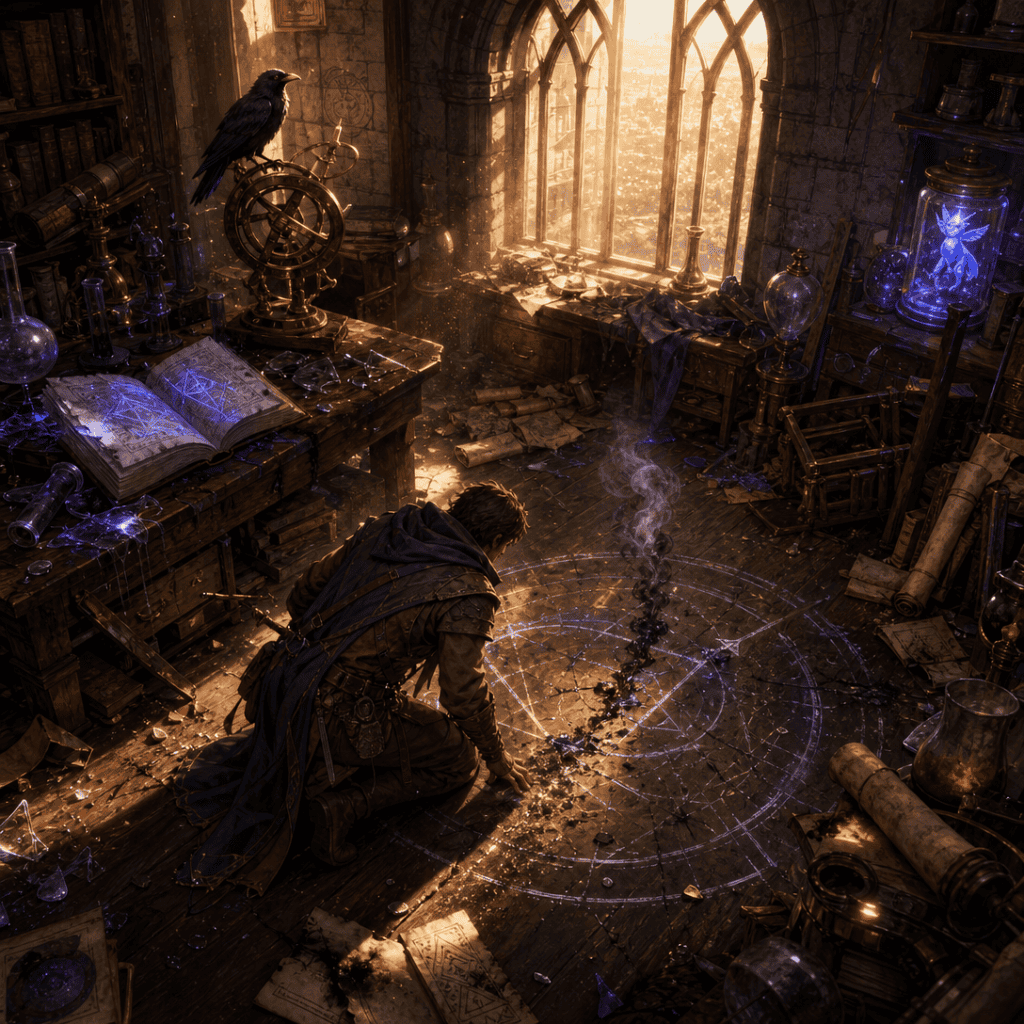

A D&D wizard tower mystery is the investigation one-shot where the crime scene is also the most magical building in the city. The wizard is dead, missing, or fundamentally changed — and the tower itself is full of witnesses: familiars who remember things, animated objects that saw what happened, magical traps that recorded the intruder. This guide covers how to run an investigation in a magical space, why the vertical dungeon structure suits the format, and the published one-shot built around the wizard-tower-as-crime-scene premise.
Why the Wizard Tower as Crime Scene Works
Most D&D mystery adventures use one of two settings: the village (cozy, small-stakes, social) or the noble’s manor (political, layered, archival). The wizard tower is a third option that combines features of both with one big advantage — the building itself is full of clues. Magical residue. Sentient familiars. Spells that recorded what happened. Animated objects with opinions. The investigation isn’t just about questioning NPCs and finding documents; it’s about reading magic.
This works for one-shots because the tower is self-contained. The party arrives, investigates, and leaves with the case solved (or not). No travel, no side quests, no need to design a region. Just one tall building with eight to ten floors, each one a different kind of clue.
For 2-3 player tables, the format is forgiving. Investigation rewards careful play, which 2-3 players excel at. Smaller parties don’t split up. They linger in rooms. They ask questions the larger party would have rushed past.
The Vertical Dungeon: Floor-by-Floor Design
A wizard tower is naturally a vertical dungeon. Each floor is a discrete location with its own character. A typical layout for a one-shot:
Ground floor — The reception. The first scene. The party enters, sees the public face of the tower, meets the apprentice (or the body, or the absence). Establishes the inciting incident.
Floor 2 — The library. Research. Magical theory. Records of the wizard’s recent work. The party finds the project the wizard was working on when things went wrong.
Floor 3 — The laboratory. Where the work happened. Glassware shattered. Magical residue still settling. Possibly the actual crime scene.
Floor 4 — The familiar’s roost. The wizard’s animal companion. Speaks Common (with the right magic) and remembers what happened, but doesn’t always tell the truth.
Floor 5 — The visitors’ chambers. Where the wizard hosted guests. Recent visitors have left traces — clothing, books, scents the familiar can identify.
Floor 6 — The wizard’s private quarters. Personal effects. Letters. The version of the wizard the public didn’t see.
Floor 7 — The summoning chamber. Where the wizard kept dangerous things. Possibly the source of whatever went wrong.
Floor 8 — The roof or observatory. The climax. The reveal happens here, with the city spread out below and the tower’s secrets finally laid bare.
Eight floors is more than the party needs to investigate. Some floors should be skippable. The party chooses where to focus based on what they find.
Investigation in Magical Spaces
The wizard tower’s clues aren’t the same as a normal crime scene’s clues. A few principles for running magical investigation:
Magical residue tells partial stories. A Detect Magic check reveals what spells were cast in a room, but not by whom. An Arcana check identifies the school. An Investigation check identifies the order. Each piece of information narrows the suspect list without solving the case.
Sentient objects are unreliable witnesses. The animated broom saw the intruder, but only described “a person, with feet.” The familiar recognized the smell but won’t say of what. The magical mirror shows a memory, but the memory is from the wrong angle. Each magical witness gives a piece — and the pieces don’t all fit.
Spells leave fingerprints. Every wizard’s spellcasting has subtle stylistic differences. The party can identify whether the magic in this room was the wizard’s, or someone else’s, with the right Arcana check. This is one of the strongest investigative tools in the format.
The tower itself remembers. Some wizard towers are partially sentient. They notice intruders. They have opinions. The DM can use the tower as a passive witness — describing what it saw without making it an active NPC.
The Dead, Missing, or Changed Wizard
The premise that the party is investigating has to be one of three things:
The dead wizard. Body in the laboratory, the bedroom, the summoning chamber. Cause of death is the question. Magical, mundane, or both? Who had access?
The missing wizard. The tower is empty. The wizard didn’t pack. They left mid-spell. Where are they, and what happened? The body might be elsewhere — or nowhere.
The changed wizard. The wizard is still here, but they’re not the same person they were last week. Possessed, polymorphed, replaced. The party has to figure out what happened to the original, while interacting with the impostor.
Each premise produces a different session texture. Dead wizard is forensic. Missing wizard is investigative. Changed wizard is paranoid. Pick one for the session and lean into its register.
The Reveal
By the climax, the party has to identify (or guess) what actually happened. Three reveal types work:
The apprentice did it. Classic. The trusted assistant has been working against the wizard for months. The motive emerges through investigation. The apprentice is in the tower with the party — usually helping the investigation in bad faith.
The summoned thing did it. The wizard was working with something dangerous, lost control, and the entity is still in the tower. The investigation is also a hunt.
The wizard did it to themselves. The “crime” was a deliberate transformation, suicide, or experiment. There’s no killer to catch — only a discovery to make. This reveal is the most affecting because the antagonist is also the victim.
Common Pitfalls in D&D Wizard Tower Mysteries
Too many magical clues. If every detail in the tower requires an Arcana check to interpret, the session bogs down. Reserve magical-investigation moments for two or three key scenes.
The unsolvable mystery. Every clue points somewhere, but no clue actually identifies the culprit. Players who follow the trail correctly should be able to reach the truth. Don’t hide the answer behind a single roll.
The dungeon-crawl wizard tower. Combat encounters on every floor turn the format into a dungeon, not a mystery. One or two fights, total. Investigation is the session.
Forgetting the wizard’s personality. The dead/missing/changed wizard has to feel like a person. Their letters, their possessions, their familiar’s memories — all should add up to a specific individual the party comes to know. Without that, the mystery has no emotional weight.
Published D&D Wizard Tower Mysteries
The Last Apprentice is Anvil N Ink’s published wizard tower mystery one-shot. The wizard is missing. The apprentice is the only one home. The tower is full of magic that didn’t quite finish what it was doing. Two hours, 2-3 players, level 2-3, structured around floor-by-floor investigation with a climactic reveal at the observatory.
For broader investigation technique, see the D&D Mystery Adventure pillar and the Mystery Adventure Toolkit. For other vertical dungeon designs in the catalog, see The Sinking Tower of Hours (different genre, similar floor-by-floor structure).
Frequently Asked Questions
What’s the difference between a wizard tower mystery and a generic D&D mystery?
The wizard tower mystery uses magical clues — residue, familiars, animated objects — instead of (or alongside) physical evidence. The investigation rewards Arcana checks, magical theory, and creative use of detection spells, in addition to the standard Investigation and Insight skills.
What level should a D&D wizard tower mystery be?
Levels 3-4 work best. The party needs at least one character with Detect Magic or comparable abilities, and ideally a scribed scroll or two. Level 2 parties can run the format with adjusted clue accessibility; higher-level parties trivialize too many investigation challenges with high-level divinations.
How long should a wizard tower mystery session run?
Two-and-a-half hours. Investigation needs time to breathe. Three-act structure: arrival and surface investigation, deeper investigation and complication, reveal and resolution. Sessions under two hours feel rushed; over three hours lose pacing.
Should the party be able to skip floors?
Yes. Not every floor needs to be visited. Players who follow leads efficiently should reach the climax faster than players who exhaustively search every room. Reward focused investigation with a tighter session.
Where can I find a published D&D wizard tower mystery?
The Last Apprentice is Anvil N Ink’s published wizard tower mystery D&D one-shot for 2-3 players. Two hours, level 2-3, vertical investigation with a climactic reveal.
Run a Wizard Tower Mystery This Month
The wizard tower mystery is one of the cleanest investigation formats in D&D one-shot design. Self-contained location, magical clue system that rewards arcane skills, vertical dungeon structure that paces itself. Two hours, three players, one tall building full of secrets.
Read the full review of The Last Apprentice — Anvil N Ink’s published wizard tower mystery D&D one-shot for 2-3 players. Two hours, level 2-3, floor-by-floor investigation.
For broader investigation design, see the D&D Mystery Adventure pillar and the Mystery Adventure Toolkit.
The wizard isn’t here. The tower is. That’s where the answers live.