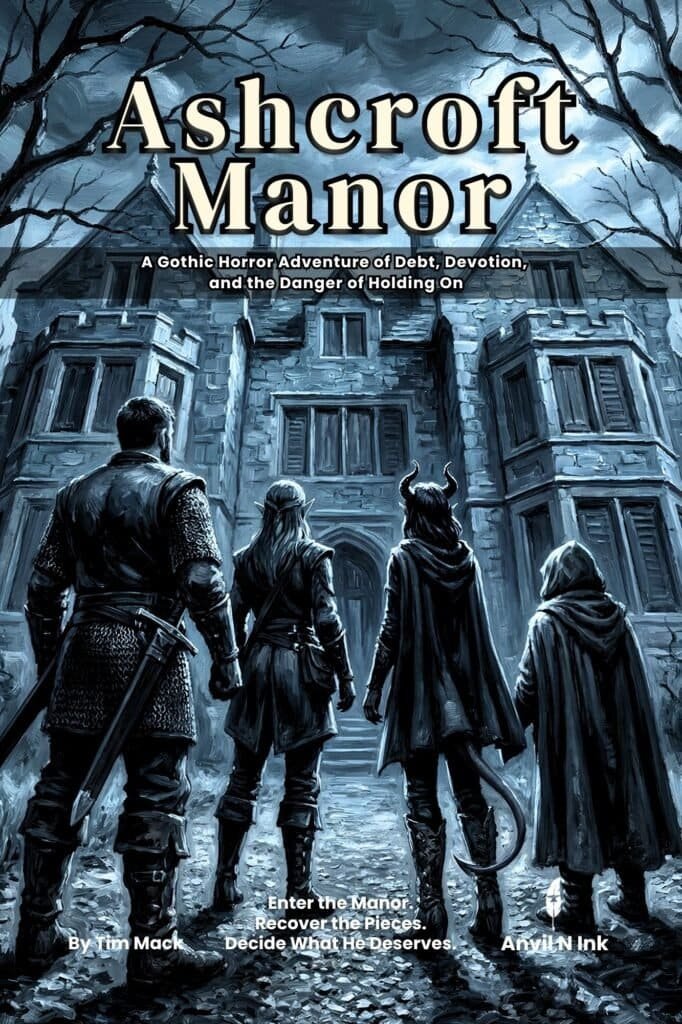

Ashcroft Manor: A Gothic Horror One-Shot Adventure for D&D 5e
Running a gothic horror one-shot adventure for D&D 5e that actually lands the tone — unsettling without being gratuitous, emotionally resonant without slowing down — is harder than it sounds. Most horror content for D&D scales poorly to small groups, runs long, or trades atmosphere for combat filler. Ashcroft Manor was designed from the ground up to solve all three problems at once.
Lord Aldric Ashcroft didn’t die in his manor. He became it. His soul, fused into the walls, floors, and foundations by a demonic pact gone wrong, has been waiting inside the house for years — protecting what little is left of him, and refusing to let go. Two days ago, a séance team entered the manor to investigate the haunting. The house killed all but one. The survivor is fused into the back doorframe, conscious, and has been counting the hours since. She warns you the house can hear through her. She asks you to come close when she tells you anything important.
That is the first five minutes. It only gets stranger from there.
A Gothic Horror one-shot Adventure Built for Small Groups
Ashcroft Manor is part of the Ready Adventure Series — zero-prep one-shot adventures designed specifically for 2–3 players and a single session of 2–3 hours. Everything in this adventure is calibrated for that format. The encounters are tuned for small parties at level 2–3. The pacing is designed to fill exactly one session without padding. The moral complexity is built into the structure, not bolted on as flavour text.
The adventure is non-linear in the middle. Players have access to five corrupted rooms inside the manor, each holding a fragment of Lord Aldric’s soul bound into demon currency as part of the original pact. They can only complete three before the house forces them forward. Which three they choose — and which fragments of Aldric’s story they never learn — directly shapes the confrontation at the end. There is no correct path. There is only the path they took.
The House Is the Antagonist
What makes Ashcroft Manor unusual as a D&D gothic horror adventure is that the haunting is not a villain. Lord Aldric is not evil. He is lost — a man who made one catastrophic decision under pressure and has spent decades building walls around it, first of pride, then of guilt, then of stone and timber and living flesh. Every hostile act the house takes is a fear response. Players are not fighting a monster. They are trying to reach a broken person who has forgotten how to be reached.
The house itself escalates across four acts. In Act 1 it is oppressive but passive — doors that drift open, mirrors that reflect a half-second late. By Act 2, the walls are bleeding. By Act 3 they have become flesh, warm and breathing, the corridors narrowing. By Act 4 the house has closed entirely, every passage sealed with pale organic material, and the only way forward is down — toward the demon pit, the living door, and whatever remains of Lord Aldric Ashcroft.
Three Endings, No Clean Answers
The endings in Ashcroft Manor are determined entirely by what the players did inside the house. How many soul coins they collected. Whether they found the key to Maren’s room. What they chose to do with the locket they found inside it. How they handled the demon Kethras at the door — paid in coins, bargained with flesh, or fought through at cost. And finally, what they brought into the confrontation with Aldric and how they used it.
The redemption ending requires all three coins, the locket, and a willingness to let Aldric’s wife speak for herself. It is the only ending where both objectives are fully achieved — the house is cleansed, and the soul passes on with someone waiting for it. The hollow ending sees the house cleansed and Aldric released, but unresolved — the property transfers, the listing goes up, and every viewer leaves quickly and cannot explain why. The destruction ending is exactly what it sounds like: the house folds into itself, the players sprint for the door, and whether Esmeralda Crane survives depends entirely on which ending they reached.
None of the endings are failures. They are consequences.
What’s Included in Ashcroft Manor
Ashcroft Manor is a complete, fully self-contained gothic horror adventure. Nothing requires additional sourcebooks beyond the D&D 5e core rules. Everything needed to run the session — maps, stat blocks, skill checks, escalation mechanics, and all three ending sequences — is inside.
- Six fully designed encounter rooms, each with a unique skill challenge, combat encounter, and a fragment of Lord Aldric’s backstory
- A four-act living house escalation system that transforms the manor from eerie to actively hostile to pure body horror
- Nine fully statted unique creatures and NPCs, including Esmeralda Crane the fused séance leader, Kethras the infernal debt collector, and Lord Aldric himself
- Eight battle maps including a full estate grounds overview and one map per encounter room
- Four pre-generated level 3 characters — a human fighter, wood elf cleric, tiefling warlock, and drow rogue — each with personal ties to the adventure’s themes
- Three distinct endings determined by player investigation, choices, and the final confrontation
- Complete scaling guidance for two-player and three-player groups
- Five campaign hooks for inserting the adventure into an existing campaign, and five sequel threads for groups who want to continue
Perfect For These Tables
Busy dungeon masters who want a high-quality gothic horror session without spending hours in prep. Ashcroft Manor is ready to run tonight. Read it once, run it the same evening.
Small groups of two or three players who find most published adventures assume a party of four or five. Every encounter, stat block, and resource curve in this adventure is designed for small groups specifically — not scaled down from something larger.
Tables that want moral complexity. Aldric is not a monster to be defeated. He is a man who made a terrible decision for understandable reasons and has been alone with the consequences for decades. How the players choose to handle that — with violence, with diplomacy, with the truth, or with his dead wife’s voice in a locket — is the adventure.
Dungeon masters running a gothic horror campaign who need a self-contained session that fits naturally into a larger story. The five campaign hooks cover everything from a straightforward job-board commission to a personal inheritance connection, and the five sequel threads give Kethras, the bank, and the estate plenty of room to resurface later.
Part of the Ready Adventure Series
Ashcroft Manor is the second adventure in the Ready Adventure Series from Anvil N Ink Publishing. The series focuses on evergreen one-shot themes — scenarios that work any time of year, at any table, without requiring a specific holiday or occasion to justify the session. The first adventure, Wrecked, drops players onto a shipwreck survivor island. Ashcroft Manor drops them into a gothic estate with a deadline, a fused séance leader, and a house that is slowly becoming something else.
Each adventure in the series is designed to the same standard: self-contained, small-group calibrated, prep-free, and built around a moral question that does not have an obvious answer. If your table liked one, it will like the others.
Ready to Run Tonight
Ashcroft Manor does not ask for hours of prep, a large party, or a taste for horror that leans on shock and gore. It asks for a dungeon master willing to slow down in the quiet rooms, players willing to read the names scratched into bedframes, and a table ready to argue about what a broken man deserves at the end of a long night.
The manor is waiting. The door is open. What happens next is entirely up to your table.
Ashcroft Manor is a gothic horror D&D 5e one-shot adventure that proves small groups can carry the weight of a story worth telling.
Get Your Copy
Choose your preferred format