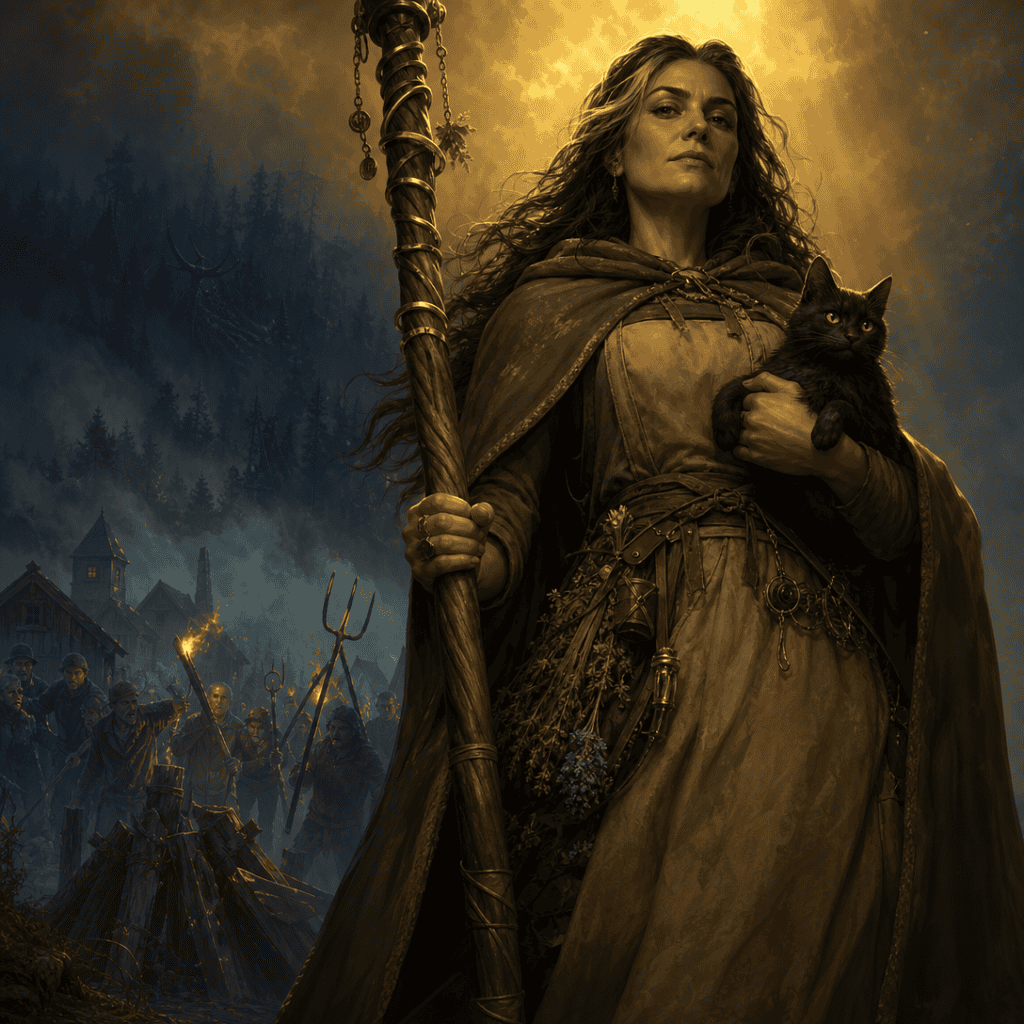

A black cat NPC is one of the most flexible recurring characters a DM can drop into a fairy-tale D&D campaign. The fairy-tale tradition gives you three distinct archetypes — familiar, guide, and trickster — and each one runs differently at the table. This guide breaks down when to use each, how to make them feel distinct, and the stat block considerations for cats that can do more than scratch.
Why Black Cats Make Good NPCs
Players will always engage with a cat. There is no convincing required. The moment a black cat shows up — sitting on the windowsill, weaving between the party’s legs, watching from the rafters — every player at the table is paying attention. That’s free narrative weight. Use it.
Black cats also fit a wide tonal range. They work in cozy fairy tale adventures (a witch’s helpful familiar), in horror (a creature that stares too long), and in moral ambiguity (a fae trickster whose loyalties shift). One NPC archetype, three completely different sessions, depending on which version you choose.
Archetype 1: The Familiar
The classic wizard’s cat. Loyal to a single caster, shares senses with them through the find familiar bond, and tends to express the wizard’s personality in fur form — sarcastic if the wizard is sarcastic, anxious if the wizard is anxious. The cat is essentially a window into the wizard’s mind.
How to run it: The familiar is the easiest archetype because it’s mechanically defined. Use the standard cat statblock with telepathic communication out to 100 feet. Roleplay the cat as a slightly distorted echo of its master. If the wizard is an NPC, the familiar can deliver information the wizard can’t be present for.
Best uses: Witches, hedge mages, sympathetic spellcasters. The Cat, the Witch, and the Auction features Soot, who is essentially this archetype — the witch’s familiar who carries on the rescue when the witch herself is taken.
Archetype 2: The Guide
The psychopomp cat. The cat that appears at crossroads, leads lost travelers through the woods, escorts the dying to whatever comes next. This archetype draws on Egyptian, Celtic, and Norse traditions — cats as boundary-walkers between worlds.
How to run it: The guide cat shows up at decision points. It doesn’t speak. It looks at the party, then at a path, then back. When followed, it leads them to where the story needs to go — often somewhere the party didn’t know they needed to be. Don’t overuse this; one or two appearances per session is plenty.
Best uses: Liminal sessions. Adventures that cross between the material plane and the Feywild. Death-themed one-shots. Any session where the party needs a nudge toward a path they’re not seeing. The Feywild fairy tale setting guide covers how to build the kind of liminal space where a guide cat fits naturally.
Archetype 3: The Trickster
The fae cat. Speaks in riddles, makes bargains, may or may not be on the party’s side, and is definitely not just a cat. Trickster cats are the most narratively rich of the three archetypes because they introduce ambiguity — the party never quite knows if the cat is an ally, an obstacle, or both.
How to run it: Give the cat a clear motivation that doesn’t align with the party’s. Maybe it wants something specific from the location they’re in. Maybe it owes someone a debt and the party is the currency. The cat should help the party right up until helping costs the cat something — at which point it disappears, reappears later, and acts surprised that they’re upset.
Best uses: Dark fairy tale one-shots. The dark fairy tale series features trickster animals throughout — cats, ravens, wolves — and the format works because the players never quite know whose side the animal is on.
Stat Block Considerations
The standard cat statblock from the Monster Manual is fine for most black cat NPCs. A few simple modifications cover the archetypes:
Familiar variant: Add telepathic communication with bonded caster (100 ft range). Otherwise unchanged.
Guide variant: Add Innate Spellcasting (1/day each: locate creature, misty step, pass without trace). The cat is a fey creature even if it doesn’t look like one.
Trickster variant: Use the Fey Cat or Sprite-equivalent variant. The cat can shift to humanoid form at will, has innate spellcasting (1/day each: charm person, invisibility, suggestion), and speaks Common and Sylvan.
If you want a cat that can fight at a higher difficulty, use the Tabaxi or Cat Lord stats instead. But for most NPC purposes, a regular cat with one or two narrative tricks is enough.
Frequently Asked Questions
Should a black cat NPC be able to talk?
Depends on the archetype. Familiars communicate telepathically with their wizard, but not with the party. Guides should never speak — their power comes from silence. Tricksters can speak if they want to, but should reveal it only at a moment that matters narratively.
How do I keep my black cat NPC from becoming a pet?
Give it agency. The cat should leave the party regularly. It should disagree with them. It should have its own goals that it pursues independently. A cat that’s always around becomes a pet; a cat that comes and goes becomes a character.
Can a black cat NPC be the protagonist?
Yes. The Cat, the Witch, and the Auction opens with the party meeting Soot, the black cat protagonist who recruits them for the rescue. The cat is the inciting NPC, not a passive companion. This works because the cat has a clear goal (save the witch) the players inherit.
What’s the difference between a familiar and a fey cat?
A familiar is bound to a specific caster through the find familiar ritual. A fey cat is a Feywild creature that may resemble a cat but isn’t one — it’s a Sprite, a Sidhe, or another fey native that wears a cat’s form. Familiars are predictable; fey cats are not.
Are black cat NPCs always evil or neutral?
No. The fairy-tale tradition leans neutral or chaotic-good for guides and familiars; tricksters tend toward chaotic neutral. Players associate black cats with bad luck, but the lore actually supports cats as protective figures more often than malicious ones. Use that contrast.
Run a Black Cat NPC in Your Next Session
Black cats are one of the lowest-effort, highest-impact NPCs you can drop into a fairy tale D&D session. Pick one of the three archetypes, give it a single clear goal, and let the players’ instinctive cat-affinity do the rest of the work.
Read the full review of The Cat, the Witch, and the Auction — Anvil N Ink’s published one-shot featuring Soot, a black cat protagonist who carries the party through a faerie auction rescue. Two hours, 2-3 players, levels 2-3.
For broader fairy tale adventure design, see the Dark Fairy Tale D&D pillar. For other Twisted Tale entries with strong animal NPCs, try Breadcrumbs and The Twelve Dancing Princesses.
Cats know things they don’t tell. Use that.