
Brothers Grimm D&D Adventure: Running Dark Fairy Tales at Your Table
A Brothers Grimm D&D adventure draws from the most underused source material in tabletop gaming. The original Grimm collection isn’t a set of children’s stories — it’s two hundred tales of desperate bargains, supernatural consequences, and ordinary people caught between powers they don’t understand. That’s the premise of every great D&D session, already written for you. This guide covers which Grimm tales adapt best, what makes the genre work at the table, and how to start running dark fairy tale adventures tonight.
Why the Brothers Grimm Are Perfect D&D Source Material
The Grimm tales work as D&D source material for the same reason they’ve survived for two centuries: they operate on moral logic that feels true. Actions have consequences. Promises must be kept — or broken at a price. Power comes with obligations. The supernatural world follows rules, but those rules aren’t always the ones the human characters assume. This is exactly the kind of world that makes for great tabletop roleplaying.
The original collection also provides something that adventure designers rarely manage: antagonists with comprehensible motivations. Rumpelstiltskin didn’t break a deal — the miller’s daughter did. The Pied Piper was owed payment for a service rendered. The witch in the forest is dangerous, but she was there first. When players arrive expecting to identify and eliminate evil, discovering that the situation is genuinely more complicated creates the kind of engagement that sustains a session long after the dice stop rolling.
For the full framework on running dark fairy tale D&D — including the three pillars that every good fairy tale adventure needs — our dark fairy tale D&D guide builds the foundation this article draws from.
5 Brothers Grimm Tales That Make Outstanding D&D Adventures
Rumpelstiltskin
The classic deal-with-a-supernatural-being story, but with an important inversion: Rumpelstiltskin kept his word. The miller’s daughter agreed to the bargain under duress, yes — but she agreed. The king who created the impossible situation has never been held accountable. Running this as a Brothers Grimm D&D adventure means giving players the job of resolving a situation where everyone has a valid grievance and there’s no clean solution available.
Anvil & Ink’s The Name of Rumpelstiltskin adapts this directly — built for two to three players with the moral complexity intact and a resolution that requires genuine engagement rather than a skill check.
The Pied Piper of Hamelin
Technically a German legend rather than a Grimm tale, but operating on the same moral logic. A town hires a supernatural contractor, benefits from his services, then refuses to pay. The contractor enforces the contract at maximum cost. The D&D adventure version puts players in the position of dealing with the aftermath — after the children are gone, after the Piper has a legal and moral claim, with a town council that would rather the problem go away than acknowledge what it did.
Pay the Piper runs exactly this premise — one of the strongest Brothers Grimm D&D adventure adaptations in the Twisted Tale Series.
The Twelve Dancing Princesses
Twelve princesses sneak out every night through a hidden underground passage. Their shoes wear through dancing. Suitors who try to discover the secret are executed when they fail. The original story eventually has a soldier discover the underground ballroom and marry one princess — but the adaptation question is richer: why are the princesses going? Are they captives down there, or captives up here? The Twelve Dancing Princesses makes that the central question, with the players’ answer determining the outcome.
The Juniper Tree
One of the darkest tales in the Grimm collection and one of the richest for D&D adaptation. A murdered child, a stepmother who covers her crime, a grieving father, and a supernatural reckoning that comes from the child’s remains rather than from any outside force. The D&D version works as a murder investigation where the truth is already known to the supernatural world — the players just have to catch up. The climactic scene, where justice is delivered in the most Grimm-appropriate way possible, is one the table will not forget.
Fitcher’s Bird
Three sisters, a sorcerer who tests them, a forbidden room, and consequences that play out across three attempts. This is a classic escape-and-rescue structure that works as a D&D adventure precisely because it’s built on repeated attempts with escalating stakes. Each failure is informative rather than terminal. The sorcerer’s logic is internal and consistent — he’s testing something specific, and the players who figure out what he’s actually testing are the ones who find the real solution.
Setting the Grimm Tone at Your Table
The biggest mistake DMs make when running a Brothers Grimm D&D adventure is softening the edges. The Disney versions of these stories exist because the original content was uncomfortable — and that discomfort is the source of their power. A Rumpelstiltskin who’s simply a cackling evil imp is boring. A Rumpelstiltskin who kept his word and has a legitimate grievance is genuinely threatening, and the players’ discomfort with that fact is where the adventure lives.
Set expectations before play begins. Describe the tone as ‘Brothers Grimm, not Disney’ — most players immediately understand what that means. Use safety tools so anyone can step back from content that becomes genuinely distressing rather than productively uncomfortable. Then commit to the register: the antagonist has a reason, the resolution isn’t clean, and consequences are real.
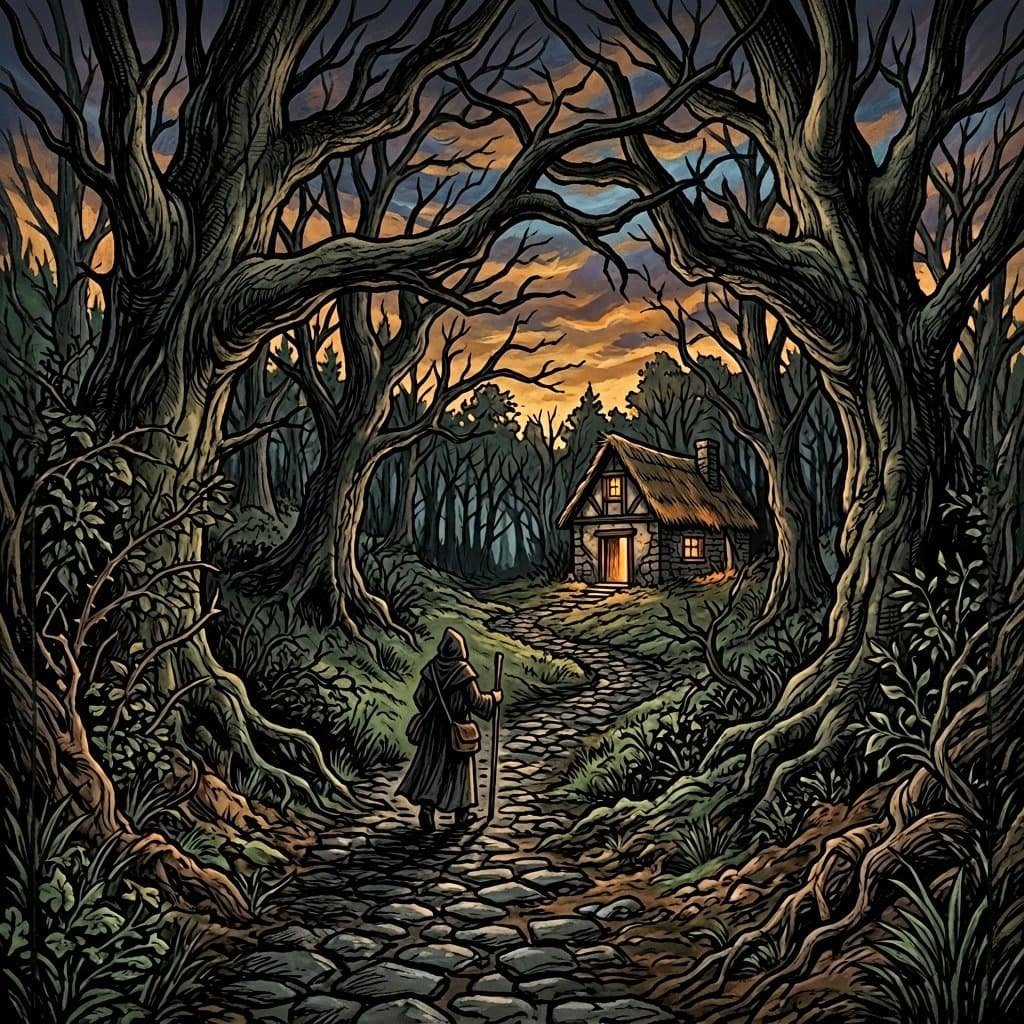
Atmosphere carries more weight in fairy tale adventures than in standard D&D. Describe the forest as something with presence — the specific quality of silence when birds stop singing, the way shadows fall wrong at the wrong time of day, the architecture of the witch’s cottage that is simultaneously inviting and wrong. The Brothers Grimm D&D adventure lives in the details that signal ‘something is off here’ before anything is explicitly revealed.
Grimm Mechanics: Making the Rules Serve the Story
A Brothers Grimm D&D adventure benefits from a few mechanical adjustments that reinforce the fairy tale logic of the world.
Supernatural contracts have weight. When a character makes a promise to a supernatural entity in your adventure, that promise is binding in a way that ordinary agreements are not. Breaking it has consequences — not because the DM is punishing the player, but because the world of the story operates on a logic where words have power. Make this explicit before the adventure begins so players engage with bargains and oaths accordingly.
Information is the real resource. Fairy tale solutions depend on knowing the right thing — the name, the weakness, the rule the entity is bound by. Design your Brothers Grimm D&D adventure so that the players can find these answers through investigation, conversation, and lateral thinking. Combat is rarely the intended solution; it’s the fallback for players who haven’t gathered enough information to find the real answer.
Third options reward careful thinking. Every Brothers Grimm D&D adventure should have at least one resolution that isn’t on the written list — something the players invent by reading the situation carefully and finding a solution that satisfies the underlying logic of the conflict. When a player argues that the Piper should be paid from the royal treasury rather than the town’s, or that Rumpelstiltskin’s contract is technically fulfilled if the child is given freely rather than stolen — say yes. These moments are the heart of the genre.
Frequently Asked Questions
Is a Brothers Grimm D&D adventure appropriate for all groups?
The genre is darker than standard D&D, but the darkness is moral rather than graphic. The discomfort comes from impossible choices and ambiguous outcomes, not from graphic violence or horror. With a brief tone conversation before play and basic safety tools available, Brothers Grimm D&D adventures work well for most adult groups and many teenage ones. They’re less suitable for younger players or groups who specifically want straightforward heroic adventure.
Do I need to read the original Grimm tales to run these adventures?
Not for published adventures that adapt specific tales — the adventure itself provides all the context needed. If you’re building your own Brothers Grimm D&D adventure from source material, reading the original tale in full (the pre-Disney version, available free through Project Gutenberg) takes fifteen minutes and provides the moral texture that makes the adaptation work.
Start your Brothers Grimm D&D adventure collection at anvilnink.com/adventures — the full Twisted Tale Series, built for two to three players, zero prep required.
A Brothers Grimm D&D adventure doesn’t ask who the villain is. It asks whether the villain and the hero might be standing in each other’s shoes.