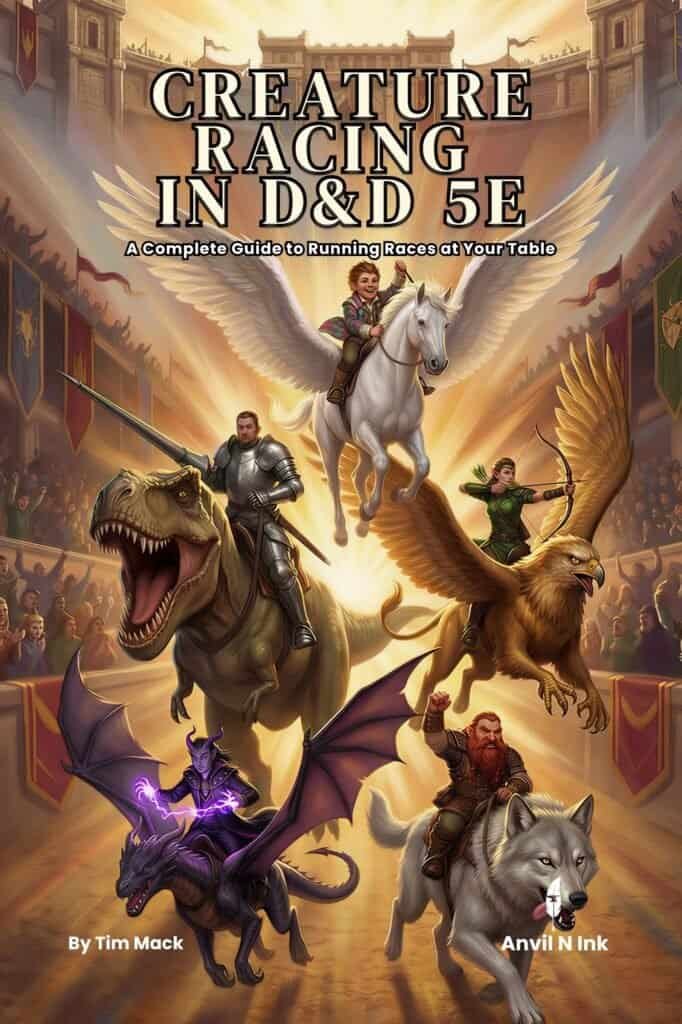

Creature Racing in D&D 5e: A Complete Guide to Running Races at Your Table
Creature racing in D&D 5e gives your table something most sessions never deliver — a competitive encounter with real stakes, real decisions, and a crowd watching every move. This complete racing supplement runs entirely inside the existing 5e ruleset. No new dice. No separate board. No special tokens. A DM can read the core mechanics and run a race in under thirty minutes. Players make meaningful choices without learning a new game first. Here is everything inside the book.
How Creature Racing in D&D 5e Actually Works
The system runs on two interlocking resources: action slots and stamina. Each turn, a rider receives slots based on their current race position. The leader gets one slot. Riders in second or third get two. Last place gets three. This is intentional — the front rider absorbs every trap and hazard while working with fewer options. The riders behind have room to claw back ground if they play well. Races stay competitive by design.
Stamina comes from the creature, not the rider. The stamina pool equals the creature’s Constitution score — so a Warhorse with Constitution 17 has 17 stamina to spend across the entire race. Every action costs stamina. Moving forward costs 1. Pushing for a burst of speed costs 2. Attacking a rival costs 1 and keeps you in place. Stamina does not reset between scenes or laps, which means every decision in scene one echoes through the final stretch.
The Push Roll and Animal Handling
PUSH is the system’s high-risk action. The rider spends 2 stamina and rolls a d20 plus their proficiency bonus against the creature’s Effective Racing DC — calculated from the creature’s stats, then reduced by the rider’s Charisma modifier. A Paladin who has earned their creature’s trust pushes against a significantly lower DC than a stranger who just climbed into the saddle. Animal Handling controls how many push attempts are available per scene. A modifier of +0 or +1 gives one push per scene; +4 or +5 gives three. Burn it early to grab the lead, or hold it for the final stretch when position matters most.
Three Racing Environments
Every race takes place in one of three environments, each with its own creature roster and tactical identity. Ground races run across city streets, jungle paths, or dungeon corridors. The ground roster spans from the Giant Lizard — steady, low-DC, the first-timer’s natural pick — up to the T-Rex at CR 8, a creature whose presence on the track changes how every rival approaches every decision.
Aerial races take place through storm layers, cliff-face channels, and open sky circuits. Falls are a real consequence of failed crash saves, and the drama of aerial racing draws the largest crowds of any circuit type. Aquatic races run through reef channels, river rapids, and ocean trenches, with a roster that skews toward stamina and durability. The Giant Shark carries 22 stamina — the largest pool of any creature in the book — while the Dolphin at the other end of the spectrum is CR 0, genuinely competitive in a clean race, and by most accounts more enjoyable to ride than anything else in the water. Courses can also combine environments across scenes, rising from cobblestones into a storm layer and finishing through a harbour channel using the cross-environment rules in Chapter 4.
Every D&D Class Has a Role on the Track
The system is not built around characters designed for racing. It is built to give every existing character something meaningful to do. Charisma reduces the creature’s push DC. Wisdom improves stamina recovery. Constitution determines how much strain a rider absorbs when the creature runs dry. Intelligence sets how many active gear items can be managed simultaneously. No stat is wasted, and no single stat dominates.
Rangers are the natural fit — high Wisdom, frequent Animal Handling proficiency, consistent push budgets. Barbarians are the exhaustion riders, able to drive a creature past zero stamina by absorbing the hit point cost personally, grinding through the final scene while rivals wait for their mounts to collapse. Wizards bring gear slots — an Intelligence modifier of +4 means five active items simultaneously, enough to outmanoeuvre faster riders without ever closing to melee range. The book covers all core classes with enough specificity to give any first-time racer a tactical identity before the starting horn sounds.
Building the Track
A race course is built from scene cards — one per scene, revealed as riders enter each stretch of track. Players never see what is coming until they arrive. Each scene is divided into four beats, each split into two half-beats for position tracking. Beats 1 and 4 are safe zones: no combat, only movement and stamina management. Beats 2 and 3 are where the race happens — traps, loot boxes, path splits, narrow passes, and optional combat.
Path splits let riders choose their own route through the middle beats, with all paths rejoining before the exit. A Loot Box on the left path against a Blank on the right creates a real decision every time. Scene modifiers layer environmental conditions across the whole scene — a hailstorm forcing push rolls at disadvantage, a tailwind granting bonus movement, a burning heat taxing stamina on every slot. Used sparingly, they mark the moments where the course itself becomes the obstacle.
What’s Included
Nine chapters cover the complete system from first principles to campaign-level play: core mechanics and rider stats, the full creature roster across all three environments, track design, an optional combat racing module, the DM operational guide for crowd favour and betting markets, gear and augmentations, three pre-built tracks, and a standalone one-shot adventure — Dead Heat at Valdremoor — with rival NPC riders and stakes that go beyond finishing position. Four appendices add five NPC rider profiles, a printable player briefing card, a DM race tracker, loot tables, a trap library, a glossary, and a full racing campaign guide.
Perfect For
DMs who want a self-contained encounter system. The core race runs in under two hours using nothing beyond standard 5e materials. Players choose from a short action list they can learn at the table in minutes.
Tables looking for a session that plays differently. A race is not combat, not exploration, not a skill challenge. It drops into any existing campaign without heavy narrative setup.
Players who want their character sheet to matter in a new way. Every ability score has a function at the track — and most characters will discover they have been ignoring at least one of them.
DMs building a racing campaign. The gear economy, crowd favour system, rival NPC profiles, and campaign appendix give enough structure to run racing as a recurring element across multiple sessions.
Part of the Roleplay Guide Series
Creature Racing in D&D 5e is part of Anvil N Ink’s Roleplay Guide Series — practical supplements designed to expand what is possible at your table without adding complexity for its own sake. Other titles in the series include racial character guides for Dwarves, Elves, Tieflings, and Harelings.
Ready to Race?
Most D&D tables never run a creature race because they assume it requires something special — a separate system, custom materials, or hours of preparation. This book proves it does not. The same dice, the same character sheet, the same DM screen. A race is up and running in under thirty minutes of reading, and the decisions it generates are as real as anything that happens in combat. If your table has never experienced the moment when the last-place rider burns their final push on the exit beat and pulls into Pole Position by half a beat, this is the supplement that makes it happen.
Creature racing in D&D 5e brings competitive, high-stakes racing to your table using only the rules your players already know.
Frequently Asked Questions
Do players need to read the book to race?
No. The DM runs the mechanics. A one-page briefing card in the appendix covers everything a rider needs to know in under two minutes.
How long does a race take to run?
A two-scene Sprint — the recommended starting format — takes approximately one to two hours of play. A full three-scene Circuit typically runs two to three hours.
Does this work with any D&D 5e character?
Yes. No character rebuild is required. Every ability score on an existing character sheet has a defined function in the racing system.
Is combat in races optional?
Yes. The contact racing rules are a separate chapter and can be skipped entirely. The core race works cleanly without them.
Get Your Copy
Choose your preferred format