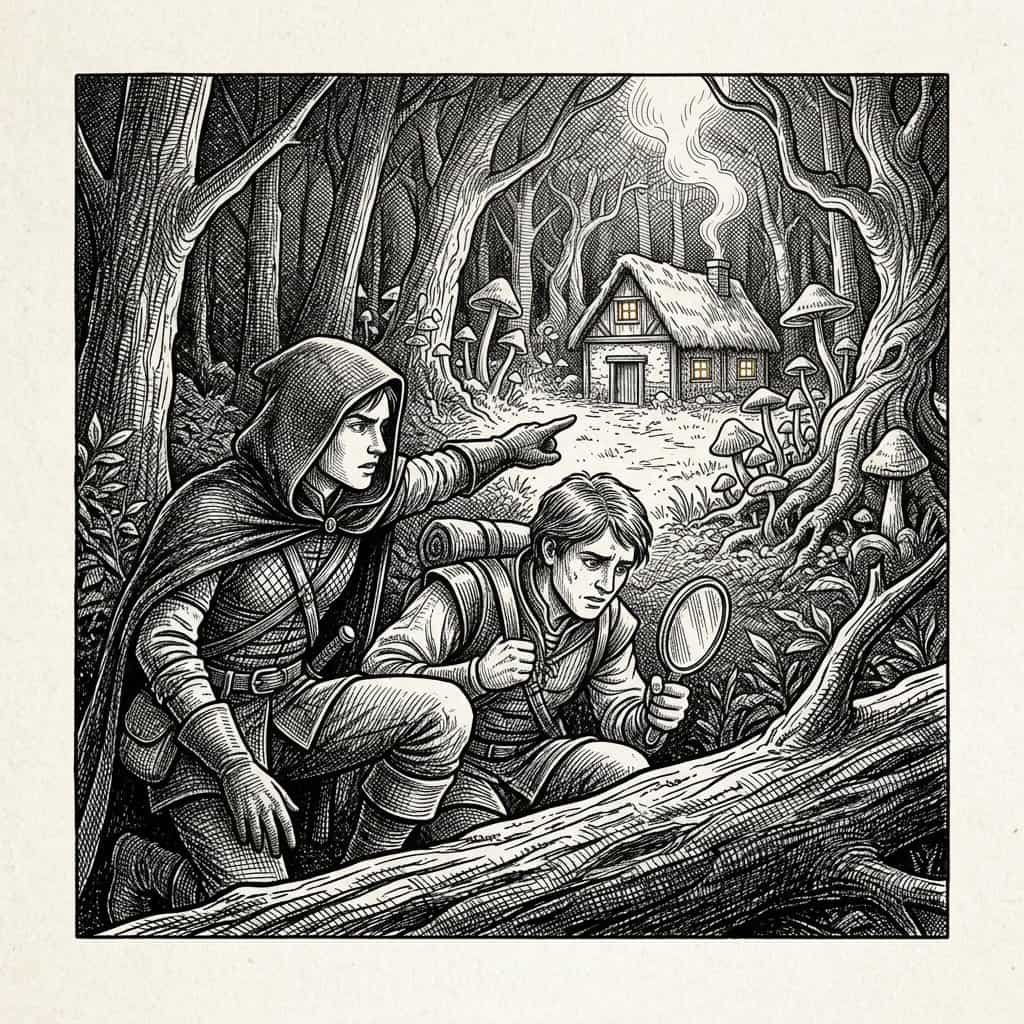

Dark fantasy D&D for small groups isn’t a compromise. It isn’t “making do” with fewer players because your usual group couldn’t make it this week. It’s a genuinely superior format for a specific kind of adventure — the kind built on atmosphere, moral complexity, and choices that haunt players long after the session ends. If you’ve ever tried running a dark fairy tale D&D adventure with five players and felt like the tension kept dissolving into committee debates and sidebar jokes, this guide explains why — and shows you how two to three players unlocks the full potential of dark fantasy storytelling at the table.
This isn’t theory. It’s the result of designing and running dozens of fairy tale one-shots specifically for small groups, watching what works and what doesn’t, and understanding why the math of small parties produces dramatically different emotional outcomes than the math of large ones.
The Intimacy Advantage: Why Fewer Players Means More Weight
Fairy tales are intimate stories. They’re about a single brave soul walking into the dark forest, not a battalion marching through it. When you seat five players around a table and present them with a moral dilemma — say, whether to honor a broken bargain or protect the innocents caught in the fallout — something predictable happens. The group discusses. Opinions emerge. Someone advocates for mercy. Someone advocates for justice. A third person suggests a compromise. The group votes, three to two, and moves on. The decision is made collectively, which means no individual player fully owns it. The weight distributes across the group and dissipates.
Now seat two players at the same table with the same dilemma. There’s no majority vote. There’s no one to break the tie if they disagree. If one player wants mercy and the other wants justice, that disagreement becomes the scene — a genuine argument between two characters who care about different things, played out in real time with no easy resolution. That friction is where the best roleplaying lives. It can’t happen in a group of five because the social dynamics of larger groups naturally push toward consensus. Small groups preserve disagreement, and disagreement is the engine of great drama.
Every Voice Carries Weight
In a party of five, a quiet player can fade into the background. Someone else will make the decision. Someone else will talk to the NPC. Someone else will take the lead in combat. In a party of two, there is no background. Both players are essential for every interaction, every fight, every choice. The quiet player must speak because there’s no one else to speak for them. The indecisive player must decide because the game stops until they do.
For dark fantasy adventures, this is transformative. When every player’s voice matters equally, the moral weight of decisions doubles. A player can’t hide behind the group’s choice — they personally chose to spare the villain or slay them, to honor the bargain or break it, to tell the truth or maintain the lie. That personal ownership creates emotional stakes that larger groups dilute.
Pacing: The Hidden Advantage of Small Groups
Dark fantasy D&D for small groups solves one of the genre’s biggest practical problems: pacing. Atmospheric horror and moral complexity require a specific rhythm — slow tension building punctuated by sharp revelations and difficult choices. That rhythm is nearly impossible to maintain with five players because the more people at the table, the more interruptions, tangents, and wait times between meaningful moments.
With two to three players, combat rounds take two to three minutes instead of ten. Social encounters stay focused because there are only two or three perspectives to manage. Investigation scenes move efficiently because every player is actively engaged rather than waiting for their turn to roll. A complete two to three hour adventure arc — setup, rising tension, revelation, climax, consequences — fits naturally into a single session. That complete arc is what makes fairy tale one-shots satisfying: players walk away having experienced a full story, not a fragment that will be continued next week.
The Tension Curve
Dark fantasy sessions need sustained tension, and tension is fragile. One out-of-character joke at the wrong moment can shatter an atmosphere you spent twenty minutes building. With five players, the odds of someone breaking tension at any given moment are high — not because they’re bad players, but because humans naturally relieve social discomfort through humor, and dark fantasy creates social discomfort by design.
With two players, tension holds. Two people leaning forward, whispering about what to do next, genuinely uncertain whether they can trust the NPC in front of them — that energy sustains itself because there’s no crowd to diffuse it. The emotional frequency stays locked. The horror stays horrible. The wonder stays wondrous. The hard choices stay hard. If you’ve ever wondered why some sessions “feel” different — why certain nights at the table crackle with energy — the answer is often group size. Smaller groups maintain emotional coherence in ways larger groups can’t.
Combat That Matters: Why Small Party Fights Feel Different
Combat in dark fantasy D&D for small groups is fundamentally different from standard D&D combat, and it’s better for the genre in every way. With two characters instead of five, every hit matters more. Every failed save is potentially catastrophic. Every decision about resource expenditure — do I use my last spell slot now or save it? — carries real weight because there’s no safety net of three other party members to pick up the slack.
This heightened danger is exactly what fairy tale encounters need. In the original Grimm tales, the hero faces the wolf alone. The brave sister confronts the witch without backup. The third son walks into the giant’s castle with nothing but his wits. That vulnerability — the feeling that one wrong move could end everything — is central to the fairy tale experience. A party of five facing a fairy tale monster feels like a tactical challenge. A party of two facing the same creature feels like a story.
Encounter Design for Small Groups
Designing encounters for two to three players requires a different philosophy than standard encounter building. The goal isn’t to create a fair fight — it’s to create a desperate situation with multiple possible solutions, only one of which is direct combat. The Bargain Wolf from the fairy tale monster guide is more dangerous than two players can handle in a straight fight. But players who remember to speak its name, offer it food, or honor a previous bargain can resolve the encounter without drawing weapons. The encounter is balanced — not through CR math, but through the availability of non-combat solutions that reward fairy tale thinking.
This design philosophy means every encounter serves the story rather than the game mechanics. Combat happens when players choose it — or when they’ve exhausted their other options. That choice makes combat meaningful in a way it rarely is in standard D&D, where initiative is rolled as a matter of routine. For comprehensive guidance on this approach, the encounter balancing guide for small groups covers the specific math and design principles.
Social Encounters: Where Small Groups Truly Shine
If combat is better with small groups, social encounters are transcendent. Dark fantasy fairy tale adventures live and die on their social encounters — conversations with fairy tale NPCs who offer bargains, hide secrets, and test the players’ values. In a group of five, social encounters often become one-player scenes where the party’s “face” handles all the talking while everyone else waits. That’s death for fairy tale adventures, where every player’s reaction to the NPC matters.
With two players, every social encounter is a three-way conversation: Player A, Player B, and the NPC. Both players are present, both are engaged, both are reacting. When the Bargain-Maker offers a deal, one player might lean forward while the other pulls back. That visible disagreement creates tension that the NPC can exploit — or that the adventure can use to deepen the moral complexity. “Your friend seems uncertain. Perhaps the price is too high for them. But is it too high for you?”
The intimacy of small-group social encounters also allows for deeper NPC portrayal. The DM can spend five minutes on a single conversation without four other players getting restless. The NPC can be subtle, layered, and slow-burning because the audience is small enough to track nuance. In a large group, NPCs often need to be broad and clear because subtlety gets lost in the crowd. In a small group, the NPC can whisper.
The Practical Reality: Running Dark Fantasy for Small Groups
Beyond the narrative advantages, dark fantasy D&D for small groups solves the practical problems that kill most gaming groups. Scheduling two or three adults is dramatically easier than scheduling five. Sessions start on time because you’re not waiting for the fourth and fifth players to arrive. Cancellations are less disruptive because two out of three players is still a functional game. The result is more consistent play, which means stories actually get told instead of endlessly postponed.
Session Length and Commitment
A complete fairy tale one-shot for two to three players runs in two to three hours — a single evening, no continuation required. This is a fundamentally different commitment than the standard D&D campaign model of weekly four-hour sessions stretching over months. For busy adults with families, jobs, and limited free time, the one-shot model isn’t just convenient — it’s the only model that consistently works.
And here’s the thing DMs rarely acknowledge: a complete two-hour story is more satisfying than two hours of an incomplete one. Players walk away from a fairy tale one-shot having made meaningful choices, faced genuine consequences, and experienced a full narrative arc with a beginning, middle, and end. They don’t walk away mid-dungeon wondering when they’ll be able to finish. That completeness matters for emotional satisfaction, and it’s far easier to achieve with a small group that moves through content efficiently.
The DM Experience
DMs benefit from small groups just as much as players do, and the advantages are worth naming. Prep time drops significantly when you’re designing for two to three players instead of five. You need fewer backup encounters, fewer contingency plans, and fewer NPCs because the adventure’s scope is naturally tighter. A small-group fairy tale one-shot requires maybe thirty minutes of preparation if you’re building from scratch — read the fairy tale, sketch the twist, note three key NPCs, and design one encounter with a non-combat option. That’s it. The session runs itself because the fairy tale provides the structure and the small group provides the momentum.
Running the session is also less exhausting. Managing five players requires constant attention distribution — making sure the quiet player gets screen time, preventing the loud player from dominating, tracking five different character arcs and motivations. Managing two players is a conversation. You can focus your energy on atmosphere, NPC portrayal, and responsive storytelling rather than traffic management. DMs who switch to small groups consistently report that sessions feel less like work and more like collaborative storytelling — which is what they were supposed to be all along.
Adventure Selection: What Works Best for Small Groups
Not every adventure style benefits equally from small groups. Here’s what works and what doesn’t for dark fantasy D&D specifically.
What Works Brilliantly
Investigation and mystery adventures are perfect for small groups because every player is a detective. There’s no one to carry while others coast. Fairy tale mysteries where the players are unraveling a story everyone thinks they know — discovering that the villain isn’t who they expected — create their best moments when both players are equally invested in the investigation.
Social-heavy adventures thrive with small groups because conversations are genuine exchanges rather than performances for an audience. Negotiation with a fey lord, interrogation of a reluctant witness, and navigating the politics of a fairy tale court all work better when fewer voices compete for airtime.
Horror and tension-driven adventures maintain their atmosphere with small groups because tension doesn’t dissipate across five people. Two players in a dark forest, hearing something move in the trees, genuinely uncertain whether the creature ahead is hostile — that scenario produces real emotional engagement that large groups struggle to sustain.
What Needs Adaptation
Large-scale combat encounters need redesigning for small groups. A battlefield with twenty enemies works for five players but overwhelms two. Replace mass combat with meaningful duels, environmental hazards, and combat puzzles where positioning and creativity matter more than damage output. Dungeon crawls with dozens of rooms also need trimming — small groups cover less ground per session, so focus on fewer, more meaningful locations rather than sprawling maps.
Character Dynamics: Why Pairs and Trios Create Better Stories
There’s a storytelling reason why fairy tales feature pairs and trios rather than parties of five. Two characters create a dyad — a relationship built on complementary strengths, shared vulnerability, and the tension of disagreement between equals. Three characters create a triad — two perspectives with a swing vote, natural coalition dynamics, and the possibility of someone being the deciding voice on every critical question. Both structures produce richer character dynamics than larger groups, where individual relationships get diluted.
In practice, this means dark fantasy D&D for small groups produces character relationships that feel more like partnerships than party membership. Two players who survive a fairy tale gauntlet together develop a bond that five players rotating spotlight time simply can’t match. The quiet moments — resting in the witch’s cottage, debating what to do next, sharing a meal before the final confrontation — feel intimate and earned rather than performative. Those quiet moments are where character development actually happens, and small groups have more room for them because they’re not competing with three other people for screen time.
Getting Started: Your First Small Group Dark Fantasy Session
If you’ve been running D&D for four or five players and want to try dark fantasy with a small group, start with a fairy tale one-shot. Pick a story your players know — the Brothers Grimm are ideal — and build a two-hour adventure around the fairy tale twist at its core. Keep the NPC cast small: three to four named characters maximum. Design one combat encounter that can be resolved through negotiation. Present one moral dilemma with no clean answer. And trust the small group dynamic to do the rest.
You’ll notice the difference immediately. The table is quieter but more focused. The conversations are deeper. The choices feel heavier. The story moves at exactly the right speed. And at the end, when both players are sitting in the aftermath of their decision, processing what they chose and what it cost — that silence is the sound of a fairy tale landing exactly the way it was meant to.
For ready-to-run adventures designed specifically for this experience, every book in Anvil & Ink Publishing’s catalog is built for two to three players. The Twisted Tale Series — including The Name of Rumpelstiltskin, The Twelve Dancing Princesses, and Pay the Piper — takes every advantage described in this guide and bakes it into complete, zero-prep one-shots that run in a single evening. No rebalancing. No adaptation. Just the story, the choice, and the price.
Dark fantasy D&D for small groups isn’t a lesser version of the full experience — it’s the format fairy tales were made for, where every voice matters, every choice has weight, and every session tells a complete story worth remembering.