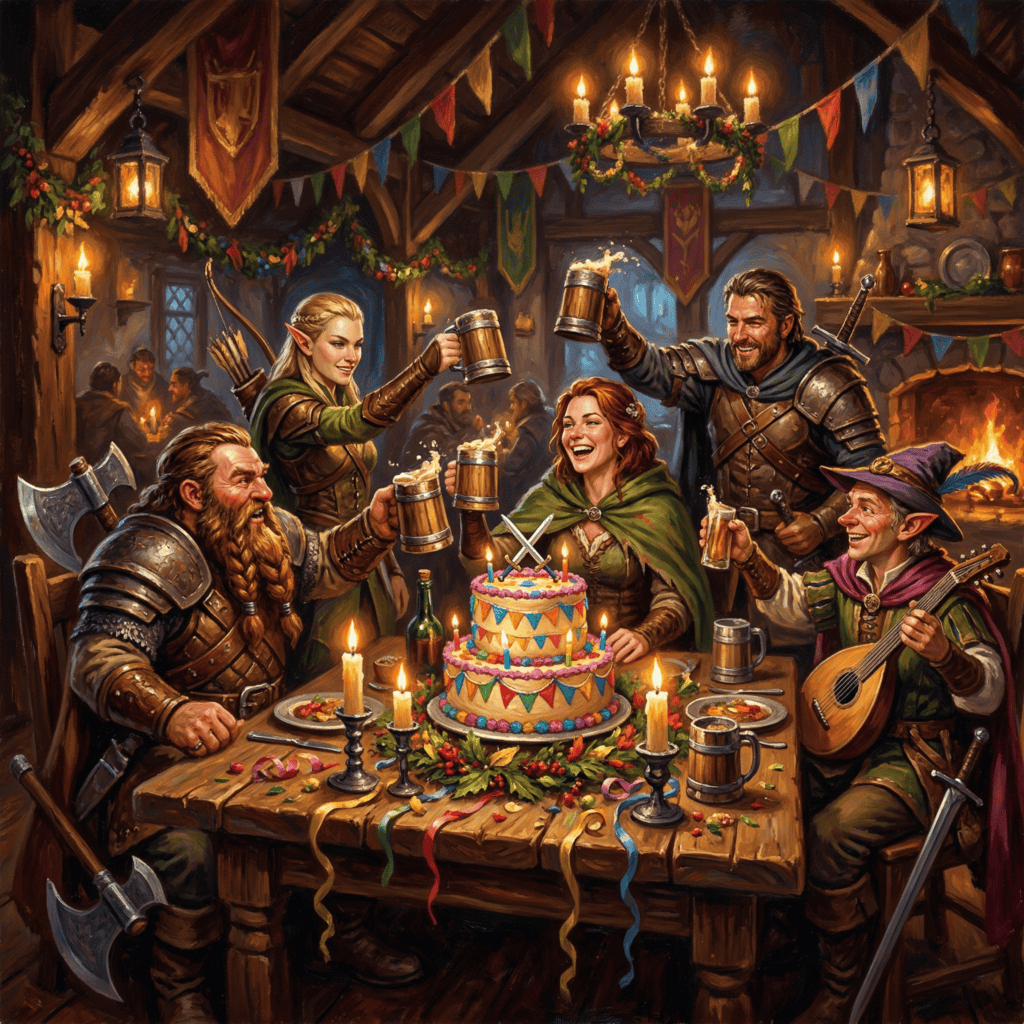

A D&D birthday party is one of the most underused options available to anyone planning a celebration for someone who likes games, stories, or just doing something genuinely different. Skip the bar. Skip the restaurant. Sit around a table, roll some dice, and give the birthday person a story they were the hero of.
It sounds more complicated than it is. A well-designed one-shot adventure runs 2-3 hours, requires no prior D&D experience from any of the guests, and leaves everyone with something to talk about that is specific to that evening and no other. You cannot get that from a bowling alley.
This guide covers how to run a D&D birthday party — from choosing the right adventure to handling guests who have never touched a d20 in their lives.
Why D&D Works as a Birthday Party Format
Most birthday celebrations are passive. You go somewhere, you consume something, you take photos. The evening is pleasant but indistinct from other pleasant evenings. A D&D one-shot is different because it is generative — the guests are creating the story together, and the story they create is specific to the people in the room on that specific night.
The birthday person gets to be the hero. Literally. You can design or choose an adventure where the central character is clearly modelled on them, where the stakes connect to something they care about, or where the ending rewards whatever qualities they actually have. That is a personalised experience that no restaurant reservation can replicate.
For groups who have never played D&D, the birthday party context also removes the intimidation factor. Nobody is there to evaluate their roleplaying. They are there to celebrate someone they like. That social context lowers the stakes on performance and makes people much more willing to try things.
Who Runs the Game?
The most common question: does the birthday person run the game, or do they play in it?
If they already DM and love it, running the game might be exactly what they want. But for most celebrations, the birthday person should be a player — specifically, the player whose character is most central to the story. The DM role for a birthday game should ideally go to someone who is comfortable with it, so the birthday person is not managing other people’s experience all evening.
If no one in the group has DM experience, zero-prep published adventures solve this. Adventures that include complete encounter notes, pre-generated characters with personality descriptions, and read-aloud text for key moments mean that someone can pick up the book and run a solid session with one read-through. The guide to running a one-shot covers the basics for someone stepping into the DM role for the first time.
Choosing the Right Adventure for a D&D Birthday Party
Not every one-shot works for a birthday party context. A few criteria that matter specifically for this format:
It Has to Work for Mixed Experience Levels
Birthday parties rarely assemble a group of experienced D&D players. You will have veterans, complete beginners, and everyone in between at the same table. The adventure needs to accommodate this — clear enough that new players can engage without rulebook knowledge, interesting enough that experienced players are not bored.
The solution is almost always pre-generated characters with personality notes. New players do not have to build a character or understand the system before play starts. They pick up a sheet, read two sentences about who their character is, and start playing. The mechanics reveal themselves through play.
It Runs in 2-3 Hours
Birthday party attention spans are different from dedicated game night attention spans. People have had a drink or two. There are side conversations. Someone is slightly late. An adventure designed for 2-3 hours runs cleanly in that context. An adventure that requires 5 hours does not.
It Has a Clear, Satisfying Ending
The ending of a birthday party D&D session should feel like a conclusion. Not a “to be continued” — a complete story. The players did something, it mattered, and now it is finished. That completeness is part of what makes the evening feel like a gift rather than an obligation.
Setting Up the Space
You do not need a dedicated game room or a fancy table. What you do need:
- A table large enough for everyone to sit around comfortably
- Enough dice for each player to have a d20 and a handful of other dice — one set can be shared, but having individual sets feels better
- Printed or written character sheets — or a tablet/laptop at each seat if you prefer digital
- Something to mark initiative and conditions — index cards work fine
- A DM screen if the DM wants one, though it is not essential
Atmosphere helps more than props. Candles or low lighting, a playlist of fantasy ambient music, snacks that do not require cutlery. The physical setup communicates that this is a specific kind of evening, which puts people in the right frame of mind before the first die is rolled.
Personalising the Adventure for the Birthday Person
This is the part that separates a D&D birthday party from a regular game night. A few ways to make the adventure specifically about them:
Name a Character After Them
The simplest and most effective personalisation. If the birthday person is playing, their pre-generated character can share their name, or a fantasy version of it. The adventure can refer to them by name in the read-aloud text. Small touch, significant impact.
Connect the Stakes to Something They Care About
If the birthday person loves dogs, the thing being rescued is a dog. If they are passionate about a particular cause, the adventure’s moral stakes can echo it. This does not require rewriting the adventure — it requires adjusting three sentences of description and knowing your person well enough to make the connection.
Give Them the Climax Moment
In the final encounter, position their character to have the decisive action. Not by rigging the dice — by designing or framing the situation so that what their character does in the last scene matters. They make the choice that ends the adventure. That is the birthday gift.
Handling Guests Who Have Never Played
New players at a birthday D&D session need exactly three things: a character they understand immediately, one person at the table who can quietly answer rules questions without making it a thing, and permission to do something impractical that their character would do.
That last one matters. New players often freeze because they are not sure what the “right” answer is. The right answer does not exist. What their character would plausibly do is right. Make that explicit before play starts, and new players relax considerably.
For the DM: when a new player does something unexpected, say yes and figure out what happens. The worst outcome of a new player making an unconventional choice is an interesting scene. The worst outcome of shutting down a new player’s unconventional choice is them disengaging for the rest of the session.
The guide to D&D one-shots for beginners covers what makes an adventure beginner-friendly in more detail — useful reading for whoever is running the birthday session.
Adventures Worth Running for a Birthday Party
From the Anvil N Ink catalog, a few titles that fit the birthday party format particularly well:
- The Golden Rest — comedy one-shot set in a retirement home for adventurers. Works brilliantly for a group that wants to laugh. The absurdist premise requires no genre knowledge to enjoy.
- The Stolen Festival Bell — clean two-player format if it is a smaller celebration. Clear objective, multiple solutions, genuine stakes. Runs in exactly 2 hours.
- A-Maze-ing Fools — soul-swap comedy. Players wake up in each other’s bodies. Immediately generates roleplay without requiring any prior investment in the characters. Chaotic and fun in the best way.
- The Merchant’s Vault — heist format. Works well for a group that is competitive and enjoys problem-solving. The planning phase keeps everyone engaged from the first minute.
If you want to see the full range of what is available before you decide, the complete guide to the best D&D one-shots covers every genre and format. For a birthday party, lean toward comedy or heist over horror — unless you know the guest of honour well enough to be confident horror is exactly what they want.
Frequently Asked Questions: D&D Birthday Party
How many people is ideal for a D&D birthday party?
Four to six total, including the DM. Larger groups mean more time managing the table and less time per player in the spotlight. For a birthday celebration, keeping the group small enough that the birthday person has meaningful screen time in every scene is worth more than including everyone who might want to come.
Do people need to know the rules before they arrive?
No. With pre-generated characters and a DM who knows the system, players can engage meaningfully from the first minute without any prior knowledge. Most of the rules they need will come up naturally during play, and the DM can explain them in context. Asking guests to study the rules before a birthday party is the wrong kind of homework.
What if the birthday person does not want to play D&D?
Do not run a D&D birthday party for someone who did not ask for one. This format works because the guest of honour is genuinely interested. If you are unsure, ask — most people who would enjoy this know immediately when the idea is floated. Most people who would not enjoy it also know immediately.
How far in advance should I prepare?
One read-through of the chosen adventure the day before is enough for a published zero-prep one-shot. If you want to personalise it significantly, add another hour or two to adjust the names and stakes. The beauty of a well-designed published adventure is that the preparation is already done — you are just reading, not building.
Can I run a D&D birthday party for kids?
Yes, with the right adventure. Choose something with clear stakes, pre-generated characters with simple mechanics, and no horror elements. The guide to D&D for small groups covers encounter design that works for younger or less experienced players. Keep the session to 90 minutes for younger kids — attention spans vary considerably by age.
Ready to run the birthday session? The Ready Adventure Series from Anvil N Ink includes zero-prep one-shots with pre-generated characters, complete encounter notes, and 2-3 hour runtimes — exactly what a birthday party needs. Browse individual titles on Amazon or pick up the Complete Collection on Payhip and choose the right adventure for your group.
A D&D birthday party gives the guest of honour something no other celebration can: a story where they were the hero, shared with the people they chose to spend the evening with.