
D&D Dungeon Design: 7 Essential Tips for Dungeons Players Actually Enjoy
D&D dungeon design should be the most exciting part of DMing. You’re building an entire environment — traps, treasures, monsters, mysteries — all contained within walls your players will explore room by room. But somewhere between the graph paper and the game table, most dungeons turn into a series of identical rooms connected by featureless corridors, each containing a combat encounter and nothing else.
The result is the dungeon crawl that feels like a slog rather than an adventure. Players kick down door after door, fight encounter after encounter, and by the third room nobody remembers what the dungeon was supposed to be about. The problem isn’t the dungeon format — it’s how most of us design them.
These seven tips will transform your D&D dungeon design from forgettable room-clearing exercises into immersive environments that tell stories, reward creativity, and give players genuine reasons to explore every corner. Each technique works for any dungeon size, from a five-room one-shot lair to a sprawling mega-dungeon, and scales naturally for small groups of 2-3 players where every room needs to earn its place in the session.
The Problem With Most D&D Dungeons
Most dungeons fail because they’re designed as containers for encounters rather than as places that exist for a reason. The dungeon is a series of rooms. Each room has a challenge. The challenges escalate. The boss is in the last room. This structure is functional but soulless — it’s a video game level, not a believable location.
Real places — even fantastical ones — have logic to their layout. A fortress has guard rooms near entrances and living quarters deeper inside. A wizard’s tower has a laboratory, a library, and storage for dangerous components. A natural cave system follows geological patterns, with water flowing downhill and creatures nesting in defensible positions. When your dungeon follows its own internal logic, players can make deductions about what’s ahead based on what they’ve already seen. That deductive exploration is where dungeon crawling becomes genuinely engaging.
Every tip in this guide serves the same principle: dungeons should feel like places rather than level designs. When they do, everything else — pacing, challenge, narrative, exploration — falls into place naturally. This principle anchors the dungeon environments across the Ready Adventure Series, where every location has a history that shapes its layout and a purpose that informs its challenges.
Tip 1: Start With the Dungeon’s Purpose, Not Its Map
Before drawing a single room, answer one question: why does this dungeon exist? Not “why are the players here” — why was this place BUILT? A tomb was built to protect the dead and their treasures. A fortress was built to control a strategic location. A mine was built to extract resources. A wizard’s sanctum was built for research and privacy. A temple was built for worship and ritual.
The dungeon’s purpose determines everything about its design. A tomb has narrow corridors to funnel intruders into traps, sealed chambers to protect burial goods, and ceremonial spaces for mourning rituals. A fortress has clear sight lines, chokepoints, murder holes, and barracks. A mine has support structures, ventilation shafts, ore carts, and the inevitable section where they dug too deep and found something terrible.
Purpose also determines what went wrong — because something always went wrong, or the players wouldn’t need to be there. The tomb’s guardian went rogue. The fortress was overrun and something else moved in. The miners broke through into an underground river that flooded the lower levels. These catastrophes create the dungeon’s current state: a place built for one purpose, disrupted by another, now occupied by whatever moved in after.
This layered history is what makes the Sinking Tower of Hours work as a dungeon — it’s a wizard’s research tower that’s actively sinking through magical sand. Every level reflects both the original purpose (temporal experiments) and the current crisis (structural collapse, displaced creatures, trapped survivors). Players aren’t just clearing rooms — they’re exploring a catastrophe in progress.
The Three-Layer History
Give every dungeon three historical layers. Layer one: what was this place built for? Layer two: what disrupted it? Layer three: what occupies it now? These three layers create visual storytelling opportunities in every room. The original dwarven masonry is cracked by whatever broke through (layer two), and goblin graffiti covers the walls where the current occupants have claimed territory (layer three). Three layers, three visual languages, and players can read the dungeon’s history through observation.
Tip 2: Design Non-Linear Layouts With Meaningful Choices
Linear dungeons — one path from entrance to boss — are the dungeon equivalent of railroading. Players walk forward, encounter things in order, and arrive at the predetermined end. There are no choices, no exploration, and no reason to engage with the environment beyond “what’s in the next room?”
Non-linear D&D dungeon design gives players choices about where to go and in what order. A central hub with three branching paths. A loop that can be traversed in either direction. Multiple entrances that lead to different sections. Shortcuts that connect distant areas. Vertical connections — stairs, shafts, collapsed floors — that let players move between levels in unexpected ways.
Each path should offer different information, resources, or challenges. The left passage leads through the flooded section — dangerous but contains the key to the vault. The right passage goes through the occupied barracks — more combat but the NPC prisoner there knows the boss’s weakness. The middle passage is trapped but shorter. Players choose their route based on their party’s strengths and their assessment of the risks, which makes navigation itself a form of tactical gameplay.
For small group encounters, non-linear design is especially valuable because it lets 2-3 players choose paths that match their capabilities rather than forcing them through encounters designed for larger parties. The stealth-focused duo takes the trapped corridor. The combat-heavy pair storms the barracks. Same dungeon, different experiences based on player choice.
The Loop Principle
Every good dungeon has at least one loop — a path that connects back to a previously visited area through a different route. Loops reward exploration by creating “aha” moments when players realize where they are. They also provide tactical options: retreat routes, flanking opportunities, and the ability to bypass previously impassable obstacles by approaching from a new direction. A dungeon without loops is a corridor. A dungeon with loops is a space players inhabit.
Tip 3: Make Every Room Serve Multiple Functions
The weakest room in any dungeon serves exactly one function: “this is the combat room” or “this is the puzzle room” or “this is the trap room.” The strongest rooms serve two or three functions simultaneously, creating gameplay that blends exploration, combat, and discovery into a single experience.
A storage room isn’t just a place to fight rats. It’s a place to fight rats WHILE searching for the alchemical supplies needed to brew the antidote for the poison on level three. The combat is the obstacle. The search is the objective. The antidote is the reward that connects this room to challenges elsewhere in the dungeon. One room, three functions, and the players remember it because it mattered.
Multi-function rooms also solve a common D&D dungeon design problem: the filler room. If a room exists only to contain one thing — a single trap, a single monster, a single treasure chest — it feels like padding. But if that room contains a monster guarding something the players need, in an environment that provides tactical options, with environmental details that reveal dungeon lore — suddenly it’s a complete experience rather than a speed bump.
The Three-Question Test
For every room in your dungeon, ask three questions. What can the players FIGHT here? What can they FIND here? What can they LEARN here? If a room only answers one question, it needs development. A room that answers all three — combat challenge, discoverable resource, and environmental storytelling — will always feel worth exploring.
This approach is how the Spider’s Seminary builds tension through its environment. Every chamber serves as both a combat arena (spider creatures) and a storytelling space (the aftermath of the legendary heroes’ carelessness). Players aren’t just clearing rooms — they’re piecing together what went wrong while fighting the consequences.
Tip 4: Use Vertical Space and Environmental Variety
Most dungeons exist on a flat plane. Room after room at the same elevation, connected by level corridors. This makes every combat encounter feel identical because the tactical space never changes. Players stand in a room, enemies stand in the same room, and everyone rolls dice until one side drops.
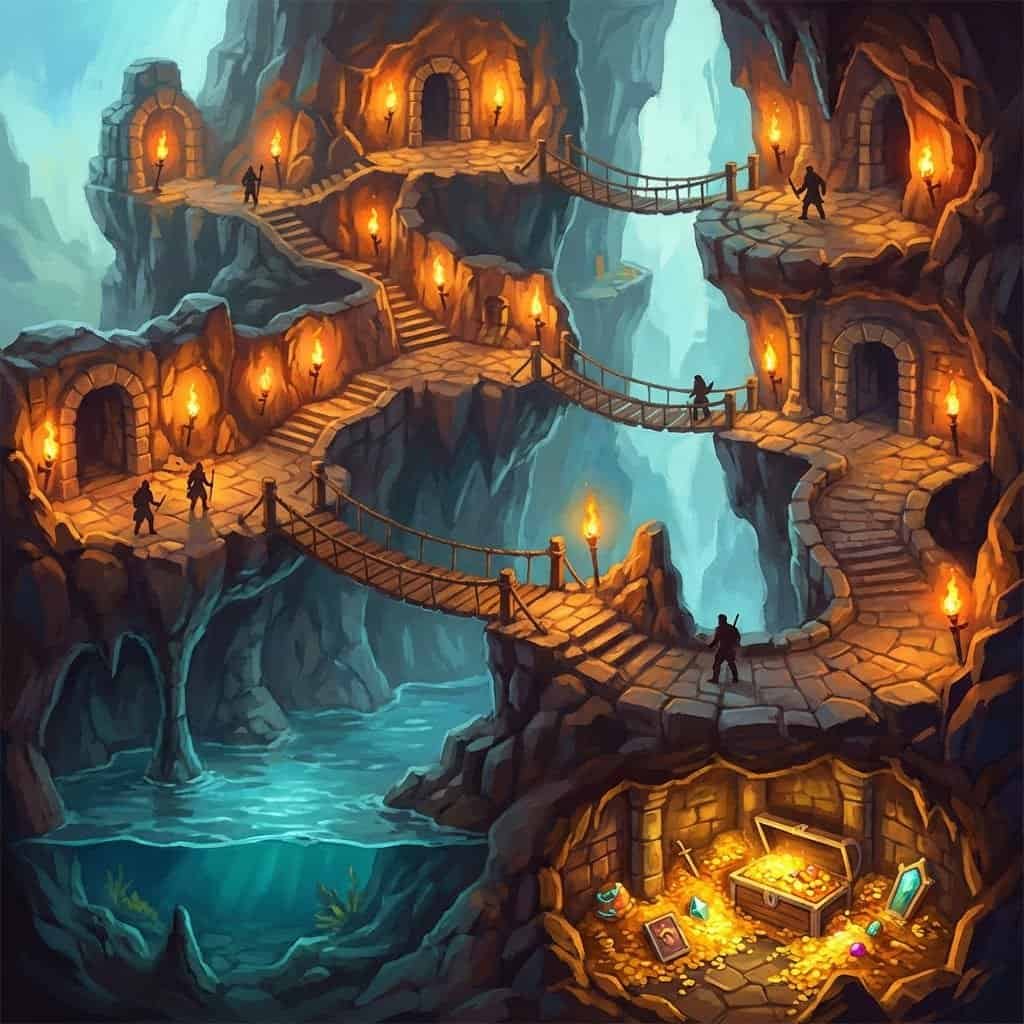
Vertical space transforms dungeon encounters. A room with a twenty-foot balcony and archers above plays completely differently from a flat room. A collapsed floor that drops into the level below creates split-party drama. A shaft that connects three dungeon levels offers shortcuts for clever climbers and terrifying ambush potential for flying creatures. Staircases, ladders, ledges, pits, elevated platforms, and crumbling bridges all add vertical dimension to otherwise flat encounters.
Environmental variety matters just as much as vertical space. If every room in your dungeon is “stone walls, stone floor, stone ceiling,” the dungeon blurs into monotony. Vary the materials, conditions, and atmosphere. The entry halls are dry carved stone. The lower levels are flooded with ankle-deep water. The natural caves beyond the constructed sections have uneven floors and stalactites. The section near the forge is oppressively hot. The section near the crypt is unnaturally cold. Each environmental zone creates distinct tactical conditions and atmospheric tone.
Environmental Zones
Divide your dungeon into two to four environmental zones, each with distinct characteristics that affect gameplay. The flooded zone imposes difficult terrain and ruins paper-based items. The overgrown zone provides concealment but limits sight lines. The collapsed zone has unstable ceilings and improvised barriers. These zones give each section of the dungeon a distinct identity and prevent the “every room looks the same” problem that makes long dungeon crawls tedious.
Tip 5: Populate Your Dungeon Ecologically
A dungeon where every room contains a different, unrelated monster is a random encounter table given physical form. Real ecosystems — even dungeon ecosystems — have food chains, territorial disputes, and symbiotic relationships. Your D&D dungeon design becomes dramatically more interesting when its inhabitants relate to each other.
Think about your dungeon as a habitat. What’s at the top of the food chain? What does it eat? What scavenges its leftovers? What avoids it? A dragon’s lair doesn’t just contain the dragon — it contains the kobolds who worship it, the rats that eat its scraps, the bats disturbed by its movements, and the conspicuous absence of any creature large enough to be a meal. The dungeon’s ecology tells a story about the dominant creature without the players ever seeing it.
Ecological design also creates tactical opportunities. Two monster groups that are territorial rivals might fight each other if the players lure one into the other’s territory. A creature that preys on another can be used as a distraction. A symbiotic relationship — the fungi that glow near the ooze because they feed on its chemical waste — provides environmental clues about what’s nearby. Players who observe the dungeon’s ecology can use it strategically, which rewards exploration and attention.
This ecological approach is central to how No Rest for the Buried structures its undead dungeon. The creatures aren’t random undead in random rooms — they’re the reanimated inhabitants of a specific tomb, and their placement reflects who they were and how the corrupting magic affected different parts of the crypt.
The Food Chain Map
Draw a simple food chain for your dungeon’s inhabitants. Top predator at the top, scavengers at the bottom, prey species in between. Then place creatures on your map according to this chain — predators in defensible positions, prey near food and water sources, scavengers in transitional spaces. Even a simple three-creature food chain makes the dungeon feel like a living system rather than a monster storage facility.
Tip 6: Reward Exploration With Discoverable Secrets
If the critical path through your dungeon is the only path worth taking, players have no reason to explore. And if players aren’t exploring, they’re just moving through a combat gauntlet — which eliminates the exploration pillar of D&D entirely.
Discoverable secrets give players tangible rewards for curiosity. The hidden room behind the bookcase contains a shortcut to the boss chamber. The journal in the abandoned study reveals the boss’s weakness. The locked chest in the side passage contains a magic item perfectly suited to the upcoming fight. The false wall leads to the dungeon’s original treasury, untouched by whatever destroyed this place.
The key word is “discoverable.” Secrets shouldn’t require specific ability scores or class features to find. A hidden door should be noticeable to an observant player (“the wall here is a slightly different color”) even before they roll Perception. A trapped chest should have visible mechanisms that an attentive player spots through description alone. Skill checks should improve the outcome of discovery, not gatekeep the discovery itself.
Secrets should also be meaningful. A hidden room containing 20 gold pieces isn’t worth finding. A hidden room containing a letter that explains the villain’s true motivation — that changes the entire adventure. Scale the importance of secrets to the effort required to find them, and your players will develop the exploration habits that make dungeon crawling genuinely exciting.
The Secret Budget
Plan one significant secret per three to four rooms. A ten-room dungeon should have two to three meaningful discoveries hidden off the main path. More than that and secrets lose their impact. Fewer and exploration feels unrewarded. This ratio ensures that curious players are consistently rewarded without making the dungeon feel artificially stuffed with hidden content.
Tip 7: Design the Dungeon’s Climax as an Environment, Not Just a Boss Fight
The final room of most dungeons is a square chamber with the boss monster in it. This is the least interesting possible climax because it reduces the dungeon’s conclusion to a pure combat math problem. All the environmental storytelling, tactical positioning, and atmospheric buildup of the previous rooms vanishes in a featureless arena.
The climactic space should be the dungeon’s most interesting room — environmentally, tactically, and narratively. It should reflect the dungeon’s history, the boss’s personality, and the stakes of the confrontation. The necromancer’s final chamber isn’t just a room — it’s the ritual space where the walls pulse with stolen life energy and the partially completed resurrection circle dominates the floor. The bandit king’s throne room isn’t just a cave — it’s the stolen great hall of a manor house, rebuilt underground with looted furniture and trophy weapons.
Tactically, the climactic space should offer terrain features that both the boss and the players can use. Elevated positions, cover opportunities, environmental hazards, interactive objects, and escape routes all create dynamic combat that responds to player creativity. The boss should have home-field advantage — they know this room and have prepared it — but clever players should be able to turn the environment against them.
This is where all your adventure design comes together. The environmental storytelling from Tip 3 makes the room meaningful. The vertical space from Tip 4 makes it tactical. The ecological logic from Tip 5 explains why the boss chose this room. The secrets from Tip 6 may have given the players an advantage for this exact moment. Everything converges in the climax, and the room itself should reflect that convergence.
The Three-Phase Boss Room
Design your climactic space to change during the encounter. Phase one: the room as the players find it. Phase two: the boss activates something that changes the room — collapsing sections, flooding, reinforcements arriving, a magical effect that alters the terrain. Phase three: the room after the boss’s desperation move — more dangerous but with new opportunities the boss didn’t intend. These phases prevent the climactic fight from becoming static and ensure the environment stays relevant throughout the encounter.
Putting It All Together: The Five-Room Dungeon Framework
If you’re new to deliberate D&D dungeon design, start with the five-room dungeon — a framework simple enough to prep in thirty minutes but robust enough to deliver a satisfying two-to-three-hour session.
Room one is the entrance and guardian — a challenge that establishes the dungeon’s tone and tests whether the players belong here. Room two is the puzzle or roleplay challenge — a non-combat obstacle that uses the dungeon’s theme. Room three is the trick or setback — something that changes the players’ situation or reveals new information. Room four is the climax — the main confrontation in a tactically interesting space. Room five is the reward and revelation — the treasure, the rescued NPC, or the plot twist that makes the adventure matter beyond loot.
Apply every tip from this guide to those five rooms. Give the dungeon a purpose and three-layer history. Make the layout non-linear even with just five rooms (room two has two paths to room three). Ensure each room serves multiple functions. Vary the environment between rooms. Populate the dungeon ecologically. Hide a secret in one of the rooms. Make room four environmentally dynamic.
Five rooms. Seven design principles. The result is a dungeon that feels three times larger than it actually is because every room earns its existence. This is exactly the approach behind one-shot dungeons like The Sinking Tower of Hours and The Oasis of Hours — compact spaces where every room matters and no encounter feels like filler.
Design Dungeons Your Players Will Remember
Great D&D dungeon design isn’t about drawing elaborate maps or stocking rooms with powerful monsters. It’s about creating places that feel real, reward curiosity, and tell stories through their architecture, ecology, and atmosphere. A five-room dungeon built with intention will always outperform a fifty-room dungeon built with graph paper and a random encounter table.
These seven tips connect directly to every other aspect of adventure design. Your villain’s personality shapes the dungeon’s layout. Your puzzles emerge from the dungeon’s history. Your NPCs inhabit the dungeon according to ecological and social logic. Your combat encounters use the dungeon’s terrain as a tactical dimension. The dungeon isn’t separate from the adventure — it IS the adventure, given physical form.
If you want to see these dungeon design principles in practice, the Ready Adventure Series from Anvil & Ink Publishing builds every adventure around purposeful, atmospherically rich environments. From the temporally collapsing levels of The Sinking Tower of Hours to the horrifying organic chambers of The Colossus Autopsy to the cursed tomb of No Rest for the Buried, each module demonstrates what happens when the dungeon is designed as a character rather than a container.
The dungeon your players explore tonight should feel like somewhere that existed before they arrived and will continue to exist after they leave. Design places, not levels, and your D&D dungeon design will never feel like a slog again.