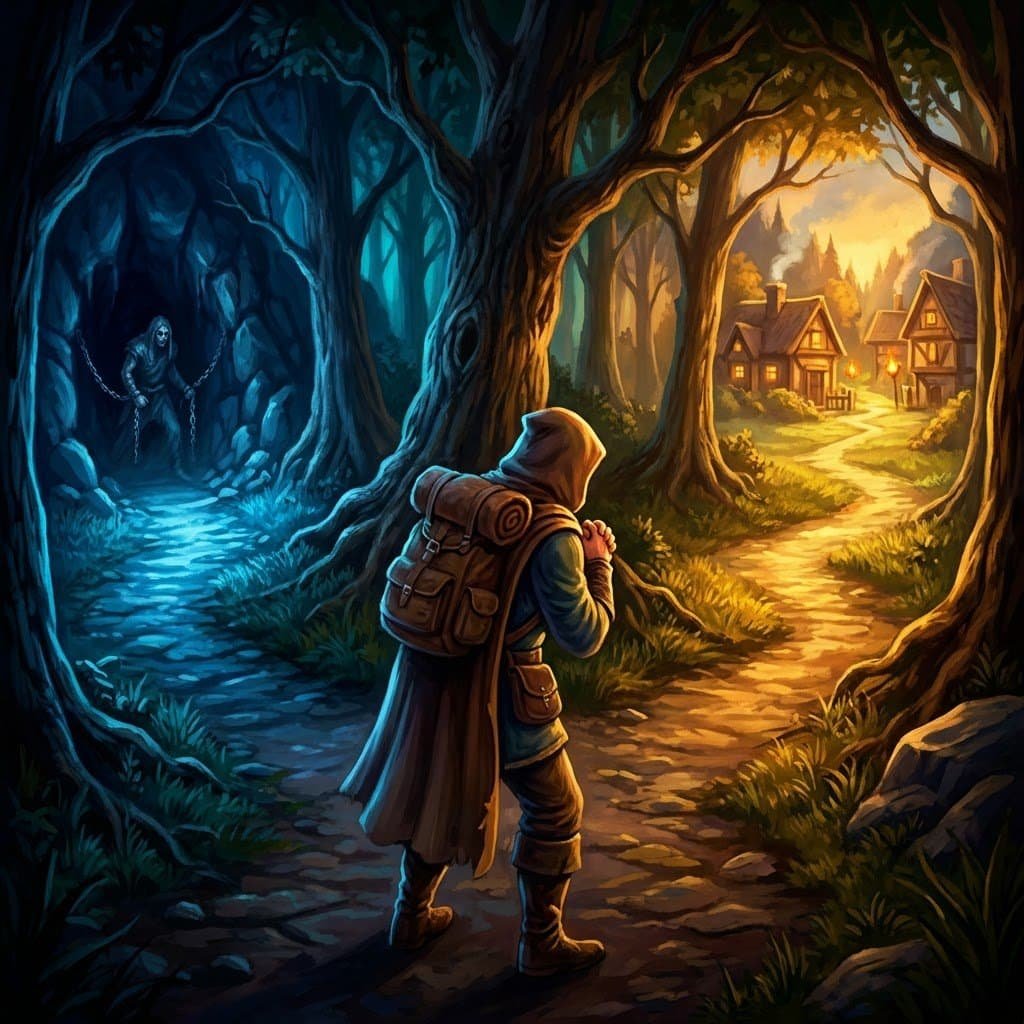

D&D Moral Dilemmas: 7 Techniques for Choices That Haunt Your Players
D&D moral dilemmas create the sessions players talk about for years. Not the combat where they rolled three critical hits. Not the puzzle they solved in record time. The session where they had to choose between saving the village and saving the girl — and every option felt like a betrayal. The session where the villain’s argument made too much sense. The session where “winning” felt like losing because of what it cost.
Moral complexity is the single most powerful tool in a DM’s arsenal for creating memorable adventures. It transforms D&D from a game about killing monsters and taking treasure into a game about navigating impossible choices, questioning assumptions, and discovering what your character truly values when everything is on the line. And it does this without adding a single rule, mechanic, or stat block.
This guide gives you seven techniques for designing moral dilemmas that genuinely challenge your players rather than presenting false choices with obvious answers. Each technique is drawn from adventures where moral complexity is the core experience — not a side feature — and each one works especially well in small group games where fewer voices mean every player’s moral perspective carries more weight in the decision.
Why Most D&D Moral Dilemmas Fail
The most common moral dilemma in D&D goes like this: “The villain offers you power in exchange for betraying your allies. Do you accept?” This isn’t a dilemma — it’s a loyalty test with a correct answer. No reasonable player betrays their party for an NPC’s offer. The “choice” is predetermined by the social dynamics of the table, and everyone knows it.
Real moral dilemmas fail gracefully in every direction. There is no correct answer. Every option costs something valuable. The “right” choice depends on values that reasonable people disagree about. A choice between good and evil isn’t a dilemma — it’s a decision. A choice between two goods, or two evils, or a good that requires an evil to achieve — THAT is a dilemma that generates genuine table discussion.
The second failure mode is the dilemma that doesn’t matter. “Do you save the random NPC or the other random NPC?” Players shrug and pick one because they have no emotional investment in either option. For a dilemma to land, the players must care about what they’re choosing between. This requires NPC creation that builds genuine connection before the dilemma forces a sacrifice, and adventure design that establishes emotional stakes before testing them.
Technique 1: The Competing Goods
The most effective D&D moral dilemma structure presents a choice between two things the players value — where choosing one means losing the other. This isn’t good versus evil. It’s good versus good, which is far more agonizing because there’s no villain to blame for the cost.
A village is flooding. The players can save the people by opening the dam — which will destroy the ancient library downstream, erasing irreplaceable knowledge. Or they can protect the library by redirecting the flood — which washes through the farmland that feeds three other villages. Save people now or preserve knowledge that will save thousands in the future? Feed one village or protect the food supply of three? Both options are defensible. Both options cost something real.
Competing Goods dilemmas work because they split the party along values rather than alignment. The paladin who values life argues for saving the village. The wizard who values knowledge argues for the library. The ranger who thinks long-term argues for the farmland. These aren’t character flaws driving the disagreement — they’re genuine philosophical differences that generate passionate, in-character debate.
The Oasis of Hours builds its central dilemma around competing goods — a father’s desperate love for his dying child versus the stability of something much larger. Players understand the father’s motivation completely, which makes opposing him feel cruel even when it’s necessary.
Building Your Competing Goods
Identify two things your players’ characters care about — duty and compassion, justice and mercy, loyalty and truth, safety and freedom. Design a situation where these values directly conflict. The more personal each option is to specific characters, the more powerful the dilemma. A competing goods dilemma that pits the fighter’s loyalty to the crown against the cleric’s commitment to healing ALL who suffer will generate roleplay that no combat encounter can match.
Technique 2: The Sympathetic Antagonist
Make the villain someone the players understand — even like. When the antagonist’s motivation is comprehensible and their suffering is real, defeating them becomes a moral action rather than a mechanical one. Players who hesitate before the killing blow are experiencing a moral dilemma that no DM narration can force.
The necromancer raising the dead isn’t building an army — she’s trying to give testimony that convicts the murderer who killed her village. The bandit lord isn’t greedy — he’s redistributing wealth from nobles who taxed his community into starvation. The cultist isn’t deluded — she’s seen proof that the world ends unless the ritual is completed, and she’s willing to sacrifice herself to prevent it. Each of these antagonists forces players to wrestle with the question: “Are we sure we’re on the right side?”
The villain creation guide covers building sympathetic antagonists in detail. The key principle for moral dilemmas specifically is that the villain must be RIGHT about the problem, even if they’re wrong about the solution. When the villain accurately diagnoses what’s broken in the world, players can’t dismiss them as crazy or evil — they have to engage with the argument on its merits.
Frostfall delivers this technique through an NPC the players spend the adventure trusting before discovering the truth. The revelation works as a moral dilemma because the NPC’s actions — while deceptive — were driven by motivations the players themselves would feel. Condemnation requires ignoring empathy, and empathy requires ignoring the harm caused. Neither feels clean.
The Villain’s Best Argument
Write the strongest possible defense of your villain’s position. If you can argue their case convincingly for two minutes, the dilemma will work at the table. If you can’t — if every defense sounds hollow or requires ignoring obvious counterarguments — the villain needs more sympathetic development. The villain’s argument doesn’t need to be RIGHT. It needs to be REASONABLE enough that players have to think before dismissing it.
Technique 3: The Impossible Bargain
Present the players with a deal that solves their problem at a terrible price — and make the deal non-negotiable. No loopholes. No clever workarounds. No third option that lets them have everything. Just the bargain, the price, and the choice to accept or walk away.
An ancient creature offers to cure the plague that’s killing the town. The price: a specific person, bound by ancestral pact, must be surrendered. The creature keeps its bargains — it will cure the plague, and the person will not be harmed physically. But they will be taken, forever. There’s no combat solution — the creature is too powerful. There’s no clever escape — the pact is magically binding. There’s no negotiation — the terms were set generations ago. There is only: accept and save the town, or refuse and watch people die.
Impossible Bargains work because they remove the players’ ability to “win” in the traditional sense. D&D players are problem-solvers — they look for the clever trick, the hidden option, the way to get everything they want. When the adventure honestly and fairly removes that possibility, players are forced into genuine moral reasoning rather than tactical optimization. The moment a player says “there has to be another way” and realizes there isn’t — that’s the dilemma landing.
The Aboleth’s Debt is the definitive Impossible Bargain adventure. The creature is ancient, the pact is real, and the price is a sixteen-year-old girl the players have gotten to know throughout the adventure. There is no trick. There is no loophole. There is only the choice — and every table that has played it remembers the choice they made.
Making Bargains Fair
For an Impossible Bargain to work, it must feel FAIR even though it’s terrible. Players who feel cheated by DM fiat don’t experience a moral dilemma — they experience frustration. The bargain must be established early, explained clearly, and consistent with the world’s rules. If the creature’s power and the pact’s binding nature are established before the players face the choice, the impossibility feels like a fact of the world rather than a railroaded plot device. Setup is everything.
Technique 4: The Collateral Damage Choice
The players can achieve their goal, but success causes harm to innocents. Not as a failure state — as the COST of success. The question isn’t whether they can win. The question is whether winning is worth what it does to people who aren’t involved.
The players can stop the cult’s ritual by destroying the building. The building is in a residential district. Destroying it will kill the families in neighboring structures. Or they can infiltrate quietly, but infiltration takes longer and the ritual might complete before they reach the sanctum. Quick and devastating, or slow and risky? The moral weight isn’t in the tactical choice — it’s in who bears the cost of each option.
Collateral Damage choices reveal character values at the table. Some players accept collateral damage as a tragic necessity — “more people die if the ritual completes.” Others refuse to harm innocents regardless of the strategic calculus — “we don’t get to decide that those families are acceptable losses.” These disagreements are incredibly productive roleplay moments because they emerge from genuine ethical positions rather than game mechanics.
The The Slab creates these dilemmas through its ticking-clock prison infiltration — every choice about how to handle obstacles has potential consequences for hostages and bystanders. Speed saves more people overall but individual encounters become more dangerous for everyone involved.
Making Collateral Real
Collateral damage only works as a moral dilemma if the “collateral” is real to the players. An unnamed crowd is an abstraction. A family the players shared a meal with, a child who asked the fighter to teach her swordfighting, a shopkeeper who gave them a discount — these are people. Show the players who lives in the blast radius BEFORE presenting the choice. The investment builds the dilemma. Without it, collateral damage is a strategic variable rather than a moral weight.
Technique 5: The Promise That Costs
Early in the adventure, have the players make a promise. Help them want to keep it. Then put them in a situation where keeping the promise means sacrificing something else they care about. The dilemma isn’t the situation — it’s the conflict between who they said they’d be and what the moment demands.
The players promise a dying soldier they’ll deliver a message to his family. Simple, right? Then they discover the message contains information that, if delivered, will devastate the family AND compromise an ally’s position. Keeping the promise causes harm. Breaking the promise betrays a dying person’s trust. The dilemma exists because the players chose to make the promise — it’s a consequence of their own values.
Promise dilemmas are uniquely powerful because the players created the obligation themselves. They weren’t forced into the promise by the DM — they made it freely, often with good intentions. When the promise becomes costly, players feel the weight of their own word rather than the weight of an imposed scenario. It’s the difference between “the DM put us in a bad situation” and “we put OURSELVES in a bad situation by being good people.”
Seeding Promises
Plant promise opportunities early in your adventures — moments where an NPC asks for help, a commitment, or a vow. Don’t force it. Let the players choose to make (or avoid) the promise. Then design a later scene where that promise conflicts with a new priority. Players who made the promise face a genuine dilemma. Players who avoided it face a different challenge — the guilt of having been right to withhold their word from someone who needed it.
Technique 6: The Information Reveal
Give the players all the information they need to make a choice — then reveal one additional piece of information that reframes everything. The choice they already made, or are about to make, suddenly looks different in light of what they now know.
The players capture the bandit lieutenant and plan to execute him as a warning to others. Then they discover he’s been feeding information to the resistance, and his “crimes” were staged to maintain cover. Kill him and you lose the best intelligence asset the resistance has. Spare him and you look weak to the bandits, emboldening future raids. The information doesn’t add options — it adds moral weight to options that already existed.
Information Reveals work because they simulate the real-world experience of making decisions with incomplete knowledge — which is every decision anyone ever makes. The reveal doesn’t punish the players for their earlier choice. It simply shows them that the situation was more complex than they knew, and now they have to decide what to do with that complexity.
Adventures built around investigation naturally support this technique. The Mystery Adventure Toolkit structures entire adventures around progressive information reveals that continuously reframe the moral landscape. Each clue doesn’t just solve the mystery — it complicates the players’ understanding of who deserves justice and what justice looks like.
The Reframe Moment
Design your information reveal as a single sentence that changes the meaning of everything before it. “The merchant you’re robbing is funding the orphanage.” “The monster you’re hunting is the transformed daughter of the woman who hired you.” “The artifact you’ve been protecting is the weapon that will destroy the village.” One sentence, total reframe. If your reveal requires a paragraph of explanation, it’s too complex — simplify until it hits like a punch.
Technique 7: The Sacrifice Play
Someone has to lose something for everyone else to win. The dilemma is who bears the cost — and whether anyone volunteers. This is the most emotionally intense D&D moral dilemma because it potentially involves the players’ own characters, making the stakes as personal as they can possibly be.
The ritual requires a living soul to complete. The only way to close the portal is from the other side. The poison has one antidote dose and two people are dying. The escape route holds one person’s weight. These scenarios force the table to confront a question that no amount of tactical optimization can solve: who matters more?
Sacrifice Plays work best when they’re genuine — meaning the DM has not pre-determined who should be sacrificed. If the adventure clearly wants the NPC to die and the player characters to survive, it’s not a dilemma — it’s a scripted sad moment. If the NPC genuinely CAN be the sacrifice but so can a player character, and the adventure supports both outcomes with equal narrative weight, the choice becomes real.
Little Lambs puts characters in a survival situation where not everyone might escape — and the choices about who takes risks, who gets protected, and who might be left behind emerge from the situation’s logic rather than DM manipulation. The horror isn’t the monster. The horror is what survival requires.
The Volunteer Problem
The most powerful version of the Sacrifice Play is when the question isn’t “who do we sacrifice?” but “does anyone volunteer?” The silence at the table — when every player looks at each other, weighing whether their character would step forward — is one of the most intense moments D&D can produce. Don’t rush it. Don’t fill the silence. Let the dilemma breathe. Whatever happens in that silence IS the session’s climax.
Making Moral Dilemmas Land: Essential Design Rules
These seven techniques will fail if the underlying design isn’t sound. Here are four rules that apply to every D&D moral dilemma regardless of technique.
First, establish before you test. Players must care about what’s at stake before you put it at risk. A dilemma involving an NPC they’ve known for five minutes has no weight. A dilemma involving an NPC they’ve adventured with for three sessions is devastating. Build emotional connections THEN design dilemmas that threaten them. This is why strong NPC creation is a prerequisite for moral complexity.
Second, support every outcome. If the players can choose option A, B, or C, the adventure must have meaningful content for ALL three choices. A dilemma where option A leads to a rich conclusion and option B leads to “the adventure kind of ends” isn’t a dilemma — it’s a guided choice with a correct answer. Equal narrative investment in all outcomes signals that the choice is genuinely the players’ to make.
Third, never judge the players’ choice. The DM’s role is to present the dilemma and implement the consequences — not to signal which choice is “right” through NPC reactions, narrative tone, or mechanical rewards. If saving the village gives more XP than saving the girl, you’ve put your thumb on the scale. Both choices should have equal mechanical treatment and different narrative consequences.
Fourth, let the consequences breathe. After a major moral choice, give players time to sit with what they’ve done. Don’t immediately launch into the next encounter. Let the cleric pray. Let the fighter stare at the horizon. Let the rogue make a dark joke that everyone laughs at uncomfortably. These quiet moments after impossible choices are where D&D becomes something more than a game.
Weave Moral Complexity Into Every Adventure
D&D moral dilemmas aren’t a separate adventure type — they’re a layer that enriches every other design element. A dungeon with moral choices embedded in its rooms is more memorable than one without. A combat encounter where the enemy deserves sympathy is more intense than one where they don’t. A social encounter where the NPC’s request has hidden costs is more engaging than a straightforward negotiation. A plot hook that contains a moral knot is more compelling than one that presents a clear mission.
Moral complexity doesn’t require dark themes or graphic content. A comedic adventure can contain genuine moral weight. A family-friendly adventure can present real ethical questions. The Golden Rest is a comedy that pivots into genuine heroism precisely because the stakes become real — and that tonal shift works because the moral weight was earned through humor rather than imposed through grimness.
If you want to experience these dilemma techniques in complete, ready-to-run form, the Ready Adventure Series from Anvil & Ink Publishing builds moral complexity into every module. The impossible bargain of The Aboleth’s Debt, the survival ethics of Little Lambs, the competing loyalties of Frostfall, and the impossible retrieval of The Extraction Job all demonstrate what happens when moral dilemmas are designed with the same care as combat encounters.
For the complete adventure design framework that supports moral complexity — including villain creation, session pacing, and NPC development — explore the full design guide series.
Your players didn’t come to the table for easy answers. Give them D&D moral dilemmas worth arguing about, and they’ll remember the choice long after they’ve forgotten the dice rolls that followed.