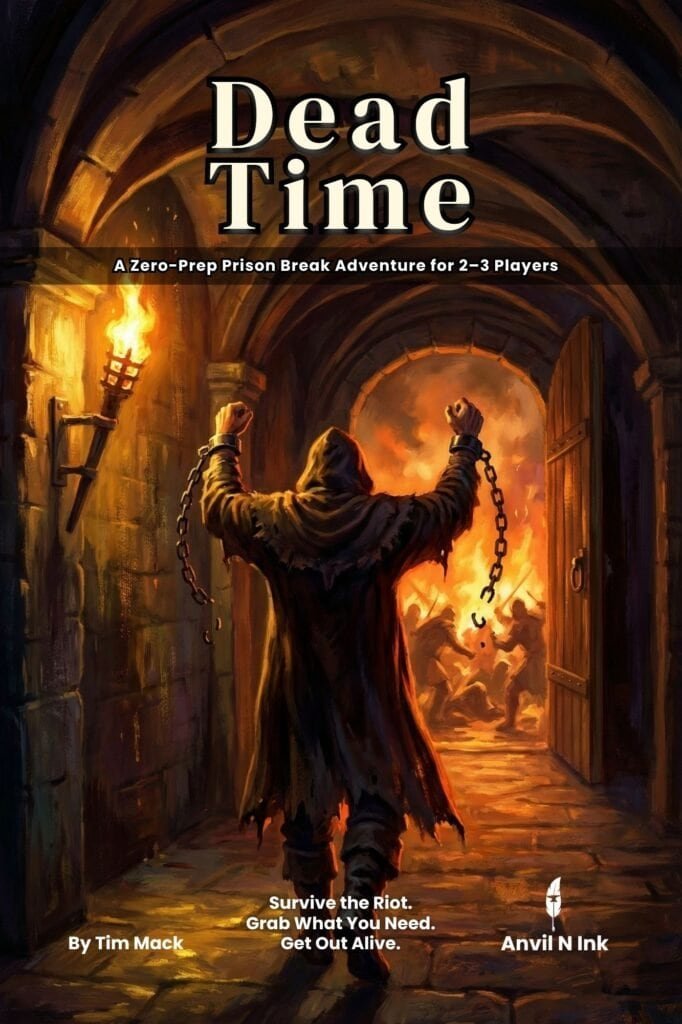

Dead Time:
A Zero-Prep Prison Break One-Shot for D&D 5e
Running a prison break one-shot in D&D 5e sounds great until you realize you need to design the prison, populate it with guards, build an escape sequence, and somehow make the players’ choices matter — all before your session starts. Dead Time does all of that for you. Open it, read the two-page overview, and run it tonight.
Dead Time is a complete, ready-to-run adventure for 2–3 players at Level 2–3, designed to fit a 2–3 hour session. The players have been wrongfully imprisoned for a month. They weren’t planning to escape today. But a riot just broke out in the mess hall, the guards are overwhelmed, and for the first time since their arrest, the doors are open. They have one window. They are going to take it.
A Prison Break Built on Real Player Choices
Most one-shot adventures give players an illusion of choice. Dead Time gives them the real thing. The adventure uses a six-location, three-act choice structure — in each act, players pick one of two locations to push through. One is held by rioting prisoners. One is controlled by guards. Each location holds a specific tool needed for the Act 4 escape. The tools they carry, and what they did to get them, directly determine how the gauntlet plays out.
Skip the flask of rendered fat and the gate section becomes a forced fight. Miss the key ring and the locked door has to come off its hinges. Every choice connects to a consequence, and the connection is visible enough that players feel clever when it pays off — without the DM ever explaining the system out loud.
The Hidden Faction Tracker
Beneath the adventure runs a scoring system the players never see. Every location is controlled by a faction — rioting prisoners or prison guards. Entering that location and taking its tool costs something with that faction. By Act 4, the hidden totals determine who is hunting the players through the city streets and how organized that pursuit is. A table that slipped through cleanly faces a different chase than one that burned every bridge. The consequences arrive in Act 4 without explanation, and the players feel them without understanding exactly why — which is exactly how cause and effect should feel in a riot.
Combat That Always Happens
Dead Time does not let skilled roleplayers skip the fights. Every location has a mandatory combat encounter. What the skill challenge determines is the difficulty — pass it and the most dangerous enemy in the room is gone before the first blow lands, leaving the players to handle the minions. Fail it and they face the full encounter, boss included. This keeps the adventure running at a consistent pace regardless of which way the dice fall, and it gives every session roughly the same runtime without feeling scripted.
The Escape Gauntlet: Four Sections, Every Tool Matters
Act 4 is the payoff. Players move through four sequential sections — Gate Guard, The Door, The Wall, The Chase — in order, with no going back. Each section can be bypassed cleanly using the right tool, or fought through without one. The adventure does not end on a missing tool. It gets harder.
The chase that closes Act 4 is five pre-written obstacles through city streets: the market lane, the canal bridge, the warehouse district, the tavern steps, and the tannery alley. Each obstacle has a fixed skill, a fixed DC, and a clear success and failure outcome. Players who get caught face a boss fight — Sera or Gerrit for the prisoner faction, Harwick for the guards — with the number of enemies scaled to how badly they antagonized that faction across the earlier acts. Getting knocked to zero HP is not the end. Both factions leave unconscious bodies in the street and move on. The players wake up, escaped, and in significantly worse shape than they planned.
The Epilogue Remembers Everything
Dead Time ends with 24 possible epilogue combinations. The DM reads two passages — one determined by the faction scores, one by the body count across all four acts — and together they describe the world the players are walking into. A clean escape with no kills produces a different city than a bloody exit with both factions at maximum hostility. The players never see the math. They just hear the result, and it lands because it is specific to what they actually did.
The body count categories run from Clean Hands (zero kills) through Necessary Violence, Bloody Exit, and Massacre. The faction outcomes range from no consequence through reputation, wanted posters, and active organized pursuit. Stack them together and you have a closing scene that feels earned rather than generic.
What’s Included in Dead Time
Dead Time is a complete package. Everything the DM needs is inside — no supplementary downloads, no extra purchases, no conversion required for 5e.
- Complete 2–3 hour one-shot for 2–3 players at Level 2–3
- Six fully detailed encounter locations across three acts, each with mandatory combat, a skill challenge that sets difficulty, and a What If section covering common player deviations
- Six battle maps with full tactical notation — cover positions, hazard zones, enemy starting positions, and objective markers
- 10 fully statted NPCs and combatants including Gerrit, Sera, Harwick, Dov, Aldric, and Warden Oskar Vane
- Four ready-made Level 2 characters — Fighter, Rogue, Cleric, Bard — with backstories and motivations, pick up and play immediately
- Hidden Faction Tracker with full consequence table for Act 4
- Five pre-written chase obstacles with fixed skills and faction-scaled caught encounters
- 24 epilogue combinations based on faction scores and body count
- Five DM Hooks for the wrongful conviction backstory
Perfect For Your Table
Busy DMs who want quality without prep time. The adventure is built to run cold. Read the two-page Story Arc Overview, keep the act structure open at the table, and let the players drive. The What If sections handle the moments when they do something unexpected.
Small groups of 2–3 players. Dead Time is designed from the ground up for small tables — not a larger adventure scaled down. The encounter difficulty, tool economy, and chase mechanics are calibrated for two or three characters without adjustment.
Convention play and one-shot nights. The runtime is reliable, the ready-made characters eliminate session zero, and the self-contained structure means it drops into any setting without backstory.
Players who want choices that actually matter. Nothing in Dead Time is decorative. Every location visited, every enemy killed, every faction antagonized feeds into Act 4 and the epilogue. Players at tables that run Dead Time tend to talk about it afterward — not because of a dramatic set piece, but because they remember what they decided and why.
Part of the Ready Adventure Series
Dead Time is part of the Ready Adventure Series by Anvil N Ink Publishing — zero-prep one-shots built specifically for small groups and short sessions. Every title in the series runs in 2–3 hours, requires no rebalancing for 2–3 players, and delivers a complete experience with meaningful consequences. No filler, no padding, no assumptions about table size.
Other titles in the Ready Adventure Series, the Twisted Tale Series, the Roleplay Guide Series, and the Adventure Toolkit Series are available at anvilnink.com.
Ready to Run a Prison Break Tonight?
Your players have been waiting for a session where their decisions matter from the first round to the last line of the epilogue. Dead Time delivers that in a package you can open twenty minutes before your session and run without breaking a sweat. The riot is already burning. The window is open. All you have to do is hand them the book and get out of their way.
Dead Time is the prison break one-shot for D&D 5e that runs itself — zero prep, real consequences, and a different escape every time.
Get Your Copy
Choose your preferred format