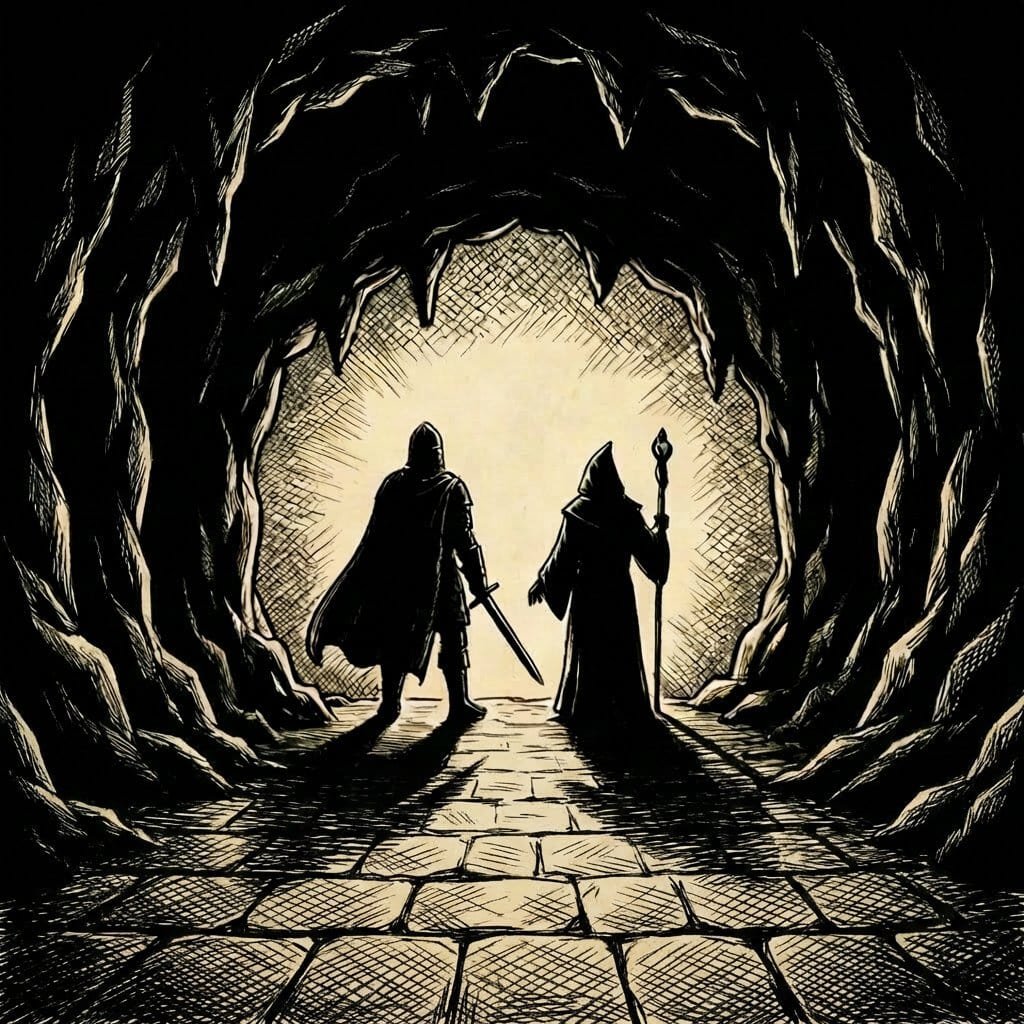

D&D for Two: How to Run Great Duet Adventures
Can you play D&D with just two people — one DM and one player? Not only can you, but duet D&D is one of the most rewarding ways to experience the game. The intimacy of one-on-one play produces character development, narrative depth, and emotional stakes that larger tables rarely achieve. No waiting for five other people to take their turns. No splitting spotlight time. Just your story, unfolding at exactly the pace you choose.
Whether you’re a couple looking for a shared hobby, a parent playing with a child, or two friends who can never coordinate a full group, this guide covers everything you need to run D&D for 2 players — from mechanical adjustments and adventure design to the unique roleplay opportunities that make duet play special.
This article is part of our Complete Guide to Running D&D for Small Groups, covering all aspects of play for tables of 2-3 players.
Why D&D for 2 Players Is Growing Fast
The TTRPG hobby has a scheduling problem. Getting four to six adults in the same room at the same time, consistently, is a logistical miracle that most groups eventually fail to sustain. Campaigns die not because the story ran out of steam but because three consecutive sessions got cancelled due to conflicts.
Two-player D&D sidesteps this entirely. Coordinating two schedules is dramatically easier than coordinating five. Sessions can happen on weeknights, during lunch breaks, or whenever both players have a spare couple of hours. The barrier to playing drops so low that “we should play D&D sometime” actually turns into playing D&D — regularly.
Beyond logistics, duet play offers something mechanically and narratively distinct. The single player character becomes the undisputed protagonist of the story. Every NPC interaction, every combat decision, every moral choice lands with full weight because there’s no committee to dilute it. The player can’t hide behind louder personalities or defer to the group’s optimizer. They are the story, and that level of investment produces sessions that both players remember for years.
The Action Economy Problem (and How to Solve It)
The biggest mechanical challenge in D&D for 2 players is action economy. A single player character gets one action, one bonus action, and one reaction per round. Most D&D encounters assume four characters are contributing to the fight. That imbalance means a solo PC can be overwhelmed by even modest opposition — not because the enemies are too strong individually, but because they simply get too many actions.
There are several proven solutions, and the best groups use a combination.
The Sidekick Approach
Tasha’s Cauldron of Everything formalized sidekick rules, and they’re tailor-made for duet play. A sidekick is a simplified companion character — a warrior, an expert, or a spellcaster — who fights alongside the player character without the complexity of a full PC build. The DM can run the sidekick, the player can control both characters, or you can split duties based on the situation.
The key is keeping the sidekick secondary. They should complement the PC’s abilities, not compete for narrative attention. A quiet warrior who follows orders and hits hard. A clever expert who picks locks and spots traps. A healer who keeps the hero standing. The sidekick enables the player’s heroics rather than generating their own.
Encounter Redesign
Rather than giving the player more characters, redesign encounters for the characters they have. Replace four goblins with two goblins and a collapsing tunnel. Swap a dragon fight for a chase sequence through burning streets. Use single powerful enemies with interesting mechanics instead of hordes of cannon fodder. When you design encounters around one or two characters instead of four, the game feels complete rather than depleted.
Environmental hazards are especially effective in duet play. A crumbling bridge, a flooding chamber, a room filling with poisonous gas — these create urgency and tactical decisions without requiring more actions on the enemy side. The environment becomes the encounter’s complexity engine, and it works beautifully for small group play at any size.
Adventures Designed for the Format
The most reliable solution is using adventures built specifically for one or two players. These adventures account for action economy, skill coverage, and resource management from the ground up — no retrofitting required.
The Stolen Festival Bell was designed specifically as a beginner-friendly adventure for exactly 2 players. Every encounter, puzzle, and social interaction is calibrated for a pair of characters. For players who want a grittier experience, The Bandit’s Keep is a stealth rescue mission for 1-2 players that emphasizes infiltration and clever problem-solving over brute-force combat — perfect for the kind of tactical, player-driven gameplay that duet sessions excel at.
Roleplay in Duet D&D: Where the Format Shines
If encounter design is duet play’s biggest challenge, roleplay is its biggest reward. One-on-one D&D produces the deepest character development in the hobby because the single player has unlimited spotlight time and the DM can tailor every NPC interaction to that specific character’s arc.
Character-Driven Storytelling
In a party of five, the DM writes story hooks broad enough for everyone to grab. In duet play, the DM writes story hooks that reach directly into the player character’s backstory, motivations, and fears. The estranged sibling shows up asking for help. The mentor they abandoned sends a letter. The thing they’re most afraid of is waiting in the next room.
This precision of narrative targeting is only possible when you’re writing for one character. Use it aggressively. Ask the player about their character’s past, their goals, their unresolved conflicts — then build sessions around those answers. The player will feel like the world revolves around them, because in duet play, it genuinely does.
NPC Relationships
With only one player character, NPCs carry more weight. The bartender isn’t background scenery — they become a recurring confidant, a source of information, or a friend the player genuinely cares about. Recurring NPCs in duet campaigns develop the kind of depth that supporting characters in novels achieve. Give them consistent personalities, let them grow and change in response to the player’s actions, and don’t be afraid to put them in danger.
Antagonists benefit from the same treatment. A villain who has a personal connection to the player character — a rival, a former ally, someone who wants the same thing for different reasons — creates stakes that abstract threats never match. When the BBEG is someone the player character knows, the final confrontation isn’t just a boss fight. It’s an emotional reckoning.
Deepening Your Roleplay
Duet play gives you room to explore character voices, mannerisms, and cultural identity in ways that larger tables don’t always support. Our Roleplay Guide Series provides practical tools for this — 50+ in-character phrases, cultural context, and detailed archetypes for races including Dwarves, Elves, and Tieflings. When you have the full spotlight, having authentic dialogue and personality foundations makes every scene richer.
Session Structure for Two-Player Games
Duet sessions benefit from a slightly different structure than full-party games. Here’s what works.
Shorter, More Frequent Sessions
The sweet spot for duet D&D is 90 minutes to 2 hours. Without the coordination overhead of a larger group — waiting for everyone to arrive, managing cross-talk, resolving competing player goals — sessions move faster. You accomplish in 90 minutes what a five-player table takes three hours to cover. This makes weeknight sessions genuinely viable, which is why duet players often game two or three times more frequently than traditional groups.
Start in Motion
Open every session with the character already doing something. Walking through rain toward a destination. Waking to the sound of breaking glass. Reading a letter that changes everything. Duet sessions don’t need warmup time because there’s no social dynamics to settle. The player is ready to engage immediately, so meet them with energy.
Alternate Between Action and Dialogue
The rhythm of duet play should alternate between high-tension scenes (combat, chases, time pressure) and lower-tension scenes (conversations, investigation, exploration). This cadence gives both the player and the DM breathing room while maintaining engagement. Two combat encounters in a row risks exhausting a solo player’s resources. Two dialogue scenes in a row risks losing momentum. Alternate, and the session flows naturally.
Couples D&D: Playing With Your Partner
One of the fastest-growing segments of duet D&D is couples play. Partners who already share a household, a schedule, and a desire for shared hobbies discover that D&D provides something most couple activities don’t — genuine creative collaboration where both people contribute to something they couldn’t create alone.
A few considerations specific to couples play. First, establish early whether the non-DM partner wants to be challenged, supported, or surprised. Some partners want the full D&D experience including character death risk and moral complexity. Others want a collaborative story where the fun is in the journey, not the danger. Neither preference is wrong, but mismatched expectations create friction.
Second, share the DM role if possible. Alternating who runs the game prevents forever-DM burnout and gives both partners the experience of being a player. You can run entirely separate stories in the same world, or even continue the same storyline from different angles.
Third, use D&D as a date night, not a chore. Set the atmosphere — candles, snacks, music. Treat it like an event rather than homework. The couples who sustain duet campaigns are the ones who look forward to it, not the ones who squeeze it in between obligations.
Parent-Child Duet Play
A parent running D&D for one child is perhaps the purest form of duet play. The parent knows the child’s interests, attention span, and emotional readiness better than any adventure designer ever could. That knowledge lets you tailor sessions in real time — pulling back when something’s too intense, leaning in when their eyes light up, and celebrating their creative solutions even when they break your carefully planned scenario.
For parent-child duets, start with simple objectives and clear heroes-versus-villains framing. Moral complexity can come later as the child develops. Keep sessions to 45-60 minutes for kids under 10, building toward 90 minutes as they mature. And always, always let them win through their own choices — not because you handed them the victory, but because you designed a challenge at the right difficulty for them to earn it.
The Stolen Festival Bell works beautifully for parent-child duets — it’s beginner-friendly, clearly structured, and designed for exactly two players. For families with children on the autism spectrum, The Neurodivergent Adventurer’s Guide provides specific session structures and adaptations for ages 8-14.
We cover family play in much more detail in our guide on starting D&D with your kids, including session length, content selection, and how to teach the game through play rather than lectures.
Adventure Selection for Duet Play
Not every adventure genre works equally well for two players. Here’s what to prioritize and what to avoid.
Genres That Excel
Stealth and infiltration missions are perfect for duet play. A single operative sneaking through a fortress, making quick decisions, and adapting on the fly captures the tension of a heist movie without the coordination challenges of a larger party. Investigation and mystery adventures reward the focused attention that a single player brings — they remember every clue, connect every thread, and feel genuine satisfaction when the pieces come together.
Survival adventures also shine with one or two characters. Every resource decision matters, every rest is a risk, and the vulnerability that would frustrate a larger party creates genuine tension for a solo adventurer. Frostfall drops a small party into frozen wilderness where trust and resource management are as dangerous as the cold.
Genres to Approach Carefully
Large-scale military conflicts and mass combat don’t suit duet play — the player character feels lost in the crowd. Political intrigue with many factions can overwhelm a single player tracking relationships. Extended dungeon crawls with dozens of rooms risk attrition that depletes a solo character’s resources past the point of fun. These genres can work with modification, but they require more careful design than the formats listed above.
The Complete Duet Library
Building a library of adventures designed for one or two players means you’re always ready to play. Beyond the adventures mentioned above, the entire Ready Adventure Series scales to small groups, and several titles work especially well at the duet level. For ongoing duet campaigns, having a collection of one-shots lets you maintain momentum even when you don’t have time to plan the next chapter of a longer story.
Common Duet D&D Mistakes
After years of designing for small groups, we’ve seen the same mistakes come up repeatedly in duet play.
Over-protecting the player character is the most common. When there’s only one PC, the DM instinctively softens every threat, fudges every roll, and ensures the hero always wins. This feels safe, but it actually undermines the experience. Players sense when danger isn’t real, and without real stakes, victories feel hollow. Trust your player to handle setbacks. A character who almost dies and claws back from the edge tells a better story than one who breezes through without a scratch.
Running encounters designed for four players is the mechanical version of the same problem. If you’re pulling monsters from the Monster Manual without adjusting for a two-character party, you’ll either TPK constantly or fudge so much that the dice stop mattering. Use adventures designed for the format, or apply the encounter redesign principles from earlier in this guide.
Neglecting NPC companions is a subtler mistake. A solo player character traveling the world completely alone feels lonely, not heroic. Populate their journey with allies, contacts, and rivals. Not every session needs a sidekick in combat, but every session benefits from the player character having someone to talk to besides the DM’s narration voice.
Finally, treating duet play as “real D&D but smaller” misses the format’s unique potential. Duet D&D isn’t a diminished version of the full-party experience. It’s a different medium — closer to a novel than an ensemble show. Embrace what it does well rather than mourning what it doesn’t, and you’ll discover why so many players consider it their favorite way to play.
Getting Started Tonight
If you’ve been waiting for the right moment to try duet D&D, this is it. Grab a willing partner, pick up an adventure designed for two players, and set aside two hours. You don’t need miniatures, battle maps, or a library of sourcebooks. You need two people, a set of dice, and a story to tell together.
The table is set. The adventure is waiting. All you need is two.
Adventures built for two. No rebalancing, no compromises. Explore the Ready Adventure Series and find your next duet session at anvilnink.com.