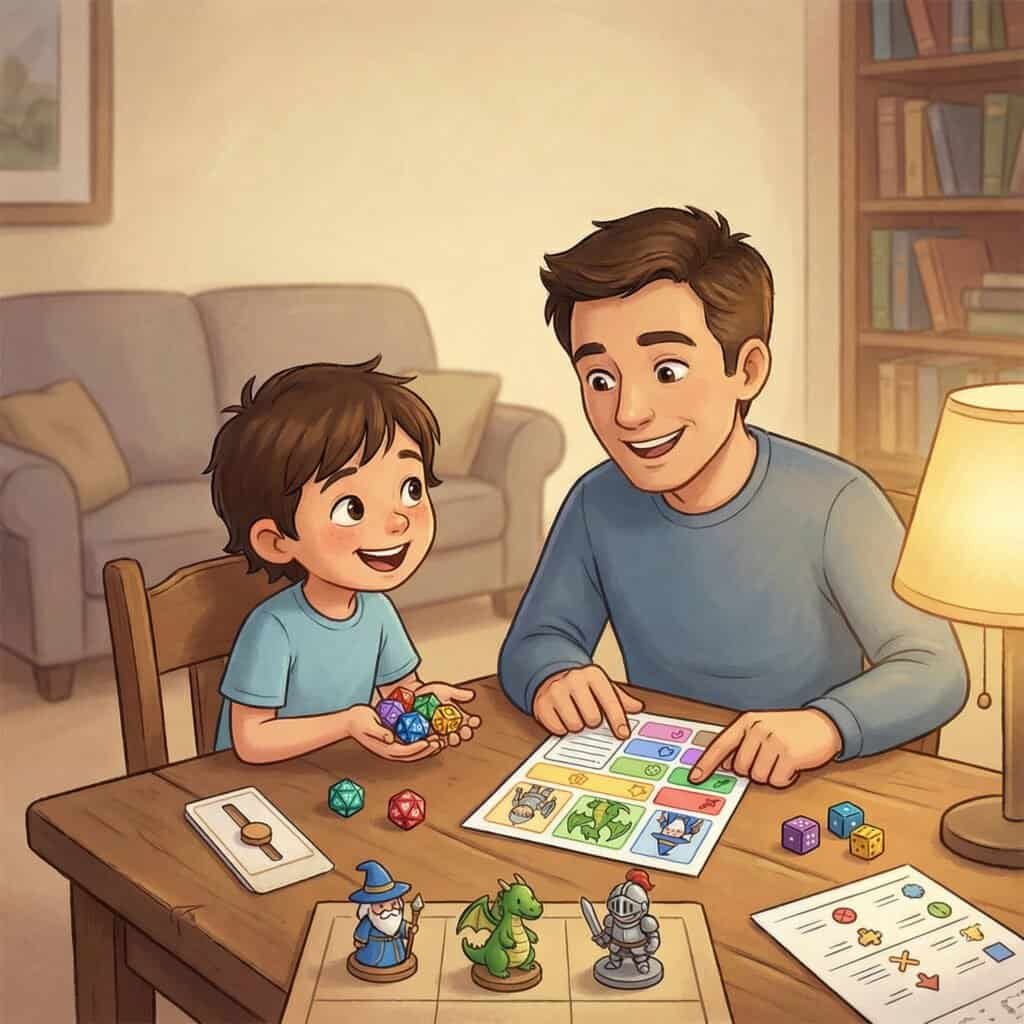

D&D for Autistic Children: A Parent’s Guide to Tabletop Adventures That Work
Your child memorizes entire monster manuals. They’ve watched every D&D actual play episode twice. They desperately want to play Dungeons & Dragons—but traditional game structures weren’t designed with their needs in mind. If you’re wondering whether D&D for autistic children can actually work, the answer is yes. With the right adaptations, tabletop roleplaying becomes a powerful tool for social skill development, creative expression, and genuine fun.
Dungeons & Dragons offers something unique for children on the autism spectrum. The game provides structured social interaction with clear rules and expectations. It rewards the deep knowledge and passionate interests that autistic children often develop. It creates safe spaces to practice conversation, perspective-taking, and collaboration without the unpredictability of unstructured social situations.
This guide covers everything parents and educators need to know about running D&D for autistic children ages 8-14. We’ll explore why the game works so well for neurodivergent players, specific adaptations that support success, common challenges and solutions, and resources designed specifically for this purpose. No prior D&D experience required—just a willingness to learn alongside your child.
Why D&D Works for Children on the Autism Spectrum
The same features that make D&D appealing to millions of players worldwide align remarkably well with autistic cognitive patterns and needs. Understanding these alignments helps you leverage the game’s natural strengths.
Structured Social Interaction
Unstructured social situations often overwhelm autistic children. Reading facial expressions, interpreting tone, knowing when to speak—the implicit rules governing casual conversation can feel impossibly complex. D&D replaces this ambiguity with explicit structure.
Players take turns in defined order. The DM provides clear prompts for when responses are expected. Game mechanics determine success and failure rather than social interpretation. This predictability reduces anxiety while still providing genuine social engagement.
The structure doesn’t eliminate social learning—it scaffolds it. Children practice conversation within a supportive framework. They learn to listen to others, build on shared narratives, and collaborate toward goals. The explicit rules make implicit social skills accessible.
Deep Knowledge Is Rewarded
Many autistic children develop intense interests and accumulate detailed knowledge about specific topics. Traditional education sometimes struggles to engage these passions. D&D celebrates them.
The child who memorizes monster statistics becomes a valued tactical advisor. The one who knows every spell in the Player’s Handbook helps the party solve problems. The encyclopedic knowledge that might seem excessive elsewhere becomes a genuine superpower at the gaming table.
This validation matters enormously. Children who often feel “too much” in other contexts discover their intensity is welcomed and appreciated. The message is clear: who you are belongs here.
Safe Emotional Exploration
Roleplaying provides distance from difficult emotions. A child who struggles to discuss their own feelings might explore those feelings through a character. Fear, anger, sadness, joy—all can be experienced and processed through the safe fiction of the game.
This emotional exploration happens naturally during play. Characters face moral dilemmas, experience loss, celebrate victories. The child engages with these experiences without the vulnerability of personal disclosure. Over time, the skills practiced in-game transfer to real-world emotional processing.
Essential Adaptations for Autistic Players
While D&D’s structure naturally supports autistic players, specific adaptations improve the experience significantly. These modifications don’t fundamentally change the game—they optimize it for neurodivergent success.
Visual Supports and Schedules
Many autistic children process visual information more effectively than auditory instruction. Providing visual supports transforms abstract rules into concrete references.
Create a session structure visual showing the sequence of activities: arrival, character review, adventure, break, more adventure, wrap-up. Knowing what comes next reduces anxiety about transitions. Post the schedule where players can reference it throughout the session.
Condition cards help track character states. Rather than remembering “you’re poisoned,” hand the player a card labeled “POISONED” with the mechanical effects listed. The physical token makes the abstract condition concrete and memorable.
Combat trackers showing turn order provide crucial predictability. Players know exactly when their turn arrives, allowing preparation without the anxiety of uncertain timing.
Sensory Considerations
Gaming environments often challenge sensory sensitivities. Fluorescent lighting, background noise, crowded spaces—any of these can overwhelm before the game even begins.
Choose your environment deliberately. Soft lighting reduces visual strain. Background music should be optional and controllable. Comfortable seating matters more than “proper” gaming setup. Consider fidget tools that don’t disrupt others—textured dice, quiet manipulatives, stress balls.
Build in sensory breaks. A five-minute pause every 45 minutes allows regulation before overload occurs. Some children benefit from movement breaks; others need quiet stillness. Know your child’s needs and build the session around them.
Modified Social Expectations
Traditional D&D emphasizes voice acting, dramatic description, and performative roleplay. These expectations can create barriers for children who struggle with verbal expression or prefer less theatrical interaction.
Offer multiple ways to participate. Some players narrate character actions in third person rather than speaking as the character. Others prefer written communication for complex ideas. Some might draw their character’s response rather than verbalize it.
The goal is engagement, not performance. A child who says “my character talks to the guard about the dungeon” participates as meaningfully as one who voices elaborate dialogue. Meet players where they are rather than pushing toward neurotypical roleplay conventions.
Running Sessions for Neurodivergent Players
Successful D&D for autistic children requires specific DM techniques that account for different processing styles and needs.
Clear Communication Patterns
Ambiguous language creates confusion. “The guard seems suspicious” requires interpretation—suspicious of whom? About what? “The guard narrows his eyes and asks why you’re really here” provides concrete, observable information players can respond to.
Avoid idioms and figurative language when possible. When using them, be prepared to clarify. “The inn is dead tonight” might genuinely confuse a literal thinker; “the inn has very few customers” communicates the same information accessibly.
Provide explicit choices when decisions are needed. Rather than “what do you do?” try “do you want to explore the left corridor, the right corridor, or try talking to the statue?” Defined options prevent the paralysis of unlimited possibility.
Processing Time
Many autistic children need additional time to process information and formulate responses. Silence after a question often indicates processing, not disengagement. Rushing or rephrasing interrupts that processing and forces restart.
After asking a question, wait. Count silently to ten before offering prompts. If the child still seems stuck, offer a choice or provide additional context rather than repeating the original question. Processing time is not wasted time—it’s thinking time.
This patience benefits the entire group. Other players learn that thoughtful consideration is valued over quick responses. The table culture becomes more inclusive naturally.
Consistent Structure Across Sessions
Predictability reduces anxiety. When sessions follow consistent patterns, children can prepare mentally for what’s coming. This preparation allows them to engage more fully rather than expending energy on managing uncertainty.
Start each session the same way. Perhaps a brief recap of previous events, then a check-in question, then adventure begins. End sessions consistently too—a summary of accomplishments, preview of next session, same closing ritual each time.
Maintain consistency in rules application. Changing how mechanics work between sessions creates confusion and undermines trust. If you need to modify a rule, explain the change clearly before implementing it.
Social Skill Development Through Play
D&D naturally teaches social skills that traditional instruction often struggles to convey. The game provides context and motivation for practicing skills that might otherwise feel arbitrary.
Turn-Taking and Listening
The fundamental structure of D&D requires turn-taking. Players must wait for others to act, listen to what happens, and respond appropriately. These skills develop through practice within an engaging activity rather than through direct instruction.
Combat especially reinforces turn-taking. The initiative order makes sequence explicit. Each player’s turn matters to everyone because it affects the shared situation. Listening becomes functional, not just polite—you need to know what’s happening to respond effectively.
Perspective-Taking
Playing a character different from yourself requires imagining another perspective. What would my dwarf fighter do? How does my character feel about this situation? What does my character know (versus what I know as a player)?
This imaginative perspective-taking practices the cognitive skills underlying social cognition. The fictional distance makes it safer than attempting to imagine real people’s perspectives. Over time, the practice transfers to improved perspective-taking in daily life.
Collaborative Problem-Solving
D&D constantly presents problems requiring group solutions. Combat encounters demand tactical coordination. Puzzles benefit from diverse thinking. Social challenges require the party to coordinate approaches.
Children learn that their contributions matter and that combining different strengths produces better outcomes than individual effort. They practice negotiation, compromise, and building on others’ ideas—all skills with obvious real-world applications.
Choosing Appropriate Adventures
Not all D&D content suits all players. Selecting age-appropriate adventures with appropriate complexity ensures positive experiences.
Complexity Considerations
Published adventures often assume experienced players and include complexity that overwhelms newcomers. For autistic children especially, simpler is often better—at least initially.
Look for adventures with clear objectives, limited NPC complexity, and straightforward moral situations. “Rescue the captured villagers from the goblin cave” provides clear motivation and obvious goals. “Navigate the political intrigue of three rival noble houses” requires social sophistication that may frustrate rather than engage.
As players gain experience and confidence, complexity can increase. Start simple, observe what engages your specific players, and adjust accordingly.
Content Warnings and Boundaries
Some D&D content includes themes that may distress specific children. Horror elements, morally ambiguous situations, character death, depictions of violence—any of these might require consideration.
Discuss content boundaries before beginning any adventure. Establish that anyone can pause the game if content becomes uncomfortable. Respect boundaries without requiring explanation. Creating psychological safety supports the engagement that makes D&D beneficial.
Purpose-Built Resources
The Neurodivergent Adventurer’s Guide provides complete adventures and DM guidance specifically designed for running D&D with autistic children ages 8-14. The adventures incorporate all the adaptations discussed here, eliminating the guesswork of modifying standard content.
Purpose-built resources save enormous preparation time. Rather than adapting adventures intended for neurotypical adult players, you run material designed from the ground up for your specific audience. The Guide includes visual supports, modified mechanics, sensory break suggestions, and complete adventures ready to run with minimal preparation.
Common Challenges and Solutions
Even with careful preparation, challenges arise. Anticipating common difficulties helps you respond constructively when they occur.
Difficulty with Unexpected Outcomes
Dice introduce randomness that some autistic children find distressing. Carefully planned actions fail due to unlucky rolls. Anticipated successes become failures. The unpredictability that excites some players frustrates others.
Several approaches help. Explain probability before play—a d20 roll has equal chance of any result; high modifiers make success more likely but never certain. Normalize failed rolls as interesting complications rather than punishments. Consider success-with-complication approaches where failed rolls still accomplish goals but introduce new challenges.
For children who find dice deeply frustrating, consider modified systems where player choices matter more than random chance, or “failing forward” approaches where failure advances the story rather than blocking it.
Rigid Rule Interpretation
Some autistic children interpret rules literally and struggle when DMs make rulings that differ from strict text readings. “But the book says…” becomes a recurring objection.
Establish early that the DM interprets rules for this specific game. Create a principle: “The rules help us tell good stories. Sometimes we’ll adjust them to make better stories.” When making rulings, explain your reasoning. Consistency matters—apply the same principles each time similar situations arise.
Channel rules expertise positively. The child who knows every rule becomes a valued rules consultant. Their knowledge helps the group while satisfying their need for systematic thinking.
Hyperfocus and Session Boundaries
Hyperfocus—intense concentration on engaging activities—is common among autistic individuals. D&D can trigger hyperfocus, making session endings difficult. The child who can’t start playing may become the child who can’t stop.
Build transition warnings into your session structure. “We have 30 minutes left” and “we have 10 minutes left” prepare for the coming end. Establish a consistent stopping ritual that signals session completion. Provide something to look forward to: “Next time, we’ll explore the dragon’s cave!”
Consider what happens after D&D. If the child must transition to homework or bedtime, that transition is harder than transitioning to preferred activities. Schedule sessions so aftermath activities are appealing rather than frustrating.
Building Your D&D Group
Finding the right group matters as much as running good sessions. The social environment surrounding the game significantly impacts outcomes.
Starting with Family
Family games provide maximum control over the environment and social dynamics. Parents, siblings, and trusted relatives already understand the child’s needs. Communication about accommodations happens naturally.
Family games also remove the social uncertainty of peer interaction. The child can learn the game in a completely safe environment before potentially expanding to include non-family members.
Expanding Carefully
If your child wants to play with peers, expand the group thoughtfully. One trusted friend at a time works better than immediately joining established groups. The new player should understand and respect the accommodations in place.
Consider whether other neurodivergent children might make ideal gaming companions. Shared experiences can create natural understanding and mutual accommodation. Many communities have autism-specific D&D groups that provide built-in compatibility.
Professional Settings
Some therapists and educators use D&D as a therapeutic tool. If your child works with professionals who understand both autism and tabletop gaming, their sessions might incorporate therapeutic D&D elements.
These professional settings provide expertise that family games may lack. Therapists can deliberately design encounters that practice specific skills. They can process game experiences afterward, connecting in-game events to real-world applications. If this option is available and affordable, it can complement home games effectively.
Getting Started: Your First Session
Theory matters less than practice. These concrete steps help you run your first D&D for autistic children session successfully.
Keep It Simple
Your first session should last 60-90 minutes maximum. Include one simple objective: rescue someone, retrieve something, explore somewhere. Use pre-generated characters rather than character creation. Limit rules to basics—attack rolls, ability checks, simple spells.
Success in the first session matters more than complexity. A child who has fun wants to play again. Complexity can always be added later; negative first impressions are harder to overcome.
Prepare Your Space
Set up before the child arrives. Minimize distractions. Have all materials ready. Post the visual schedule. Test any technology. The session should begin smoothly rather than with setup chaos.
Consider a dedicated gaming space if possible. Consistency in physical environment supports cognitive accessibility. The child knows what to expect when they enter the D&D space.
Celebrate Everything
First sessions should feel successful regardless of what happens in the fiction. Did the character die? What a dramatic story! Did they defeat the goblins easily? Heroic victory! Did they go completely off-script? Creative problem-solving!
The message: playing D&D is fun, and you’re good at it. Build confidence before introducing challenges.
Conclusion: Adventures Waiting to Happen
Running D&D for autistic children isn’t just possible—it’s potentially transformative. The game offers structured social interaction, validates intense interests, provides safe emotional exploration, and builds practical skills through engaging play. With appropriate adaptations, children who struggle in other social contexts thrive at the gaming table.
Resources like The Neurodivergent Adventurer’s Guide eliminate the guesswork, providing complete adventures and detailed guidance for parents and educators. You don’t need D&D expertise to share this experience with your child—just willingness to learn together and commitment to creating a supportive environment.
Your child’s greatest adventures are waiting. The dice are ready. The story begins whenever you’re ready to tell it.
Every child deserves epic adventures. Autism doesn’t change that—it just means we adapt the adventure to fit the hero.