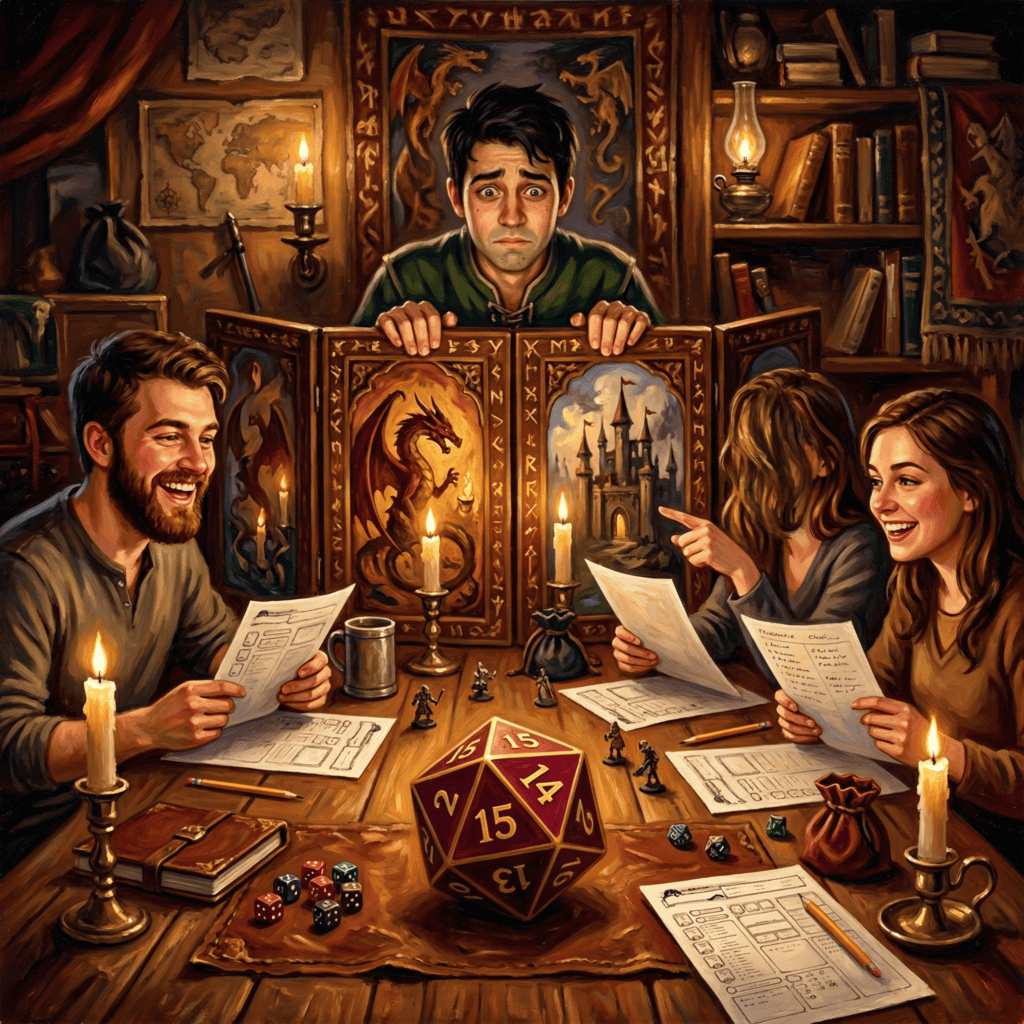

Finding the right D&D one-shot for beginners is not about finding the simplest possible adventure. It is about finding an adventure that is designed so the DM can focus on learning to run the game rather than managing a complicated structure at the same time.
The difference matters. A simple adventure and a beginner-friendly adventure are not the same thing. A simple adventure might have one location and three encounters. A beginner-friendly adventure has a clear structure, forgiving pacing, pre-generated characters the DM can hand to players without explanation, and enough flexibility that when something goes sideways — and something will go sideways — the session does not collapse.
This guide covers what to look for in a D&D one-shot for beginners, seven specific recommendations across different styles, and answers to the fears every new DM has before their first session.
What Makes a D&D One-Shot Beginner-Friendly?
Four features separate a genuinely beginner-friendly one-shot from an adventure that just happens to be short.
Pre-Generated Characters Included
Character creation is a significant time investment, and for a first session it front-loads all the complexity before anyone has had any fun. A one-shot that includes pre-generated characters lets the DM hand out sheets and start playing. Players will ask questions about their character as they come up during the session — which is actually the best way to learn the mechanics, because the context makes them meaningful.
Pre-gens should include personality notes, not just stat blocks. A stat block tells players what their character can do mechanically. Personality notes tell them how to play the character when it matters — which is most of the session.
Clear Structure and Obvious Stakes
A beginner-friendly one-shot communicates the objective clearly within the first five minutes of play. Players should know what they are trying to do, roughly what stands in their way, and why it matters. Adventures that reveal the true objective two-thirds of the way through require players to hold uncertainty for too long — which is fine for experienced groups who trust the DM to deliver, but confusing for new players who are not sure if they are doing it right.
Clear does not mean simple. An adventure can have genuine moral complexity and still communicate the core situation clearly. “Someone took something. Get it back. The person who took it might have had a reason.” That is clear, and there is still a lot of room for an interesting session within it.
Forgiving Encounter Design
New DMs have not yet developed the instinct for when to fudge a roll, when to scale an encounter on the fly, or when a combat is running long and needs a shortcut. Beginner-friendly adventures account for this by designing encounters that have some give — enemies who retreat rather than fighting to the death, situations where creative solutions are obviously available, and climax encounters that are dramatic without being mechanically punishing.
An encounter that can kill the party in round two is not a good beginner adventure. Not because the stakes should not be real, but because the DM does not yet have the tools to recover gracefully from an unexpected total party kill. Give the first-time DM room to manage.
Pacing That Accounts for Slow Scenes
New players take longer to make decisions. Not because they are indecisive — because they are processing more. They are figuring out what their character would do while simultaneously figuring out what the rules allow and whether the DM expects them to act now. Adventures marketed as “2 hours” run 3 to 4 hours with a new group. A beginner-friendly one-shot should be designed light enough that this expansion does not break the adventure.
7 D&D One-Shots for Beginners Worth Running
1. The Stolen Festival Bell (Anvil N Ink)
Designed specifically for 2 players plus a DM, which reduces the table management overhead considerably. Clear objective from the first scene. Pre-generated characters included. Multiple solutions to the central problem, none of which require combat if players choose to avoid it. Runs cleanly in 2 hours, so even with new-player expansion it stays manageable. The moral stakes are real without being overwhelming — a good first session for players who want to feel like their decisions mattered.
2. No Rest for the Buried (Anvil N Ink)
A gateway adventure specifically designed for new players. The premise is immediately clear, the setting is grounded and familiar, and the encounters build in complexity as the session progresses rather than throwing everything at the table in the first act. Good for groups that want something with a bit of mystery without the full apparatus of a mystery one-shot.
3. Goblin Defense — The Other Side of the Door (Anvil N Ink)
One of the best beginner adventures for a group that wants to try something unexpected. Players take the roles of goblins defending their home from the “adventurers” who have come to raid it. Flips the standard D&D premise in a way that immediately makes the stakes personal and legible. No genre knowledge required — the situation communicates itself. Excellent for groups who are interested in D&D but bored by the idea of a standard dungeon crawl.
4. The Lost Mine of Phandelver (Wizards of the Coast)
The classic recommendation for a reason. It is designed as an introductory adventure, it is well-tested, and it has extensive community support in the form of guides, prep notes, and advice for new DMs. It is technically a short campaign rather than a one-shot, but the first session (the ambush scene and Cragmaw Hideout) works as a standalone session and gives new DMs an excellent first experience. The main limitation is that it assumes a party of four, so it may need light adjustment for smaller groups.
5. The Crimson Ceremony (Anvil N Ink)
A more ambitious choice for a beginner DM who is comfortable with the basic rules and wants to try something with more roleplay weight. Political thriller structure, four suspects, genuine ambiguity. The reason it works for beginners despite its complexity: the information architecture is clean. The DM always knows who actually did it and why. Players are investigating a situation the DM has complete clarity on, which makes improvisation much easier than mysteries where the DM is also discovering the answer.
6. A-Maze-ing Fools (Anvil N Ink)
For a group that wants to laugh. The soul-swap premise — characters wake up in each other’s bodies — immediately generates roleplay without the DM having to engineer it. Players are incentivised to play each other’s characters, which is both funny and genuinely useful for new players who are not sure what “playing in character” means. The comedy scaffolds the roleplay learning.
7. The Merchant’s Vault (Anvil N Ink)
If the group wants a heist. More complex than the other options here, but the heist format is naturally beginner-friendly in one specific way: the planning phase gives players agency before any dice are rolled, which means they arrive at the execution phase feeling invested. New players who planned the heist themselves are more engaged with what happens when the plan goes wrong. The Merchant’s Vault provides the location, the guards, and the complications — players provide the plan.
Answering the Fears Every New DM Has
What if the session finishes too early?
Have one expansion beat ready before you run: a character or complication you can introduce if the players resolve the main problem faster than expected. It does not need to be elaborate — a secondary NPC with a request, a discovery that raises a new question, a complication that adds one more scene. You probably will not need it. But knowing it is there removes the anxiety that keeps new DMs from letting players succeed efficiently.
What if players go completely off-script?
Say yes to what they are trying to do, then figure out what happens. You do not need to know the answer immediately — a brief pause to think is completely normal and experienced DMs do it all the time. The adventure is not the game. The adventure is the starting point. What players decide to do with it is the game. For more on this, the guide on how to run a one-shot in D&D covers the session structure and improvisation basics in detail.
What if combat runs too long?
Two options. First, enemies can retreat, surrender, or be interrupted — any of these ends the combat without a total resolution and often produces more interesting fiction than fighting to the last hit point. Second, in a genuinely stalled combat, you can accelerate by having enemies make mistakes, introducing a distraction, or simply asking players “what do you do?” more quickly and keeping the pace up. Combat runs long when players feel like they have time to deliberate. Gentle urgency from the DM speeds it up.
What if I forget a rule?
Make a call, keep moving, look it up after the session. The worst thing that happens when you get a rule wrong is that you correct it next session. The worst thing that happens when you stop to look up every rule is that the session stops being fun. Experienced DMs get rules wrong constantly. The skill is not knowing every rule — it is making confident decisions that keep the game moving while you figure it out later.
For new DMs who want more support beyond this article, the guide on new DM mistakes to avoid covers the ten most common first-session errors and how to sidestep them. The session zero guide is also worth reading before your first session — it covers the conversations to have with players that prevent most first-session problems before they happen.
For a broader view of what makes one-shots work across all genres and experience levels, the complete guide to the best D&D one-shots covers the full picture.
Frequently Asked Questions: D&D One-Shots for Beginners
How long should my first D&D one-shot be?
Aim for a session designed to run 2-3 hours, then plan for it to actually run 3-4 hours with a new group. New players take longer to make decisions because they are processing more. An adventure that runs 2 hours with an experienced group is a 3-hour adventure with beginners. That is not a problem — it is just the realistic runtime to plan around.
Do I need to read the whole adventure before I run it?
Yes. Once is enough, but read it all the way through before you sit down at the table. You need to know how the adventure ends and what the major beats are before you can improvise confidently when players go sideways. DMs who have only read partway through consistently get caught by surprises they could have anticipated.
What if my players have played before but I haven’t DMed?
Tell them. Experienced players are generally very willing to help a new DM, and knowing the DM is new calibrates their expectations appropriately. Most experienced players have been new DMs themselves and remember what it was like. The worst thing you can do is pretend to know things you do not — questions you cannot answer will come up, and pretending you know creates more problems than admitting you do not.
Can I run a one-shot for just 2 players?
Yes, and it is often the best format for a first session. Fewer players means less table management, more focus per player, and a faster pace. Make sure you choose an adventure designed for 2-3 players rather than scaling down a full-table adventure. Adventures designed for 2 players balance encounters and spotlight appropriately for that group size. The complete guide to D&D for 2-3 players covers what makes this format work differently from larger tables.
Is it better to use a published adventure or make my own for a first session?
Published adventure for your first session, without question. Writing a one-shot well is a skill that develops over time. Running a well-designed published adventure teaches you what good adventure structure feels like from the inside, which is the foundation you need to write your own. Once you have run two or three published one-shots, you will have a much clearer sense of what your homebrew needs to do and why.
Ready to run your first session? The Ready Adventure Series from Anvil N Ink is designed specifically for new DMs — complete one-shots with pre-generated characters, clear structure, and zero-prep runtime. Browse individual titles on Amazon or pick up the Complete Collection bundle on Payhip for the full library at a discount.
The best D&D one-shot for beginners is the one you actually run — and the one you actually run is the one that was designed to be run, not the one that sounded good in the product description.