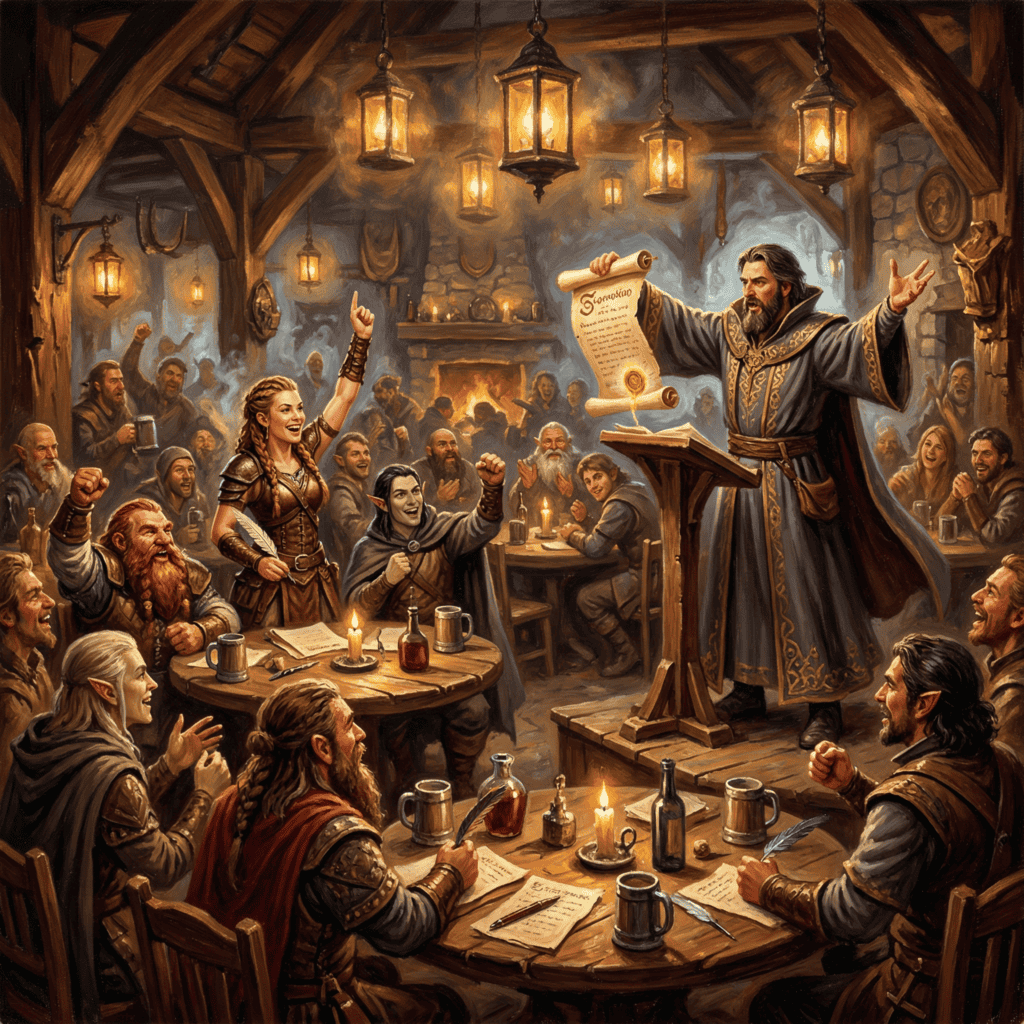

D&D pub quiz questions are harder to find than they should be. Most D&D trivia online is either too easy to be interesting, too obscure to be fair, or buried in formats that require a subscription to access. This page gives you 30 free D&D pub quiz questions — actual usable trivia with answers — sorted into categories so you can run a proper quiz tonight without any additional prep.
Below the free questions you will find information about Roll for Knowledge, the Anvil N Ink pub quiz book with 550 questions across ten categories. But the 30 questions here are free. Use them as-is, mix them with your own, or treat them as a preview before you decide whether you want the full book.
How to Run D&D Pub Quiz Questions at Your Table
Before the questions, a quick note on format. The cleanest approach for a one-session quiz is four to five categories with five to eight questions each. Read each question aloud, give players thirty seconds to write their answer, then reveal and score at the end of each category. Keep the tone light — the goal is a good evening, not a comprehensive knowledge assessment.
If you are running this for a mixed group — some players are deeply into D&D lore, others are newer — weight your categories toward rules and general knowledge rather than deep lore. A question about what a Beholder looks like is accessible; a question about the specific number of eye stalks requires memorisation. The best pub quiz questions reward people who pay attention to the game they play, not people who have read every sourcebook.
For a full guide on setting up a D&D quiz night — venue tips, scoring systems, team formats, and how to handle disputes — the D&D pub quiz night guide covers the complete setup.
30 Free D&D Pub Quiz Questions With Answers
Category 1: D&D Rules and Mechanics (8 Questions)
Q1. What is the maximum number of attunement slots a character can have in D&D 5e?
Answer: 3
Q2. What ability score modifier is used for spell attack rolls and spell save DC for most spellcasters?
Answer: Their spellcasting ability modifier (varies by class — Intelligence for Wizards, Wisdom for Clerics, Charisma for Sorcerers/Bards/Warlocks)
Q3. What happens when a character fails three death saving throws?
Answer: The character dies
Q4. How many sides does a d20 have? (Yes, this is a trick warm-up question.)
Answer: 20
Q5. What is the name of the action a character can use to help an ally, granting them advantage on their next ability check or attack roll?
Answer: The Help action
Q6. In D&D 5e, what is the term for a short period of rest that takes at least 1 hour?
Answer: Short rest
Q7. What does AC stand for in D&D?
Answer: Armour Class
Q8. What condition prevents a character from moving and imposes disadvantage on Dexterity saving throws?
Answer: Restrained
Category 2: D&D Monsters and Creatures (8 Questions)
Q9. How many eyes does a Beholder have in total (including the central eye)?
Answer: 11 (one large central eye plus ten eye stalks)
Q10. What type of creature is a Lich?
Answer: Undead (a wizard or spellcaster who has achieved undeath through dark magic)
Q11. What is the name of the legendary dragon turtle that is essentially an island until it moves?
Answer: Dragon Turtle (this describes the creature type — specific named versions vary by setting)
Q12. Which creature type is immune to the frightened condition by default?
Answer: Undead (most are immune to the frightened condition)
Q13. What do you call a dragon that has given up its life force to become undead?
Answer: A Dracolich
Q14. Mind Flayers — also called Illithids — are associated with which plane of existence?
Answer: The Far Realm (though they operate across many planes)
Q15. What is the Challenge Rating of an Adult Red Dragon in D&D 5e?
Answer: 17
Q16. Which creature type encompasses Vampires, Zombies, and Ghosts?
Answer: Undead
Category 3: D&D Lore and World-Building (7 Questions)
Q17. What is the name of the city of the dead in the Forgotten Realms, ruled by Kelemvor?
Answer: The City of the Dead / Kelemvor’s realm (City of Judgment)
Q18. Which of the nine alignments is described as “the true neutral” alignment?
Answer: True Neutral (or simply Neutral)
Q19. What are the nine layers of Baator (the Nine Hells) collectively called in D&D lore?
Answer: The Nine Hells of Baator (or just the Nine Hells)
Q20. What language do most dragons speak natively in D&D 5e?
Answer: Draconic
Q21. The Underdark is home to which spider-obsessed dark elf civilization?
Answer: The Drow (or the civilization of Menzoberranzan in the Forgotten Realms)
Q22. What is the name of the plane that exists between all other planes and acts as a transit zone?
Answer: The Astral Plane (or the Astral Sea)
Q23. Which god of the Forgotten Realms is known as the Lord of the Dead and judge of souls?
Answer: Kelemvor
Category 4: D&D History and Meta-Knowledge (7 Questions)
Q24. In what year was the original Dungeons and Dragons game published?
Answer: 1974
Q25. Who are the two game designers credited with creating the original Dungeons and Dragons?
Answer: Gary Gygax and Dave Arneson
Q26. What is the current edition of D&D as of 2024?
Answer: The 2024 revision of D&D 5e (sometimes called the 2024 Player’s Handbook or “One D&D”)
Q27. What does TTRPG stand for?
Answer: Tabletop Role-Playing Game
Q28. What is the name of the famous actual-play D&D show that launched in 2015 and brought D&D to mainstream audiences?
Answer: Critical Role
Q29. Which D&D sourcebook introduced the Feywild as a fully detailed plane of existence?
Answer: The Manual of the Planes (original) / more detailed treatment in various 4e and 5e sourcebooks including The Wild Beyond the Witchlight
Q30. What is the name of the company that currently publishes D&D?
Answer: Wizards of the Coast (a subsidiary of Hasbro)
Scoring and Tips for Quiz Night
For a 30-question quiz, a clean scoring system is one point per correct answer. Partial credit for questions with multiple acceptable answers (like Q2 about spellcasting modifiers) can be agreed on before the quiz starts. Half points for almost-right answers keep the evening moving without arguments.
If you are running teams rather than individuals, four to six people per team is ideal. Teams larger than six spend more time negotiating their answer than thinking about it. Smaller teams of two or three work well for a game night setting where people already know each other.
A good bonus round question — worth two points, contested — is something with a clear definitive answer that requires specific knowledge. “Name all five classes available in the original 1974 D&D” is a good example. Answer: Fighting Man, Magic-User, Cleric, Thief, Elf (the last three were added in supplements).
Want 520 More D&D Pub Quiz Questions?
Roll for Knowledge is the Anvil N Ink pub quiz book with 550 questions across ten categories — rules, lore, monsters, history, famous campaigns, magic items, spells, classes, setting-specific knowledge, and a wildcard category. Questions are sorted by difficulty within each category so you can build an easy round, a medium round, and a hard round without doing any work yourself.
It is available as a PDF through Payhip and Amazon. The PDF format means you can search it, copy individual questions, and run it on a tablet without printing anything.
If you are running a quiz night for a D&D group that takes its trivia seriously, the full book handles the prep so you can focus on the evening itself. The 30 questions above cover four categories. Roll for Knowledge covers ten, with enough questions per category to run multiple quiz nights without repeating.
Frequently Asked Questions: D&D Pub Quiz Questions
How many questions should a D&D pub quiz have?
Twenty to forty questions is the sweet spot for a one-evening quiz. Under twenty feels thin. Over forty and energy starts to drop in the final rounds. Thirty questions across four or five categories runs cleanly in about an hour including scoring and discussion time.
What difficulty level works best for a mixed D&D group?
Bias toward rules and general knowledge rather than deep lore. A question about how the Help action works rewards players who pay attention to the game they play. A question about an obscure sourcebook from 2002 rewards trivia collectors. For a mixed group, aim for roughly 60% accessible, 30% moderate, 10% hard. The hard questions are there for the table argument about whether the answer is actually right.
Can I use these questions for a charity event or convention?
Yes. The 30 questions on this page are free to use for any non-commercial purpose. If you are running a large event and need more questions, Roll for Knowledge has 550 — enough for multiple rounds across a full day of programming without repeating.
What makes a good D&D trivia question?
A good trivia question has one clearly correct answer, rewards people who have paid attention to the game rather than read every sourcebook, and is phrased so the question itself is unambiguous. Avoid questions where the answer depends on which edition you are playing. Avoid questions where the “correct” answer is actually contested in the community. The best questions produce a clean “oh right, of course” response when the answer is revealed.
How do I handle disputes when players disagree on an answer?
Designate a quizmaster before the quiz starts and give them final authority. Arguments about whether an answer counts slow everything down and create bad feelings. The quizmaster’s ruling is final, their decision is announced without debate, and you move on. Most disputes are about partial credit rather than factual disagreements — establish your partial credit policy before the first question is read.
Need more questions? Roll for Knowledge has 550 D&D pub quiz questions across ten categories, sorted by difficulty, ready to run. Available as a PDF on Payhip and in print on Amazon. The 30 questions above are a sample — the full book handles a complete quiz night with questions left over.
The best D&D pub quiz questions do one thing: they make people who love this game feel like that love was worth something tonight.