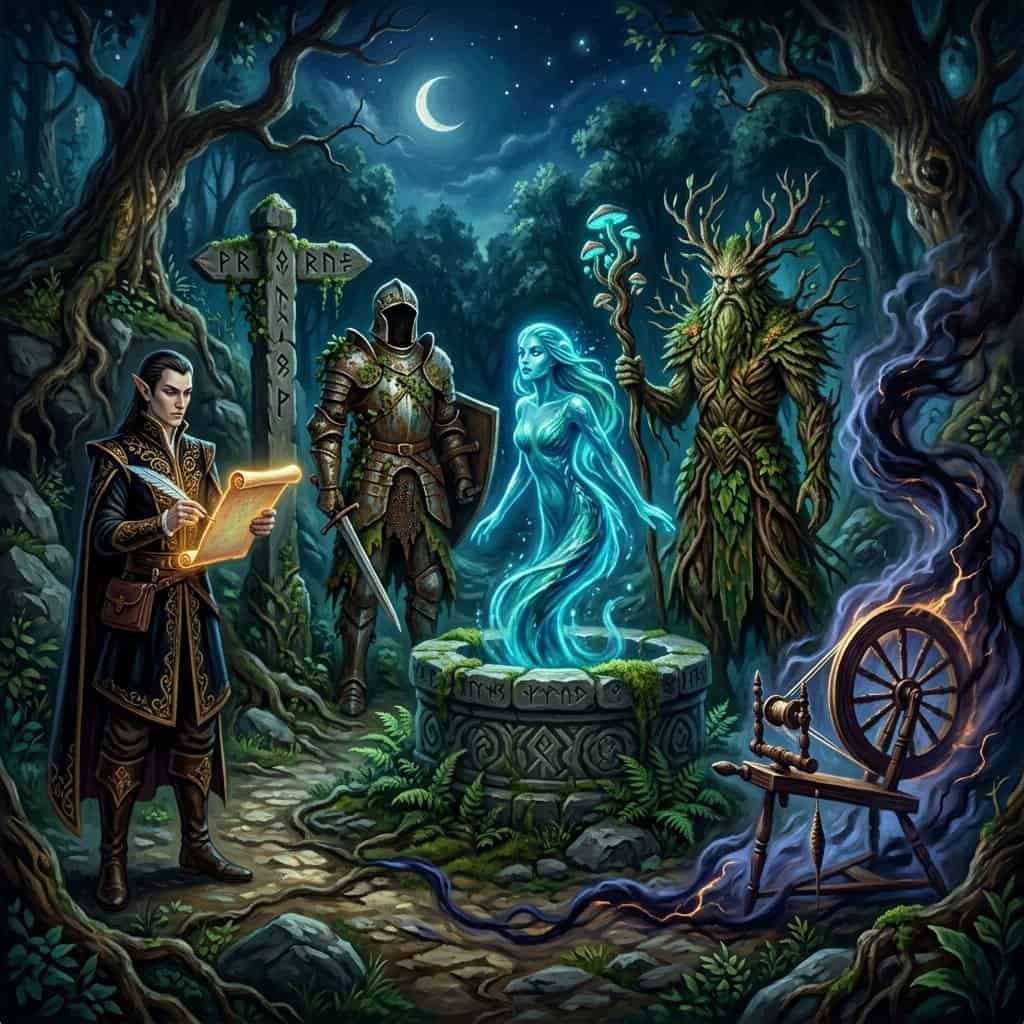

Fairy Tale Monsters D&D 5e: Stat Blocks and Story Hooks
Fairy tale monsters D&D 5e adventures actually need aren’t in the Monster Manual. Orcs, dragons, and undead carry decades of genre associations that work against the fairy tale register. The creatures that make dark fairy tale adventures feel right are defined by rules they must follow, bargains they are bound by, and hungers that function as metaphors — not by Challenge Ratings and action economy. This guide presents five fairy tale creature types, each with a free re-skinned 5e stat block and story hooks to drop straight into your next session.
What Makes Fairy Tale Monsters Different in D&D 5e
Standard D&D monsters are defined by what they do in combat. Their stat blocks describe attack patterns, resistances, and special abilities designed for tactical encounters. Fairy tale monsters are defined by what they are — by the internal logic that governs their behaviour and the specific nature of the threat they represent.
A fairy tale monster is dangerous because of its nature, not its HP pool. The creature that grants wishes always extracts a price — not because it’s greedy, but because that’s the law of the world it inhabits. The entity that speaks in riddles cannot answer direct questions truthfully. The guardian of the forest cannot harm those who show proper respect, but the players don’t know the specific rules until they test them. This internal logic makes fairy tale monsters far more interesting to engage with than monsters who simply attack until destroyed.
For the full framework on running dark fairy tale D&D — including antagonist design, moral complexity, and tone — our dark fairy tale D&D guide covers the genre in depth.
5 Fairy Tale Monsters for D&D 5e (Free Re-Skinned Stat Blocks)
1. The Debt Collector (Re-Skin: Cambion, CR 5)
What it is: A supernatural contract enforcer — elegantly dressed, impeccably polite, and absolutely implacable. The Debt Collector arrives when a bargain has been broken and the original party to the deal is no longer available to fulfil it. It doesn’t want a fight. It wants the debt paid.
Fairy tale logic: The Debt Collector cannot collect more than was originally owed. It cannot harm anyone who was not party to the original agreement. It will negotiate — but always from a position of complete legal certainty about what it is owed. Players who try to argue their way out of an inherited debt will find it an extraordinarily patient and precise opponent.
Mechanical re-skin: Use the Cambion stat block (MM p.36). Replace Fire Ray with Contract Binding (recharge 5–6): the target must succeed on a DC 14 Charisma saving throw or be unable to leave the immediate area until the debt is acknowledged. Remove the Fiendish Charm action and replace with Enumerate the Terms — a non-combat action that forces the nearest creature to hear a precise accounting of the debt, requiring a DC 12 Wisdom save or becoming frightened for 1 minute. The Cambion’s flying speed represents the Collector’s ability to appear wherever the debtor goes.
Story hook: The players’ employer hired the Debt Collector three years ago to recover a stolen item. The employer died before paying. The Collector has now presented the bill to the players as the employer’s current agents. The amount owed is reasonable. The problem is that no one told the players the original deal existed.
2. The Hollow Knight (Re-Skin: Death Knight, CR 17 — scale to CR 5 variant)
What it is: A warrior who made a promise they could never fulfil — to protect a person who died, to serve a lord who betrayed them, to return home from a war that never ended. The Hollow Knight is still keeping a vigil that no longer has a purpose, bound to a post, a road, or a location by an oath that was never formally released.
Fairy tale logic: The Hollow Knight cannot be defeated by conventional combat — it simply rises the following dawn, still bound to its vigil. The only way to end the encounter is to release it from its oath: by finding the name of the person they served, speaking the formal words of release, or completing the task they were set and never finished. Violence without understanding is pointless.
Mechanical re-skin (CR 5 version): Use the Revenant stat block (MM p.259). The Revenant’s Regeneration represents the bound nature of the vigil — it cannot be permanently killed until released. Replace Vengeful Glare with Name the Oath (action): the Hollow Knight states the name of the person or cause it serves, and any creature that hears it must make a DC 13 Wisdom save or be compelled to help fulfil the original oath on their next turn. The Revenant’s immunity to exhaustion and the poisoned condition reflects a creature that has moved beyond mortal concerns.
Story hook: A road through the forest has been impassable for thirty years. The Hollow Knight blocks it and attacks anyone who tries to pass. Investigation reveals it was sent to escort a noble’s daughter to a wedding — a wedding that happened, or didn’t, or was called off under circumstances that the local lord has never fully explained.
3. The Well Wisher (Re-Skin: Water Weird, CR 3)
What it is: A water spirit bound to a specific well, spring, or pool that grants wishes — with perfect literalness. The Well Wisher is not malicious. It does exactly what it is asked. The problem is that it interprets requests with the precise logic of contract law rather than the generous interpretation of human intent.
Fairy tale logic: The Well Wisher grants one wish per visitor per year. It cannot refuse a sincere request made with proper form (traditionally: a coin thrown into the water and a wish spoken aloud). It cannot grant a wish that would harm the wisher directly. It will grant a wish that harms the wisher indirectly, if the literal wording permits. Players who wish for ‘all the gold in the castle’ will find the castle emptied of everything gold — including the structural supports.
Mechanical re-skin: Use the Water Weird stat block (MM p.299). The Water Weird’s Constrict attack represents the Well Wisher using its power to enforce the terms of a wish that the wisher is trying to escape. Add Grant Wish (1/day, requires ritual action): the Well Wisher fulfils a stated wish to the letter of its wording, with the DM adjudicating the effect. The Water Weird’s Invisible in Water trait represents the spirit’s dormant state when no one is actively wishing.
Story hook: A village has been using the local well for wishes for generations. Small ones, mostly — a good harvest, a healthy child, fair weather for the festival. No one has tracked how many wishes have been made. The Well Wisher has an account of every one. Recently, it has started presenting bills for wishes that were granted but whose terms were subsequently violated.
4. The Forest Remembrance (Re-Skin: Green Hag, CR 3)
What it is: Not a witch in the malicious sense — a custodian of the forest’s memory. The Forest Remembrance knows every wrong done in its territory going back centuries. It holds these wrongs the way a library holds books: catalogued, organised, available for retrieval. It doesn’t seek vengeance. It simply knows.
Fairy tale logic: The Forest Remembrance will tell the truth to anyone who asks the right questions and pays the right price — always a fair price, never a comfortable one. It cannot lie about what it knows. It can choose not to answer, but if it speaks, it speaks true. It is not aligned with the players or against them. It is aligned with the accurate record of what happened.
Mechanical re-skin: Use the Green Hag stat block (MM p.177). Remove Illusory Appearance and replace with Perfect Recall (passive): the Forest Remembrance has advantage on all Insight checks and cannot be deceived by illusions or false claims about events that occurred within its territory. Replace Horrific Appearance with Weight of Knowledge: creatures that meet the Forest Remembrance’s gaze must make a DC 11 Wisdom save or be incapacitated for one round as the weight of all wrongdoing in the territory washes over them.
Story hook: The players need to know who was responsible for a crime that was never solved. They’ve been told the Forest Remembrance knows. What they haven’t been told is that the Forest Remembrance’s price for information about an old wrong is always another truth — one the asker has been keeping from themselves.
5. The Spinning Shadow (Re-Skin: Shadow Demon, CR 4)
What it is: The physical manifestation of a secret that has been kept too long. The Spinning Shadow doesn’t have an agenda independent of the secret it embodies — it simply grows larger, more active, and more dangerous the longer the secret remains unspoken. Speaking the secret aloud in the creature’s presence is the only thing that can destroy it.
Fairy tale logic: The Spinning Shadow is drawn to the person who is keeping the secret. It does not harm others unless they try to intervene. It cannot be harmed by weapons — only by the truth it represents. Every round the secret remains unspoken in its presence, it gains 10 temporary HP and its attack bonus increases by 1. The only ‘combat’ solution is a Charisma (Performance or Persuasion) check against DC 15 to speak the secret convincingly enough that the Shadow accepts it as genuine.
Mechanical re-skin: Use the Shadow Demon stat block (MM p.64). Add Secret’s Weight (passive): for each round of combat in which the kept secret is not spoken aloud, the Spinning Shadow gains 10 temporary HP. Add Dissolution: if the secret is spoken aloud clearly and sincerely within 30 feet of the creature, it must make a DC 15 Constitution saving throw or be immediately destroyed, regardless of remaining HP.
Story hook: A noble family has been plagued by a shadow creature for three generations. Every child born in the house grows up haunted by it. The family believes it is a curse placed by an enemy. It isn’t. It’s something the family’s founder knew and never told anyone — and the shadow grows with every generation that inherits the silence.
Using Fairy Tale Monsters in Published Adventures
All five creatures above can be dropped directly into Anvil & Ink adventures with minimal adjustment. The Debt Collector fits naturally into Pay the Piper as an alternative or additional antagonist. The Forest Remembrance works as an information source in The Name of Rumpelstiltskin. The Spinning Shadow adds a ghost-story layer to any investigation-focused Ready Adventure.
For more on building and running dark fairy tale D&D scenarios that use creatures like these effectively, our Brothers Grimm D&D adventure guide covers the full design framework, and our twisted fairy tale RPG guide digs into moral complexity and antagonist design.
Frequently Asked Questions
Can I use these stat blocks in published adventures I sell?
These are re-skins of existing official D&D 5e stat blocks, which are published under the Systems Reference Document (SRD) and available for commercial use under the Creative Commons licence. The flavour text and re-skin mechanics presented here are original Anvil & Ink material — feel free to use and adapt them for your own games, but please don’t republish them verbatim for commercial purposes.
How do I signal fairy tale monster logic to players without a rules lecture?
In-world signals work best. An NPC who warns the players ‘the Collector cannot take what was not promised’ tells them the relevant rule without breaking the fiction. A Forest Remembrance that refuses a direct question but answers a properly phrased one demonstrates its nature through behaviour rather than exposition. Let the players discover the rules by testing them — and make sure the first test is survivable.
Browse the full Twisted Tale Series — dark fairy tale D&D adventures built for two to three players — at anvilnink.com/adventures.
Fairy tale monsters D&D 5e adventures need most aren’t the ones that hit hardest. They’re the ones that make players think before they swing.