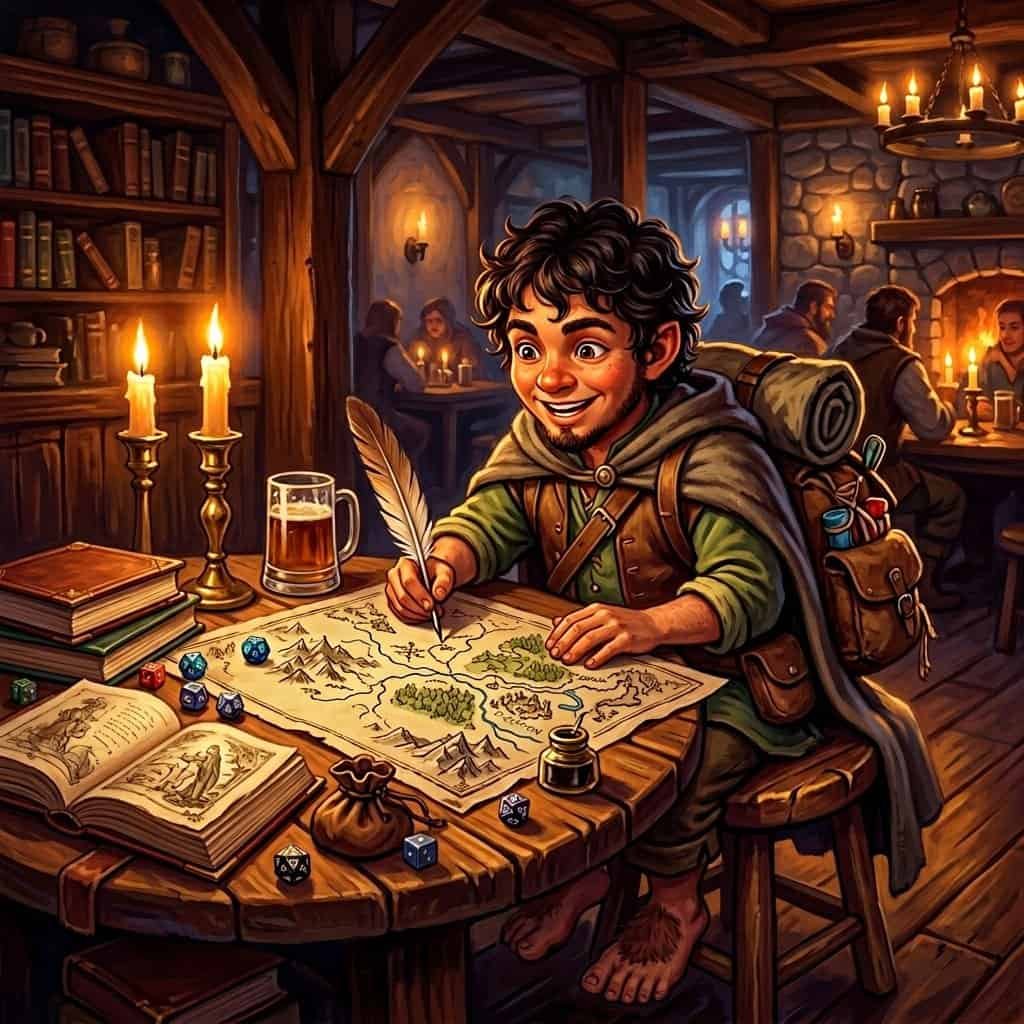

How to Play D&D Alone: Solo D&D From Scratch
Learning how to play D&D alone is easier than most players expect. With the right tools and a few basic techniques, you can run complete D&D 5e sessions with no group and no Game Master — just dice, a character sheet, and the rules you already know.
Can You Actually Play D&D Solo?
Yes — and thousands of players do it every week. Solo D&D has grown from a niche workaround into a legitimate way to enjoy the game, supported by dedicated supplements, purpose-built gamebooks, and a thriving community of solo players.
The core challenge with solo D&D is the Game Master role. In a standard game, the GM generates encounters, portrays NPCs, and decides what happens next. Playing alone means you need a system to fill that role — either a GM emulator, an oracle, or a structured gamebook that does the work for you.
Two Ways to Play D&D Solo
Option 1: Oracle + Standard Rules
You play standard D&D 5e and add an oracle system to handle GM functions. An oracle is a simple dice-based tool that answers yes/no questions: “Does the guard hear me?” Roll a die. The result drives the story rather than your own preference. This approach gives you full D&D 5e flexibility but requires more improvisation and setup.
Option 2: Solo Gamebook or Supplement
A solo gamebook like Deep Delving handles all GM functions within its structure. The book generates the dungeon, presents choices, and resolves encounters using full D&D 5e rules — but without the open-ended narrative work that an oracle requires. Faster to start, more structured throughout.
Both approaches work well. Option 1 gives you more narrative freedom; Option 2 gives you more support and guidance. Beginners typically find Option 2 more satisfying at first.
What You Need to Play D&D Alone
For the Oracle + Standard Rules approach: D&D 5e basic rules (free from Wizards of the Coast), a polyhedral dice set, a simple fate oracle (the d6 method described below works fine), and a journal or notepad. Optional but recommended: Mythic Game Master Emulator for a more robust oracle system as your confidence grows.
For the Solo Gamebook approach: Deep Delving includes all rules and dungeon generation in one book — everything self-contained. Or play Half-Pint entirely in your browser with no physical materials needed at all.
Step-by-Step: Your First Solo D&D Session
1. Create your character. Use standard D&D 5e character creation. For your first solo game, choose a martial class — Fighter, Ranger, or Paladin. You’ll have fewer mechanics to track while you’re also learning oracle tools.
2. Write an opening situation. Don’t plan a full campaign. Write one sentence: “My character is [doing X] because [motivation Y].” Example: “My character is searching the ruins of her burned village because she wants to know who was responsible.” That’s enough to start.
3. Start the first scene. Place your character in a specific location. Describe it briefly in your journal. Then ask: “What happens first?”
4. Use the oracle for uncertainty. Any time you don’t know what happens — roll the oracle. Let the result drive the story rather than deciding in advance.
5. Run combat normally. D&D combat runs exactly as written in the Player’s Handbook. The only difference: you control the player character and decide monster tactics. Keep monsters straightforward at first — they fight without complex positioning or tactics.
6. End scenes naturally. When a scene reaches a conclusion — combat ends, information is gained, a new problem emerges — close it out. Write one sentence summarising what changed. Start the next scene.
Using Oracle Tables in Solo D&D
The oracle is the heart of solo D&D. Here’s the minimum version you need to get started:
Before any scene where the outcome is uncertain, ask a yes/no question and roll a d6:
- 1 — No, and something goes worse than expected
- 2 — No
- 3 — No, but there’s a small silver lining
- 4 — Yes, but with a complication
- 5 — Yes
- 6 — Yes, and something goes unexpectedly in your favour
Adjust the probability by using different dice. “Is this dungeon likely to be heavily guarded?” — if very likely, roll a d8 and treat 1-2 as No. If unlikely, roll a d6 and treat 1-4 as No. The intuitive probability adjustment is part of what makes the oracle feel alive rather than mechanical.
More sophisticated oracle systems like Mythic GME add a “chaos factor” that tracks how out-of-control the situation is and adjusts oracle probabilities dynamically. This adds significant depth to extended solo campaigns once the basic approach feels natural.
The Easiest Way to Start: Solo D&D Gamebooks
If oracle tables sound like more setup than you want right now, solo gamebooks remove the need for them entirely.
Deep Delving is a solo dungeon crawler that uses full D&D 5e rules within a structured book format. You roll to generate the dungeon as you explore — no planning required. All GM decisions are handled by the book’s tables and structure. It’s the best choice if you want full D&D 5e mechanics without the open-ended narrative work of an oracle system.
For the fastest possible start, Half-Pint is a free browser-based solo RPG that runs on any device. Open the page at anvilnink.com/half-pint, start reading, make choices, roll when prompted. It’s the single fastest way to experience solo D&D-style play — no dice, no books, no setup at all.
Common Mistakes When Playing D&D Solo
Planning too much. Solo D&D works best when you use the oracle as intended — to generate surprises. If you plan the entire adventure in advance, you’re writing a story, not playing a game. Leave outcomes open and let the dice decide.
Playing too safely. Without a GM to challenge you, there’s a temptation to let your character’s life run smoothly. Resist it. Ask the oracle whether bad things happen. Let complications arise. The drama is what makes the session worth playing.
Using full-party encounter balance. Standard D&D encounters are designed for four to five players. A solo character at those difficulty settings will die repeatedly. Scale down to lower CR encounters, or use a solo-balanced supplement like Deep Delving that handles this automatically.
Quitting after one awkward session. The first solo session almost always feels mechanical. The oracle feels clunky, the narrative feels thin, the pacing feels off. This is normal. Session two is usually significantly better as the systems become intuitive and your confidence with improvisation grows.
Frequently Asked Questions
How do you DM yourself in D&D?
You replace DM decisions with an oracle — a dice-based system that answers story questions randomly. The randomness generates surprise and prevents you from simply choosing the most convenient outcome for your character.
What is the best solo D&D system?
For D&D 5e specifically: Deep Delving (structured dungeon crawler using standard 5e rules) or Mythic GME (open-ended oracle system). For browser-based play with no setup: Half-Pint.
Can you solo D&D 5e without any supplements?
Technically yes, but it’s significantly harder. Without an oracle, you’re essentially writing a story rather than playing a game. Even a simple d6 fate die adds the randomness that makes solo play feel like a genuine game rather than structured daydreaming.
How do you handle NPCs in solo D&D?
Use the oracle to generate NPC reactions and motivations. Before an NPC scene, ask: “Is this NPC friendly?” Roll. Then ask follow-up questions as needed. More advanced oracle tools generate NPC personality traits automatically using random tables.