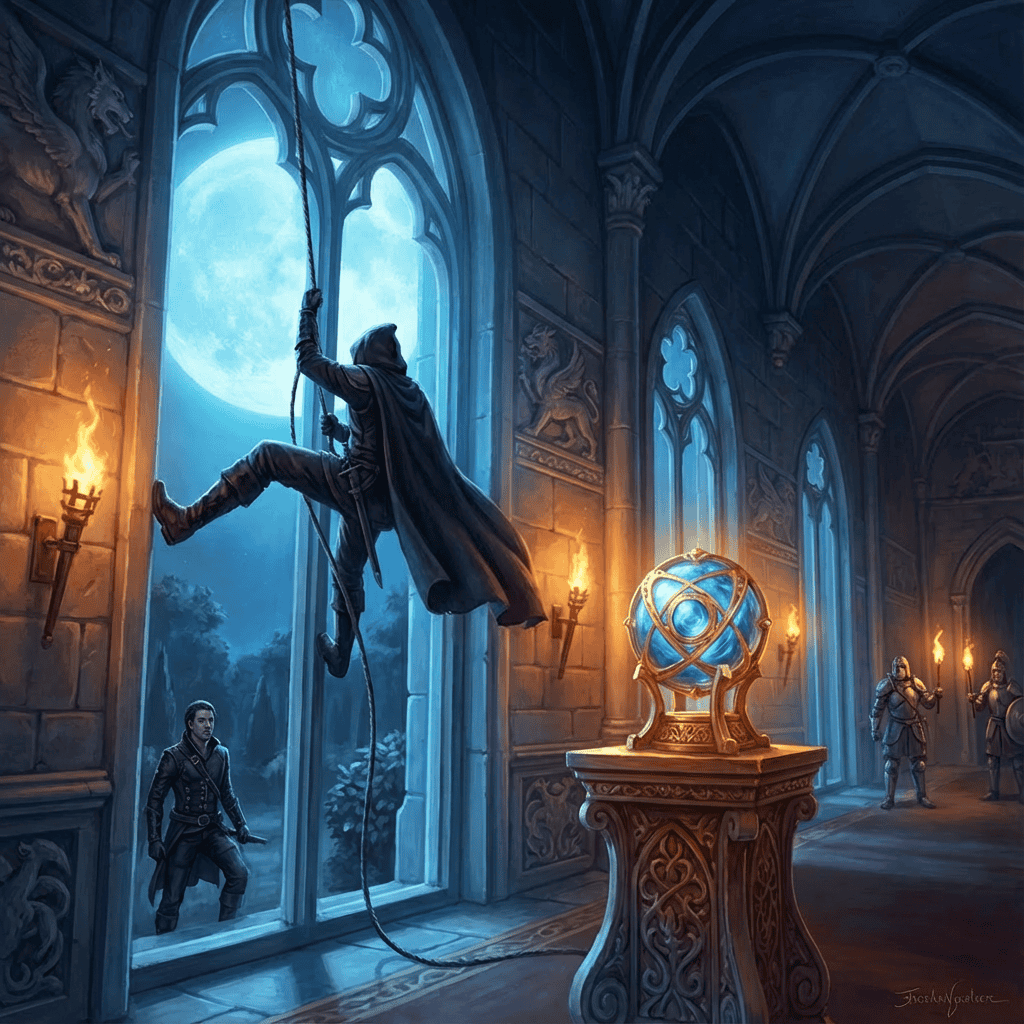

How to Run a Heist in D&D (Without It Becoming a Disaster)
Few adventure types promise more excitement and deliver more frustration than the D&D heist adventure. The fantasy of pulling off an elaborate Ocean’s Eleven-style operation appeals to players and DMs alike, but actually running heist D&D sessions requires specific techniques that differ dramatically from standard dungeon crawling.
The challenge isn’t conceptual—everyone understands what heists involve. The problem is mechanical: traditional D&D structure emphasizes reactive play (explore room, fight monsters, find treasure), while heists require proactive planning, execution of player-created schemes, and handling the inevitable moment when everything goes sideways.
This guide teaches you how to run a heist adventure that actually delivers the heist fantasy: tense infiltration, clever problem-solving, dramatic complications, and satisfying escapes. You’ll learn to structure planning phases that don’t consume entire sessions, handle improvised player plans, and create climactic moments that make players feel genuinely clever.
Why Heists Are Different From Standard Adventures
Understanding what makes heists unique helps you prepare appropriately rather than treating them like dungeons with social encounters.
Player Agency Reaches Maximum
In most D&D adventures, the DM creates situations and players react. You design a dungeon, players explore it. You introduce NPCs, players talk to them. The DM leads, players follow.
Heists flip this dynamic. Players design the operation. They choose entry points, create diversions, assign roles, and determine timing. The DM’s job becomes responding to their plan rather than directing their actions.
This shift requires different preparation and a willingness to let player creativity drive the session.
Information Becomes Currency
Standard adventures give players information through exploration: you enter a room and discover what’s there. Heists require information before action: you need guard schedules, security measures, and layout details to plan effectively.
This means running heists involves significant pre-heist investigation phases where players gather intelligence. Managing this phase—giving enough information to plan without making it trivial—is crucial.
Failure States Are More Complex
In dungeon crawls, failure usually means combat or damage: you trigger the trap and take 2d6 piercing damage. In heists, failure means detection, alarm escalation, and the plan falling apart—consequences that cascade through the rest of the adventure.
You need graduated failure states rather than binary success/failure. Getting spotted by one guard differs from triggering a building-wide alarm.
Time Pressure Is Central
Heists inherently involve deadlines: complete the job before the patrol returns, before the ball ends, before dawn. This time pressure creates tension that standard exploration lacks.
Managing pacing around these time constraints—making players feel rushed without actually railroading them—requires deliberate technique.
The Heist Structure: Six Phases
Successful heist adventures follow a predictable structure. Knowing this structure helps you prepare appropriate content for each phase.
Phase 1: The Setup (5-10 Minutes)
Establish the target, the goal, and the stakes. Someone wants something stolen, recovered, or sabotaged. The target is protected. Players are offered the job.
“The merchant prince stores a magical artifact in his vault. Our patron wants it recovered—it was stolen from her family generations ago. She’ll pay 2,000 gold for its return.”
Keep setup brief. Players need to know what they’re stealing, where it is, and why they’re doing it. Everything else emerges through investigation.
Phase 2: Investigation and Planning (45-60 Minutes)
Players gather information about the target location and create their plan. This phase often determines heist success—thorough investigation enables better plans.
Provide 3-5 potential information sources: bribed servants, building records, staking out the location, contacting underworld informants, or using magic for reconnaissance.
Each source reveals some information but not everything. Players must prioritize which sources to pursue given time constraints.
Phase 3: Preparation (15-20 Minutes)
Players acquire needed resources: disguises, tools, forged documents, bribed contacts, or escape vehicles. Some resources are automatic (you can buy rope). Others require checks or roleplaying (convincing the servant to leave a door unlocked).
This phase also involves final plan confirmation. Have players explicitly state their plan so everyone understands the roles and sequence.
Phase 4: Infiltration (30-45 Minutes)
Players execute the entry portion of their plan. They navigate security, avoid detection, and reach the target. Complications arise, requiring adaptation.
This phase should feel tense but not impossible. Early successes build confidence before later complications raise stakes.
Phase 5: The Score (15-20 Minutes)
Players acquire the target objective—stealing the artifact, accessing the documents, sabotaging the machine. This often involves final obstacles: vault locks, guardian creatures, or unexpected discoveries.
Include at least one complication or revelation at the score: the artifact is larger than expected, the documents reveal additional targets, or the vault contains something unexpected.
Phase 6: Escape (20-30 Minutes)
Getting out is harder than getting in. Alarms may have sounded, guards are alerted, and players must reach safety while protecting whatever they’ve acquired.
The escape should feel like a climactic sequence with chase elements, tense decisions, and dramatic moments. Don’t let it become anticlimactic “you leave without problems.”
Running the Investigation Phase
The investigation phase makes or breaks heists. Too little information and players can’t plan effectively. Too much information and the heist becomes trivially easy.
Create Information Tiers
Organize target information into categories that different sources can reveal:
Basic information (freely available): The target exists, its general location, public reputation of the owner. Players learn this just by accepting the job.
Intermediate information (requires investigation): Guard numbers and shift patterns, general security measures, building layout, owner’s schedule. Available through observation, bribery, or social engineering.
Advanced information (requires effort or risk): Vault combinations, magical wards, secret passages, guard captain’s weaknesses. Requires successful skill checks, spending resources, or taking risks.
Hidden information (discovery during heist): Unexpected complications, additional security, secret rooms. Players only learn this during execution, creating tension.
Limit Investigation Time
Don’t let investigation consume the entire session. Set clear constraints:
“You have three days before the artifact ships to another city. That’s enough time to pursue three investigation approaches. What do you prioritize?”
This forces meaningful choices about what information to gather rather than pursuing everything exhaustively.
Make Information Sources Feel Real
Each information source should involve roleplay or interesting decisions:
The bribed servant is nervous and needs reassurance. The building records require sneaking into the city archive. Staking out the location risks being noticed by guards. The underworld contact wants a favor in return.
These mini-encounters make investigation engaging rather than just “I roll Investigation, what do I learn?”
Reward Creative Investigation
When players propose clever investigation approaches you hadn’t considered, reward them with useful information. The player who asks “Does the merchant have any enemies who might know his secrets?” deserves an NPC contact you create on the spot.
Creative investigation should feel rewarded. This encourages the proactive thinking heists require.
The Planning Phase: Don’t Let It Consume Everything
Player planning is essential to the heist fantasy, but unconstrained planning discussions can consume entire sessions without any actual heisting.
Time-Box Planning
After investigation, give players a specific planning window: “Take 20 minutes to finalize your plan. Then we execute.”
This constraint forces decision-making. Players can’t endlessly debate the perfect plan because time runs out. Whatever they’ve decided by the deadline is what they execute.
Require Explicit Plan Components
Ask players to specify key plan elements:
- Entry method: How are you getting in?
- Team roles: Who does what?
- Target acquisition: How do you get the objective?
- Exit strategy: How do you get out?
- Contingency: What if things go wrong?
This structure helps scattered discussions coalesce into actionable plans and ensures players have considered essential elements.
Embrace Imperfect Plans
Players will never have enough information for perfect plans. That’s intentional. Heists are exciting because plans encounter unexpected complications.
Don’t hint that their plan is flawed or encourage more planning. Let them execute and discover complications organically. “We didn’t know about the guard dog” is more dramatic than “The DM warned us about the guard dog during planning.”
Write Down the Plan
Have one player (or yourself) write down the agreed plan as players discuss it. This prevents disputes later about what was actually decided and gives you reference for what they’re attempting.
Using Flashback Mechanics
One of the most useful heist tools is the flashback: the ability for players to retroactively establish preparations they “already made” when encountering obstacles.
How Flashbacks Work
During the heist, a player encounters an obstacle: “There’s a guard dog we didn’t know about.”
The player proposes a flashback: “Actually, during preparation, I bought drugged meat to throw to guard dogs. I throw it now.”
You determine cost (if any) and success chance, then resolve: “That works. The dog eats the meat and falls asleep within a minute.”
Why Flashbacks Improve Heists
Flashbacks solve the impossible planning problem. Players can’t anticipate every obstacle during planning, but flashbacks let them respond to surprises by establishing that “of course a professional thief would have thought of this.”
This makes players feel competent rather than caught flat-footed by obstacles they couldn’t have predicted.
Limiting Flashbacks
Unlimited flashbacks remove all tension. Establish constraints:
Resource cost: Each flashback costs gold, representing supplies purchased during preparation. “Drugged meat costs 25 gold from your preparation budget.”
Limited uses: Each player gets 1-2 flashbacks per heist. Use them wisely.
Plausibility requirement: Flashbacks must be things characters could reasonably have prepared. “I actually hired a wizard to teleport us out” doesn’t work if they couldn’t afford it.
Skill check: Some flashbacks require checks to see if preparation succeeded. “Make a Deception check to see if the bribed guard actually left the door unlocked like you paid him to.”
Designing the Target Location
Your heist location should enable multiple approaches while presenting genuine obstacles.
Multiple Entry Points
Design at least three viable entry methods with different advantages and risks:
Front entrance: Well-guarded but allows disguise/social engineering approaches. Best for face characters.
Service entrance: Less guarded but requires timing around deliveries/servants. Good for stealth characters.
Unconventional entry: Roof access, sewer connection, or magical transportation. Higher skill requirements but bypasses most security.
Each approach should feel viable for the right party composition. Don’t create “correct” solutions—create interesting trade-offs.
Layered Security
Security should intensify as players approach the target:
Outer perimeter: External guards, walls, locked gates. Detectable from outside, bypassable with moderate effort.
Interior security: Patrols, locked doors, servant witnesses. Requires ongoing stealth or deception.
Inner sanctum: Vault locks, magical wards, guardian creatures. The final obstacle before the score.
This layered approach creates progression and allows partial success—players might breach outer security before complications arise at inner layers.
Environmental Opportunities
Include elements players can exploit creatively: chandeliers to swing from, fireplaces connecting to the roof, wine cellars with exterior access, or servants’ passages between rooms.
Don’t plan how players will use these elements. Just include them and see what players devise. Their creativity often exceeds your expectations.
Patrol Patterns and Timing
Create guard patrols with predictable patterns that investigation can reveal. This gives players information they can exploit through timing.
“Guards patrol the east wing every 15 minutes. You have about 10 minutes once one passes before the next arrives.”
Time pressure from patrols creates tension without requiring constant combat.
Handling Complications: When Plans Go Wrong
Plans will go wrong. That’s not failure—that’s drama. How you handle complications determines whether heists feel exciting or frustrating.
Graduated Alert Levels
Create escalating alert states rather than binary “detected/undetected”:
Level 0 – Normal: Standard security, no suspicion. Players operate freely.
Level 1 – Suspicious: Something’s wrong but not confirmed. Extra patrols, guards more attentive. Players can still operate with increased difficulty.
Level 2 – Alert: Intruders confirmed but not located. Active searching, locked exits, reinforcements called. Players must evade or fight.
Level 3 – Lockdown: Full alarm, all hands responding, authorities possibly summoned. Players must escape immediately or face overwhelming force.
Move between levels based on player actions and failed checks. A single failed Stealth doesn’t jump to Level 3—it might raise suspicion to Level 1, giving players chances to recover.
Complications That Create Choices
Good complications force interesting decisions rather than simply making things harder:
“The vault contains two artifacts, but you can only carry one quickly.” Choice: which to take?
“The guard you knocked out is the servant’s brother. She’s found him and is about to scream.” Choice: silence her (how?) or flee immediately?
“Alarms sound but the exit is close. Run now or grab extra valuables first?” Choice: greed versus caution.
These complications engage players rather than simply punishing them.
Let Players Solve Problems Creatively
When complications arise, don’t have predetermined solutions. Present the problem and let players propose responses.
“The guard is waking up. What do you do?”
Then evaluate their proposed solution and determine outcomes. Maybe they knock him out again, tie him up, bribe him, convince him he’s dreaming, or flee. Each response has different consequences.
Avoid Unrecoverable Failures
Don’t design complications that end the heist with no recourse. Every problem should have potential solutions, even desperate ones.
“The alarm sounds and guards flood the building” is recoverable—they can fight, flee, hide, or surrender and escape later. “The artifact explodes when you touch it” ends the heist anticlimactically.
The Escape: Making Getaways Exciting
Many heists build to the score and then anticlimatically end with “you leave.” The escape should be a climactic sequence in itself.
Complicate the Exit
The route in shouldn’t be the easy route out. Complications during the heist should affect escape:
- Alarms summoned guards who now block the planned exit
- The acquired item is bulkier or more visible than expected
- A team member is injured and can’t climb/run/swim
- The window for extraction passed (the boat left, the carriage departed)
Players must improvise new escape routes under pressure.
Use Chase Mechanics
Escapes often become chases. Use simplified chase rules where each round involves:
- Describe the current situation and obstacles ahead
- Players choose actions (dash, create obstacle, hide, attack pursuers)
- Roll appropriate checks
- Determine distance gained or lost
- Repeat until escaped or caught
Keep chases to 4-6 rounds maximum. Longer chases become repetitive.
Provide Dramatic Moments
Escapes should include moments for heroism: the fighter holding a doorway while others flee, the rogue cutting the rope bridge after crossing, the wizard casting fog cloud to cover the retreat.
Create opportunities for players to sacrifice resources (spell slots, hit points, equipment) for dramatic effect. “You could collapse the tunnel behind you, ensuring escape but destroying your climbing gear.”
End With Consequences
The heist’s aftermath matters. Did they escape cleanly or leave witnesses? Is the target aware who robbed them? Are authorities investigating?
These consequences create future adventure hooks and make the heist feel consequential rather than self-contained.
Common Heist Running Mistakes
Avoid these errors that undermine heist adventures.
Mistake: Requiring the “Correct” Solution
If you design a heist where only one approach works and players must discover it, you’re running a puzzle, not a heist. Players feel clever when their creative plan succeeds, not when they guess your predetermined solution.
Multiple approaches should be viable. Evaluate player plans on plausibility and cleverness, not conformity to your expectations.
Mistake: Making Investigation Mandatory for Basic Success
If players skip investigation and try to improvise the heist, that should be difficult but not impossible. Penalize poor preparation with increased difficulty, not automatic failure.
“You don’t know the patrol schedule, so you’ll need to move cautiously and react to guards as you encounter them” is fair. “You automatically fail because you didn’t investigate” removes agency.
Mistake: Too Many Unwinnable Obstacles
If every obstacle requires specific preparation or items, players feel trapped by what they didn’t think to bring. Include obstacles that skill checks, magic, or creativity can overcome without advance preparation.
Mistake: Punishing All Failures Severely
Not every failed check should trigger alarms. Failed Stealth might mean a guard glances over but doesn’t investigate. Failed Deception might mean the NPC is unconvinced but not suspicious.
Save severe consequences for dramatically appropriate moments or repeated failures, not every die roll below the DC.
Mistake: Forgetting the Fun of Success
When player plans work, celebrate it. Describe their success cinematically. Let them feel like master thieves pulling off an impossible job.
“Your distraction works perfectly. Guards rush toward the commotion while you slip through the side entrance completely unnoticed. You’re in.”
Heists should deliver power fantasy when plans succeed, not just challenges when things go wrong.
Sample Heist Structure: The Merchant’s Vault
Here’s a complete heist framework you can adapt:
Setup
A former business partner claims the merchant stole a family heirloom during their falling out. She wants it recovered discreetly—no authorities, no scandal.
Target
The merchant’s townhouse contains a basement vault. The heirloom (a decorative dagger with sentimental value) is inside.
Security
- Two guards at front entrance, one at service entrance
- Servants throughout the house during day, sleeping quarters at night
- Merchant and family occupy upper floors
- Vault in basement protected by locked door (DC 18) and poison needle trap (DC 14 to detect, DC 16 to disable)
- Inside vault: guard dog (sleeps at night unless disturbed)
Investigation Sources
- Observation from across street reveals guard shift changes (midnight)
- Bribed servant reveals vault location and dog presence
- Building records show sewer access to basement (requires navigating filthy tunnels)
- Former employee knows about trap on vault door
Complications
- The vault contains multiple valuable items—temptation to take more
- The merchant’s child is having nightmares and might wander downstairs
- The heirloom is displayed prominently, requiring careful extraction
Escape Complications
- Guard dog barking alerts household if not silenced
- Dawn patrol arrives early if city watch noticed suspicious activity
- The patron double-crosses players (wants dagger for herself, not family sentiment)
This structure provides enough detail to run while leaving room for player creativity and DM improvisation.
Why Heists Are Worth the Extra Effort
Running a D&D heist adventure requires more preparation and different skills than standard adventures. But successful heists deliver experiences no other adventure type matches.
Players feel genuinely clever when their plans succeed. They experience real tension during execution. They make meaningful choices throughout rather than reacting to DM-created situations. And they walk away with stories about “that time we broke into the merchant’s vault” that they’ll tell for years.
The heist fantasy—brilliant thieves executing impossible plans through skill and cunning—is deeply appealing. With proper structure and technique, you can deliver that fantasy at your table.
Your next heist awaits. Someone has something your players want. Time to plan the job.