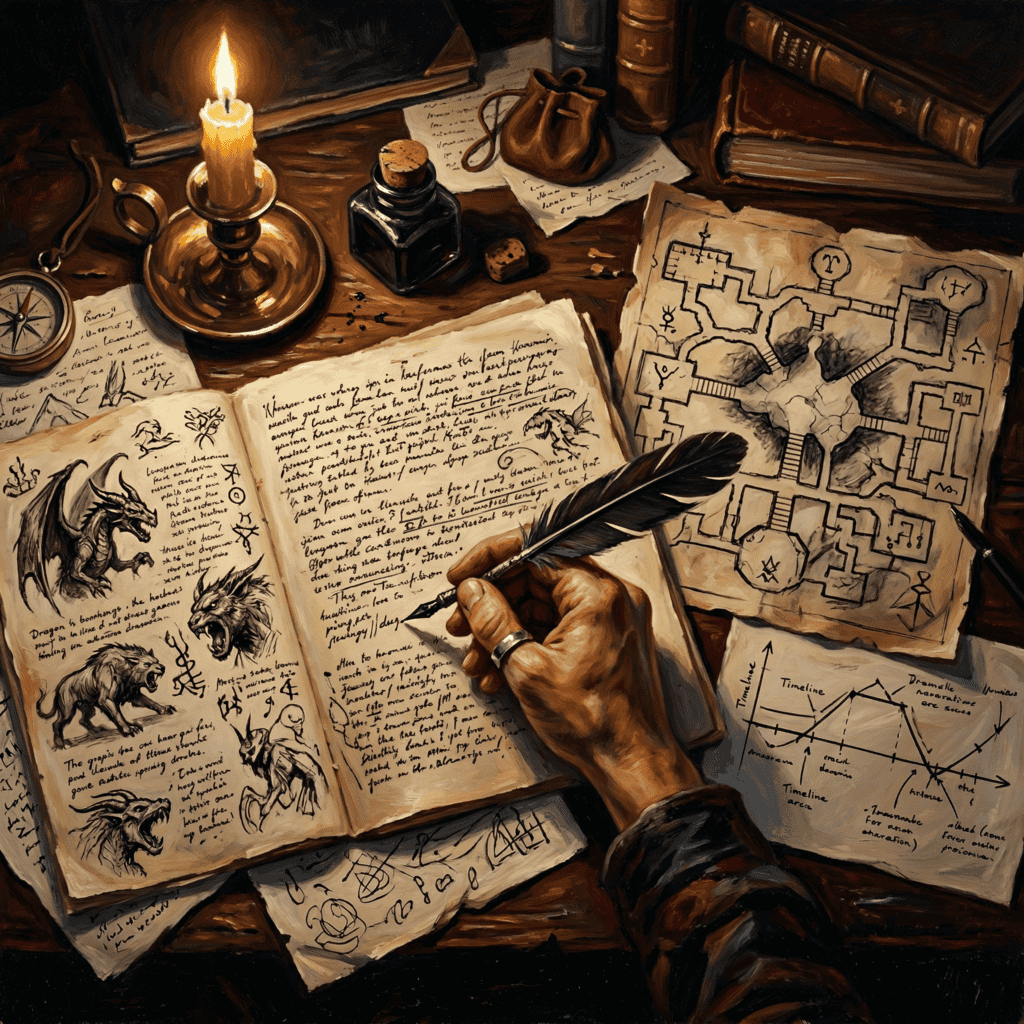

Knowing how to write a D&D one-shot well is a distinct skill from knowing how to run one. Running is improvisation inside a structure someone else built. Writing is building the structure. The two inform each other — experienced DMs write better adventures because they know what breaks at the table, and experienced adventure writers run better sessions because they understand why the structure is there in the first place.
This guide covers the practical side of writing an original one-shot: the three-act structure that works for a single session, how to open a session so players are immediately invested, how to design encounters that serve the story rather than fill time, and the structural mistakes that cause most one-shots to collapse in the final act.
Start With the Constraint, Not the Concept
The biggest mistake writers make when approaching a one-shot is starting with a concept — a cool villain, an interesting location, a clever twist — and then trying to fit it into a single session. That approach produces adventures that are too long, too complex, or that sacrifice the ending to get everything in.
Start with the constraint: 2-3 hours, one complete story arc, a clear resolution. Then build the concept inside that container. The constraint is not a limitation to work around. It is the design brief. Every choice you make — how many locations, how many NPCs, how many encounters — should be tested against whether it fits in the time available and whether it serves the arc.
The 3-Act Structure for a D&D One-Shot
A three-act structure for a one-shot is not three equal sections. The proportions matter:
- Act 1 (20-25% of session time): Establish the situation, introduce the stakes, get players moving. For a 3-hour session this is roughly 40 minutes.
- Act 2 (50-60% of session time): The players investigate, engage, and complicate. This is where most of the play happens. 90-100 minutes.
- Act 3 (20-25% of session time): The climax and resolution. 40-50 minutes.
Most one-shots that run long have bloated Act 2s. The investigation goes on too long, or there are two combat encounters where one would do, or a subplot expands to fill the available space. Act 2 needs a pressure valve — something that escalates toward the climax and prevents the middle of the adventure from becoming a holding pattern.
How to Write a Strong Opening Hook
The first ten minutes of a one-shot determine whether players are invested in the next two hours. A weak opening — characters meeting in a tavern, a long NPC monologue explaining the backstory, a slow journey to the inciting incident — loses players before the adventure has actually started.
The strongest openings drop players into the middle of something already happening. In medias res. Not backstory first and then action — action first, context revealed as they go. A few opening structures that work:
The Inciting Incident Happening Now
The thing that kicks off the adventure is occurring as play begins. The festival bell is being stolen as the players arrive at the square. The heist is already in progress when an alarm triggers. The investigation starts because a body has just been discovered and the players are on the scene. Players make their first meaningful decision in the first five minutes, not the first thirty.
The Established Mission
Players already know why they are here and what they are supposed to do. The briefing happened off-screen. Play begins at the moment of commitment — they are standing outside the vault, or arriving at the village, or meeting the person they were hired to rescue. This respects player time and avoids the passive information-delivery problem of long prologues.
The Immediate Moral Question
The first scene presents a situation where players have to make a choice before they fully understand the context. Not a combat — a decision. Someone is fleeing someone else. Someone is asking for help the players are not sure they should give. The opening question creates investment because players immediately have a stake in what happens next.
Encounter Design: Serve the Story, Not the Runtime
Every encounter in a one-shot should do at least one of three things: advance the plot, reveal character (NPC or player), or raise the stakes. An encounter that does none of these is filler, and filler is the enemy of pacing.
The most common filler encounter is the random combat — a fight that exists to demonstrate danger or use up a spell slot rather than because it advances anything. Players fight four bandits. The bandits have no connection to the main plot. Nothing is learned. Nothing changes. Twenty minutes pass. This is a structural waste in a format where every twenty minutes counts.
Contrast with an encounter that advances plot and raises stakes simultaneously: players fight the same four bandits, but one of them is carrying a document that changes what the players think they know about the job they were hired for. Same encounter, entirely different function. The fight was worth running because the outcome matters.
Give Every Encounter a Non-Combat Resolution
For every encounter you design, ask: what happens if players do not fight? Is there a way through that requires persuasion, deception, stealth, or creative problem-solving? One-shots that funnel players into combat at every encounter feel linear and exhausting. One-shots that offer genuine alternatives at each encounter give players agency and produce different sessions every time you run the same adventure.
This is also practical insurance. You cannot guarantee how long any individual combat will run. An encounter that can be bypassed gives you a pacing lever — if you are running long, players who find the non-combat solution save you thirty minutes.
Writing Multiple Endings
A one-shot with one possible ending is a story with the illusion of player agency. If the outcome is predetermined regardless of what players do, the decisions during the adventure did not actually matter — and experienced players will feel that, even if they cannot articulate why.
At minimum, a well-written one-shot has three possible endings: a success, a partial success with a cost, and a failure that is nonetheless interesting and complete. These do not need to be wildly different — the same final scene can play out differently depending on what the players accomplished in Act 2. The villain is defeated, but the thing they were protecting is destroyed. The vault is robbed, but the players now know something that complicates the job they thought was finished.
Writing multiple endings also makes your adventure more resilient. If players find a shortcut to the climax, or if a combat goes faster than expected, you can move to the ending earlier without the session collapsing. The ending works whenever it arrives.
Pacing a 2-3 Hour Session
Pacing is the gap between your projected runtime and the actual runtime. Every DM who has run enough sessions has experienced both versions of the gap: the adventure that runs out of content with an hour to go, and the adventure that reaches the final act with fifteen minutes left.
A few mechanics that help control pacing as you write:
The Pressure Clock
A ticking clock — a ritual that completes at midnight, a ship that leaves at dawn, a hostage situation with a deadline — creates natural urgency that moves players through the adventure without the DM having to push. Players who know time is running out make faster decisions. The clock also gives you an honest reason to escalate toward the climax when you need to.
Expandable and Collapsible Scenes
When writing each scene, identify which elements are essential and which are optional. Essential elements are the information or progression the players must get for the adventure to work. Optional elements — additional NPCs, extra lore, secondary puzzles — can be included if time allows and cut if it does not. A DM who knows which parts of their adventure are optional can adapt on the fly without losing the structure.
The Three-Clue Rule
For any critical piece of information players need to find, place it in at least three different locations or sources. If players miss one clue, the adventure should not stall. This is not about making things easy — it is about preventing the entire session from grinding to a halt because one Perception check failed. The Mystery Adventure Toolkit covers this principle in detail for investigation-focused adventures.
The Most Common Structural Mistakes
Too many encounters. A 3-hour one-shot needs four to five encounters total, not eight. Each additional encounter compresses everything that comes after it. Count your encounters before you finish writing and cut the ones that do not carry their weight.
Weak stakes. Players need to know what happens if they fail, and the answer needs to matter. Abstract stakes — “the world will be in danger” — land weaker than specific stakes — “the person who hired them will be executed.” Make the consequences concrete and personal.
The information dump opening. An NPC who explains the entire backstory before play actually starts is the fastest way to lose player investment. Trust players to piece context together from what they observe during play. Reveal information as earned, not as a prerequisite.
No decision in the climax. The final scene should require a choice, not just a dice roll. If the climax is purely mechanical — defeat the boss, open the door, escape the building — it lacks the weight that makes a one-shot memorable. Put a genuine decision at the end: who gets saved, what gets sacrificed, what truth the players have to act on.
For more on adventure structure and what makes one-shots work across different genres, the complete guide to the best D&D one-shots covers how genre shapes structure — heists, mysteries, and horror one-shots all have distinct pacing needs. The guide on how to run a one-shot covers the execution side once the writing is done.
Frequently Asked Questions: How to Write a D&D One-Shot
How long should a D&D one-shot script actually be?
Enough to cover every scene the DM needs to run confidently, no more. For a 3-hour one-shot, that is typically 8-15 pages including encounter stats, NPC notes, and location descriptions. Longer than that and the DM cannot find information during play. Shorter and there are gaps that require improvisation in places the writing should have handled.
Do I need a villain for a one-shot?
Not necessarily. You need an antagonist force — something generating the problem players are solving. That can be a person, a situation, a natural disaster, or a moral dilemma with no clear villain. The most memorable one-shots often have antagonists who are sympathetic or whose goals are understandable, even if their methods are not. A villain players feel something complicated about is more interesting than one they simply want to defeat.
How do I write an adventure that works for different group sizes?
Design encounters around the minimum group size you expect and add scaling notes. Two-player encounters that add reinforcements for larger groups are easier to adapt than five-player encounters trying to scale down. The encounter balancing guide for small groups covers the math in detail.
How do I know when my one-shot is finished?
Run through it once mentally from beginning to end. If you can trace a clear path from the opening hook to each possible ending without encountering a gap the players would fall into, the structure is sound. If you find yourself thinking “players would just figure it out” at any point, that is a gap that needs filling before the adventure is finished.
Should I playtest before publishing?
Yes, at least once. Adventures that have not been run always have at least one scene that plays differently at the table than it reads on the page. A single playtest session reveals more about your adventure’s weaknesses than any amount of re-reading. If a full playtest is not possible, run the climax encounter solo to check the math, and read the opening scene aloud to hear whether the hook actually lands.
Want to see how a well-structured one-shot is built? The Ready Adventure Series from Anvil N Ink covers every genre covered in this guide — heist, mystery, horror, fairy tale, comedy. Each title is a working example of the structure described above. Available on Amazon individually or as the Complete Collection on Payhip. The Mystery Adventure Toolkit is particularly useful if you are writing investigation-focused content.
A well-written D&D one-shot does not feel like a tight constraint — it feels like exactly the right amount of space for the story it tells.