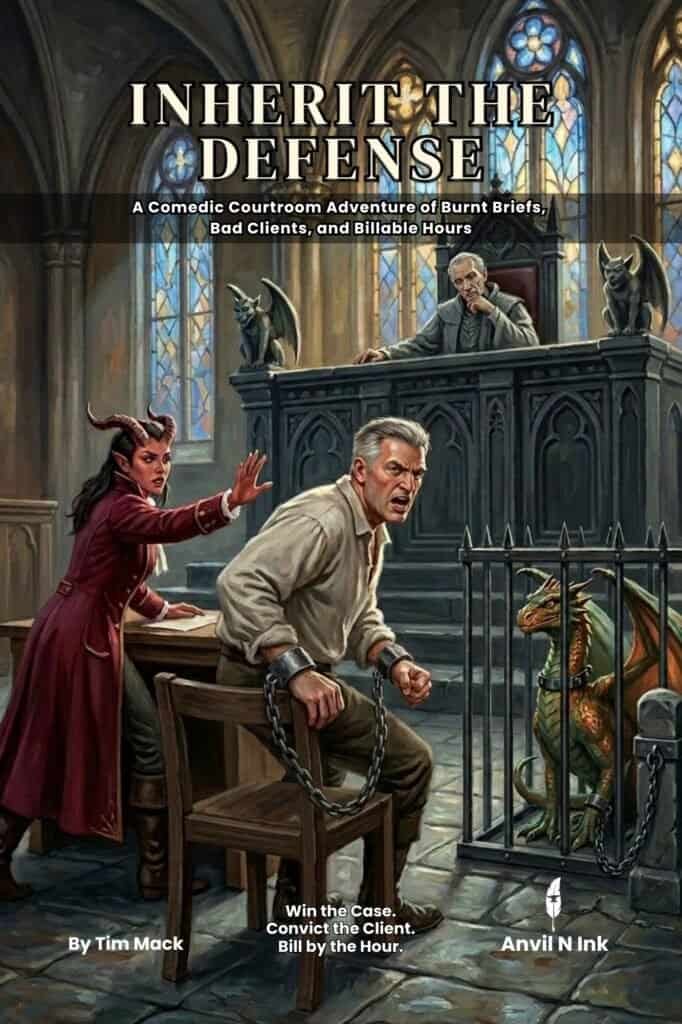

The Comedic Courtroom Adventure That Defends a Crime Lord
Inherit the Defense is a 5E courtroom adventure for two to three players at levels 2 or 3, designed to play in two to three hours. The party signs a routine Solicitors’ Guild surety bond at the offices of an attorney named Hadrian Pell. Twenty-four hours later, they arrive to complete a follow-up signature and find the firm is a smoking ruin. Pell is missing. A crime lord’s lieutenant is standing in the ashes informing them — with great courtesy — that the bond’s continuity clause has just made them counsel of record on every active case the firm held. Including the murder trial that begins in forty-eight hours.
Their client is a man named Vortigan Mire. The case against him is wrong. The truth that proves him innocent is worse than the lie.
What Makes This 5E Courtroom Adventure Different
Most one-shots ask the party to defeat a villain. Inherit the Defense asks them to defend one. The comedic engine of the adventure is built into the trial mechanic itself: every piece of evidence that proves the client innocent of murder also proves him guilty of running the city’s largest smuggling operation. Win the case, and the prosecutor files smuggling charges on the spot. The party walks out of court with a dismissed murder charge, a fresh indictment for a different crime, and the quiet realisation that they have just dismantled an underworld empire while trying to save a crime lord.
The premise is structurally clever and tonally distinctive. Comedy on the surface, with darker beats waiting for any party that wants to lean in. The DM is not asked to perform comedy or to push for laughs. The situation is funny on its own. A judge who has heard every excuse this court can produce. A prosecutor running on six cases at once. A crime lord who is offended at being charged with murder and who would rather admit to other crimes than account for his whereabouts. A party legally bound to defend a man none of them like, against a charge he is genuinely innocent of, with evidence they did not know they were going to need to gather. The absurdity does the work.
It is the kind of adventure that gives every build a moment, every spell a courtroom use, and every player a story worth telling at the next session.
The Investigation Structure
Acts Two and Three of the adventure cover the investigation phase. The party arrives at the burned office in Act One and recovers three clues from the wreckage: a half-burned letter, a scorched receipt, and a coded notebook. Those three clues identify four possible investigation leads — the wharf, a smuggling warehouse, an effigy maker’s shop, and the murder victim’s lodgings. The party picks two. They have one full day per lead.
The four leads are paired by structure: two establish the client’s alibi, two establish forensic anomalies in the alleged murder. Any combination of two leaves the party with enough evidence to mount a defense, but a balanced split between the pairs gives them the cleanest path to acquittal. Each lead awards Evidence Tokens that the party will spend in Act Four against named prosecution claims. The investigation rewards specificity. Every clue points to something concrete the party can drop on the prosecutor’s table at trial.
The Trial Mechanic
Act Four is built on a structured trial system. Three clocks track the state of the case: Jury Sympathy, Prosecution’s Case, and a hidden Time Until Verdict counter. The prosecutor advances four named claims — Opportunity, Means, Motive, Consciousness of Guilt — each of which can be broken with a piece of evidence the party recovered during the investigation. Players have four action options each round: present an Evidence Token, argue or bluff with a partial-success skill check, cast a spell, or use a class feature. Spells matter. Class features matter. A Detect Thoughts on the right witness, a Cutting Words on the prosecutor’s roll, a Speak with Animals on the drakes whose pen the body was found in — every build has a designed-in spotlight moment, and the trial mechanic is calibrated to reward creative use of standard 5E mechanics rather than special trial-only abilities.
Halfway through the trial, a charmed bailiff with a spear interrupts the closing arguments. Combat erupts in the gallery. The trial does not stop. Players take both trial actions and combat actions in the same round, and the courtroom layout is included as a battle map.
Designed for Small Tables
The adventure is calibrated for two-player and three-player groups. Combat encounters scale automatically. The trial mechanic adjusts its clocks for two-player parties to compensate for fewer actions per round. The investigation structure is the 2-of-4 branching design described above — players pick two of four available leads, each lead awards Evidence Tokens, and the leads are paired so any combination of two leaves the party with enough evidence to win. The scaling is built into the manuscript, not bolted on as an afterthought. Two players running the adventure have the same experience as three. They have a slightly harder trial, and the book gives them the tools to handle it.
The Optional Side Quest
An optional night-before-trial side quest opens up if the party decodes the rest of the missing attorney’s notebook. The lead points them to an actress hired to play the murdered man’s grieving widow at trial. They have one night to find her, decide what to do with her testimony, and return to court before sunrise. Three resolution paths exist: she vanishes, she flips on the prosecution, or the party leaves her in place and prepares to dismantle her testimony in cross-examination. Each path has different mechanical effects on Act Four.
The side quest is the path to the deeper truth — that the murder was never real, that the missing attorney engineered the bond to dump his caseload on the party, and that the conspiracy goes deeper than anyone thought. The trial is winnable without the side quest. The story is bigger with it.
What’s Inside the Book
The book contains everything a DM needs to run the adventure cold. A full four-act structure with a mid-point optional side quest. Battle maps for every keyed location. Stat blocks for every named NPC and every combat creature. Four pre-generated player characters at level 3 — Tiefling Bard, Mountain Dwarf Fighter, Halfling Rogue, Human Paladin — each built using only Systems Reference Document 5.1 mechanics for full system compatibility. Five alternative opening hooks for tables that want a different way in. Edge case guidance for the most common ways a clever party can break a courtroom adventure. Three verdict outcomes with branching consequences, sequel hooks, and a properly comedic exit on every branch — including the conviction loss state.
Perfect For
Busy DMs running small groups who want a complete adventure they can read on a Sunday afternoon and run that night. Two-player and three-player tables tired of adventures sized for parties of five. Groups looking for a comedic one-shot with real mechanical depth and a twist that lands. DMs who want to run a 5E courtroom adventure without inventing the rules from scratch. Players who want a trial that feels like Dungeons and Dragons rather than a debate club — where weapons get drawn, spells get cast, and the bailiff might be charmed by something somebody snuck into the gallery.
The adventure drops cleanly into any campaign setting via its generic-city framing. There is no required cosmology, no required pantheon, no required region. Place it in any city your campaign already has. The bond paperwork transfers.
Win the case. Convict the client. Bill by the hour.
Get Your Copy
Choose your preferred format