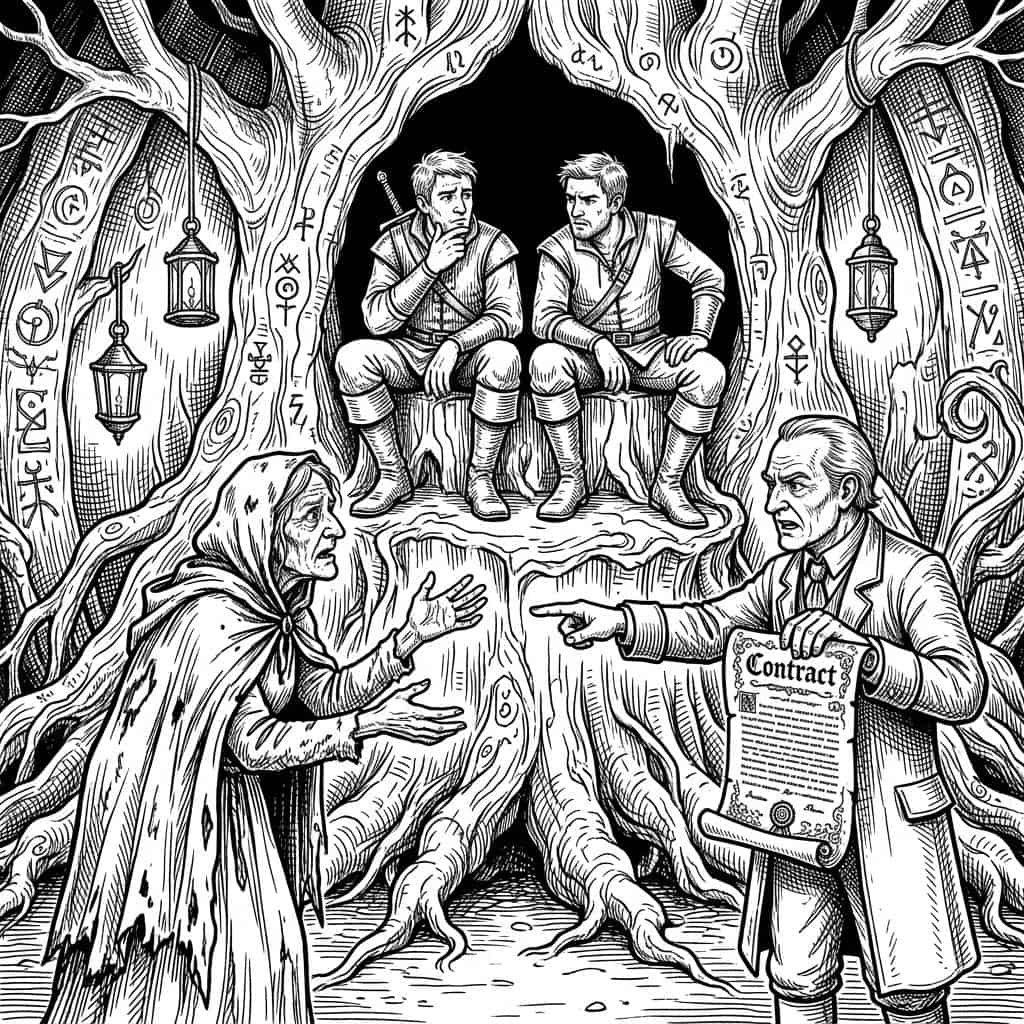

Moral dilemmas in D&D are the reason some sessions fade from memory within a week while others get brought up at every game night for years. The difference isn’t better combat or cleverer puzzles — it’s a moment where the DM presents a choice that has no right answer. Where every option costs something. Where two players look at each other across the table and realize they fundamentally disagree about what the right thing to do is. That moment of genuine moral friction is the most powerful experience tabletop RPGs can deliver, and fairy tales are the single best source material for creating it.
Fairy tales are built on moral dilemmas. Every classic story revolves around a bargain, a betrayal, a broken promise, or an impossible choice. The miller’s daughter must give up her firstborn or die. The town must pay the piper or lose their children. The princess must keep her repulsive promise or break her word. These stories have survived for centuries because the dilemmas at their core are genuinely unresolvable — and that’s exactly what makes them perfect for dark fairy tale D&D adventures.
This guide presents six specific fairy tale moral dilemmas you can drop into your sessions, along with the design principles that make them work at the table.
What Makes a Moral Dilemma Work in D&D
Not every hard choice is a moral dilemma. Choosing between two magic swords is a tactical decision. Choosing between saving a village and saving a single person you love is getting closer. But a true moral dilemma — the kind that creates those electric table moments — requires three specific ingredients.
First, both options must have genuine moral weight. Not “good versus evil” but “good versus good” or “justice versus mercy.” If one option is clearly correct, there’s no dilemma. Second, both options must have real consequences that the players will witness. Abstract consequences don’t land — players need to see the fallout of their choice in the faces of NPCs they’ve come to care about. Third, the choice must be irreversible. If players can fix things later, the dilemma loses its teeth. The best moral dilemmas in D&D create a permanent scar on the game world that persists as a reminder of what the players chose and what they sacrificed.
Why Fairy Tales Deliver Better Dilemmas Than Original Scenarios
When you create a moral dilemma from scratch, you’re fighting uphill. Players don’t have emotional investment in NPCs they just met or situations they don’t fully understand. But fairy tale dilemmas come pre-loaded with emotional context. Your players already know the story of Rumpelstiltskin. They already feel something about a mother being asked to give up her child. They already have opinions about whether a deal is a deal, even when the price is terrible. That pre-existing emotional investment means the dilemma lands harder and faster than anything you could build from zero.
The fairy tale framework also provides natural structure. Every tale has a clear setup (the bargain is made), escalation (the price comes due), and climax (the choice must be made). That structure maps perfectly to a single-session adventure arc, making fairy tale dilemmas ideal for one-shots where you need to build emotional investment quickly.
Dilemma 1: The Broken Bargain — Justice vs. Mercy
A town made a deal with a powerful fey creature. The creature solved the town’s crisis — a plague, a monster, a famine — and the town promised payment. Then the town refused to pay. Now the creature has taken something precious in forfeit: the town’s children, the harvest, the mayor’s voice, whatever fits your adventure. The town wants the players to get it back by force.
The dilemma: the fey creature is the wronged party. They kept their end of the deal. The town cheated them. By every standard of fairness, the creature is owed what was promised. But the forfeit is harming innocents who had nothing to do with the original agreement. The children didn’t break the promise. The crops didn’t sign the contract.
Players must choose between justice (the deal was broken, the forfeit stands) and mercy (innocents are suffering, regardless of who’s at fault). Neither option is clean. Forcing the town to pay what they owe might bankrupt families who weren’t involved. Returning the forfeit by force means punishing the only party that honored the agreement. This exact dynamic drives Pay the Piper, where the moral weight of a broken bargain lands squarely on the players’ shoulders.
Dilemma 2: The Sympathetic Captor — Freedom vs. Safety
Someone has been taken — kidnapped, imprisoned, held against their will. The players are sent to rescue them. Standard hero stuff. But when they find the captive, the situation isn’t what they expected. The captor genuinely cares for the captive. The captive is being protected from something worse. The prison is also a sanctuary.
Think Hansel and Gretel inverted: the witch’s cottage isn’t a trap, it’s a refuge. The children were abandoned by their parents. The witch took them in. She feeds them, teaches them, keeps them safe. She refuses to let them go because the world they came from hurt them. Some of the children don’t want to leave. One child begs the players not to send them home.
The dilemma: freedom versus safety. The captive’s right to self-determination versus their actual wellbeing. Is it rescue if the person doesn’t want to be rescued? Is it kidnapping if the person is better off where they are? Do the players have the right to decide what’s best for someone else? This dilemma is especially brutal because players’ instinct is always to “free the prisoner” — and forcing them to question that instinct reveals assumptions they didn’t know they had.
Dilemma 3: The Necessary Monster — Peace vs. Truth
A community lives in peace and prosperity. The reason for their good fortune is a secret known only to a few: someone — or something — is being sacrificed, imprisoned, or exploited to maintain the community’s wellbeing. A fairy tale creature bound beneath the town square whose suffering purifies the water. A cursed individual whose pain absorbs the community’s diseases. A fey bargain that trades one person’s happiness for the entire town’s safety.
The dilemma: the players discover the truth. Now they must decide whether to expose it. Revealing the secret will end the suffering of the sacrificed individual, but it will also end the community’s prosperity. People will get sick again. The water will go bad. The protection will fail. The person being sacrificed wants to be freed. The community — including children, elderly, people who had no say in the original arrangement — will suffer if they are.
This is the moral dilemma structure at its purest: two incompatible goods. The sacrificed person’s freedom is a good. The community’s survival is a good. Both cannot exist simultaneously. Players can’t fight their way to a solution because the problem isn’t a monster — it’s a situation where someone has to lose. How do you build these impossible choices into your adventures effectively? Building sympathetic villains on every side of the dilemma ensures no option feels easy.
Dilemma 4: The Cursed Inheritance — Punishment vs. Innocence
A fairy tale curse has been passed down through generations. The original offender — a king who broke a promise to a fey lord, a merchant who cheated a witch, a knight who killed a sacred beast — is long dead. But the curse persists, affecting their descendants who had nothing to do with the original crime. The current bearer of the curse is entirely innocent. They’ve lived a good life, harmed no one, and done nothing to deserve their suffering.
The dilemma: the curse can only be broken by acknowledging the original crime and paying the original price. But the price is terrible — a life, a memory, a firstborn child — and the person who would pay it didn’t commit the crime. Alternatively, the curse can be transferred to someone willing, but that just moves the injustice rather than resolving it. Or the players can do nothing, and the curse continues to punish innocents for another generation.
This dilemma forces players to confront a question that has no comfortable answer: how far does inherited guilt extend? Should descendants pay for ancestors’ crimes? Is a debt still valid when the debtor is dead and the payer is innocent? Different players will have viscerally different reactions to this scenario, and that disagreement is where the best roleplaying happens.
Dilemma 5: The Willing Sacrifice — Autonomy vs. Protection
Someone is willingly walking into danger — or has willingly made a terrible bargain — and the players discover it before the consequences land. A young woman has agreed to marry a fey lord she’s never met in exchange for her family’s debts being forgiven. A father has promised his own life to a witch in exchange for his daughter’s cure. A soldier has volunteered to be transformed into a beast to guard the kingdom’s border, knowing the transformation is permanent.
The dilemma: the person made their choice freely and with full knowledge of the consequences. They don’t want to be saved. They’ve weighed the cost and decided the sacrifice is worth it. But the players can see what the person can’t — or won’t — acknowledge: the bargain is worse than it appears, the cost will be higher than expected, or the other party intends to exploit a loophole. Do the players respect the person’s autonomy and let them walk into a bad deal? Or do they intervene, overriding someone’s freely made choice because they think they know better?
This is one of the most sophisticated moral dilemmas in D&D because it challenges the fundamental heroic impulse. Heroes save people. But what if saving someone means denying their agency? What if “rescue” is just another word for “I know what’s best for you”? Players who navigate this dilemma often discover uncomfortable things about their own characters’ assumptions about heroism and control.
Making Autonomy Real at the Table
For this dilemma to work, the NPC making the sacrifice must be fully competent, fully informed, and genuinely willing. If there’s any hint of coercion or manipulation, the dilemma collapses into a rescue mission. The power of this scenario comes from the NPC looking the players in the eye and saying “I chose this. Please respect my choice.” When that moment lands — when a player’s character wants desperately to help and the person they want to help says “no” — the table goes quiet in the best possible way.
Dilemma 6: The Rewritten Story — Memory vs. Truth
The players discover that a community’s foundational story — the tale they tell about their origins, their heroes, their greatest triumph — is a lie. The beloved founder was actually a villain. The heroic sacrifice was actually a murder. The great victory was actually a betrayal. The truth has been hidden for generations, and revealing it would destroy the community’s identity and sense of self.
The dilemma: truth versus stability. The community deserves to know their real history. The people who were erased or villainized in the false version deserve to have their story corrected. But the community has built their entire culture, their values, their sense of belonging on this story. Destroying it won’t liberate them — it will shatter them. Children who grew up proud of their heritage will learn it was built on a crime. Elders who devoted their lives to preserving tradition will discover the tradition is a cover-up.
This dilemma resonates because it’s fundamentally about what fairy tales themselves do. Fairy tales reshape truth into narrative. They simplify complex events into stories with heroes and villains. The players are discovering what happens when you pull back that curtain — and they must decide whether the truth is always worth telling, or whether some lies hold communities together in ways the truth never could.
Designing Your Own Fairy Tale Moral Dilemmas
Every effective moral dilemma in D&D follows the same structural formula: two competing goods, both with legitimate claims, both requiring sacrifice. The fairy tale layer adds emotional resonance because the scenarios tap into stories players already know and care about. Here’s the design process in three steps.
Step 1: Find the Bargain
Every fairy tale has a bargain at its core — an agreement, a promise, a contract. Find it. That bargain is the foundation of your dilemma. The more clearly defined the bargain, the sharper the dilemma will be. “The town promised to pay” is clear. “Some bad things happened” is vague. Clarity creates stakes.
Step 2: Break It From Both Sides
The bargain should be broken or corrupted in a way that makes both parties partly responsible. If only one side is at fault, the dilemma resolves into a simple judgment call. But when the town cheated the piper AND the piper’s retaliation targeted innocents, both sides carry guilt. That shared responsibility is what makes the players’ choice genuinely difficult.
Step 3: Make the Stakes Visible
Abstract consequences don’t create emotional weight. “The town will suffer” is a statistic. “The baker who gave you free bread this morning will lose her shop” is a person. Give every side of the dilemma a face, a name, and a moment where the players connect with them before the choice is revealed. When players have to choose between two NPCs they care about, the dilemma becomes personal rather than philosophical.
Why Fairy Tale Dilemmas Hit Harder With Small Groups
Moral dilemmas in D&D scale inversely with group size. The more players at the table, the easier it is for individuals to defer to the group. Someone takes charge, makes the call, and the rest follow. In a group of five, a moral dilemma often becomes a quick vote — three against two, decision made, move on. The weight dissipates because responsibility is shared.
With two or three players, there’s nowhere to hide. Every voice carries equal weight. If two players disagree about the right course of action, that disagreement becomes the scene — a genuine argument between characters who care about different things, played out in real time at the table. Those moments of friction, where players discover they hold fundamentally different values, are the scenes that define campaigns. They can’t happen when moral decisions are made by committee.
This is why fairy tale adventures designed for small groups consistently produce the most memorable moral moments. The intimate scale forces every player to own their choice completely — and to live with the consequences personally rather than collectively.
For ready-to-run adventures that use all of these dilemma structures, The Twisted Tale Series from Anvil & Ink Publishing builds fairy tale moral complexity into every adventure. The Name of Rumpelstiltskin puts players between a freely-made bargain and an innocent child. The Twelve Dancing Princesses forces players to decide how much truth a community can survive. Each adventure runs in two to three hours for two to three players — small enough that every player’s moral compass matters.
Moral dilemmas in D&D transform your sessions from combat exercises into genuine tests of character — and fairy tale scenarios deliver the impossible choices players will argue about long after the dice are put away.