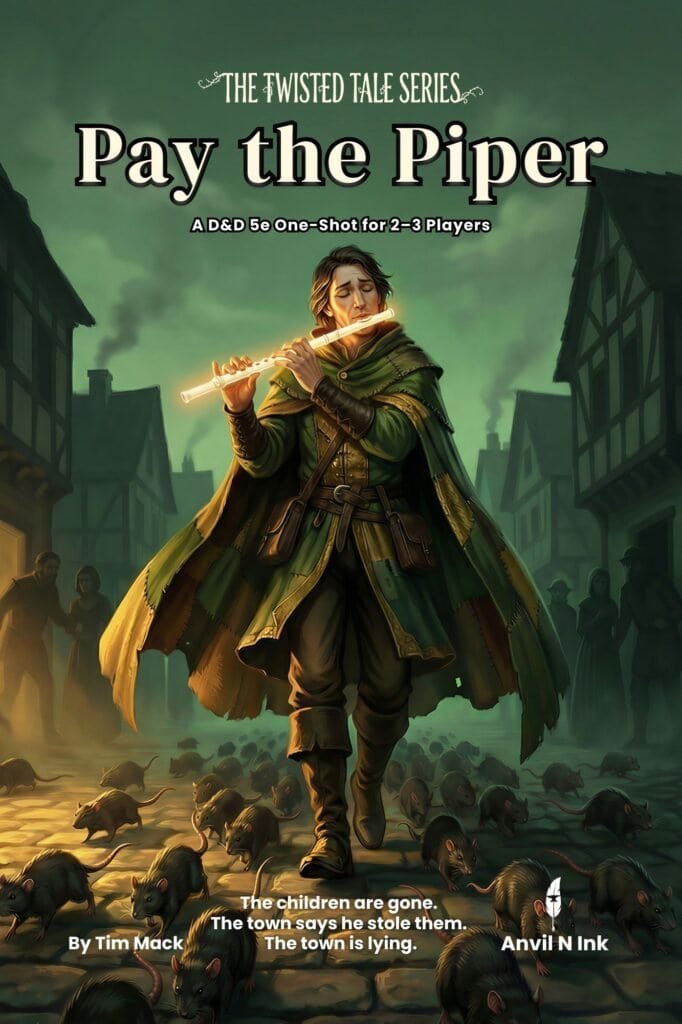

Pay the Piper is a D&D 5e fairy tale one-shot that takes the story everyone thinks they know — the Pied Piper of Hamelin — and reveals the truth the fairy tale never told you. Designed specifically for 2-3 players and completable in a single 2.5-3 hour session, this adventure drops your group into a plague-ravaged town overrun with rats, introduces them to a mysterious piper with a bone-white flute, and then pulls the ground out from under them when the town breaks its promise and every child vanishes overnight. This is not a simple rescue mission. The Piper is not a villain. And the choice waiting at the end of this adventure will haunt your table long after the session is over. Part of The Twisted Tale Series from Anvil & Ink Publishing, Pay the Piper is built for busy DMs who want zero-prep moral complexity and players who are tired of adventures where the right answer is obvious.
Not Your Bedtime Story: The Pied Piper Reimagined
Everyone knows the fairy tale. A piper rids a town of rats. The town refuses to pay. The piper takes the children. End of story — except it isn’t. Pay the Piper asks the question the original never did: what if the piper had a reason? What if taking the children wasn’t revenge — but rescue?
Your players start as rat-catchers, hired by a desperate mayor to deal with an infestation that is destroying the town’s food supply. They fight swarms in a grain-choked granary, navigate plague-marked streets, and witness a town slowly dying from the inside. Then the Piper arrives — a kind, exhausted wanderer with a gift for music and a deal that seems too good to refuse. Five hundred gold and every rat gone by sundown.
The town agrees. The Piper delivers. And then the mayor refuses to pay.
What happens next is not what your players expect. The children vanish, yes. But the trail leads through a dark forest, past fey guardians who demand personal sacrifice, and into the Feywild itself — where the children are alive, laughing, playing in silver grass beneath a twilight sky. They are safe. They are happy. And they are slowly becoming something no longer human.
The Twist That Makes It a Twisted Tale
The Piper didn’t steal the children. He saved them. A plague is coming that kills children first — fast, brutal, and without cure. Every town the Piper has visited in the last two years has buried its children within weeks. The Feywild is the only place the sickness cannot reach. But the Feywild changes everything that stays too long. The children will forget their names, their families, their humanity. They will become fey — wild, ageless, and joyful. They will never remember Hamelin.
Your players must choose: bring the children home to a town where plague will find them, or leave them in a paradise that will erase who they were. There is no third option. There is no clean answer. There is only the choice, and the price that comes with it.
Four Acts of Escalating Moral Complexity
Pay the Piper runs across four tightly paced acts, each shifting the tone and raising the stakes. Act 1 is combat-focused — rat swarms in tight spaces, an alpha predator in the granary, and environmental storytelling that makes Hamelin feel like a real place dying a real death. Act 2 introduces the Piper and builds genuine affection before the town’s betrayal tears it away. Your players will like this man. They will trust him. And then they will watch a coward cheat him out of everything he earned.
Act 3 is investigation and exploration. A twelve-year-old deaf girl named Maren — the only child left behind because she couldn’t hear the music — becomes the party’s guide through a fey-touched forest. She is not a damsel. She is brave, practical, and determined to find her little brother. The Thorn Wardens who guard the path demand personal sacrifice, not gold. Your players will have to give up something that matters to them.
Act 4 is the conversation that changes everything. The Piper tells the truth. The plague, the children, the impossible math of saving lives at the cost of identity. Then he steps aside and lets the players decide. Two fully written endings follow — both bittersweet, both with long-term consequences, both designed to generate the kind of post-session conversation that makes tabletop gaming unforgettable.
Built for Small Groups, Not Scaled Down
Every encounter in Pay the Piper was designed from the ground up for 2-3 players. This is not a four-player adventure with a “reduce hit points” sidebar. Scaling notes are woven into every combat encounter, every social scene, and every exploration sequence. Two players get tighter encounters with adjusted enemy counts and modified abilities. Three players get the full experience. Either way, the balance holds and the tension stays exactly where it should be.
The three pre-generated characters — a grief-hardened fighter, a fast-talking halfling rogue, and a fey-scarred warlock — each have personal connections to the adventure’s themes. Bryn lost her brothers to plague. Thistle knows what it’s like to be a child no one came looking for. Aldric served a fey patron for five years and recognises the Piper for what he is immediately. These aren’t generic stat blocks with names attached. They are people with reasons to care about what happens in Hamelin.
What’s Inside Pay the Piper
This is a complete, ready-to-run adventure. Open the book, read for fifteen minutes, and you are prepared to run a session that your players will talk about for months.
The book includes a four-act adventure spanning 48 or more pages, with five fully statted creatures and NPCs — each with tactics, scaling notes, and negotiation options for groups that prefer talking to fighting. Three pre-generated fairy tale-themed characters at level 4 come with full backstories, personality traits, and connections to the adventure. Three battle maps cover the key encounter locations: the market square and granary, the narrow plague-district street, and the Feywild glade. Three player handouts are ready to print and hand across the table. A DM quick reference sheet puts every NPC, clue, and timeline on one page. The “What If?” section covers eight common player decisions with detailed guidance. And five adventure hooks offer paths for continuing play if your group wants to see what happens next.
Perfect For Your Table
DMs who run for small groups — you are tired of rebalancing adventures designed for four or five players. This was built for your table from page one.
Tables that love moral complexity — if your group enjoyed the fairy tale quests in The Witcher 3, or anything Neil Gaiman has ever written, this adventure speaks your language. No moustache-twirling villains. No obvious right answer. Just people making impossible choices.
Busy DMs who need zero-prep sessions — everything is in the book. Read-aloud text, NPC dialogue, encounter scaling, contingency plans for eight different “what if” scenarios. Open it, run it, done.
Groups who want a complete evening — 2.5 to 3 hours, start to finish. No cliffhangers, no “to be continued.” A full story with a beginning, middle, and an ending that means something.
Players who think they know the Pied Piper story — they don’t. Not this version. The fairy tale recognition makes the twist hit harder, because they will see it coming and still not be ready for it.
The Twisted Tale Series
Pay the Piper is Book 3 in The Twisted Tale Series — a collection of D&D 5e one-shots that adapt classic fairy tales into morally complex adventures. Each book takes a story everyone knows and reveals what really happened. Sympathetic villains, difficult choices, and endings where every path has a price. The series includes The Twelve Dancing Princesses, The Golden Thread (Rumpelstiltskin), and more to come. Every Twisted Tale is designed for 2-3 players, completable in a single session, and built to make your table argue about what the right thing to do actually was.
Run It Tonight
The children of Hamelin are missing. A deaf girl is standing at the town gate with a note that says “I saw them go. I can show you.” A piper is waiting in a silver meadow with the truth no one wants to hear. And your players are about to discover that the hardest part of a fairy tale isn’t fighting the monster — it’s deciding who the monster actually is.
Pay the Piper is ready when you are. No prep. No rebalancing. Just the story, the music, and the choice.
Pay the Piper — a D&D 5e fairy tale one-shot where the villain has reasons, the children are safe but changing, and the only thing worse than the truth is what happens when you act on it.
Get Your Copy
Choose your preferred format