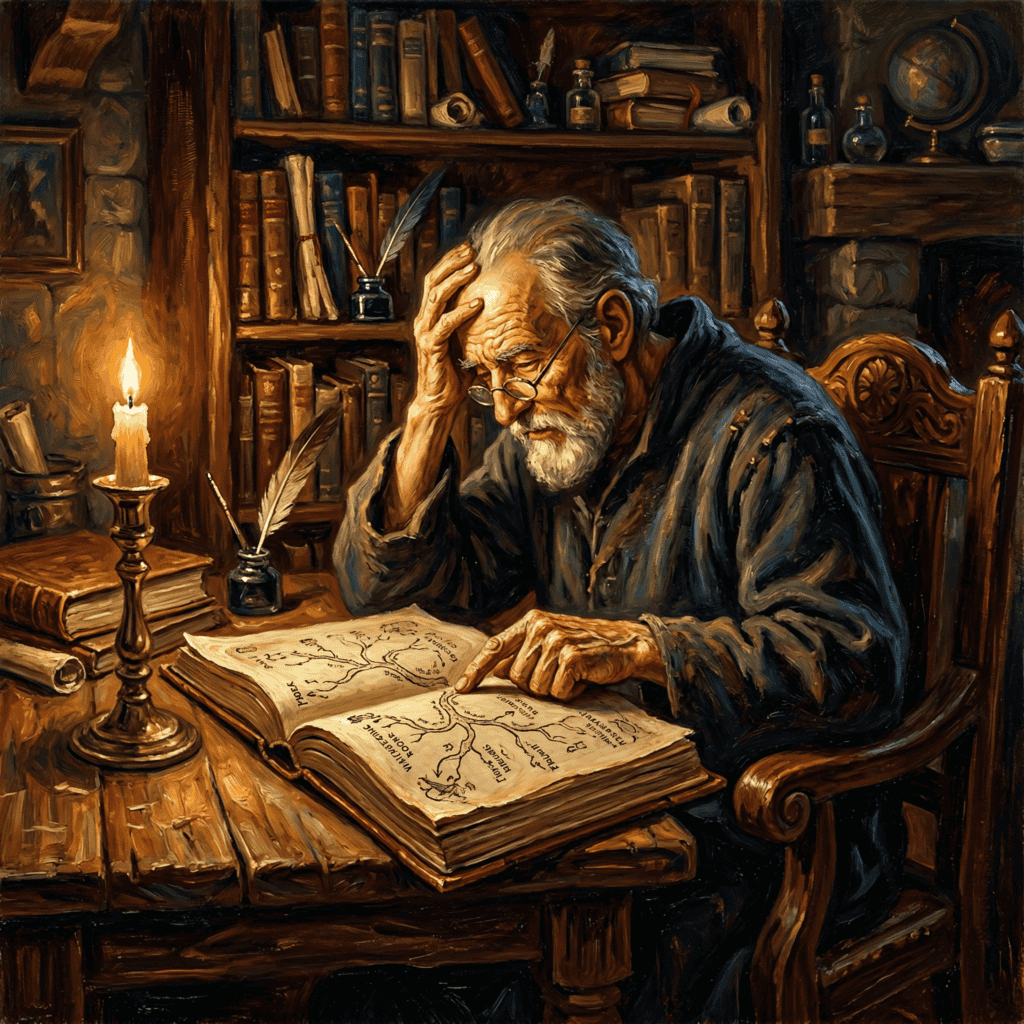

A solo RPG gamebook is one of the oldest formats in tabletop gaming and one of the least understood by people coming to it from D&D. If your experience with solo play is either a standard roleplaying game or a choose-your-own-adventure novel, a gamebook sits exactly between those two things — and understanding what makes it distinct is the fastest way to find the right one for you.
This guide covers what solo RPG gamebooks actually are, how they differ from other solo play formats, what to expect from your first one, and how the format has evolved into modern browser-based versions that carry the same DNA.
What Is a Solo RPG Gamebook?
A solo RPG gamebook is a book you play through alone, making decisions that branch the narrative and using a simple dice-based system to resolve uncertain outcomes. Unlike a standard novel, you do not read from page one to the end — you jump between numbered paragraphs or sections based on choices you make. Unlike a standard RPG, there is no dungeon master and no other players. Unlike a video game, there is no screen.
The format emerged in the late 1970s and reached peak mainstream popularity in the 1980s with series like Fighting Fantasy, Lone Wolf, and Choose Your Own Adventure. Those series are still in print and still have active communities. But the format never went away — it evolved, absorbed influences from tabletop RPGs, and is currently experiencing a quiet renaissance driven by players who want narrative depth without the scheduling overhead of a group game.
The core experience is this: you are sitting alone with a book and some dice. You read a paragraph that describes a situation. You make a choice — turn to section 47 if you take the left passage, turn to section 83 if you take the right. You might roll dice to determine whether your character succeeds at something. You turn to the indicated section and continue. The story branches based on what you decide.
How a Solo RPG Gamebook Differs From Other Solo Formats
The solo RPG space has expanded considerably in recent years, and the terminology can be confusing. It helps to understand what makes a gamebook distinct from other formats people sometimes use the term for.
vs. Solo RPG Systems (like Ironsworn or Scarlet Heroes)
A solo RPG system gives you a framework for generating your own narrative — oracles, random tables, prompting mechanics — and asks you to create the fiction as you go. It is collaborative storytelling with yourself, using dice and tables to introduce uncertainty. A gamebook has a fixed authored narrative. The choices are yours, but the story content was written by someone else. Gamebooks are more structured and guided; solo systems are more open-ended and generative.
vs. Choose-Your-Own-Adventure Books
Choose-your-own-adventure books branch purely on decisions with no mechanical resolution. You choose, you turn to a section, you read. Gamebooks add a character sheet — hit points, inventory, ability scores — and dice-based resolution for conflicts and uncertain outcomes. Your character can fail. The adventure has genuine stakes because the dice can end your run.
vs. Dungeon Crawl Solo Games
Dungeon crawl solo games like Deep Delving are primarily mechanical — procedurally generated encounters, tactical combat, resource management. The narrative is emergent rather than authored. A gamebook prioritises authored narrative with mechanical elements; a dungeon crawler prioritises mechanical depth with narrative as context.
What to Expect From Your First Solo RPG Gamebook
First-timers often make the same mistake: they try to “win” the gamebook in a single playthrough. That is not how the format works, and it sets up an experience that feels short and incomplete.
Gamebooks are designed for multiple runs. Your first playthrough establishes the shape of the world and the rough direction of the story. You will probably die or hit a bad ending. That is correct. The information you accumulate across multiple runs — which choices led where, which sections are worth pursuing, what the consequences of different decisions feel like — is part of the experience. Gamebook mastery is knowing the branches well enough to navigate toward the best outcomes while still encountering genuinely new content.
A few things that will make your first session better:
- Keep a bookmark or notepad. Track which sections you have visited and what choices led there. Some gamebooks are large enough that you will lose your place across sessions.
- Do not restart on death. Continue from a recent branch point. Dying is information, not failure.
- Read every word of the section you land on. Gamebook writing is dense with information. Details that seem irrelevant on one pass become critical on another.
- Honour the dice. It is tempting to reroll bad results. Accepting them produces a more interesting experience and gives the format its genuine stakes.
The History of the Solo RPG Gamebook
The format was invented almost simultaneously by Steve Jackson and Ian Livingstone with Fighting Fantasy (UK, 1982) and by Edward Packard with the Choose Your Own Adventure series (US, which predated Fighting Fantasy but lacked the RPG mechanical layer). Fighting Fantasy added hit points, skill scores, and combat resolution — the mechanical scaffolding that made it a solo RPG rather than just an interactive story.
Lone Wolf, written by Joe Dever from 1984 onward, extended the format into a true campaign structure. Your character progressed across dozens of books, carrying equipment and abilities forward between volumes. It was effectively a solo RPG campaign delivered in book form.
The format declined in the mid-1990s as video games provided a more immersive branching narrative experience with better production values. But the mechanical depth and physical ownership of a book gamebook was never fully replicated by digital games, and the community maintained the format through the internet era. Modern publishers — including Fighting Fantasy reissues, new Lone Wolf volumes, and a wave of indie gamebook designers — have brought the format back to mainstream tabletop attention.
Modern Gamebooks: The Browser-Based Evolution
The core gamebook experience — authored narrative, branching choices, dice-based resolution — translates naturally to browser-based play. The page-turning mechanic becomes a click. The dice roll becomes a button. The character sheet persists automatically without a notepad.
Half-Pint from Anvil N Ink is a browser-based solo gamebook that carries this tradition into a modern format. You play as a halfling burglar on a heist — choices branch the narrative, dice determine outcomes, and the story responds to what you decide. It is available to play tonight at anvilnink.com/half-pint/ with no download or installation required.
The browser format removes the friction of physical setup — no dice to find, no page to mark, no character sheet to maintain separately. For a first experience with the gamebook format, it is the lowest-barrier entry point available.
Choosing Your First Solo RPG Gamebook
A few recommendations depending on what you are looking for:
For the classic experience: The Warlock of Firetop Mountain (Fighting Fantasy #1) is where most people start and still holds up. Short enough to complete in a single session, mechanically simple, and structurally clever in ways that are still being discussed decades later.
For narrative depth: Flight from the Dark (Lone Wolf #1) introduces the campaign structure and is more story-focused than mechanical. The emotional stakes are higher than most early gamebooks.
For a modern indie take: Thousand Year Old Vampire is technically not a gamebook in the traditional sense, but it uses the same core structure — prompts, choices, journaling — to produce a deeply personal narrative experience. Worth knowing about as a contemporary evolution of the format.
For immediate digital play: Half-Pint — halfling heist, browser-based, available right now.
The complete beginner guide to solo RPGs covers the broader solo play landscape beyond gamebooks — including solo systems, dungeon crawlers, and how to adapt standard D&D for solo play. The best solo RPGs for 2026 list covers specific title recommendations across all formats if you want to explore beyond the gamebook format specifically.
Frequently Asked Questions: Solo RPG Gamebook
Do I need dice to play a solo RPG gamebook?
For most traditional gamebooks, yes — typically two six-sided dice. Some modern gamebooks use a single d6 or have optional diceless modes. Browser-based gamebooks handle randomisation digitally so no physical dice are needed. Check the specific gamebook you are interested in, but assume dice are required unless stated otherwise.
How long does a solo RPG gamebook session take?
A single playthrough of a standard gamebook runs 1-3 hours. A full “completion” — exploring most branches and finding the optimal path — can take 5-10 hours across multiple sessions. This makes the format ideal for play in fragments: you can stop at any section and return later without losing your place, unlike a group game where stopping mid-session affects everyone.
Are solo RPG gamebooks replayable?
Yes, and that replayability is a core feature rather than a bonus. Branching structure means that different choices produce genuinely different content — not just different outcomes, but different scenes, different information, different characters encountered. A well-designed gamebook rewards multiple playthroughs because each run reveals parts of the structure the previous run missed.
What is the difference between a solo RPG gamebook and a solo D&D supplement?
A solo D&D supplement adapts the D&D ruleset for single-player use — you still use the full D&D mechanics but without a DM, using oracles or AI tools to replace the DM’s role. A solo RPG gamebook is a self-contained format with its own simpler mechanics. They are different tools for different experiences. Solo D&D supplements like Deep Delving give you mechanical D&D depth; gamebooks give you authored narrative with lighter mechanics. Both are worth playing.
Can children play solo RPG gamebooks?
Many classic gamebooks were written explicitly for a young adult audience and remain appropriate for older children with reading ability. The Fighting Fantasy series starts accessibly and scales in complexity. Parental review of specific titles is recommended — some later Fighting Fantasy books and many modern indie gamebooks include content intended for adult readers. Half-Pint is suitable for all ages.
Ready to try it? Play Half-Pint in your browser tonight — a solo halfling heist gamebook with no setup required. For more solo play options, Deep Delving delivers the solo dungeon-crawling experience with 8,000+ boss combinations on Amazon.
A solo RPG gamebook gives you a complete adventure with no scheduling, no group coordination, and no setup — just a story that branches based on what you decide.