
Time Pressure Mechanics in D&D: How to Create Urgency That Makes Every Decision Matter
The dungeon has no deadline. The dragon waits patiently. The cultists pause their ritual while players debate for forty-five minutes about which corridor to explore first. Sound familiar? Without time pressure mechanics in D&D, sessions often lose momentum to endless deliberation. Players optimize instead of act. Caution replaces courage. The adventure stalls while everyone discusses theoretical outcomes that never materialize.
Time pressure transforms D&D sessions. When consequences attach to delay, players make decisions. When the clock ticks audibly, caution becomes a calculated risk rather than a default approach. When “we’ll rest and try again tomorrow” isn’t an option, every resource matters. The urgency that great adventure stories contain becomes present at your table.
This guide explores time pressure mechanics in D&D that create genuine urgency without frustrating players. We’ll cover different approaches to implementing countdowns, techniques for communicating pressure effectively, methods for balancing tension with fairness, and adventures designed around time pressure from the ground up. Transform your sessions from leisurely explorations into desperate races against consequences.
Why Time Pressure Improves D&D Sessions
Time pressure isn’t arbitrary cruelty—it’s a design tool that solves real problems at the gaming table. Understanding what time pressure accomplishes helps you implement it effectively.
Eliminating Analysis Paralysis
Given unlimited time, players will use unlimited time. Every decision becomes an optimization problem. Which spell is mathematically optimal? What’s the theoretically best marching order? How can we guarantee success before attempting anything?
This deliberation feels productive but actually reduces fun. Players spend more time discussing the game than playing it. Sessions become meetings about hypothetical dungeons rather than adventures through real ones.
Time pressure short-circuits analysis paralysis. When delay has consequences, “good enough” decisions happen. Players act on instinct and intuition rather than exhaustive analysis. The game moves. Things happen. Adventures feel like adventures.
Creating Meaningful Resource Decisions
D&D’s resource management assumes pressure. Spell slots, hit dice, consumables—these resources create interesting decisions only when conservation matters. Without time pressure, players can rest whenever resources deplete. The “adventuring day” becomes infinitely extensible. Resources become unlimited through patience.
Time pressure restores resource meaning. You can’t long rest when the hostage dies at midnight. You can’t wait for spell slots when the tower collapses in an hour. Resources become genuinely finite, and decisions about their use become genuinely meaningful.
Enabling Heroic Moments
Heroes in stories face desperate situations. They act despite inadequate preparation. They sacrifice certainty for necessity. They succeed against odds that cautious planning would never accept.
Without time pressure, D&D players never face these situations. Full preparation is always possible. Optimal conditions are always achievable. The desperate heroism that defines adventure fiction never occurs because desperation never develops.
Time pressure creates space for heroism. The paladin charges the demon lord with three hit points because there’s no time for a better plan. The wizard casts their last spell slot because the ritual completes in two rounds. These moments become possible only when delay isn’t.
Types of Time Pressure Mechanics
Different time pressure mechanics in D&D create different gameplay experiences. Choosing the right approach for your adventure determines whether pressure enhances or frustrates.
Real-Time Countdowns
The most intense pressure uses actual timers. Set a phone timer for 60 minutes. When it expires, consequences occur. Players experience genuine time pressure because real time actually passes.
Real-time countdowns work best for climactic sequences—the final dungeon level, the escape sequence, the ritual interruption. Extended real-time pressure exhausts players. Short, intense applications create memorable peaks without sustained stress.
Communicate clearly when using real time. “You have one hour of real time before the volcano erupts” establishes expectations. Players can make informed decisions about pacing. Surprise real-time pressure feels unfair; announced pressure feels exciting.
Turn-Based Countdowns
Abstract countdowns measure pressure in turns, rounds, or narrative beats rather than real time. “The ritual completes in 10 rounds.” “You have three chances before the guard returns.” “Each room you explore, roll for collapse.”
Turn-based pressure allows normal gameplay pacing while maintaining urgency. Players can think without real-time stress, but every action costs progress toward consequences. The countdown advances predictably, enabling strategic planning within constraints.
Visible tracking helps players engage with turn-based pressure. A countdown die showing remaining rounds, tokens removed from a track, or a literal hourglass turned at each interval all make abstract pressure tangible.
Narrative Countdowns
Some pressure operates through narrative rather than mechanics. “The ship sails at dawn—you have tonight to find the spy.” “The duke’s patience is wearing thin—one more failure and he withdraws support.” The deadline exists in fiction without mechanical tracking.
Narrative pressure allows flexible pacing. You control when consequences trigger based on dramatic appropriateness rather than predetermined counts. This flexibility enables responsive storytelling but requires disciplined follow-through—consequences must eventually occur, or the pressure becomes meaningless.
Environmental Pressure
The environment itself can create time pressure. Rising water, spreading fire, collapsing structures, advancing enemies—physical circumstances that worsen over time regardless of player actions.
Environmental pressure feels natural because players see and understand its source. The water is rising; of course we need to hurry. The logic is embedded in the fiction rather than imposed by abstract mechanics. This naturalness makes environmental pressure particularly effective for immersion.
The Sinking Tower: Time Pressure Done Right
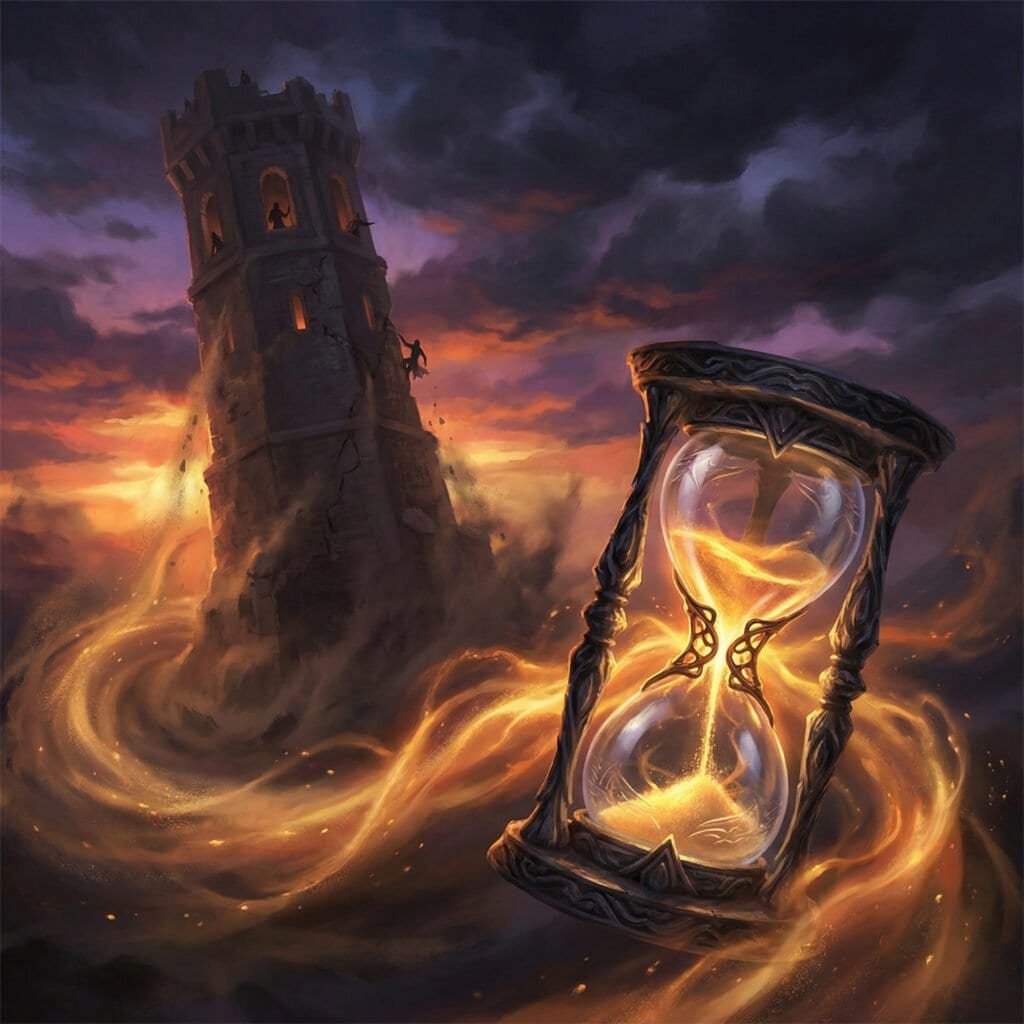
The Sinking Tower of Hours demonstrates how time pressure mechanics in D&D can drive an entire adventure. The premise is elegant: a wizard’s tower sinks into magical sand. Players must descend through five levels to rescue a trapped boy before the tower vanishes forever.
How the Pressure Works
The tower’s descent provides constant, visible environmental pressure. Players can see the sand rising. Each level they complete sinks behind them—no backtracking, no retreating to rest. The pressure isn’t arbitrary; it’s physically present in the game world.
This environmental approach solves common time pressure problems. Players understand why they can’t delay. The consequence (being trapped as the tower sinks) feels proportionate and fair. The pressure enhances rather than punishes because it creates the adventure’s central tension.
Temporal Mechanics Integration
The Sinking Tower goes further, integrating time into its very mechanics. Temporal effects, time-based puzzles, and the tower’s magical nature create thematic coherence. The pressure isn’t just a constraint—it’s the adventure’s core identity.
This integration demonstrates best practices for time pressure design. When urgency connects to theme and fiction, it feels essential rather than imposed. Players engage with time pressure as part of the adventure rather than as an obstacle to enjoying it.
Small Group Optimization
The adventure works specifically for 2-3 players, completing in approximately two hours. Small groups face fewer coordination challenges, and the compressed timeline prevents the session from dragging. Time pressure and small-group focus reinforce each other—both push toward decisive action.
For DMs wanting complete time-pressure adventures without extensive preparation, The Sinking Tower of Hours delivers the format’s benefits with the work already done. The adventure runs smoothly because it was designed around pressure from conception.
Implementing Time Pressure in Your Adventures
Adding time pressure to adventures requires more than announcing deadlines. These techniques ensure pressure enhances rather than undermines your sessions.
Establish Stakes Clearly
Players must understand what happens if time expires. Vague consequences feel arbitrary; specific consequences feel meaningful. “The hostage dies” creates different urgency than “something bad happens.” Clarity enables informed decision-making.
Stakes should be proportionate to the pressure intensity. Minor time pressure (slight inconvenience if deadline missed) suits routine situations. Major pressure (campaign-altering consequences) suits climactic moments. Mismatched stakes and pressure frustrate rather than excite.
Provide Information for Planning
Time pressure without information creates guessing games, not strategic challenges. Players need enough knowledge to make meaningful choices about time allocation. How many rooms remain? What obstacles stand between here and the objective? How dangerous is rushing versus how costly is caution?
Information needn’t be complete. Uncertainty creates tension. But the uncertainty should concern execution, not basic parameters. Players can decide whether to fight or sneak past guards when they know guards exist; they can’t make meaningful choices when they don’t know what’s ahead.
Make Time Visible
Abstract countdowns fade from awareness. Visible countdowns maintain pressure throughout play. Use physical representations: countdown dice, token tracks, actual timers, rising water lines on battle maps. When players see time passing, they feel its pressure.
Verbal reminders supplement visual tracking. “Two rounds until the portal closes.” “You’ve used half your time.” “The sand is rising faster now.” Regular communication prevents players from forgetting pressure during complex encounters.
Allow for Meaningful Choices
Time pressure should create choices, not eliminate them. If only one path exists and time allows exactly that path, pressure becomes railroading with extra stress. Good time pressure forces prioritization: you can’t do everything, so what matters most?
Design adventures with more content than time allows. Optional objectives, multiple routes, side goals that reward exploration—these elements make time pressure meaningful because players must choose what to pursue. The choices reveal character priorities and create replayability.
Balancing Pressure and Fairness
Time pressure walks a line between exciting urgency and frustrating punishment. These principles help maintain that balance.
Consequences Should Be Survivable
Failed time pressure shouldn’t typically mean campaign-ending total party kills. Consequences matter, but they should create new situations rather than simply ending the game. The hostage dies—now players must deal with that failure. The ritual completes—now players face the summoned demon. The tower sinks—but perhaps players escape with partial success.
Survivable consequences maintain engagement after failure. Players experience loss without losing everything. The story continues in a new direction rather than simply stopping.
Players Should Understand the System
Hidden pressure mechanics feel unfair when they trigger consequences. Players should know how time works in your adventure. Is it real-time? Turn-based? What actions advance the countdown? What actions don’t? Transparent systems enable strategic play; opaque systems enable only guessing.
This doesn’t mean players know exactly when consequences occur—uncertainty about specific timing creates tension. But they should understand the mechanism generating that timing.
Provide Opportunities to Recover Time
Strict countdowns that only decrease create desperation that can overwhelm enjoyment. Consider including ways to recover time: shortcuts discovered through exploration, NPCs who provide assistance, clever solutions that bypass time-consuming obstacles.
Time recovery opportunities reward player creativity and prevent the feeling that failure is inevitable. Even if players never find these opportunities, knowing they might exist maintains hope alongside pressure.
Time Pressure Across Adventure Types
Different adventure formats interact differently with time pressure mechanics in D&D. Matching pressure type to adventure type maximizes effectiveness.
Dungeon Crawls
Traditional dungeon crawls respond well to environmental pressure. Collapsing structures, rising water, spreading corruption—these hazards fit naturally into underground exploration. Each room cleared is progress against both the dungeon’s challenges and the environmental clock.
Dungeon crawls with time pressure require careful design to prevent impossible situations. If players must clear ten rooms and time allows only eight, the adventure fails regardless of their choices. Ensure critical paths are achievable while optional content provides meaningful time tradeoffs.
Heists and Infiltrations
Heists often incorporate time naturally. The target leaves at midnight. The guard shift changes in an hour. The window of opportunity closes at dawn. These deadlines feel organic because heists depend on timing.
Heist time pressure emphasizes planning consequences. Plans that account for time constraints succeed; plans that ignore timing fail. The pressure rewards thorough preparation while preventing infinite deliberation.
Rescue Missions
Rescues create immediate time pressure through victim vulnerability. The prisoner will be executed. The hostage will be moved. The kidnapped child will be sold. These stakes require no explanation—players understand why delay costs lives.
Rescue time pressure should balance victim welfare against player resources. Rushing produces casualties; waiting produces victim harm. Neither extreme should be optimal, forcing difficult decisions about acceptable costs.
Investigation Adventures
Mysteries can incorporate time pressure through ongoing crimes. The killer strikes again in three days. The conspiracy activates at the full moon. The evidence will be destroyed tomorrow. These deadlines prevent investigations from becoming leisurely puzzles without urgency.
Investigation time pressure requires careful information management. Players need enough time to gather sufficient clues while feeling pressure to prioritize. Too little time makes mysteries unsolvable; too much time removes urgency entirely.
Common Time Pressure Mistakes
Certain errors consistently undermine time pressure implementation. Avoiding these mistakes improves your chances of success.
Pressure Without Payoff
If deadlines pass without consequences, players learn to ignore future deadlines. Time pressure requires follow-through. When you establish a countdown, something must happen at zero—even if that something is different from what players expected.
This doesn’t mean always delivering the threatened consequence. Partial failures, unexpected developments, and modified outcomes all constitute payoff. But players must see that time mattered. Countdowns that fizzle into nothing train players that pressure is performative rather than real.
Unwinnable Scenarios
Time pressure should challenge players, not guarantee failure. If the countdown cannot be beaten regardless of player choices, pressure becomes cruelty rather than design. Test your timing against expected player performance, and err toward generosity rather than impossibility.
Punishing Rest Exclusively
Some DMs use time pressure solely to prevent resting. While rest management is legitimate, pressure that exists only to restrict mechanical recovery feels adversarial. Time pressure should create narrative urgency, with rest restriction as a consequence rather than the primary purpose.
Constant Pressure
Unrelenting time pressure exhausts players. Tension requires release to remain effective. Design adventures with pressure peaks and valleys—intense countdown sequences followed by moments of relative calm. This rhythm maintains engagement without creating fatigue.
Ready-to-Run Time Pressure Adventures
Designing effective time pressure requires balancing many factors. Ready-to-run adventures with built-in pressure eliminate this design burden while delivering the format’s benefits.
The Sinking Tower of Hours provides the definitive time-pressure dungeon crawl experience for small groups. The entire adventure builds around temporal urgency, with mechanics, theme, and structure reinforcing the central countdown.
Other adventures in The Ready Adventure Series incorporate time pressure elements appropriate to their formats. Heist adventures include infiltration windows. Rescue missions feature victim deadlines. Investigation adventures present ongoing threats. Each adventure applies pressure fitting its specific structure.
Conclusion: Racing Against the Clock
Time pressure mechanics in D&D transform how sessions play. Analysis paralysis gives way to decisive action. Resource decisions become genuinely meaningful. Heroic moments emerge from desperate circumstances. The urgency that defines adventure fiction becomes present at your table.
Implementation requires care—pressure must feel fair, consequences must be survivable, and systems must be transparent. But when done well, time pressure elevates ordinary sessions into memorable adventures. The clock becomes another player at the table, driving the story forward through its inexorable countdown.
Try The Sinking Tower of Hours for a complete time-pressure experience designed from the ground up. Or apply these principles to your own adventures, creating urgency that makes every decision matter.
The sand is rising. The countdown continues. Your players’ choices matter—but only if they make them in time.