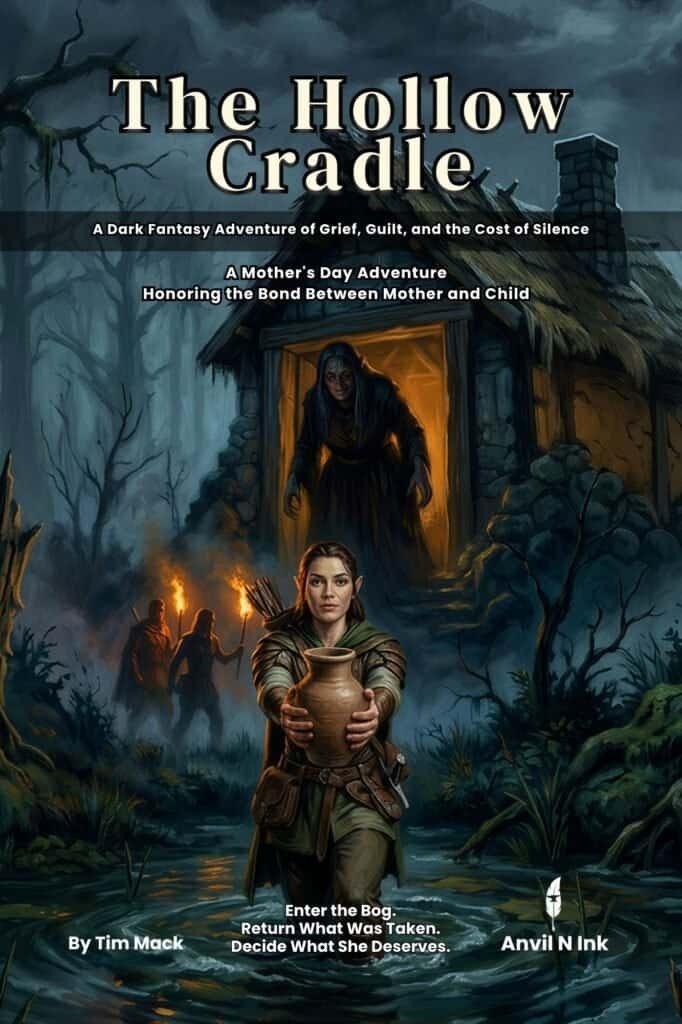

The Hollow Cradle is a Mother’s Day one-shot for 5e — a complete, ready-to-run dark fantasy session for small groups, built around a monster who is not a monster and a village that would rather you did not ask why. Every Game Master knows the bind: you want a night that lands with real emotional weight, the kind your players go quiet after, but you do not have a weekend to build one. This adventure hands you that night, prepped and playable. Twenty-five children have vanished from a village at the edge of a black bog. Your players are hired to find the thing responsible and end it. What they find is a mother who has been waiting forty years for someone to give back what was taken from her — and an old man in the village who has known where it was the entire time.
The Hag Is Not the Villain. She Is Also Not Innocent.
Most 5e one-shots hand you a creature to kill. This one hands you a person to understand, and then refuses to tell you what to do about it. Maren was a healer before she was a hag. She had a son — half-human, visibly different, gentle by nature — who followed the village lights one night out of curiosity and was beaten to death in the fog before anyone thought to ask what he was. She went looking for him. What she found unmade her.
The children she takes are alive. They are wooden dolls on her shelves, twenty-five of them, each with a different face, each one tended and dusted and kept. That is not cruelty. It is a terrible kind of care from someone who stopped being able to tell the difference between keeping something and trapping it. The book is explicit on the hardest point: she is not redeemed at the end. She is understood. Both of those things are true at once, and the adventure does not resolve that tension for your players. It leaves it with them.
The Elder Who Sends You
Before the party enters the bog, a frail old man presses a clay urn into their hands and tells them it holds the remains of her child. Give it to her, he says, and this ends peacefully. He is telling the truth. He is also concealing the rest of it — that he was her lover, that the boy was his, that he walked away from both of them, and that the urn has been sitting in his house for forty years because returning it would have meant admitting what he did. He is not a villain. He is a man who made a coward’s choice for six decades and is now trying to fix it at one remove, through strangers, without having to watch.
The Urn Is a Choice, Not a Quest Item
Your players can take the urn or leave it. No NPC nudges them. The Elder believes it will work and says so once — that is the entire push the adventure gives you. Whether they carry it into the bog, and what they do when they arrive, is the whole session compressed into a single object.
A Bog That Costs Something to Cross
The journey is not a corridor between scenes. Two full acts take your players through outer and inner bog on a navigation skill challenge, through a channel where bog crocodiles are waiting under the black water, past a will-o’-wisp that has been feeding on grief and death out there for decades, and across the Drowning Ground — a three-round gauntlet of quicksand, root webs, and rising channels that arrives with no combat and no enemy to hit. By the time they reach the lair, they are depleted, cold, and out of easy answers. That is deliberate. The final act is meant to be played by tired people.
The Gatekeeper
The construct at the lair door was not built to fetch. It was built to hold, and it will not withdraw. Your players can fight the hardest encounter in the book while exhausted — or they can present the urn, and watch it simply step aside without a word. It is the cleanest statement of the adventure’s whole thesis: the door was never locked. It was waiting.
Four Endings, and the Book Will Not Save You From Any of Them
The resolutions are real, and none of them is blocked by the text.
- Deliver the urn. Maren opens it. A boy takes a breath in the middle of the room for the first time in forty years. She hands over a box, and every child goes home.
- Kill her first. The dolls stay dolls. Water does nothing. Magic does nothing. Twenty-five children are simply gone, permanently, and the village has nothing to bury.
- Deliver the urn, then kill her. The children come home. Your players watched a mother receive her son back after forty years of grief, and then killed her. The text does not comment. Neither should you.
- Never take the urn at all. It stays on the Elder’s shelf, where it has been the whole time, and where it will stay.
The instruction to the Game Master is blunt and repeated: do not steer, do not editorialise, do not soften. Describe what happens and let the table carry it. That is what makes the good ending feel earned instead of assigned — it was genuinely possible to miss it.
What Is Included in This Mother’s Day One-Shot
This is a complete session between two covers, written for busy Game Masters who want depth without the prep grind. Everything you need is here — no supplements, no homebrew patching, no missing pieces.
- A complete two-to-three hour adventure for two to three players at levels two to three, with zero prep
- Four acts and a full epilogue, with atmospheric read-aloud narration throughout
- Full fifth-edition stat blocks for every creature — bog constructs, bog crocodiles, the bog haunt, and Maren herself
- Four ready-made characters — Sable Mourne, Elowen Thrace, Vesper, and Brynn Halstead — any two of which form a viable party
- An overview map of the Fenwick region plus five battle maps: the village square, the outer bog, the deep bog, and the hag’s lair inside and out
- A navigation skill challenge and a three-round environmental gauntlet that put pressure on the party without a single enemy
- Six opening hooks, from a simple contract to a personal connection to one of the missing children
- A “What If?” appendix covering every way a table can go sideways, including the ones you hope they do not
- Four distinct resolutions, all fully written, none of them steered
Perfect For
This one was built for a specific kind of table, and it knows exactly who it is for.
- Busy Game Masters who want an emotionally serious session with no prep grind.
- Small groups and two-player duos who want a story that lands rather than a dungeon that lasts.
- Tables who want a real antagonist — one with a reason, a history, and a claim on your sympathy she never asks for.
- Game Masters who trust their players with a choice that has a wrong answer and no warning label.
- Anyone with a free evening looking for a single-session detour to drop into an ongoing fifth-edition campaign.
A Note on Tone
This is a heavy adventure and it does not pretend otherwise. It deals with child abduction, the killing of a child, decades of parental grief, and a village council that covered up what it did. One resolution path ends with twenty-five children permanently lost, and that outcome cannot be undone. It was written as a Mother’s Day one-shot — not as a celebration, but as an act of recognition: that mothers carry grief, guilt, and silence the rest of us rarely have to name, and that the table is a place where difficult things can be held and looked at honestly. Read the content warnings with your group before you sit down. If that is the night your table wants, this one delivers it without flinching and without cheapening it.
Part of the Ready Adventure Series
The Hollow Cradle joins the Ready Adventure Series, a growing library of small-group 5e one-shots built for two to three players and a single evening of play. Every title is designed the same way: zero prep, a complete session in a couple of hours, meaningful choices, and no railroading. If your table loves a night that feels finished — a real beginning, middle, and end without a month of planning — this is the shelf to watch.
If the sympathetic monster is what draws you, the series has neighbours worth a look. The Aboleth’s Debt puts a coastal town’s survival against the life of a sixteen-year-old girl bound by a pact seven generations old, with no loophole and no trick, and The Mournmere Survey drowns a village under a reservoir and leaves something beneath the water that has waited forty years to be answered. Same design promise, a completely different night at the table.
Enter the Bog
You do not need another dungeon. You need a night where the monster has a name, the villain has a reason, and the people at your table have to decide what a grieving mother is owed by the people who took everything from her. This Mother’s Day one-shot gives you all of it in one ready-to-run package, with the maps drawn and the weight already built in. Enter the bog. Return what was taken. Decide what she deserves.
Twenty-five children, one clay urn, and a mother who has been waiting forty years — The Hollow Cradle turns a single evening into a dark fantasy one-shot your players will not stop thinking about on the drive home.
Get Your Copy
Choose your preferred format