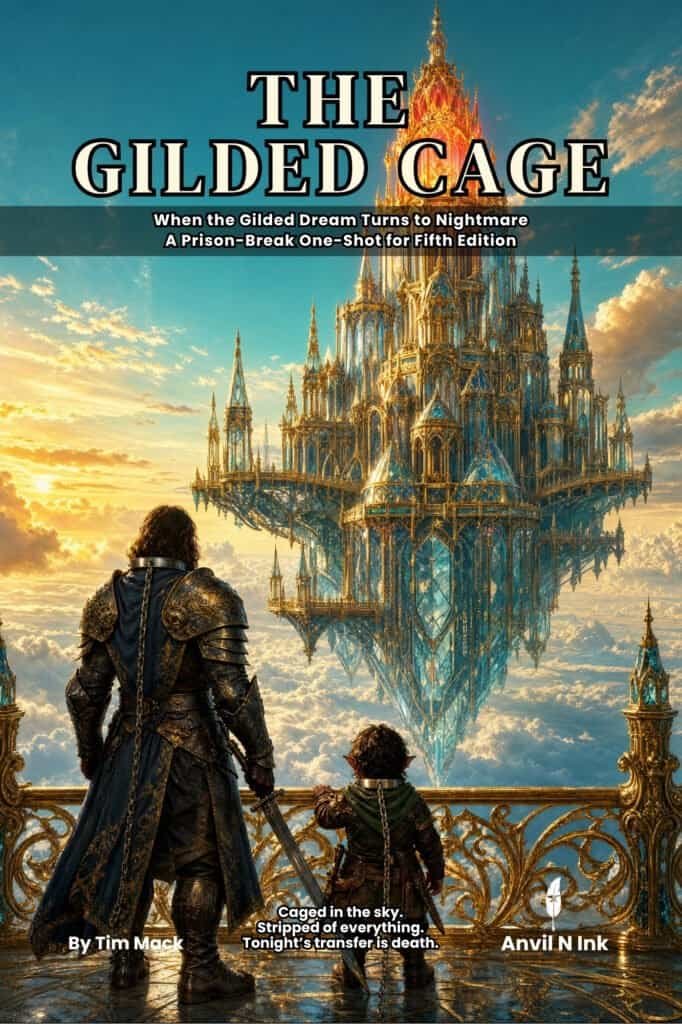

The Gilded Cage is a 5e-compatible prison-break one-shot for two or three players at levels 2–3 that runs in a single 2–3 hour session with zero prep. The party wakes collared and disarmed in the Aurum Spire — a floating prison of crystal and gold three hundred feet above the clouds — with their name on a “transfer” list that is really a sacrifice roster, and one night to break out before the Heart-Crystal is fed their souls. Anvil N Ink published this title, and the breakdown below is honest about what it does well and where it will not suit every group.
This is a small-group, 5e-compatible one-shot built for the table most people actually have — two or three friends and one free evening — not a six-player module with the numbers filed down. If you want a countdown escape with a gilded-horror twist you can read cold and run tonight, here is what The Gilded Cage offers and who it is not for.
How does The Gilded Cage play?
The Gilded Cage runs as a four-act escape against a rising clock: learn the prison, reach the vault, and confront the Warden before the spire tears itself apart. The whole tower is the timer, and the players watch the number climb.
Act One, The Gilded Lock, is arrival and wonder — the party is processed, walked through a gorgeous atrium, tested in a tutorial brawl in the Sky-Yard, and finally pulled aside by an inmate named Fingers Malone, who explains that the transfer list is a death warrant with his name on it. Act Two, The Fork, splits into two routes to the Warden’s Vault: a social infiltration through the servant quarters on disguises and bluffs, or a physical climb through the spire’s under-croft — both converging where the party’s gear and the Warden’s Signet wait. Act Three, The Truth Revealed, escalates through a mid-boss clash with the Gilded Sentinel in the mirrored Panopticon, three centuries of sacrifice records, and a running fight up the Eyrie Stair. Act Four, The Heart, is a three-phase confrontation with Warden-Speaker Aldric Vane and a choice at the Heart-Crystal that decides whether the spire falls out of the sky, changes hands, or is reborn as something stranger. Every ending is written out in full.
What’s included in this prison-break one-shot?
Everything needed to run the night is in the book — the full adventure, the stat blocks, the maps, and four ready-to-play characters — with nothing that assumes a second purchase or a subscription.
- Four acts and eighteen named scenes, with read-aloud narration throughout, written to be read cold at the table.
- A branching Act Two — a social route through the servant quarters or a physical climb through the under-croft — converging on the Warden’s Vault.
- The Aether-Anchor Strain: a visible 0–12 instability track with a floor that rises each act, so the spire keeps groaning, listing, and cracking no matter how cleanly the party plays.
- Suppressor-collars that seal 2nd-level-and-higher spell slots inside the spire — casters keep cantrips and 1st-level magic, and their higher spells return the instant they escape.
- Six creatures with full 5e stat blocks, four NPCs, and a three-phase boss (Warden Aldric Vane) stress-tested at the worst-case two-player table so it never one-shots a hero.
- Four ready-made characters — any two of them form a viable party, and all six pairings were checked against the worst-case math.
- Six battle maps, six opening hooks, six “what if” contingencies, five campaign seeds, and three distinct endings.
Who is this adventure for?
The Gilded Cage fits a Game Master who wants a full session without a week of prep and a table of two or three players who enjoy a ticking-clock escape over an open-ended crawl. It rewards groups who like their horror dressed as luxury — the danger here smiles at you and offers you wine.
It is a strong pick for a one-night break from a longer campaign, a convention slot, or a table that likes a puzzle-box location with a countdown. The pre-generated characters and cold-readable boxed text carry a group with little 5e experience, and because every clue points three ways, the truth always reaches the table — a missed roll changes the pace, never the outcome.
It is a weaker fit for players who want a sandbox or a straight hack-and-slash dungeon. The disarmed, collared opening deliberately strips the party’s gear and higher spells for the first stretch, and a table that lives for its optimized loadout should know that going in. The horror is dread and helplessness rather than gore — table-safe and unsettling rather than graphic — and the book includes content warnings and Lines-and-Veils guidance for the imprisonment and coercion themes it leans on.
How long does The Gilded Cage take to run?
The adventure is designed for a single 2–3 hour session, in line with the rest of Anvil N Ink’s zero-prep, small-group catalog. The Aether-Anchor Strain does the pacing work — the clock is diegetic, so players feel the time pressure the design is using rather than watching a real-world timer.
A two- or three-player table lands squarely in that 2–3 hour window; a full four-player group can stretch toward three and a half hours, and the book says so plainly and offers trims. Because combat never gates progress — the goal is the vault and the Heart-Crystal, not the body count — a faster group can push straight through while a slower table lingers in the spire’s gilded horror without breaking the structure.
Strengths and weaknesses
The Gilded Cage’s biggest strength is its central inversion — a prison that punishes you with comfort, wired to a clock you can watch tick; its biggest limit is that the disarmed opening and quiet-horror tone ask more setup from a Game Master than a straightforward dungeon does. Here is the candid version.
Strengths. The beautiful-prison concept gives the session a distinct identity, and the Aether-Anchor Strain turns that identity into mechanics — the tower physically comes apart as the number climbs, so the night builds instead of sagging. The three-clue design means the story never stalls on a failed check, and the boss is capped and stress-tested across all six two-player pairings so it drops a hero without ever killing one outright. The closing choice at the Heart-Crystal is a real one, with three endings and a genuine moral weight, because the NPCs you met are the ones you may be leaving inside.
Weaknesses. Starting the party collared and disarmed — with 2nd-level spells sealed until the escape — is a strong creative choice that not every group enjoys, so it is worth flagging at session zero, especially for a caster who likes their full kit. The gilded-horror tone wants a Game Master willing to sell politeness as menace, a different muscle than running a monster fight. And it is firmly a one-shot: there is a real ending here, not the opening of a campaign, only seeds for one.
How The Gilded Cage compares
Within Anvil N Ink’s small-group catalog, The Gilded Cage is the “beautiful prison” entry in the escape lane — closest in spirit to the studio’s other break-out and infiltration one-shots, but trading a dungeon or a vault for a palace in the sky.
| Adventure | Setting & hook | Players | Session | Prep |
|---|---|---|---|---|
| The Gilded Cage | A luxurious sky-prison that sacrifices one soul a night to stay aloft | 2–3 | 2–3 hrs | Zero |
| Dead Time | A straight prison-break from a grim dungeon lockup | 2–3 | 2–3 hrs | Zero |
| The Slab | An action-movie prison heist — break in, not just out | 2–3 | 2–3 hrs | Zero |
A taste of the action
The session opens on the party waking where they were never arrested to. This is the adventure’s first read-aloud block, as it appears in the book:
You wake on cold marble, wrists chafed by iron that glows faintly blue. Above you, a dome of crystal shows nothing but sky — no ground, no horizon, just a dizzying depth of cloud and distance. Your head aches where someone struck it, or drugged it, or both. A voice like a ledger being closed says, without looking up: “Names. Crimes. Then the yard.”
From there the party is walked through the wonder, tested in the yard, and told the only way down is the midnight transfer — before they learn what the transfer really is.
Where to buy The Gilded Cage
The Gilded Cage is available on Payhip, with additional editions to follow; the current purchase links appear at the top of this page. It joins the rest of Anvil N Ink’s small-group, zero-prep catalog at anvilnink.com — see the full lineup of D&D prison break and escape one-shots and the best D&D one-shots for 2 players.
Frequently asked questions
Can I run The Gilded Cage with two players? Yes. It is written for two or three players at levels 2–3, and all six two-player pairings of the pre-generated characters were checked against the adventure’s worst-case math — a duo is a supported way to play, not an afterthought.
Do I need anything besides the book? Just the core fifth-edition rules and two or three friends. Characters, monsters, maps, and read-aloud text are all inside.
Is it good for beginners? It works well as a first 5e adventure. The pre-generated characters, cold-readable boxed text, and three-ways-in clue design keep a new table moving even as the tension climbs.
Do I have to use the battle maps? No. The book says outright that the maps are a starting point, and it runs cleanly in theatre of the mind, on a whiteboard, or on a grid.
The Gilded Cage is a 5e prison-break one-shot where the prettiest cell in the sky is still a cell — get the collar off before midnight, or the spire gets one more night in the air.
Get Your Copy
Choose your preferred format