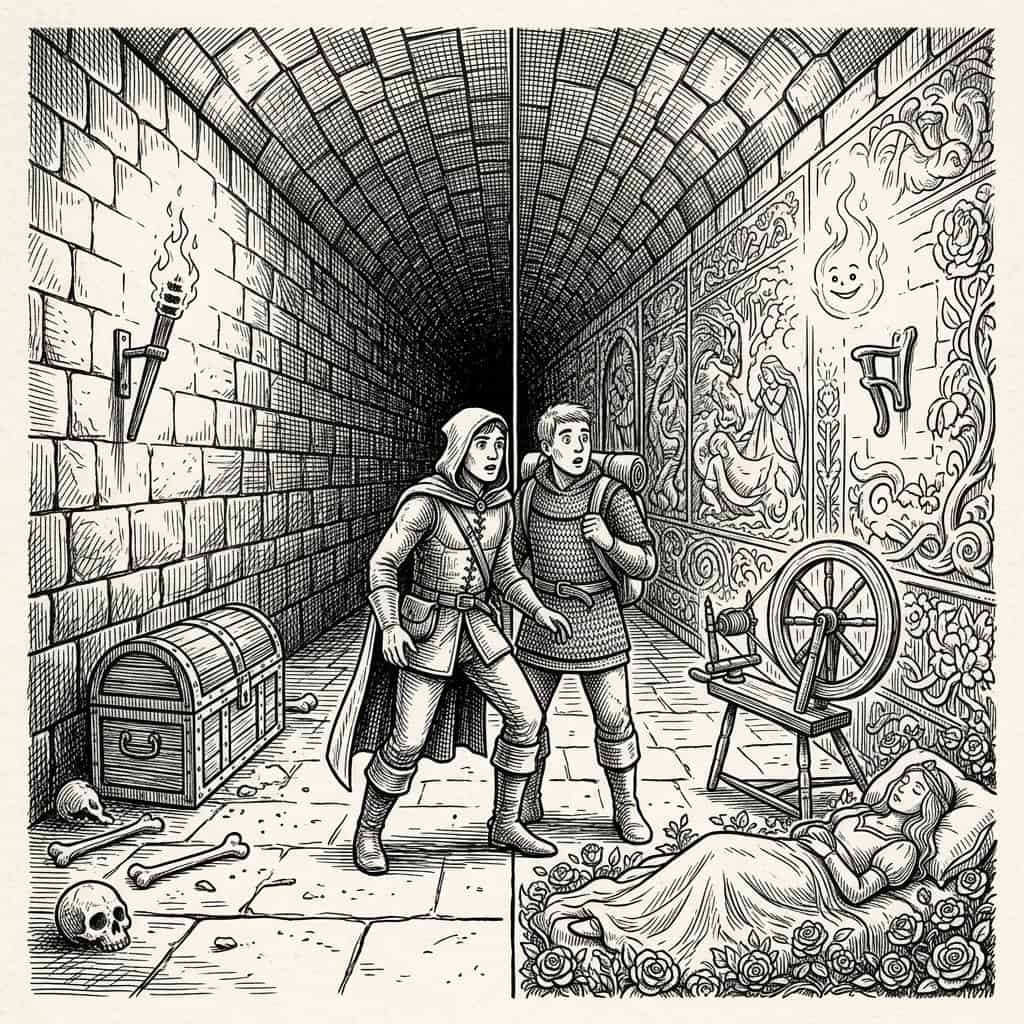

D&D one-shot themes are the single biggest factor in whether your session becomes a story players retell for years or a forgettable evening of rolling dice. Most DMs default to the same handful of themes: clear the dungeon, kill the dragon, retrieve the artifact. These work. They’re functional, reliable, and require minimal setup. But they also produce sessions that blur together in memory because there’s nothing distinctive about the experience. The players fought some monsters, found some treasure, and went home. Was it Tuesday’s session or last month’s? Hard to say.
Fairy tale themes fix this problem completely. When you build a one-shot around a story everyone already knows — and then twist it into something they don’t expect — you create sessions with a built-in emotional hook, a natural narrative arc, and a moral weight that generic adventure themes simply can’t match. This guide breaks down why fairy tale themes outperform traditional one-shot themes and how to use them to create the best sessions your table has ever experienced. If you’re already sold on the concept, the complete guide to dark fairy tale D&D adventures covers the full design methodology.
The Problem With Generic One-Shot Themes
Generic D&D one-shot themes share a structural weakness: they rely on external motivation. The quest-giver tells you to go somewhere and do something. You go. You do it. You come back. The motivation is transactional — gold, experience, reputation — and transactional motivation creates transactional engagement. Players do enough to complete the task and collect the reward. They don’t invest emotionally because the theme doesn’t ask them to.
The Dungeon Crawl Problem
The classic dungeon crawl is the most popular one-shot theme in D&D, and it’s the most forgettable. Room after room of monsters, traps, and treasure. The gameplay is mechanically engaging — players solve tactical puzzles, manage resources, and overcome challenges. But when the dungeon is cleared, what story has been told? “We went underground, fought things, and came back richer.” That’s a summary of actions, not a narrative. There’s no character development because the dungeon doesn’t test character — it tests builds. There’s no moral complexity because the monsters are obstacles, not people. There’s no lingering emotional resonance because nothing that happened in the dungeon connects to anything outside it.
Dungeon crawls have their place in ongoing campaigns where the dungeon serves a larger narrative purpose. But as standalone one-shots, they produce sessions that are fun in the moment and forgotten the next day. The theme doesn’t give players anything to carry with them.
The Boss Fight Problem
“Defeat the villain” is another common one-shot theme, and it suffers from a different weakness: predictability. The session builds toward a single combat encounter. The villain monologues. Initiative is rolled. The fight happens. The villain falls. The end. The theme gives players a clear goal but no interesting decisions along the way. Every choice is tactical — how to deal the most damage, how to avoid the most harm. The mind is engaged but the heart isn’t.
The boss fight theme also creates a binary outcome: you win or you lose. There’s no space for complexity, compromise, or moral ambiguity. The villain is evil, the players are good, and the session exists to confirm that arrangement. It’s satisfying the way a puzzle with one solution is satisfying — you feel smart for solving it, but you don’t feel changed by the experience.
Why Fairy Tale Themes Create Superior One-Shots
Fairy tale D&D one-shot themes solve every problem listed above because they operate on fundamentally different design principles. Instead of external motivation (a quest-giver tells you to do something), fairy tales create internal motivation (you recognize the story and want to see how it unfolds). Instead of transactional engagement (complete task, receive reward), fairy tales create emotional engagement (care about the characters, wrestle with the choices). Instead of binary outcomes (win or lose), fairy tales create branching consequences (every ending has a price).
Built-In Emotional Investment
The most powerful advantage of fairy tale D&D one-shot themes is that players arrive at the table already emotionally invested. They know Rumpelstiltskin. They know the Pied Piper. They know Hansel and Gretel. These stories live in their childhood memories, their cultural DNA, their instinctive understanding of how stories work. When you set a one-shot in a recognizable fairy tale framework, players don’t need twenty minutes of exposition to care about the stakes. They care immediately because the stakes are pre-loaded.
This is an enormous advantage for one-shots specifically, where you don’t have multiple sessions to build investment. A campaign can afford a slow burn — spend three sessions establishing the world, the NPCs, the political dynamics. A one-shot has two to three hours to create a complete emotional experience from scratch. Fairy tale themes let you skip the establishment phase because the establishment was done by the Brothers Grimm two hundred years ago. You’re not building investment from zero. You’re activating investment that already exists.
Natural Narrative Arc
Every fairy tale has a complete story structure built in: a clear beginning (the bargain, the curse, the quest), a rising middle (things get complicated, the truth emerges), and a definitive ending (the choice is made, the price is paid). That structure maps perfectly to a single-session adventure. You don’t need to worry about pacing or whether the adventure will feel complete — the fairy tale provides the arc. Your job as DM is to fill the arc with player-driven content rather than scripted events.
Compare this to the dungeon crawl, which has no inherent narrative arc. Room one through room ten are structurally identical — enter, encounter, resolve, proceed. The “story” is just a sequence of events. Or the boss fight, whose arc is essentially a straight line from “you need to fight someone” to “you fought them.” Fairy tales give you curves, twists, reversals, and revelations. The fairy tale twist isn’t an add-on — it’s the structural backbone of the story. The session has shape because the theme has shape.
Moral Weight
This is the killer advantage. Generic one-shot themes rarely create genuine moral engagement because the moral landscape is flat: good guys versus bad guys. Fairy tale themes create moral complexity as a default because the original stories were built on impossible choices. The miller’s daughter must choose between her life and her child. The town must choose between paying an unfair debt and losing their children. The hero must choose between honoring a repulsive promise and breaking their word.
When players face these choices — genuinely face them, without a clear correct answer — something shifts at the table. The session stops being about mechanics and starts being about values. Who are you when there’s no right answer? What do you sacrifice? What do you protect? Those questions create the sessions players remember, and fairy tale themes deliver them every single time.
Head-to-Head: Fairy Tales vs. Five Common One-Shot Themes
Let’s compare fairy tale D&D one-shot themes directly against the five most common alternatives across the dimensions that matter for one-shot quality.
Fairy Tale vs. Dungeon Crawl
The dungeon crawl excels at tactical gameplay and resource management. Players who love combat optimization and puzzle-solving will always enjoy a well-designed dungeon. But for emotional engagement, narrative satisfaction, and post-session memorability, the fairy tale wins decisively. A dungeon crawl gives you a sequence of challenges. A fairy tale gives you a story with a moral. After a dungeon crawl, players remember their best combat moves. After a fairy tale one-shot, players remember the choice they made and what it cost.
Fairy Tale vs. Heist
Heists are excellent one-shot themes — they have natural tension, require creative problem-solving, and produce memorable moments when plans go wrong. Fairy tales and heist adventures actually share a lot of DNA: both involve deception, both reward cleverness over brute force, and both create situations where social skills matter as much as combat abilities. The fairy tale’s advantage is moral complexity. Heists are usually morally simple — steal the thing, outsmart the guards. Fairy tales layer moral dilemmas on top of the tactical challenge. You can combine the two for exceptional results: a fairy tale heist where the players are stealing something for a sympathetic villain who may or may not deserve what they’re asking for.
Fairy Tale vs. Mystery
Mystery one-shots and fairy tale one-shots are natural partners rather than competitors. The best fairy tale adventures ARE mysteries — investigations into what really happened behind the story everyone thinks they know. The mystery adventure framework provides the investigative structure, and the fairy tale provides the emotional stakes. When the mystery being solved is “who is the real villain of this fairy tale?” rather than “who committed the crime,” the investigation gains a moral dimension that purely procedural mysteries lack.
Fairy Tale vs. Horror
Horror one-shots and fairy tales share more in common than most DMs realize. The original Grimm tales are horror stories — children abandoned in forests, wolves wearing human skin, cursed transformations that strip away identity. The fairy tale framework adds something pure horror often lacks: moral complexity. Horror sessions create fear. Fairy tale horror sessions create fear AND ethical uncertainty. The monster is terrifying, but it also has a point. The curse is horrible, but someone earned it. That additional layer makes the horror linger longer because players can’t simply dismiss it as “we fought the scary thing and won.”
Fairy Tale vs. Political Intrigue
Political intrigue one-shots require significant setup — factions, alliances, competing interests, power dynamics. In a single session, there’s rarely enough time to establish all the moving pieces and then let players navigate them. Fairy tales deliver political complexity through a shortcut: the fey courts. Everyone instinctively understands that a fairy tale court is a place of rigid hierarchy, dangerous etiquette, and hidden agendas. You don’t need three sessions of exposition to establish that talking out of turn in the presence of the Fairy Queen is dangerous. The fairy tale genre pre-loads that understanding. Players walk into the Feywild court already on guard, already calculating, already playing the game.
Choosing the Right Fairy Tale Theme for Your Table
Not every fairy tale works for every group. The best D&D one-shot themes match the fairy tale to the players’ preferences while pushing them slightly beyond their comfort zone.
For Action-Oriented Players
Choose fairy tales with clear physical stakes: Hansel and Gretel (rescue mission with a ticking clock), Jack and the Beanstalk (infiltration and escape from a dangerous location), or the Twelve Dancing Princesses (investigation with potential combat when the truth is uncovered). These tales provide the combat and exploration action players want while adding the moral layer that makes the session memorable.
For Roleplay-Heavy Groups
Choose fairy tales built around social dynamics: Rumpelstiltskin (negotiation and bargaining), the Frog Prince (obligation and consent), or the Emperor’s New Clothes (social pressure and truth-telling). These tales create sessions where talking IS the gameplay and every conversation carries genuine consequences.
For Horror Fans
Choose the darker Grimm tales: the Juniper Tree (murder, grief, and undead vengeance), the Robber Bridegroom (discovery of a serial killer in a social setting), or Bluebeard (investigation in a confined space with a dangerous host). These tales deliver genuine horror atmosphere with the moral complexity that elevates fear into something more lasting. The Brothers Grimm D&D guide covers seven specific tales and how to adapt each one.
Making the Switch: Your First Fairy Tale One-Shot
If you’ve been running generic D&D one-shot themes and want to try a fairy tale session, start simple. Pick one Grimm tale your players will recognize. Build a three-hour adventure around the twist — the moment when the story they expected becomes something different. Keep the group small — two to three players is ideal for the emotional weight fairy tales carry. Design three possible endings, none of them clean. And trust the theme to do the heavy lifting.
The Theme Selection Process
When choosing a fairy tale theme for your next one-shot, ask three questions. First: will my players recognize this story within the first ten minutes? Recognition is the foundation of everything. If players don’t know the tale, you lose the pre-loaded emotional investment and the power of the eventual twist. Stick to well-known stories for your first attempts — Rumpelstiltskin, the Pied Piper, Hansel and Gretel, Sleeping Beauty, the Twelve Dancing Princesses. Save obscure tales for experienced groups who’ve already played through the familiar ones.
Second: what is the central bargain in this story? Every good fairy tale theme revolves around a deal — a promise made, a price agreed upon, a contract that binds. That bargain becomes the engine of your adventure. If you can’t identify a clear bargain in the tale, either dig deeper into the original version or choose a different story. No bargain means no stakes, and no stakes means a forgettable session regardless of how atmospheric your descriptions are.
Third: what if the villain has a point? This question generates your twist. In the Disney version, the villain is simply evil. In your version, the villain is someone who was wronged, who made a desperate choice, who is fighting for something understandable even if their methods are terrible. That “what if” transforms the theme from a simple narrative into a moral dilemma that players will wrestle with at the table.
What to Expect the First Time
The first time you run a fairy tale one-shot, watch for the moment it clicks. It usually happens in the second act, when the first contradictions emerge and players realize the story isn’t what they thought. Someone will say “wait” or “hold on” or just go quiet, re-evaluating everything they’ve done so far. That’s the fairy tale theme working. That moment of recognition followed by recalculation — that’s what D&D one-shot themes are supposed to create, and it’s what generic themes almost never deliver.
You’ll also notice something shift in the final act. Instead of the usual end-of-session energy — players rushing to finish, checking the clock, already thinking about next time — fairy tale endings create a different kind of silence. The choice has been made. The consequences are unfolding. And everyone at the table is sitting with what just happened rather than moving past it. That silence is the strongest possible evidence that your theme worked.
The first time you run a fairy tale one-shot and watch two players sit in silence at the end, processing the choice they made and what it meant — you’ll understand why this theme outperforms everything else. It’s not about clever mechanics or elaborate worldbuilding. It’s about telling a story that matters. Fairy tales have been doing that for centuries. All you have to do is bring them to the table.
For complete, ready-to-run fairy tale one-shots that demonstrate everything in this guide, The Twisted Tale Series from Anvil N Ink Publishing adapts classic fairy tales into morally complex D&D adventures for small groups. The Name of Rumpelstiltskin, The Twelve Dancing Princesses, and Pay the Piper each run in a single session with zero prep. Pick a tale. Gather two friends. Play the story everyone thinks they know — and discover the one they don’t.
D&D one-shot themes determine whether your session becomes a story worth retelling — and fairy tales deliver the emotional weight, moral complexity, and narrative completeness that generic dungeon crawls never can.