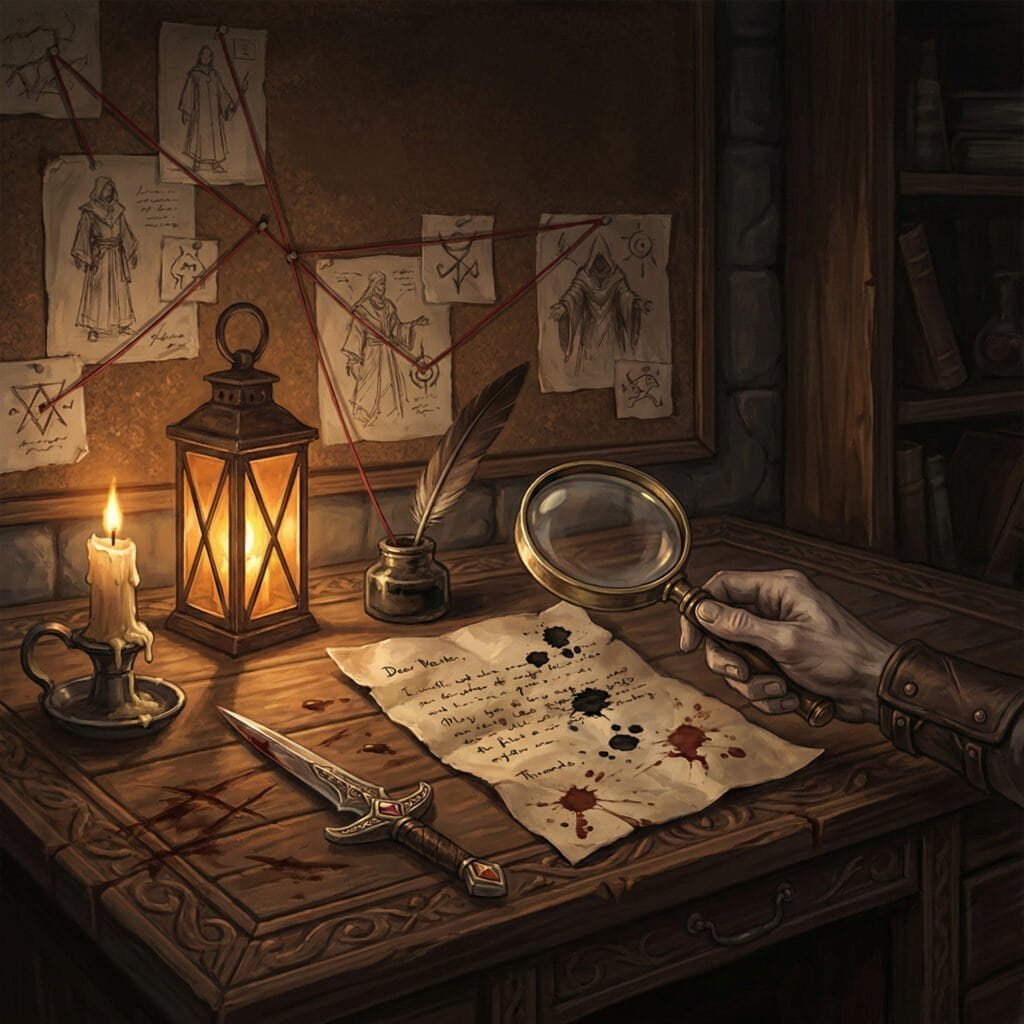

How to Run Mystery Adventures in D&D: The Complete Guide to Investigations That Actually Work
You’ve designed the perfect murder mystery. The clues connect elegantly. The suspects have motives. The twist is brilliant. Then your players miss the obvious clue in room one, spend two hours interrogating the wrong NPC, and the session ends in frustrated confusion. Sound familiar? Learning how to run mystery adventures in D&D requires fundamentally different techniques than standard dungeon crawling—and most DMs discover this the hard way.
Mystery adventures represent D&D’s highest-risk, highest-reward format. When they work, players talk about them for years. When they fail, everyone leaves the table frustrated. The difference between triumph and disaster often comes down to structural choices made during preparation, not improvisation during play.
This guide teaches you how to run mystery adventures in D&D that consistently deliver satisfying experiences. We’ll cover the Three-Clue Rule that prevents dead ends, scene-based design that keeps investigations moving, and practical techniques for handling the unexpected directions players inevitably take. Whether you’re running your first investigation or refining your approach after past struggles, these methods transform mysteries from frustrating gambles into reliable session highlights.
Why Traditional D&D Design Fails for Mysteries
Standard D&D adventure design assumes players will find critical information. The dungeon has one entrance—they’ll use it. The dragon guards the treasure—they’ll fight it. The path forward is usually obvious, and when it isn’t, players can always kick down doors until something happens.
Mystery adventures invert this assumption. The path forward depends entirely on players noticing, interpreting, and connecting information. Miss a clue, and the investigation stalls. Misinterpret evidence, and they pursue dead ends. The “kick down doors” approach produces suspects who won’t talk and crime scenes trampled beyond usefulness.
The Pixel-Hunting Problem
Many DMs design mysteries like point-and-click adventure games. One specific clue exists in one specific location, requiring one specific action to discover. This creates “pixel hunting”—players exhaustively searching every corner, rolling endless Investigation checks, hoping to stumble across whatever the DM hid.
Pixel hunting isn’t fun. It’s tedious, frustrating, and disconnected from the narrative tension mysteries should create. Players stop thinking like detectives and start thinking like completionists systematically clearing a checklist.
The Single-Thread Trap
Worse than pixel hunting is the single-thread mystery—an investigation where one missed clue breaks everything. The entire solution depends on finding the letter in the desk. Players search the bedroom instead. Now what?
Some DMs force the clue into players’ hands through increasingly contrived circumstances. Others watch helplessly as the investigation collapses. Neither outcome respects player agency or creates satisfying gameplay.
The Three-Clue Rule: Foundation of Working Mysteries
The single most important principle for how to run mystery adventures in D&D is the Three-Clue Rule: for any conclusion you want players to reach, include at least three clues pointing toward that conclusion.
This seems excessive until you understand player behavior. One clue will be missed entirely—players search the wrong room, fail a check, or simply don’t recognize its significance. Another clue will be found but misinterpreted—they’ll construct elaborate theories connecting it to the wrong suspect. The third clue provides the redundancy necessary for actual discovery.
Implementing Three-Clue Design
Start mystery design by identifying the core conclusions players must reach. Who committed the crime? What method did they use? Where is the evidence? Each answer needs three independent paths to discovery.
For a murder mystery where the butler is guilty, you might include: the butler’s muddy boots matching footprints at the scene (physical evidence), a maid who saw him leaving the restricted wing (witness testimony), and a letter revealing his motive (documentary evidence). Players might find one, two, or all three. Any combination leads toward the truth.
The clues don’t need equal prominence. One might be obvious, another hidden, and the third requiring specific investigation. Varied difficulty creates natural pacing—easy discoveries build momentum while challenging ones reward thorough investigation.
Clue Categories for Variety
Diversifying clue types ensures different character specialties contribute to investigations. Consider including physical evidence (found through Investigation or Perception), witness testimony (gathered through Persuasion or Intimidation), documentary evidence (discovered through research or theft), magical traces (detected through Arcana or specialized spells), and logical deduction (connecting observed facts).
When your clues span multiple categories, the entire party participates. The rogue examines physical evidence. The bard interviews witnesses. The wizard detects magical residue. Everyone has meaningful contributions beyond watching one character roll repeatedly.
Scene-Based Mystery Design
Traditional adventure design is location-based. Room 1 contains goblins. Room 2 contains a trap. Room 3 contains treasure. Players move through locations encountering whatever each contains.
Mysteries work better with scene-based design. Each scene presents a situation requiring player interaction—a location to investigate, a witness to interview, a confrontation to navigate. Scenes contain clues pointing toward other scenes. Players choose their path through the investigation based on what they discover.
Building Your Scene Web
Start with the crime scene—the inciting location where players enter the mystery. This scene should contain clues pointing to at least three other scenes. Maybe physical evidence suggests a location (mud from the docks), witness testimony identifies a person (the victim argued with someone), and documentary evidence reveals a motive (financial records show embezzlement).
Each subsequent scene contains its own clues pointing forward. The docks scene reveals the murder weapon was a sailor’s knife. Interviewing the argument witness reveals they heard mention of a warehouse. The financial records point to a specific merchant.
The investigation converges as clues from multiple scenes point toward the same conclusions. Players approaching from different directions reach the same revelations. The culprit’s identity emerges from accumulated evidence rather than a single discovery.
Floating Clues for Flexibility
Some clues work in multiple locations. A floating clue has no fixed position—you place it wherever players investigate most thoroughly. If they skip the docks entirely but spend an hour at the warehouse, the sailor’s knife evidence floats to the warehouse.
Floating clues aren’t cheating. They’re acknowledging that your job is creating a satisfying investigation, not testing whether players guess your preferred sequence. The clue exists in the fiction; its exact location is a detail you determine during play.
Use floating clues sparingly. Too many removes the sense that locations matter. But having two or three floaters ensures critical revelations occur regardless of player choices.
Running Investigations at the Table
Preparation creates the foundation, but execution determines success. These techniques help you run mystery adventures in D&D that flow naturally during actual play.
The Revelation List
Before the session, list every piece of information players might discover. Not where they’ll find it—just what exists to be found. During play, cross off revelations as players uncover them. At a glance, you see what they know and what remains hidden.
The revelation list also prevents accidental information dumps. Excited DMs sometimes reveal too much too quickly. When you see how many revelations remain uncrossed, you pace disclosures appropriately.
Progressive Disclosure Through Skill Checks
Don’t make critical clues depend on successful skill checks. The clue exists; players find it. Skill checks determine how much additional context accompanies the discovery.
Everyone finds the bloody knife. A successful Investigation check reveals it’s a specific type used by dock workers. A high roll adds that the blade shows distinctive wear from cutting rope, narrowing the owner’s profession further.
This approach ensures investigation progresses while rewarding investment in relevant skills. The rogue with expertise in Investigation genuinely contributes more than the wizard who dumped Wisdom, but the wizard still participates meaningfully.
Handling Wrong Theories
Players will construct theories. Many will be wrong. Some will be spectacularly wrong. Resist the urge to immediately correct them.
Wrong theories drive investigation. Players pursuing incorrect theories still gather evidence. That evidence eventually contradicts their assumptions, forcing revision. The process of theorizing, testing, and revising creates engagement that simply being told the answer never matches.
Only intervene when wrong theories lead to actions that would derail the session entirely—like killing an innocent suspect before gathering sufficient evidence. Even then, intervene through the fiction (the suspect has an alibi, witnesses saw them elsewhere) rather than out-of-character correction.
Common Mystery Structures That Work
Certain mystery frameworks consistently succeed at D&D tables. These structures provide reliable foundations you can customize for specific stories.
The Murder Mystery
Someone is dead. Players must identify the killer, method, and motive. The classic structure works because stakes are immediately clear—justice demands answers, and the killer might strike again.
Effective murder mysteries present multiple viable suspects. Each has motive, means, and opportunity. Evidence gradually eliminates possibilities until the truth emerges. Red herrings exist but connect to actual story elements rather than arbitrary misdirection.
The Conspiracy Investigation
Something sinister is happening beneath the surface. Cultists infiltrate the city guard. Nobles plot assassination. A merchant cabal controls the economy through blackmail. Players must identify the conspiracy, discover its members, and stop whatever they’re planning.
Conspiracies work well because they naturally escalate. Initial discoveries reveal the conspiracy exists. Further investigation identifies key figures. The climax involves confronting or exposing the conspirators. The Crimson Ceremony uses this structure with demon summoning—investigation quality directly impacts the difficulty of stopping the ritual.
The Missing Persons Case
Someone has vanished. Players must find them—or discover what happened to them. The emotional stakes connect immediately; someone’s loved one needs saving.
Missing persons cases allow for varied resolutions. The victim might be rescued, discovered dead, found hiding voluntarily, or revealed as the villain of a different crime. The investigation can lead anywhere because the victim’s situation isn’t fixed until players discover it.
Tools and Resources for Mystery Adventures
Building investigations from scratch demands significant preparation. These resources reduce your workload while improving results.
The Mystery Adventure Toolkit Approach
The Mystery Adventure Toolkit provides comprehensive frameworks for running investigations in D&D 5e. It includes the Three-Clue Rule implementation, scene-based design templates, and three complete mystery adventures you can run directly or use as models.
The toolkit addresses the specific challenges of how to run mystery adventures in D&D—not generic detective fiction advice, but techniques that account for D&D’s magic system, skill mechanics, and party dynamics. When a player casts Speak with Dead or Zone of Truth, the toolkit explains how your mystery accommodates those capabilities.
Integrating Mysteries into Larger Adventures
Mystery elements enhance adventures that aren’t primarily investigations. A dungeon crawl becomes more engaging when players must discover why the cultists are here, not just fight through them. A wilderness journey gains depth when strange occurrences demand explanation.
You don’t need full Three-Clue implementation for minor mysteries. But the principles—redundant paths to revelation, information that rewards investigation rather than depending on it—improve any adventure with unknown elements.
Advanced Techniques for Experienced DMs
Once you’ve mastered fundamentals, these techniques add sophistication to your mystery adventures.
Player-Facing Clue Handouts
Physical props transform abstract information into tangible evidence. A handwritten letter players can examine. A map with suspicious markings. A torn page from a journal. Props create ownership—this evidence belongs to the players, not just their characters.
Keep props simple. Elaborate puzzle boxes and cipher codes risk the same frustrations as pixel-hunting. The prop’s purpose is immersion and reference, not additional obstacles.
Timed Investigations
Adding time pressure transforms leisurely investigation into urgent problem-solving. The ritual completes at midnight. The ship sails at dawn. The killer strikes again in three days. Players must prioritize, accepting incomplete information rather than pursuing every lead.
Timed investigations require clear communication about the deadline and elapsed time. Players should understand consequences of running out of time before it happens. The pressure creates tension only when players can make informed choices about managing it.
Competing Investigators
Introduce NPCs pursuing the same mystery. Maybe the city watch conducts their own investigation—and they’re about to arrest the wrong person. Perhaps a rival adventuring party seeks the same answers for different purposes. Competition creates urgency without arbitrary countdowns.
Competing investigators can also provide information through their actions. The watch arrests someone based on evidence players missed. The rivals’ investigation points toward leads players hadn’t considered. Competition becomes collaboration through parallel discovery.
Avoiding Mystery Adventure Pitfalls
Certain mistakes consistently undermine otherwise well-designed mysteries. Recognizing these pitfalls helps you avoid them.
The Unsolvable Mystery
Some mysteries are too clever for their own good. The DM’s brilliant twist requires deductions no reasonable player would make. The evidence points toward the wrong conclusion more convincingly than the right one. The solution depends on information players never received.
Test your mystery by explaining how players could solve it using only information available to them. If your explanation requires phrases like “they might guess” or “if they’re really clever,” add more clues.
The Obvious Mystery
The opposite problem: players immediately identify the culprit and spend the session going through motions. Investigation becomes box-checking rather than discovery.
Obvious mysteries usually suffer from insufficient red herrings or suspects who are too clearly innocent. Every suspect should seem potentially guilty until evidence eliminates them. Players should doubt their conclusions even when they’re correct.
The Interminable Investigation
Mysteries can sprawl indefinitely as players pursue every tangent. Without clear conclusions, investigations become exhausting rather than exciting.
Set boundaries during design. The mystery has a defined solution—reaching it ends the investigation. Build toward climactic confrontation rather than endless accumulation of evidence. Players should feel they’re progressing toward resolution, not wandering through infinite information.
Conclusion: Mysteries Worth Solving
Learning how to run mystery adventures in D&D transforms one of the hobby’s most challenging formats into one of its most rewarding. The techniques aren’t complicated—Three-Clue redundancy, scene-based design, progressive disclosure through skill checks—but they require deliberate implementation. Mysteries don’t happen accidentally.
Start with the Mystery Adventure Toolkit if you want comprehensive guidance and ready-to-run adventures. Or apply these principles to your own creations, testing them against the standards that separate functional investigations from frustrating guessing games.
Your players want to feel clever. They want to piece together evidence, construct theories, and experience the satisfaction of deduction rewarded. Mystery adventures deliver that experience when designed and run correctly. The investment in learning these techniques pays dividends across countless sessions.
The clues are there. The suspects have secrets. The truth waits for investigators clever enough to find it. Give your players the mystery they deserve.