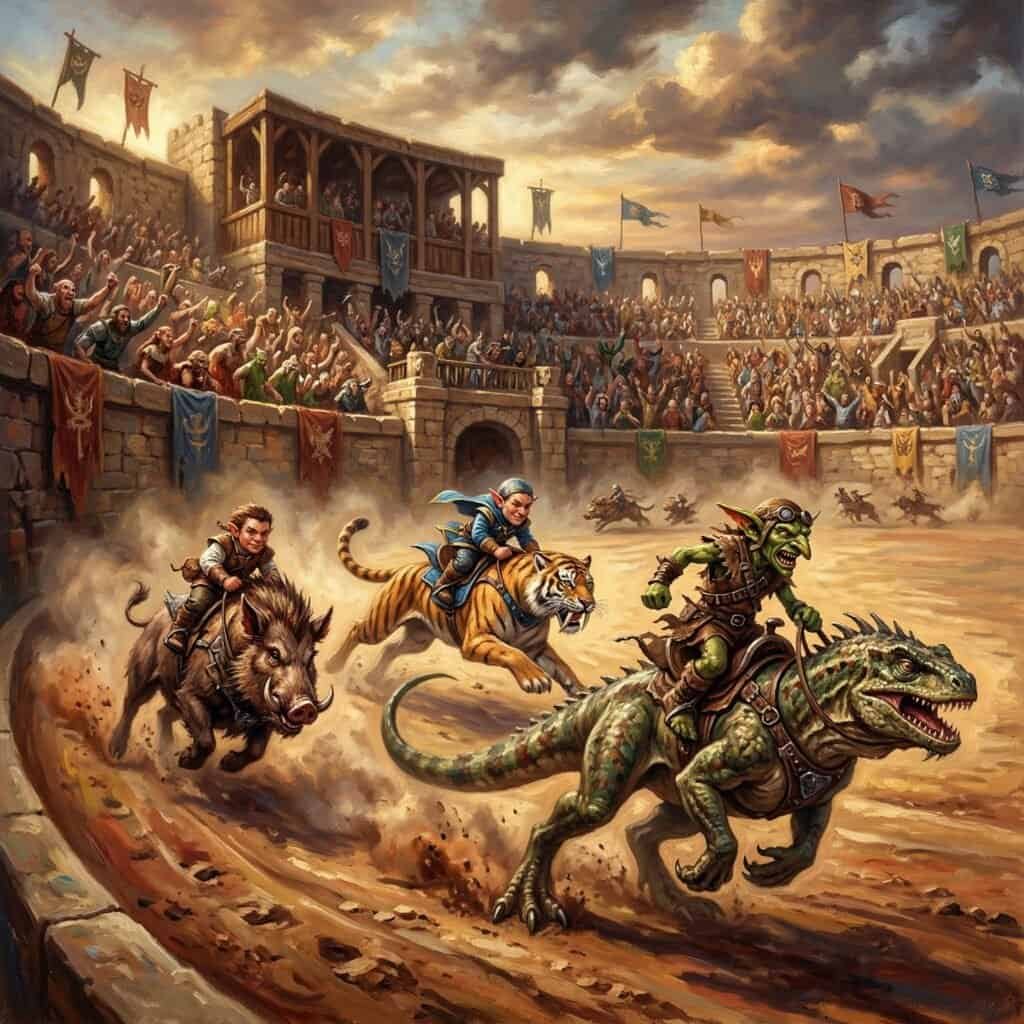

Creature racing in D&D 5e is one of the most underused encounter formats in the game. Most DMs default to combat or investigation when they want something tense and engaging. Racing delivers something different — speed, spectacle, crowd energy, and the kind of chaotic momentum that produces stories people tell for years. It works as a standalone one-shot event, as a campaign side encounter, and as a way to resolve something that would otherwise be a flat skill check.
This guide covers how to actually run creature racing at your table: initiative variants that make the race feel like a race, track design, betting mechanics, crowd reactions, the best creature types for racing, and NPC jockeys who add personality to the field. If you are waiting for the Anvil N Ink Creature Racing supplement, this gives you a solid foundation to start running races right now.
Why Creature Racing Works as a D&D Encounter
Standard D&D encounters resolve through combat, skill challenges, or exploration. Racing is none of these — it is a structured competitive event with clear stakes, clear rules, and a clear winner. That clarity is what makes it work. Players know what they are trying to do and what the finish line looks like from the first moment of the encounter.
Racing also scales unusually well for small groups. A party of two or three can participate meaningfully in a race — as jockeys on their own mounts, as bettors with money riding on the outcome, as saboteurs trying to affect the result, or some combination of all three. The format gives every player a role without requiring a full party to fill it.
And there is the spectacle factor. A creature race happens in front of a crowd. The crowd reacts to what happens on the track. That ambient energy — the noise, the pressure, the public stakes — creates atmosphere that a dungeon room simply cannot replicate.
Initiative Variants for Racing
Standard initiative does not model a race. Rolling d20 plus Dexterity modifier to determine who goes first produces a result that has nothing to do with speed or track position. Racing needs a different mechanic.
The Speed Check System
Each round, every racer makes a Constitution check to maintain speed and a Dexterity check to handle the track. The combined result moves them forward a number of spaces on the track — high results mean ground gained, low results mean ground lost or an obstacle triggered. Contested rolls between adjacent racers represent jockeying for position. This system keeps every participant rolling every round and produces genuine momentum shifts throughout the race.
The Lane System
Divide the track into a grid with lanes and segments. Each round, racers move a base number of segments equal to their mount’s speed divided by 10 (minimum 1), then make one check — Athletics, Animal Handling, or Dexterity depending on the track section — to attempt to move an additional segment or overtake an adjacent racer. Simple to track on a battle map and visually clear for everyone at the table.
Hazard Cards
Prepare a deck of index cards with track hazards — a sharp turn, a water crossing, a crowd surge onto the track, a rival jockey throwing an elbow. Draw one per round and apply it to the front-runner or a specific lane. This introduces unpredictability without requiring complex pre-planning and gives the DM a lever to keep the race close if one racer pulls too far ahead.
Track Design for Creature Racing
A good racing track has three things: a clear start and finish, at least two distinct terrain features that change the tactical situation mid-race, and a layout that fits on your battle map without being so large that tracking positions becomes work.
Track Sections to Include
The Open Straight: Speed matters here. Mounts with high movement speeds pull ahead. No checks required — this is where the fast creatures shine.
The Obstacle Section: A series of jumps, gates, water features, or debris fields. Requires Animal Handling or Athletics checks. Slower, more agile creatures can make up ground here.
The Crowd Tunnel: The track passes close to spectators. Mounts that spook easily must make Wisdom saving throws. Jockeys who play to the crowd can gain advantage on their next check.
The Final Straight: Everything opens up again for the finish. Often the most dramatic moment, especially if the race is close.
Three or four sections of 6-8 spaces each gives you a track that runs in 8-12 rounds — long enough to develop genuine drama, short enough to stay tight.
The Best Creatures for Racing
Racing creatures need three things: enough personality to be interesting as characters, enough mechanical distinction to matter tactically, and a plausible reason to be in a race. Describe each creature physically at the table before the race starts — what they look like, how they move, what the crowd thinks of them.
Riding Horse / Warhorse
The baseline. Fast on open ground, mediocre everywhere else. The horse in a creature race is the everyman — reliable, not exciting. If players are using a horse, they are relying on the jockey’s skill to compensate for the mount’s predictability. Good for a player character who wants to win on ability rather than creature advantage.
Giant Lizard
Slow but steady, with excellent traction on difficult terrain. Climbing obstacles that would slow other creatures barely registers. In a track with significant obstacle sections, the giant lizard is a dark horse contender that the crowd consistently underestimates. Its handler is usually portrayed as either very patient or very stubborn.
Panther / Lion
Explosive speed in short bursts, unpredictable in crowds. Big cats in a race environment are simultaneously the most exciting creatures to watch and the hardest to manage. Their handlers tend to be either supremely confident or quietly terrified. The Pounce ability creates opportunities for dramatic overtaking moves in the final straight.
Giant Boar
Aggressive and difficult to steer, but terrifying in close quarters. A boar in a tight pack of racers is a hazard to everyone around it. The Relentless trait means it keeps running through damage that would stop other creatures. Often portrayed as a crowd favourite for the chaos it introduces — nobody bets on the boar to win, but everyone watches the boar.
Hippogriff (Aerial Track)
For a flying race variant. Aerial tracks remove terrain obstacles and replace them with altitude changes, wind currents, and aerial hazards. Hippogriffs, giant eagles, and griffons all work. Flying races tend to be faster and more visually spectacular, but harder to represent on a standard battle map without some vertical tracking.
Construct or Unusual Entry
A clockwork horse. An animated suit of armour on a sled pulled by trained dogs. A wealthy noble’s custom racing vehicle. One unusual entry adds flavour and signals that the race exists in a world with creative people in it. This entry does not need to win — it needs to be memorable.
Betting Mechanics
Betting gives players who are not riding a meaningful stake in the race’s outcome. Without a bet on the table, watching a race is passive. With money riding on a specific outcome, every round of the race becomes tense for everyone at the table.
Simple betting system: before the race, players can wager on any combination of outcomes — first place, last place, which creatures finish in the top three, whether a specific creature completes the course. Set odds based on how credible each outcome seems (the crowd’s favourite pays 2:1, the long shot pays 8:1). Pay out at the end of the race.
Complication bets add texture: does the giant boar cause a crash? Does the panther overtake in the final straight? Does the lizard finish in under twelve rounds? These side bets give players something to root for independently of the overall winner and produce moments of genuine excitement when they resolve.
If players want to affect the betting outcome — bribing a jockey, sabotaging a rival mount, getting track information before the public does — that becomes its own scene with its own skill checks and moral weight. Creature racing is naturally fertile ground for the kind of morally complicated activity that makes D&D interesting.
NPC Jockeys and Race Personalities
A race with five anonymous riders is less interesting than a race with five distinct personalities the players have reason to care about. Introduce jockeys before the race starts — at the stable viewing, during the weigh-in, in the betting hall. Three or four sentences per jockey is enough to make them distinct.
A few archetypes that work consistently:
- The Veteran: Been riding for twenty years. Has won this race three times. Knows every corner of the track and uses that knowledge rather than raw speed. Respected, slightly arrogant, and genuinely talented.
- The Upstart: First major race. More skill than experience. Will do something unexpected in a crisis because they do not know enough to be conservative. Could win or could crash spectacularly.
- The Fixer: Has a relationship with the race organisers that seems a little too comfortable. Possibly cheating. Definitely knows more about the race than the public does. The crowd does not trust them. They usually place well anyway.
- The Crowd Favourite: Not the best rider, but the most loved. Has been racing this circuit for years without a major win. The crowd wants them to succeed. Their mount is named something endearing. If they win, the crowd noise is deafening.
Creature racing connects naturally to the small-group D&D format — the chaos, the betting, and the spectacle all work better at an intimate table. The complete guide to D&D for 2-3 players covers how encounter formats like this adapt for smaller parties. For a broader view of the one-shot format that creature racing works within, the guide to the best D&D one-shots covers what makes event-based encounters worth building a session around.
Running a Creature Race as a One-Shot
A creature race one-shot has three acts: the pre-race scene (introductions, betting, potential complications), the race itself (6-12 rounds depending on track length), and the post-race scene (payouts, consequences, whatever the race outcome changed).
The most memorable race one-shots give players a reason to care about the outcome beyond the bet. Someone they know is riding. Something important has been wagered that is not money. The race is a cover for something else happening simultaneously. The winner gets information the players need. The race format is the backdrop — the story is whatever the players are actually trying to accomplish within it.
Frequently Asked Questions: Creature Racing D&D 5e
How long does a creature race encounter take at the table?
A standard race runs 8-12 rounds. With the Speed Check system, each round takes 3-5 minutes including roleplay and crowd reactions. Total race time at the table: 30-60 minutes. Add 20-30 minutes for the pre-race scene and 15-20 minutes for the post-race resolution, and a full creature racing session runs 75-110 minutes — well within a single session.
Can players ride their own mounts in a creature race?
Yes, and it is often the most engaging version of the encounter. A player character as jockey has much more at stake than a bettors-only role. Make sure the player’s mount has a stat block before the race starts and that the checks involved (Animal Handling, Athletics, Dexterity) play to what that player can contribute.
What if one creature pulls so far ahead the race stops being interesting?
Use your hazard cards. A surprise obstacle, a crowd surge, a sudden weather change — anything that affects the leader more than the pack closes the gap without feeling arbitrary. Alternatively, have a rival jockey make an aggressive move that triggers a contested roll. Races should stay close through the obstacle section and only separate definitively in the final straight.
Is creature racing appropriate for low-level parties?
Yes. The racing mechanics do not depend on character level — Animal Handling, Athletics, and Dexterity checks are available to any character. Betting and sabotage subplots scale to whatever the party can afford and accomplish. A level 1 party can race giant lizards on a village track with exactly the same basic structure as a level 10 party racing hippogriffs over a mountain circuit.
Where can I find a complete creature racing supplement?
The Anvil N Ink Creature Racing supplement is in development and will cover everything in this article in full mechanical detail — complete track designs, pre-built race events, NPC jockey profiles, betting systems, and a full one-shot adventure built around a race. Follow anvilnink.com for the launch announcement.
Want more D&D encounter formats worth building a session around? The complete guide to the best D&D one-shots covers heist, mystery, horror, fairy tale and more — every genre that works for a single session. The Ready Adventure Series delivers complete zero-prep one-shots for 2-3 players on Amazon and through the Complete Collection on Payhip.
Creature racing in D&D 5e works because it gives everyone at the table something to root for — and because the chaos of a close race produces exactly the kind of story that nobody planned and everybody remembers.