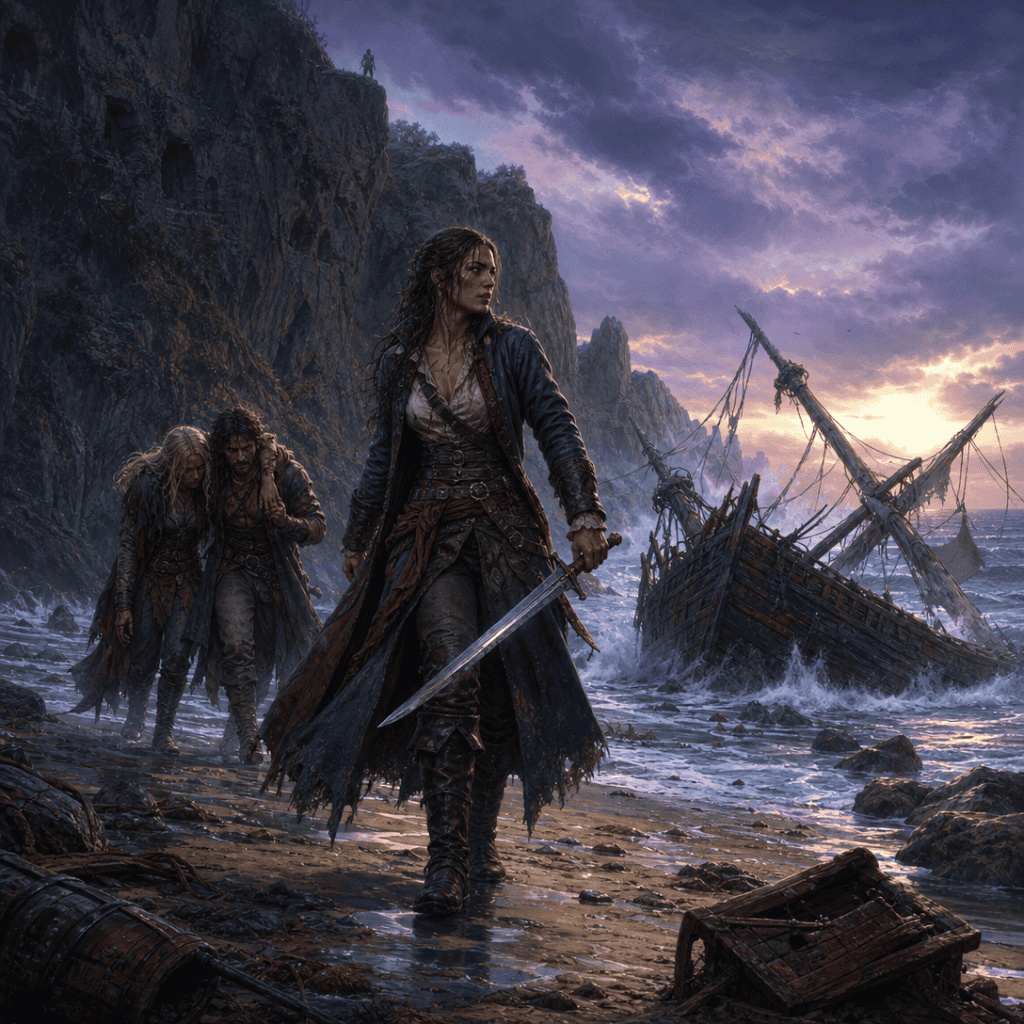

A D&D shipwreck adventure is one of the most reliable survival-themed one-shot formats. The party loses everything — ship, supplies, sometimes characters — and washes up somewhere they don’t want to be. The session is about regaining footing, surviving the immediate environment, and figuring out what to do next. This guide covers three opening setups for shipwreck adventures, how to design hostile-shore environments, the survival mechanics that matter, and the published one-shot built around the structure.
Why Shipwreck Adventures Work for One-Shots
Shipwrecks are one of the cleanest narrative resets in fantasy. The party arrives at the location with no supplies, no plan, and no easy escape. Whatever campaign baggage they brought is washed away with the ship. The session starts at zero — and zero is the perfect starting point for a one-shot.
The format also handles small parties well. With 2-3 players, the survival format gives each character a clear role: the one with high Wisdom does the foraging, the one with high Strength does the heavy work, the one with high Charisma negotiates with whoever — or whatever — they meet on shore. Roles emerge from the situation rather than from class optimization.
And the location is built in. The shore. The wreck itself. The territory inland. Three distinct environments in a single session, each with different threats and opportunities. The DM doesn’t need to design a sprawling campaign world — just a single bad coastline.
Three Opening Setups for D&D Shipwreck Adventures
1. The Aftermath
The session opens with the wreck already over. The party wakes up on the shore, soaked, bruised, and missing equipment. Some of their gear is on the beach; some is in the surf; some is gone. The first scene is inventory and triage. This setup is the cleanest for one-shots — no time wasted on sailing scenes — and works for any party regardless of nautical backstory.
2. The Storm in Progress
The session opens during the wreck. The ship is breaking apart in a magical storm. Players have one round each to grab what they can before they’re thrown overboard. Combat-style decision-making about what to save, what to leave, who to help. The wreck plays out across the first 15 minutes, ending with the party scattered along the shore.
3. The Survivor’s Discovery
The session opens days after the wreck. The party has been on the shore for a while. They’ve established a small camp. They’re functional. The hook is what they’ve now discovered — a structure inland, a body in the water, a sail on the horizon — that turns the survival situation into an active adventure. This setup works well for groups who want survival texture without spending the first hour just figuring out where they are.
Designing the Hostile Shore
The shore in a shipwreck adventure isn’t just a setting — it’s an antagonist. A few principles for making the environment hostile in interesting ways:
Three terrain zones. The beach (low, exposed, tidal). The transition (cliffs, dunes, marshland). The interior (forest, jungle, mountain, depending on setting). Each zone has distinct threats. Don’t let one terrain dominate — moving between zones is part of the session structure.
Tide as time pressure. The tide rises and falls. Caves accessible at low tide become death traps at high tide. Rocks visible at low tide hide ships at high tide. The tide is a natural ticking clock the DM can lean on without explaining it.
Weather as obstacle. The storm that wrecked the ship may not be over. Cold, rain, fog, sun exposure — the weather isn’t atmospheric flavor; it’s a mechanical obstacle. Exhaustion levels work especially well here.
The wreck as resource and danger. The ship’s remains hold supplies the party desperately needs, but the wreck is also unstable. Climbing into it risks drowning, structural collapse, or attack from whatever has moved in. Reward bold parties; punish careless ones.
Inhabitants who got there first. Pirates. Smugglers. Sahuagin. Cultists who consider the shore sacred. Hermits with secrets. The shore isn’t empty. The party isn’t the only one who survived something — or who chose to live this far from civilization.
Survival Mechanics That Matter
5e’s survival rules are sparse, which is actually a feature for shipwreck one-shots. Use them lightly and consistently:
Exhaustion. The most useful survival mechanic 5e has. Cold and wet without shelter? Constitution save or one level of exhaustion. No food for 24 hours? Constitution save. Each level adds disadvantage and complications. Don’t track hit points for survival; track exhaustion.
Supplies as countdown. The party’s water lasts six hours. Their food lasts twelve. The DM tracks these explicitly and tells the players. Players make decisions accordingly. This is the survival version of the ticking clock.
Skills replace gold. No shops on the shore. Fire, water, food, shelter, navigation — all earned through skill checks and time, not gold. Players who never use Survival, Nature, and Athletics in their normal campaigns suddenly have to use them.
Don’t track everything. Resist the urge to make players track every match, every fishhook, every rope. Track the three or four resources that genuinely matter for the session. Everything else is in the background.
Combat in Shipwreck Adventures
Combat happens, but it’s different than in a dungeon crawl. Three principles:
Combat is desperate, not heroic. The party is wet, exhausted, and underequipped. Fights aren’t power displays — they’re survival. Even a small enemy is dangerous when the party has no spell slots and one healing potion total.
Terrain matters more than usual. The cliff, the surf, the slick rocks. Position determines everything. A fall isn’t just damage; it’s drowning, broken limbs, lost gear.
Smart combat is winning combat. Players who fight head-on lose. Players who lure enemies into traps, use the terrain, fight at distance, or avoid combat entirely succeed. Reward this with encounter design that has multiple paths to resolution.
Common Pitfalls in D&D Shipwreck Adventures
The empty shore. No threats, no inhabitants, no progression — just a long walk inland. Players check out. Make the shore active.
The TPK shipwreck. Designing the survival mechanics so harshly that the party is doomed regardless of choices. Survival should be hard but possible. Players who die because they made bad calls accept it; players who die because the game was rigged don’t come back.
The endless inventory check. Spending the first hour of the session counting what gear survived. Streamline this. A quick “you have your weapons, half your supplies, and one piece of equipment per character that you’d describe to me as essential” handles inventory in five minutes.
Forgetting the wreck. The ship is the most interesting set piece on the shore. Use it. Hidden compartments, trapped cargo, a body the party knew, a captain’s locked log book. The wreck is a dungeon you don’t have to design from scratch.
Published D&D Shipwreck Adventures
Wrecked is Anvil N Ink’s flagship shipwreck survival one-shot. The party washes up on a hostile shore after a magical storm wrecks their vessel, and has to survive the cliffs, the inhabitants, and the wreck itself before extraction is possible. Two hours, 2-3 players, level 2-3, designed around the three-zone structure and tide-based time pressure.
For another survival one-shot with similar tonal weight, Frostfall handles the wilderness-survival format in an arctic setting — different terrain, similar mechanical concerns.
For broader survival horror tonality, see Little Lambs.
Frequently Asked Questions
What level should a D&D shipwreck adventure be?
Levels 2-3 work best. The party is competent enough to handle terrain and combat without long-resting every encounter, but not so powerful that survival mechanics feel trivial. Higher-level parties trivialize most environmental threats with magic.
How long should a shipwreck one-shot run?
Two to two-and-a-half hours. Three acts: shore arrival and triage, exploration of the wreck and the inland, and the final encounter or escape. Longer sessions risk losing the immediacy of the survival situation.
Should the players keep all their gear after a shipwreck?
No, but don’t strip them entirely. The cleanest rule: keep weapons (most are still on their bodies), lose half of their supplies, and let each player describe one essential piece of gear that survived. Total gear loss is dramatic but feels punitive; total gear retention undercuts the format.
What’s the best class for a shipwreck adventure?
Ranger and Druid both shine in survival formats. Bards and Rogues bring social and skill versatility. Pure combat classes (Fighter, Barbarian, Paladin) work but lean harder on the rest of the party for survival skills.
Can a shipwreck adventure include water encounters?
Yes, but use them carefully. Combat in deep water is fiddly in 5e, and most parties aren’t built for it. A short underwater scene at the wreck site is fine; an extended underwater dungeon usually isn’t. Stick to surf-line combat and the wreck’s interior for water encounters.
Run a Shipwreck Session This Month
The shipwreck adventure is one of D&D’s most replayable formats — clean reset, three terrain zones, built-in time pressure, survival texture without the math overhead of a longer survival campaign. Two hours, 2-3 players, and one bad coastline.
Read the full review of Wrecked — Anvil N Ink’s published shipwreck D&D one-shot for 2-3 players. Two hours, level 2-3, hostile shore, hostile inhabitants, hostile wreck.
For another survival one-shot in a different climate, see Frostfall. For the broader small-group resources, see the D&D for 2-3 Players Complete Guide.
The ship is gone. The shore is hostile. Now the session begins.